Affiliate disclosure: some links in this article are partner links. If you start a paid plan through them, imisofts may earn a commission at no extra cost to you. We only recommend tools we actually use to run client campaigns.
Short answer. Oklahoma's Telephone Solicitation Act of 2022 (15 O.S. 775C.1 to 775C.6), in force since 1 November 2022, requires prior express written consent before a sales call that uses an automated system for "the selection or dialing" of numbers or plays a recorded message. It bars solicitation calls before 8 a.m. or after 8 p.m. in the called person's time zone and more than three in 24 hours on the same subject, and a called party aggrieved by a violation can sue for actual damages or $500, whichever is greater, up to three times that if the violation was willful or knowing. Older laws add a state do not call list ($600 a year to access, per the Attorney General) and seller registration ($250 in the Attorney General's 2019 packet, plus a $10,000 bond).
We earn a commission if you buy Close or Apollo through our links; Oklahoma's legislature and Attorney General pay us nothing. We read the statutes in Justia's 2025 Oklahoma Statutes, checked exemption item 13 and the effective date against the enrolled bill, HB 3168 (not OSCN, the courts' official site), and read every source on 9 November 2026. This is general information, not legal advice.
Key numbers
| Item | Number |
|---|---|
| Oklahoma Telephone Solicitation Act in force since (Laws 2022, c. 290; 15 O.S. 775C.1 to 775C.6) | 1 November 2022 |
| Sales call window, called person's time zone (775C.4) (federal rule for residential subscribers: 8 a.m. to 9 p.m.) | 8 a.m. to 8 p.m. |
| Same-subject sales calls per person in 24 hours (counted across any number used) | 3 at most |
| Damages per violation (775C.6) (whichever is greater; up to 3 times if willful or knowing) | $500 or actual damages |
| Automatic dial announcing devices window (755.1) (with 775C.4, where both apply: 9 a.m. to 8 p.m.) | 9 a.m. to 9 p.m. |
| Oklahoma do not call list access (Attorney General page) (or $150 a quarter; free for consumers) | $600 a year |
| Grace period after a number first appears on the list (775B.6; the Attorney General updates the list quarterly) | 30 days |
| Seller registration fees (Attorney General 2019 packet) (the statutory maximums; plus a $10,000 surety bond (face amount)) | $250, then $100 a year |
| Abandoned call cap in Oklahoma (775A.4) (federal: 3% of live answers over 30 days per campaign) | 5% of answered calls a day |
| Exemptions listed in 775C.5 (from the 2022 Act only, not from the do not call list) | 26 |
| Close Chloe batch call window (contact's time zone) (not configurable; starts before 755.1's 9 a.m. if 755.1 applies (our reading)) | 8 a.m. to 6 p.m. |
| Close plan with the Predictive Dialer (Scale) (billed yearly; $149 monthly; Power Dialer on Growth at $99 billed yearly) | $139 a user a month |
Read on 9 November 2026 from Justia's 2025 Oklahoma Statutes, the enrolled HB 3168, eCFR, the Oklahoma Attorney General's registry page and forms, Close's pricing and help pages, and Apollo's knowledge base.
What the Oklahoma Telephone Solicitation Act requires
Section 775C.3 says a person "may not make or knowingly allow" a sales call that "involves an automated system for the selection or dialing of telephone numbers or the playing of a recorded message when a connection is completed to a number called without the prior express written consent of the called party." Under 775C.2, that consent is a written agreement signed by the called party (electronic signatures count where federal law or state contract law recognizes them) that clearly authorizes such calls, includes the number to be called, and clearly and conspicuously discloses that signing authorizes them and is not required "as a condition of purchasing any property, goods, or services".
Section 775C.4 adds limits on every solicitation call, "including calls made through automated dialing or recorded messages". A commercial telephone seller or salesperson may not make one "before 8 a.m. or after 8 p.m. local time in the called person's time zone", or make "[m]ore than three commercial telephone solicitation phone calls from any number to a person over a twenty-four-hour period on the same subject matter or issue, regardless of the phone number used to make the call."
The caller must transmit the originating number (and its name when the carrier provides it), may show the seller's customer service number only if it "is answered during regular business hours", and must make sure a call back reaches the solicitor or the seller. Sellers may not "[i]ntentionally act to prevent transmission" of their name or number, use technology that "deliberately displays a different caller identification number" to conceal the caller, or intentionally disguise the caller's voice to defraud, confuse, injure or obtain personal information. A sales call to any Oklahoma area code is presumed, unless rebutted, to reach an Oklahoma resident or someone in the state at the time. See local presence dialing for the federal caller ID rules.
Who can sue under the Act, and for how much
Under 775C.6, a called party "aggrieved by a violation" may sue to stop it and "recover actual damages or Five Hundred Dollars ($500.00), whichever is greater." A court that finds a willful or knowing violation may raise the award to "not more than three times" that amount, so up to $1,500 where the $500 figure applies, more if actual damages are higher. The section has no attorney fee clause or pre-suit notice, the Act states no deadline for suing, and it does not say how violations are counted across many calls. The federal rules in 47 CFR 64.1200 apply alongside it; see the TCPA statute of limitations.
The 26 exemptions, and the one that reads oddly
Section 775C.5 lists 26 exemptions "from this act", including insurance and real estate licensees acting within their licenses (items 8 and 23), supervised banks, credit unions, finance lenders and insurers within their supervised activity (item 7), calls to prospective consumers "who have an existing business relationship with or who have previously purchased from the business enterprise for which the solicitor is calling" (item 20), one-off solicitations (item 1), and sellers who neither present nor close on the call and do both at a later face-to-face meeting (item 3, unless the seller then sends someone just to collect payment or deliver). They exempt callers from the 2022 Act only, not from Oklahoma's do not call list, the device rules below or the federal rules. See real estate cold calling for the federal side.
Item 13 is the odd one. It exempts "A commercial telephone seller;", while 775C.4's hours and call cap are written for "A commercial telephone seller or salesperson". Read literally, the two collide. The same item is in the enrolled bill, so it is not a copying error. We did not search case law and know of no court decision on it, and we would not build a calling program on the hope that item 13 means what it appears to say.
Does the Act cover B2B sales calls?
The Act does not define "commercial telephonic sales call" or "commercial telephone seller". Oklahoma's older Commercial Telephone Solicitation Act defines a seller and a solicitation in 775A.2, "As used in Section 775A.1 et seq.", and its solicitation covers calls to induce a purchase of "goods, services or property" with no household-goods limit; neither text says whether that carries over. The Act's own business-to-business exemption (item 10) covers only a seller "lawfully operating continuously for at least three (3) years under the same business name" with at least 50% of its dollar volume from "repeat sales to existing businesses", or buyers who resell, promote with or manufacture with the goods. On our reading, a young agency or a young SaaS company cold calling Oklahoma businesses does not fit, so we would apply the Act to business numbers too. See the do not call list for businesses for the federal rules.
Oklahoma's do not call list and seller registration
Oklahoma keeps its own do not call list under the Telemarketer Restriction Act. The Attorney General's registry page (last modified 29 October 2026) says registration is free for consumers and "[t]elemarketers who want to solicit business in Oklahoma must purchase the list", at $150 a quarter or $600 a year. Under 775B.6, a telemarketer may not make an unsolicited telemarketing call or text to a listed consumer "more than thirty (30) days after" the number first appears on the registry. The statute requires updates "not less than quarterly"; the Attorney General's page gives this schedule:
| Consumer registers by | Number must be removed by |
|---|---|
| December 1 | February 1 |
| March 1 | May 1 |
| June 1 | August 1 |
| September 1 | November 1 |
The list covers Oklahoma residents only: 775B.2 defines a consumer as "any natural person who is a resident of this state" and excludes businesses. The Attorney General's page lists exceptions, including established business relationships formed in the preceding 24 months and calls to arrange a face-to-face meeting. The national registry is separate; see do not call registry cost.
Under 775A.3, a commercial telephone seller must also register with the Attorney General "at least ten (10) days prior" to doing business, which includes calling from Oklahoma or calling purchasers located there. The filing lists the seller's phone numbers and sales scripts, is signed by each principal under penalty of perjury and is public. The Attorney General's 2019 application packet lists $250 to apply and $100 to renew (the statutory maximums; we could not confirm current charges) and a $10,000 surety bond, a face amount whose premium the Attorney General does not publish. Section 775A.2 excludes, among others, businesses regulated by the Insurance Commission or the Oklahoma Real Estate Commission and callers soliciting "solely from business purchasers who have previously purchased identical or similar goods or services" from the business they call for; that takes them out of registration, not off the do not call list. See telemarketer registration by state.
Section 775A.4 lists unlawful practices, including calling unregistered, not disclosing a three business day cancellation right, techniques meant to block caller ID, and dialing more than one person at a time with "abandoned calls per day that are more than five percent (5%) of the number of answered calls per day in any campaign"; violations breach the Oklahoma Consumer Protection Act.
That 5% daily cap is not the federal rule. The FCC's rule in 64.1200(a)(7) allows up to 3% of calls "answered live by a person, as measured over a 30-day period for a single calling campaign". In a hypothetical campaign where 1,000 calls a day are answered live, a first day with 60 abandoned calls (6.0%) breaks Oklahoma's daily cap, even if 28 a day for the next 29 days keeps the 30-day rate at about 2.9%, under the federal line. See parallel dialing and the TCPA call abandonment rate.
AI voice agents and recorded messages in Oklahoma
In a Declaratory Ruling announced in a news release dated 8 February 2024, the FCC recognized that calls made with AI-generated voices are "artificial" under the TCPA, which puts AI voice telemarketing calls to the lines listed in 64.1200(a)(1)(i) to (iii) under the written consent rule in 64.1200(a)(2). Oklahoma's 2022 Act names "the playing of a recorded message", not synthesized speech, but on our reading an AI agent dialing from a list also involves an automated system for "the selection or dialing" of numbers.
An older law is more direct. 15 O.S. 752(12) defines an "automatic dial announcing device" as "automatic equipment" that stores or generates numbers to be called, "conveys a prerecorded or synthesized voice message to the number called", and is used to offer goods or services; on our reading an AI voice agent placing sales calls from a stored list fits. If it does, 755.1 limits its calls into Oklahoma to 9 a.m. to 9 p.m., requires disconnecting within 20 seconds of a hang-up, bars random or sequential dialing, and allows calls only to people who called first or made "a written request to be called", about goods or services already ordered or bought, by creditors, or when a live operator starts the call and offers to disconnect first. Under 755.2, a consumer purchase on such an unsolicited call without a live operator, in violation of the law, is voidable "at the option of the consumer" unless signed in writing. We did not search case law on AI voice agents under these sections.
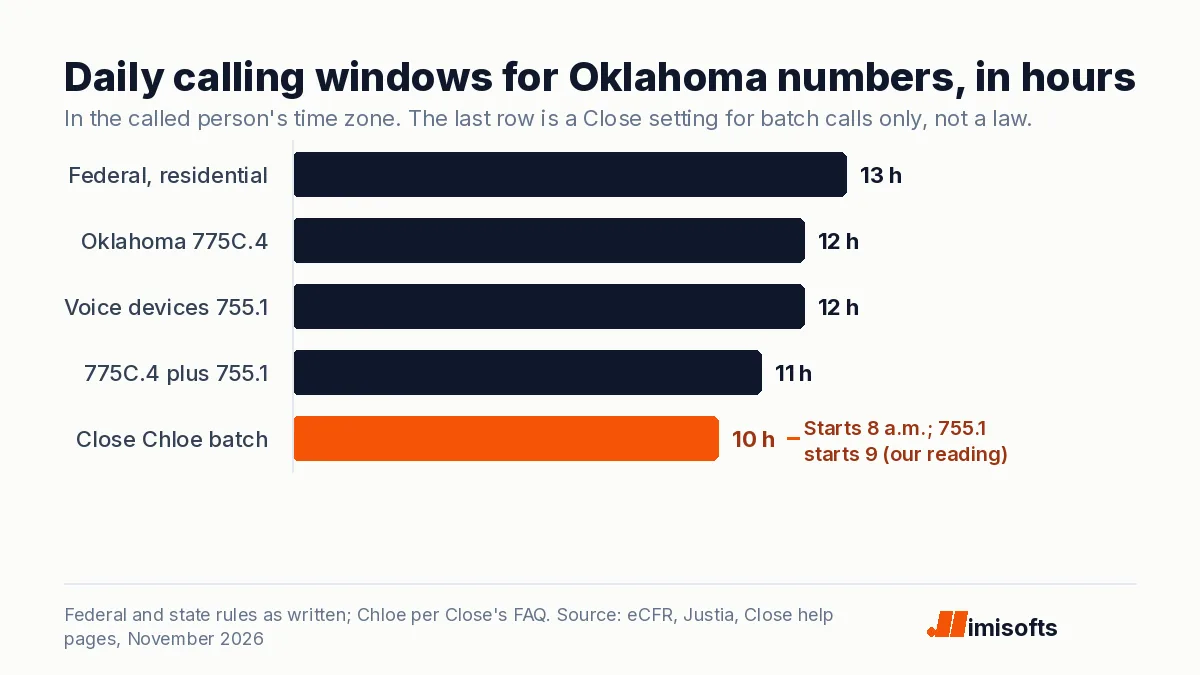
| Rule | Daily window | Hours |
|---|---|---|
| Federal, 47 CFR 64.1200(c)(1), residential subscribers | 8 a.m. to 9 p.m. | 13 |
| Oklahoma Telephone Solicitation Act, 775C.4 | 8 a.m. to 8 p.m. | 12 |
| Automatic dial announcing devices, 755.1 | 9 a.m. to 9 p.m. | 12 |
| 775C.4 and 755.1, where both apply | 9 a.m. to 8 p.m. | 11 |
Where both apply, that leaves 9 a.m. to 8 p.m., 11 hours a day. On our reading, callbacks to people who made "a written request to be called" fit the first allowed use; whether a web form counts is unsettled, and 775C.3's consent rule still applies to automated sales calls.
Our page on AI calling built around TCPA consent describes the consent, suppression and opt-out layer we build underneath an AI dialer, and AI calling for home services describes an agent that answers calls and calls new web leads back. For tools, see the best AI voice agents and AI answering for HVAC.
What Close and Apollo do, and do not do, for Oklahoma rules
Close. Close's pricing page (9 November 2026) puts the Power Dialer, which "automatically calls through lead lists", on Growth ($99 a user a month billed yearly, $109 monthly) and the Predictive Dialer on Scale ($139 yearly, $149 monthly), with most outbound calls "around $0.02/minute". The Predictive Dialer guide says it skips leads "Called in the last hour" (Start from Scratch overrides this), waits 72 hours before redialing an abandoned lead, and plays an abandonment message with your organization's name and a phone number. It publishes no abandonment target, and none of the three Close dialer guides we read uses "time zone", "timezone", "calling hours", "consent", "do not call" or "TCPA". The one-hour skip does not enforce Oklahoma's cap: a fourth call an hour after the third is still inside 24 hours. On our reading, both Close dialers involve "an automated system for the selection or dialing of telephone numbers", so Oklahoma sales calls through them need written consent first.
Chloe, Close's AI voice agent, is available on all Close plans; its calls are charged telephony usage plus AI credits, and the pages we read do not say how many credits a minute uses. Its FAQ says batch calls go out "between 8am" and "6pm in the contact's timezone", a window that "is not currently configurable". Its compliance page says Chloe announces it is an AI and that the call is recorded, Close "does not verify consent on your behalf", Chloe does not automatically check the national registry or add opt-outs to your internal list, Workflow and one-off calls are not held to the batch window, and "Using Chloe for cold outbound calls to contacts who have not consented is not recommended and may expose your organisation to legal risk." For Oklahoma the hours are the smaller issue: if Chloe counts as an automatic dial announcing device, as we read the definition, cold batch calls fit none of 755.1's four allowed uses, and the 8 a.m. start is an hour before 755.1's 9 a.m. Close lists a 14-day free trial with no credit card; you can start a Close trial (partner link).
Apollo. Apollo's caller reputation guide says to call "during legally permitted hours based on their local time zone", which in the US "generally means between 9 a.m. and 8 p.m.", using its time zone filter. That sits inside both Oklahoma windows, but it is advice and a filter you apply, not a window the guide says Apollo enforces. With do not call screening enabled by an admin, Apollo flags numbers on "supported DNC lists in regions including the US, UK, Germany, and Australia" and skips them in parallel and power dialing, but calls the feature "provided for convenience only" and says an unflagged number does not confirm consent. It names no state list and never mentions abandonment rates or Oklahoma, so parallel dialing into Oklahoma needs your own check against the 5% daily cap and, on our reading, written consent first. You can compare Apollo's plans (partner link).
An Oklahoma calling checklist
What we suggest for any team calling Oklahoma numbers:
- Call only 8 a.m. to 8 p.m. in the called person's time zone, and 9 a.m. to 8 p.m. for prerecorded or synthesized voice calls (AI voices too, on our reading).
- Stop at three same-subject sales calls per person in 24 hours, across all your numbers.
- Get signed written consent with the 775C.2 disclosures before automated or recorded sales calls, and treat AI voice sales calls the same way.
- Use voice devices only for the four uses 755.1 allows, disconnect within 20 seconds of a hang-up, and never dial random or sequential numbers.
- Show a caller ID that rings back to you or the seller.
- Buy Oklahoma's list, scrub the national registry and honor opt-outs; see the TCPA compliance checklist.
- Register at least 10 days before calling or, if you claim an exemption, file the Attorney General's sworn exemption form with your list application.
- Keep abandoned calls under 5% of answered calls each day and 3% of live answers over each 30 days.
For teams on Close, its Chloe compliance page suggests Custom Fields to track consent status, date and method, and Smart Views to filter lists to consented contacts before a batch call. If that fits your Oklahoma setup, you can try Close free for 14 days (partner link).
Compare the Florida Telephone Solicitation Act, the summary in telemarketing laws by state and how state laws word the dialer test in our autodialer guide. For calls abroad, start with cold calling laws by country and South Africa's POPIA rules.
Frequently Asked Questions
It is the Telephone Solicitation Act of 2022, 15 O.S. 775C.1 to 775C.6, often called Oklahoma's mini-TCPA, in force since 1 November 2022. It requires prior express written consent for sales calls that use an automated system for the selection or dialing of numbers or play a recorded message, bars commercial telephone solicitation calls before 8 a.m. or after 8 p.m. in the called person's time zone and more than three on the same subject in 24 hours, sets caller ID rules, and lets a called party who is aggrieved by a violation sue for actual damages or $500, whichever is greater, up to three times that if willful or knowing. This is general information, not legal advice.
Under the Telephone Solicitation Act, a commercial telephone seller or salesperson may not make a solicitation call before 8 a.m. or after 8 p.m. in the called person's time zone. Under 15 O.S. 755.1, an automatic dial announcing device (automatic equipment that stores or generates the numbers it calls and plays a prerecorded or synthesized voice message to sell goods or services) may not call before 9 a.m. or after 9 p.m., so where both apply the window is 9 a.m. to 8 p.m. The federal rule for residential subscribers is 8 a.m. to 9 p.m.
Yes. The Attorney General keeps a state list under the Telemarketer Restriction Act. Registration is free for Oklahoma residents, online, by mail or at (405) 521-3921. The Attorney General's page says telemarketers who want to solicit business in Oklahoma must buy access, $150 a quarter or $600 a year, and the law bars unsolicited telemarketing calls or texts to a listed consumer more than 30 days after the number first appears on the list. It covers Oklahoma residents, not businesses, and the national registry is a separate list.
Section 775C.6 lets a called party who is aggrieved by a violation ask the court to stop it and recover actual damages or $500, whichever is greater. If the court finds the violation willful or knowing, it may raise the award to not more than three times that amount: up to $1,500 where the $500 figure applies, more if actual damages exceed $500. The section has no attorney fee clause. This is general information, not legal advice.
The Act does not say. It does not define a commercial telephonic sales call, and its business-to-business exemption is narrow: a seller lawfully operating continuously for at least 3 years under the same business name with at least 50% of its dollar volume from repeat sales to existing businesses, or sales of goods for resale, advertising or promotion, or manufacturing. On our reading, a typical new B2B seller cold calling Oklahoma businesses does not fit that exemption, so we would follow the hours, the three-call cap and the consent rule for business numbers too.
Commercial telephone sellers that are not exempt must register with the Oklahoma Attorney General at least 10 days before doing business in the state, which includes calling prospective purchasers located there, under 15 O.S. 775A.3. The Attorney General's 2019 application packet lists $250 for an initial application and $100 to renew each year, the most the statute allows, and requires a $10,000 surety bond. Businesses regulated by the Insurance Commission or the Oklahoma Real Estate Commission are among those excluded from the definition of a seller, which takes them out of registration, not out of the do not call list.