Affiliate disclosure: some links in this article are partner links. If you start a paid plan through them, imisofts may earn a commission at no extra cost to you. We only recommend tools we actually use to run client campaigns.
Short answer. On our reading of federal law, yes, when the caller ID is a number your account holds, you have no intent to defraud, cause harm or wrongfully obtain anything of value, and the number shown lets anyone make a do-not-call request during regular business hours. The Truth in Caller ID rule, 47 CFR 64.1604, bans misleading or inaccurate caller ID only when it is sent "with the intent to defraud, cause harm, or wrongfully obtain anything of value", and neither it nor 64.1601 uses the words "area code" or "local presence". A second rule, 64.1601(e), binds every sales caller with no intent test: transmit caller ID, never block it, and show a number that "must permit any individual to make a do-not-call request during regular business hours". Since 18 October 2026, Pennsylvania's Act 47 has also removed an old equipment limit from the state's ban on acting with the primary intent to "falsely identify" a telemarketer's number, a test with no intent-to-defraud element.
We earn a commission if you buy Apollo or Close through our links; the regulators and Twilio pay us nothing. We read every rule and vendor page linked below on 4 November 2026. This is general information, not legal advice. Spam labels are a separate problem from legality; see why a business number shows as spam.
Key numbers
| Item | Number |
|---|---|
| FCC fine cap per caller ID violation (47 CFR 1.80; the statute's own figure is $10,000) | $14,432 |
| Continuing violation (up to $1,443,275 for any single act) | $43,296 a day |
| Time the FCC has to issue its notice (47 U.S.C. 227(e)(5)(A)(iv)) | 4 years |
| Pennsylvania caller ID amendment in force (Act 47 of 2026, signed 20 July, effective in 90 days) | 18 October 2026 |
| FCC proposed penalty, 2018 spoofing case (over two million apparently illegal spoofed calls in 14 months; NAL, FCC 18-135) | $37,525,000 |
| Apollo Advanced Dialer (local presence), per team (billed yearly ($1,428 a year); $149 billed monthly; labelled introductory) | $119 a month |
| Apollo phone numbers allowed (Free, Basic, Professional, Custom; 1 free per user; extras cost credits) | 0, 1, 5 or 10 |
| Close plans with Local Presence (Essentials $35 a user a month billed yearly; not on Solo) | Essentials and up |
| Close phone numbers (billed at Twilio pay-as-you-go rates, per Close) | about $1 a month |
| Twilio US local number (toll-free $2.15 a month) | $1.15 a month |
| Business name on caller ID (CNAM) (Apollo: US only; Close: United States, not Canadian numbers) | US numbers |
Rules and prices read on 4 November 2026 from eCFR, the US Code, the FCC, the Pennsylvania General Assembly, and the Apollo, Close and Twilio pricing and help pages.
What local presence and neighbor spoofing are
- Apollo. Apollo's help center: "With local presence, when you call contacts, Apollo uses an existing team number or generates a number local to the contact's area code." It saves those numbers to the team, and the feature "requires the advanced dialer add-on". When a contact calls back "a local presence number you generated, your phone rings based on your calling preferences" (Apollo, Make and Receive Calls).
- Close. Close's caller ID guide: "Local Presence can pick your caller ID for each call and text", choosing "a number the contact already knows, or the one closest to their area code", and "It only picks numbers you’re a member of." Close also lets you verify "a number you own elsewhere (for example, one from your mobile carrier)" as an outbound caller ID, but "External numbers can’t receive inbound calls or SMS in Close."
- Neighbor spoofing, in the FCC's consumer guide: "Scammers often use neighbor spoofing so it appears that an incoming call is coming from a local number", and robocallers use it to display "a phone number similar to your own". It breaks the federal rule when done with the intent 64.1604 names. On our reading, what separates it from local presence is whose number is shown and why, not the area code.
The federal spoofing test is intent, not the area code
The statute, 47 U.S.C. 227(e)(1), and the FCC's rule, 47 CFR 64.1604(a), use the same three-part intent test: "with the intent to defraud, cause harm, or wrongfully obtain anything of value". We counted the words in the two FCC sections that set these rules, 64.1601 and 64.1604, on eCFR (current to 2 November 2026): "area code" appears 0 times, "local presence" 0 times. Neither rule mentions local presence dialing.
The FCC's consumer guide says spoofing "is when a caller deliberately falsifies the information transmitted to your caller ID display to disguise their identity." The closest regulatory wording we read is in a 2018 FCC Notice of Apparent Liability (FCC 18-135), a proposed penalty rather than a rule: caller ID is spoofed "when it is manipulated or altered to display anything other than the originating telephone number." That wording alone cannot settle local presence. Read literally, it would also catch the seller's customer service number that 64.1601(e)(1) expressly allows a telemarketer to show, and we did not verify how Apollo or Close originate calls. The intent test does the work. The FCC's consumer guide says "spoofing is not always illegal", citing a doctor who shows the office number and "a business displays its toll-free call-back number."
What the FCC pursued in that 2018 case looks different. It found that a telemarketer, Affordable Enterprises of Arizona, made "more than two million apparently illegal spoofed calls" in 14 months, displaying "numbers assigned to pre-paid burner phones, unassigned numbers, or numbers assigned to innocent consumers", and proposed a $37,525,000 penalty. We did not check the final outcome.
The ceiling is real. The statute sets up to $10,000 a violation; the FCC's inflation-adjusted rule, 47 CFR 1.80, now lists $14,432 a violation, $43,296 a day for a continuing violation, and up to $1,443,275 for any single act. The FCC has four years from the violation to issue its notice. Its consumer guide prints the statute's unadjusted $10,000.
The rule with no intent test: a number that takes opt-outs
47 CFR 64.1601(e) applies to anyone "that engages in telemarketing", with no intent test at all:
- Caller ID "must include either CPN or ANI, and, when available by the telemarketer's carrier, the name of the telemarketer."
- You may substitute "the name of the seller on behalf of which the telemarketing call is placed and the seller's customer service telephone number."
- "The telephone number so provided must permit any individual to make a do-not-call request during regular business hours."
- "Any person or entity that engages in telemarketing is prohibited from blocking the transmission of caller identification information."
B2B callers are not outside it. The FCC defines telemarketing in 64.1200(f)(13) as a call to encourage a purchase "which is transmitted to any person", with no consumer limit (64.1601(e) still cross-references (f)(10)). The FTC's matching rule, 16 CFR 310.4(a)(8), requires transmitting the telemarketer's number and, when its carrier makes it available, its name; a substituted seller number must be one "answered during regular business hours". 310.6(b)(7) exempts most business-to-business calls from that FTC rule, but not from 310.3(a)(4), which bars "a false or misleading statement to induce any person to pay for goods or services". On our reading, a local number you hold is fine, and a script line claiming you are based in a town where you have no office is where the risk moves.
So each local presence number needs a working return path. Apollo says a callback to "a local presence number you generated" rings your phone; the pages we read do not say who a shared team number rings. Close separates the two jobs: "Sharing a number’s inbound calls and sharing its caller ID are separate choices", so a number the whole team calls out from may ring only a few people; check that someone answers it in business hours. A verified external number cannot receive calls in Close, so a callback goes to whoever answers it at its own carrier.
Pennsylvania since 18 October 2026
Act 47 of 2026, signed 20 July 2026 and in force 90 days later, amended section 5.1 of Pennsylvania's telemarketing law. It now reads: "No telemarketer shall take any action with the primary intent: (1) to prevent the transmission of a telemarketer's name or telephone number or to falsely identify the telemarketer's name or telephone number to any recipient of a telephone solicitation" or "(2) to circumvent, bypass or disable any product or service used by the residential, wireless or business telephone subscriber to screen telephone calls or messages." The "falsely identify" ban is older; Act 47 deleted a limit that applied it only when the caller's equipment could transmit a name or number.
Two differences from federal law matter for local presence. First, the test is the primary intent to falsely identify the number, not intent to defraud or harm. Second, clause (2) reaches any action aimed at getting past a subscriber's call screening. The amended act's "telephone solicitation" covers calls, voicemails, ringless voicemails and texts to residential, business or wireless subscribers that solicit the sale of "consumer goods or services", and excludes calls made with the subscriber's prior express written consent, calls about an existing debt or contract, and calls to someone with an established business relationship, among others. Whether a sale of business services to a company is a "consumer" sale is a question we did not resolve.
The vendors sell the feature on answer rates: Apollo says local numbers "can improve answer rates" and "help increase pickup rates"; Close's pricing page says "Get more calls answered". Apollo's FAQ adds that its power and parallel dialers "can distribute calls across the phone numbers you've purchased" to avoid "repeated use of the same number in a short period of time." We read no Pennsylvania guidance on whether rotating numbers to stay ahead of spam labels is an action with the primary intent "to circumvent, bypass or disable" a screening product; ask counsel before you rotate. Full rules: our Pennsylvania telemarketing laws guide and telemarketing laws by state.
What Apollo and Close document
| Question | Apollo | Close |
|---|---|---|
| Where local numbers come from | An existing team number, or one Apollo generates in the contact's area code | Only numbers you are a member of; you buy them by area code |
| Plan needed | A paid Apollo plan with the dialer, plus the Advanced Dialer add-on ($119 a team a month billed yearly, $149 monthly) | Essentials or above ($35 a user a month billed yearly, $49 monthly); not on Solo |
| Free and total numbers | 1 free per user; totals 0 (Free), 1 (Basic), 5 (Professional), 10 (Custom); extra numbers cost credits, amount not stated | Numbers billed monthly at Twilio pay-as-you-go rates; "From about $1/month per number" |
| Callbacks to a local number | A number you generated rings you, per your calling preferences; not stated for shared team numbers | Ring whoever is set to receive that number's inbound calls; external numbers are outbound only |
| Business name on caller ID (CNAM) | "only available for US phone numbers", needs an approved business profile, and "may not appear on every call" | In the United States, after Close's carrier approves your business information; not for Canadian numbers |
| Bringing your existing number | "It isn't possible to port existing phone numbers into Apollo." | Porting not covered in the pages we read; a number you own elsewhere can be verified as outbound caller ID |
Sources: Apollo phone numbers, Apollo pricing, Close outbound caller ID, Close calling, Close usage costs, Close pricing. Apollo's FAQ does not say whether generated local presence numbers count toward its number totals.
If Apollo is already your data source, see Apollo's Advanced Dialer and local presence (partner link); check the add-on price against the table first.
What local presence costs on top of the plan
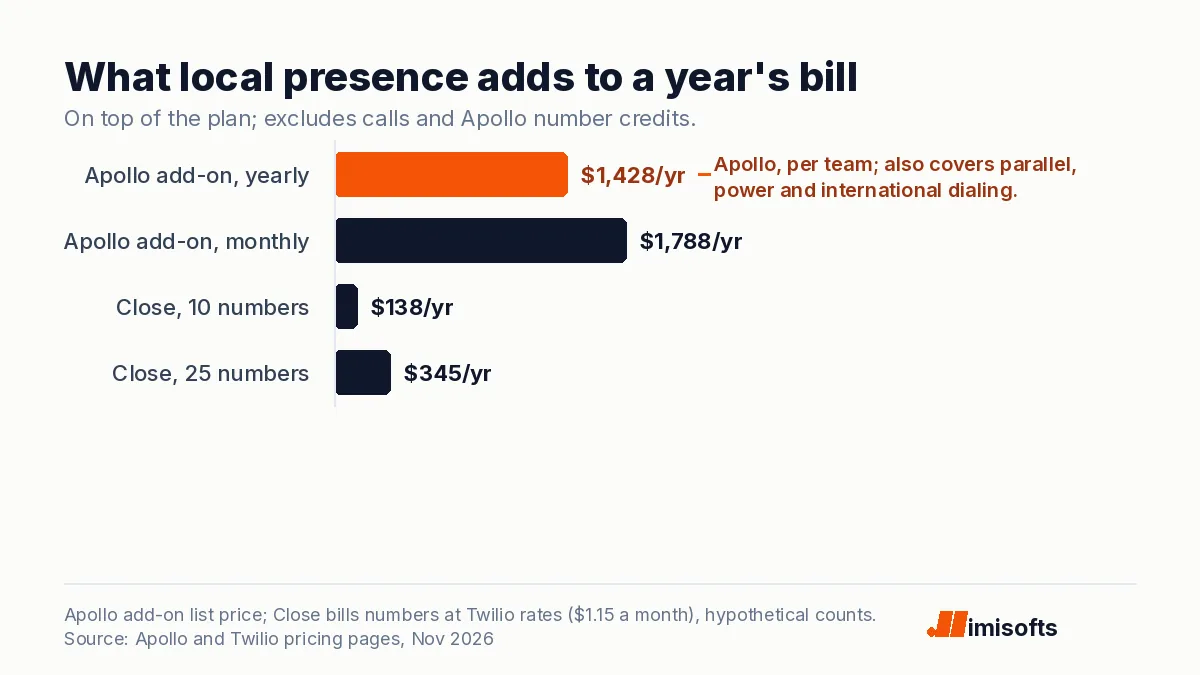
Apollo charges for local presence through an add-on; Close includes it from Essentials and charges for the numbers. Close's help center says numbers are billed "according to Twilio’s “Pay-as-you-go” Voice pricing", and Twilio's US price list shows $1.15 a month for a local number and $2.15 for toll-free.
| Setup | Extra cost a year | What it excludes |
|---|---|---|
| Apollo Advanced Dialer, billed yearly | $1,428 a team | The paid Apollo plan; extra numbers (credits, amount not stated); calls, "charged in 30-second increments" |
| Apollo Advanced Dialer, billed monthly | $1,788 a team | As above |
| Close, 10 local numbers at $1.15 | $138 | The Close plan (Essentials or above, not Solo); call minutes |
| Close, 25 local numbers at $1.15 | $345 | As above |
The Close rows are hypothetical setups at Twilio's list price; Close's own page says numbers start "about $1/month". At these counts Apollo's add-on is the dearer line, but it also includes Apollo's parallel, power and international dialers; Close lists its Power Dialer on Growth and Scale only, and its Predictive Dialer on Scale only. Apollo labels its prices "Introductory pricing" and says "features and pricing may change." For dialer rules, see is parallel dialing legal and our cold calling software comparison.
A checklist before you switch local presence on
- Use only numbers your account holds, never a number that belongs to someone else or one nobody has assigned to you. Two of the three kinds of number in the FCC's 2018 case were unassigned numbers and numbers assigned to innocent consumers.
- Test a callback to every local number during business hours. The number must let anyone make a do-not-call request then (64.1601(e)(1)); the FTC's version for a seller's number says "answered during regular business hours". Log it against your internal list; see TCPA opt-out requirements.
- Never block caller ID on a sales call, and set your business name (CNAM) where the vendor offers it, knowing Apollo says it "may not appear on every call".
- Keep scripts honest about where you are. A local number is not a local office.
- For Pennsylvania contacts, decide with counsel whether number rotation is aimed at screening tools; our suggestion is to keep a stable number per area code rather than cycling.
- Outside the US, numbers can need paperwork: Close's setup guide says US numbers and UK mobile numbers need no documents, while "UK local and AU local/mobile numbers require documentation before you can procure the number." Country calling rules differ too; see cold calling laws in South Africa for one example.
If your outbound runs on an AI voice agent rather than reps, the same caller ID rules apply to the numbers it dials from. Our page on AI calling built around TCPA consent describes the consent, suppression and opt-out layer we build under an AI dialer; see also AI calling for home services, the AI voice agents comparison and the HVAC answering service guide.
If you already run Close or want a CRM with calling built in, try Close, where Local Presence starts on Essentials (partner link). If you prospect in Apollo, compare Apollo's dialer add-on (partner link). This is general information, not legal advice.
Frequently Asked Questions
Under federal law it is, on our reading, when the caller ID is a number your account holds, there is no intent to defraud, cause harm or wrongfully obtain anything of value (47 CFR 64.1604), and the number shown lets anyone make a do-not-call request during regular business hours (64.1601(e)). Neither rule mentions local presence or area codes. Since 18 October 2026, Pennsylvania's Act 47 has removed an equipment limit from its ban on acting with the primary intent to falsely identify a telemarketer's number. This is general information, not legal advice.
The FCC describes neighbor spoofing as making a call appear to come from a local number, or showing a number similar to the one being called, so the person answers. It breaks 47 U.S.C. 227(e) and 47 CFR 64.1604 when done with intent to defraud, cause harm or wrongfully obtain anything of value. In a 2018 Notice of Apparent Liability about spoofed telemarketing calls, FCC 18-135, which we did not see describe the calls as neighbor spoofing, the FCC proposed a $37,525,000 penalty against a telemarketer that made more than two million apparently illegal spoofed calls showing burner, unassigned or other people's numbers.
The statute sets up to $10,000 a violation. The FCC's inflation-adjusted rule, 47 CFR 1.80, lists up to $14,432 a violation, $43,296 a day for a continuing violation and $1,443,275 for any single act. The FCC must issue its notice within four years of the violation.
The FCC's rule does: 64.1601(e) covers anyone engaged in telemarketing, which 64.1200(f)(13) defines as calls encouraging a purchase transmitted to any person. The FTC's caller ID rule, 16 CFR 310.4(a)(8), does not reach most business-to-business calls, which 310.6(b)(7) exempts, but the FTC's ban on false or misleading statements to induce payment, 310.3(a)(4), still applies to them.
Yes. 64.1601(e)(1) allows substituting the seller's name and its customer service number, and the FTC rule allows a seller's number that is answered during regular business hours. Whatever number you show must let any person make a do-not-call request during regular business hours. The FCC's consumer guide gives a business showing its toll-free call-back number as a legitimate use.
On 4 November 2026, Apollo's local presence needed a paid plan with the dialer plus the Advanced Dialer add-on at $119 a team a month billed yearly or $149 monthly, and Apollo labels that pricing introductory; extra numbers cost credits, amount not stated. Close includes Local Presence on Essentials ($35 a user a month billed yearly, $49 monthly), Growth and Scale, not Solo, and bills numbers at Twilio pay-as-you-go rates, which Twilio lists at $1.15 a month for a US local number.