October 15, 2026. Federal rules allow telemarketing calls to consumers between 8 a.m. and 9 p.m. in the called person's local time, but several states are stricter. Florida, Oklahoma and Maryland allow sales calls only from 8 a.m. to 8 p.m. and cap them at three in 24 hours on the same subject. Texas starts at 9 a.m., or noon on Sunday, and requires many sellers to register and post $10,000 in security before calling or texting its residents. Virginia treats marketing texts as calls and lets each person sue for $500 to $5,000 per violation. Our TCPA-compliant AI calling service is built around these rules, and this guide sets out the hours, consent rules and penalties in each of these states, plus one calling schedule that fits all of them.
Each rule below comes from the statute or regulation text, read 15 October 2026: the FCC's rule at 47 CFR 64.1200 and the state codes linked in each section. For Texas we used a published copy of the code and law-firm alerts on Senate Bill 140. This is not a 50-state survey. It covers the federal baseline and five states whose rules go further: Florida, Oklahoma, Maryland, Texas and Virginia. These laws come with private lawsuits, so treat this as a map, not legal advice.
Key numbers
| Item | Number |
|---|---|
| Federal telemarketing calling window (called party's local time, 47 CFR 64.1200(c)(1)) | 8 a.m. to 9 p.m. |
| Florida, Oklahoma and Maryland calling window | 8 a.m. to 8 p.m. |
| Same-subject call cap in Florida, Oklahoma and Maryland | 3 calls in 24 hours |
| Texas calling window (noon to 9 p.m. on Sunday) | 9 a.m. to 9 p.m. |
| Texas telemarketing registration (renewed yearly; covers texts since 1 September 2025) | $200 fee and $10,000 security |
| Virginia damages per violation | $500, then $1,000, then $5,000 |
| Federal do-not-call damages (up to 3x if willful or knowing) | up to $500 per violation |
| Do Not Call Registry copy used for calls | no older than 31 days |
| Federal deadline to honor a stop request | 10 business days |
47 CFR 64.1200 (eCFR); 47 U.S.C. 227(c)(5) (govinfo); Florida Statutes 501.059 and 501.616, Oklahoma Statutes 15-775C.3 to 775C.6 and Maryland Commercial Law 14-4502 and 14-4503 (Justia); Texas Business and Commerce Code 301.051 and chapter 302; Virginia Code 59.1-510 to 59.1-515; Godfrey & Kahn alert on Texas SB 140; all read 15 October 2026.
The federal baseline: 8 a.m. to 9 p.m.
Under the FCC's rule, no one may make a telephone solicitation to a residential subscriber before 8 a.m. or after 9 p.m., local time at the called party's location. Two more federal rules apply to every calling program:
- National Do Not Call Registry. The rule bars telephone solicitations to residential subscribers who have registered their numbers, with limited exceptions. The safe harbor for an accidental call requires a scrub against a copy of the registry obtained no more than 31 days before the call.
- Your internal do-not-call list. When someone asks you to stop calling, you must record the request and honor it within a reasonable time, which may not exceed ten business days.
Under 47 U.S.C. 227(c)(5), a person who gets more than one call in 12 months in breach of these do-not-call rules can sue for actual losses or up to $500 per violation, whichever is greater, and a court can raise that up to three times if the violation was willful or knowing. A company that set up reasonable procedures with due care has a defense. For how opt-outs work across calls and texts, see our guide to the TCPA revoke-all rule.
Calling hours by state at a glance
| Rule | Calling window (called person's local time) | Same-subject call cap | Private damages per violation |
|---|---|---|---|
| Federal (TCPA) | 8 a.m. to 9 p.m. | None stated | Up to $500, up to 3x if willful or knowing; needs two or more calls in 12 months |
| Florida | 8 a.m. to 8 p.m. | 3 calls in 24 hours, from any number | $500 or actual damages under the FTSA, up to 3x if willful or knowing |
| Oklahoma | 8 a.m. to 8 p.m. | 3 calls in 24 hours, from any number | $500 or actual damages, up to 3x if willful or knowing |
| Maryland | 8 a.m. to 8 p.m. | 3 calls in 24 hours | Up to $500 or actual damages, up to 3x if willful or knowing |
| Texas | 9 a.m. to 9 p.m.; Sunday noon to 9 p.m. | None stated | Deceptive Trade Practices Act remedies for registration violations |
| Virginia | 8 a.m. to 9 p.m., unless prior consent | None stated | $500 first, $1,000 second, $5,000 each after |
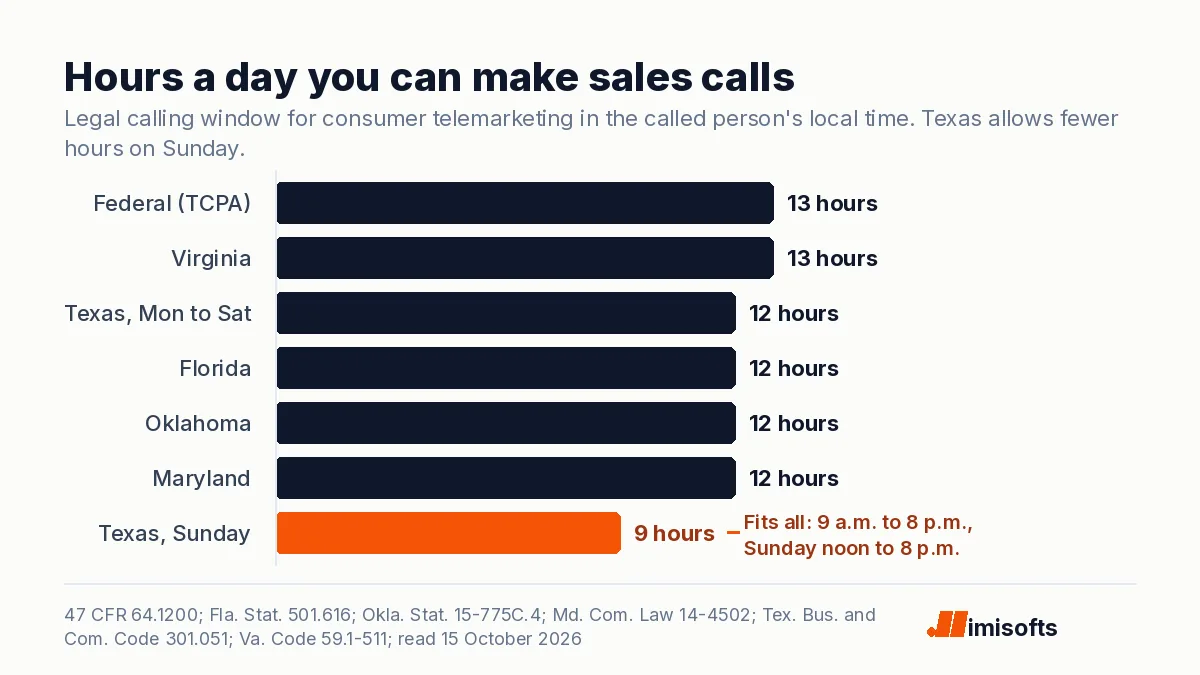
Two patterns stand out. First, the 8 p.m. states end the day an hour earlier than federal law, so a dialer set to the federal window will reach Florida, Oklahoma and Maryland numbers in a forbidden hour every evening. Second, Florida and Oklahoma count calls on the same subject from any number, so rotating caller IDs does not reset the count. In Florida the hours and the call cap sit in a separate section of its telemarketing law, 501.616, while the $500 damages come from the Telephone Solicitation Act itself.
Florida: the Telephone Solicitation Act
Florida's section 501.059, known as the FTSA, is the law the other state versions most resemble. It covers a "telephonic sales call", which the statute defines as a call, text message or voicemail to a consumer to sell consumer goods, services or credit. The main rules:
- Consent: a sales call that uses an automated system for the selection and dialing of numbers, or plays a recorded message, needs the called party's prior express written consent.
- Identification: the caller must give their first and last name and the business they represent.
- Opt-outs: once a consumer or business says they do not want calls, you may not call, text or leave a voicemail again.
- Hours and frequency: section 501.616 bars commercial telephone solicitation before 8 a.m. or after 8 p.m. in the called person's time zone, and more than three calls in 24 hours on the same subject, regardless of the number used.
- Area codes: a call to a Florida area code is presumed to reach a Florida resident, and the caller has to rebut that presumption.
The private right of action is what made the FTSA well known: $500 or actual damages per violation, whichever is greater, up to three times that if the violation was willful or knowing, and attorney fees for the prevailing party. For texts, the recipient must first reply STOP and give the sender 15 days before suing, which makes a fast opt-out process the cheapest protection a texting program has.
Oklahoma: Florida's rules with a wider net
Oklahoma's Telephone Solicitation Act took effect on November 1, 2022 and follows Florida closely, with one wording difference that matters. Its consent rule covers an automated system "for the selection or dialing" of numbers, where Florida's current text says "selection and dialing", so more dialing tools fall inside it. The other rules:
- Prior express written consent for automated or prerecorded sales calls.
- Calls only from 8 a.m. to 8 p.m. in the called person's time zone, and no more than three calls from any number in 24 hours on the same subject.
- Caller ID must show the originating number, and a call back to that number must reach the seller or the solicitor.
- Intentionally altering the caller's voice to disguise who is calling, in order to defraud, confuse or harm the person, is unlawful.
- Calls to Oklahoma area codes are presumed to reach Oklahoma residents.
Each violation carries $500 or actual damages, whichever is greater, and up to three times that for willful or knowing violations. Because the hours and call cap sit in the same act as the damages provision, a single late call may support a $500 claim.
Maryland: the Stop the Spam Calls Act
Maryland's version, in Commercial Law 14-4502, has the same three pillars: prior express written consent for sales calls that use an automated system for the selection or dialing of numbers or a recorded message, no calls between 8 p.m. and 8 a.m., and no more than three calls in 24 hours on the same subject. It also requires the caller's number to be transmitted to caller ID. Two details matter for B2B teams:
- The act's exemptions include a business-to-business sale where the telephone solicitor has operated lawfully and continuously for at least three years under the same business name. A company younger than three years, or one that changed its name in that time, cannot use it.
- Under section 14-4503, a violation is an unfair, abusive or deceptive trade practice under Maryland's Consumer Protection Act, and the person called can sue for up to $500 or actual damages, whichever is greater, with up to three times that for willful or knowing violations.
Like Florida and Oklahoma, Maryland presumes that a call to one of its area codes reaches someone who lives or has a place of business in the state.
Texas: register before you call or text
Texas spreads its telemarketing rules across several chapters of its Business and Commerce Code; two matter most here. Business and Commerce Code 301.051 limits consumer telephone calls to after 9 a.m. and before 9 p.m. on weekdays and Saturdays, and after noon and before 9 p.m. on Sundays, and requires the caller to give their name, the business and the purpose of the call. Calls made at the consumer's express request, about an existing debt or contract, or to someone with whom you have a prior or existing business relationship fall outside that section.
Chapter 302 is the bigger burden. A seller may not make a telephone solicitation from Texas or to a purchaser in Texas without a registration certificate for each business location it calls from. Registration means a $200 filing fee and $10,000 in security, as a bond, letter of credit or certificate of deposit. It lasts one year and needs quarterly updates listing the salespeople. A violation is a deceptive act under the Texas Deceptive Trade Practices Act, so consumers can use that act's remedies.
Senate Bill 140, in force since September 1, 2025, extended the definition of telephone solicitation to text, graphic and image messages, so SMS marketing to Texans now needs the same registration unless an exemption applies. According to Godfrey & Kahn's alert on the bill, the exemptions are narrow and the burden of proving one falls on the business. The bill also made violations of the Texas no-call list rules actionable under the Deceptive Trade Practices Act.
Virginia: texts count and damages climb
Virginia's Telephone Privacy Protection Act defines a telephone solicitation call to include text messages sent to a wireless number with a Virginia area code or registered to a Virginia resident. Its section 59.1-511 allows solicitations only between 8 a.m. and 9 p.m. at the contacted person's location, unless the person gave prior consent. The penalties escalate: under section 59.1-515, a person can recover $500 for a first violation, $1,000 for a second and $5,000 for each one after that. A court can raise a willful first or second violation to $5,000, and attorney fees and court costs are recoverable. Claims can be filed in general district court or small claims court.
Which state's rules apply to your call
Calling hours follow the person you call, not your office, although Texas registration also covers solicitations made from Texas. Federal and Virginia hours are measured at the called person's location, Florida and Oklahoma use the called person's time zone, and Florida, Oklahoma and Maryland presume that a number with one of their area codes belongs to a resident. So under Florida's Telephone Solicitation Act, a lead with a Florida mobile number who now lives in Arizona is presumed to be a Florida resident unless you can show otherwise. The simplest way to handle this is to apply the strictest rule to every number, rather than guessing where each person lives.
If you also call outside the US, the rules change again; our cold calling laws by country guide compares nine countries.
One schedule that satisfies every state here
If you call or text consumers across the US, these settings cover the main rules in this guide, federal and state:
- Call only from 9 a.m. to 8 p.m. in the recipient's local time, Monday to Saturday, and from noon to 8 p.m. on Sunday.
- Make no more than three attempts per person in 24 hours on the same offer, counting every number you call from.
- Get prior express written consent before any sales call that uses an automated dialer or a prerecorded or AI-generated voice, and before any marketing text.
- Scrub against the National Do Not Call Registry at least every 31 days, and against state no-call lists such as Texas's.
- Honor every opt-out across calls and texts right away, well inside the federal ten business days, and log it.
- Send a caller ID number that rings back to your business, and have the caller give their name, the company and the purpose of the call at the start.
- Register in Texas before calling or texting Texans, unless you have confirmed an exemption, and check whether Florida's telemarketing act requires you to be licensed as a commercial telephone seller.
The 9 a.m. start comes from Texas, the 8 p.m. finish from Florida, Oklahoma and Maryland, and the Sunday noon start from Texas again. Other states have their own rules, so check any state where you call heavily.
Where AI calling fits
An AI voice agent has to follow every rule above, and the FCC confirmed in February 2024 that AI-generated voices count as artificial voices under the TCPA, which brings in its consent rules for artificial or prerecorded calls. The difference is that software can enforce the rules on every call: it can check the time at the recipient's location before dialing, count attempts across numbers, stop the moment someone says stop, and give the same identification every time. Our TCPA-compliant AI calling setup is designed to enforce these limits in the dialer rather than in a policy document. For whether the agent must say it is an AI, see our guide to AI caller disclosure laws by state, and if you record calls, the consent rules are different again; our guide to call recording laws by state covers them.
Frequently Asked Questions
Federal law allows telemarketing calls to consumers between 8 a.m. and 9 p.m. in the called person's local time. Some states are stricter: Florida, Oklahoma and Maryland end at 8 p.m., Texas starts at 9 a.m. on weekdays and Saturdays and at noon on Sundays, and Virginia uses 8 a.m. to 9 p.m. unless the person consented to other times.
It is a state law that adds its own telemarketing rules on top of the federal Telephone Consumer Protection Act, usually with a private right of action. Florida's Telephone Solicitation Act is the best known. Oklahoma and Maryland have similar laws requiring prior express written consent for automated sales calls. All three states end calls at 8 p.m. and cap same-subject calls at three in 24 hours; in Florida those two rules sit in a separate section, 501.616.
The federal rules covered here set no daily cap, but Florida, Oklahoma and Maryland allow no more than three sales calls to a person in 24 hours on the same subject. Florida and Oklahoma count calls from any number, so switching caller IDs does not reset the count.
Several do. Florida's definition of a telephonic sales call includes texts and voicemails, Virginia's includes texts to Virginia numbers, and Texas extended its registration law to text, graphic and image messages on September 1, 2025. In Florida, a person must reply STOP and wait 15 days before suing over a text.
Unless an exemption applies, a seller making telephone solicitations to purchasers in Texas needs a registration certificate from the Texas Secretary of State for each calling location, with a $200 filing fee and $10,000 in security, renewed every year. Since September 1, 2025 this also covers marketing texts.
The called person's. Federal and Virginia rules use the local time at the called person's location, and Florida and Oklahoma use the called person's time zone. Florida, Oklahoma and Maryland also presume that a number with their area code belongs to a resident, so the safest approach is to apply the strictest window to every call.