October 11, 2026. Cold calling a business is legal in most of the big English-speaking and Gulf markets, but the rules differ on the three things that decide a program: whether a business number needs consent, which hours you may call, and whether an AI or recorded voice changes the answer. In six of the nine countries below you may make a live call to a business without its consent. Germany asks for at least presumed consent, Austria for prior consent, and South Africa's regulator reads its data protection law as allowing one call to a non-customer, only to ask for consent. An AI voice needs consent or approval in most of the markets in this table. Penalties include up to $1,500 per violation in US private lawsuits and up to 17.5 million pounds or 4 percent of worldwide turnover in the UK.
Each row links to our full guide for that country, researched from the statute and the regulator, and the dates in the table come from those guides. If you run calls across several of these markets, our compliant AI calling setup builds the hours, consent records and scripts in from the start. This is a map of the rules, not legal advice; check the guide and the regulator before a campaign.
Key numbers
| Item | Number |
|---|---|
| Countries compared | 9 |
| Countries allowing live B2B calls without consent | 6 of 9 |
| Countries needing consent for live B2B calls (South Africa on its regulator's reading; Germany needs presumed consent) | Austria; South Africa |
| UK maximum penalty since February 5, 2026 (of worldwide turnover) | 17.5 million pounds or 4 percent |
| Canada maximum per violation, corporation | $15,000 |
| Germany, consumer sales call without consent | up to EUR 300,000 |
| Australia, Industry Standard breach, company | A$250,000 per contravention |
| UAE, marketing calls without approval | up to AED 150,000 |
| US private damages per violation (usually counted per call) | $500, up to $1,500 if willful |
| Shortest weekday calling window (UAE; France's consumer window, split) | 9 hours |
imisofts country guides for Australia, Austria, Canada, France, Germany, South Africa, the UAE, the UK and the US, each researched from statutes and regulator guidance between August and October 2026, compiled read 11 October 2026.
The comparison table
| Country (links to the guide) | Live B2B cold calls | Register to check | Weekday calling hours | AI or recorded voice | Maximum penalty as written |
|---|---|---|---|---|---|
| Australia | Allowed; the Industry Standard still governs every call, B2B included | Do Not Call Register; business numbers cannot be listed, mixed-use phones can | 9 a.m. to 8 p.m.; Saturday 9 a.m. to 5 p.m.; no Sundays or national public holidays | A "recorded or synthetic voice" is a voice call under the Act, so every rule applies | A$250,000 per contravention of the Industry Standard; A$36,400 per call in court for a first-time company |
| Austria | Prior consent required, businesses included | No statutory do not call register | No statutory window in the laws we reviewed | Consent required | Up to EUR 100,000 per case (TKG 2021) |
| Canada | Allowed; business consumers are exempt from the National DNCL but not from the Telemarketing Rules | National DNCL for consumers; registration required even for exempt calls | 9 a.m. to 9:30 p.m.; weekends 10 a.m. to 6 p.m. | Express consent for any sales call using a synthesized voice (ADAD Rules) | $15,000 per violation for a corporation |
| France | Allowed to professionals at professional numbers about their activity; consumers opt-in only since August 11, 2026 | Bloctel ended August 11, 2026 | 10 a.m. to 1 p.m. and 2 p.m. to 8 p.m., Monday to Friday | Treat as needing consent for consumers | Administrative fines up to EUR 75,000 for an individual, EUR 375,000 for a company; contracts after a non-compliant call are void |
| Germany | Allowed on presumed consent, read narrowly by the courts; consumers need prior express consent | No statutory do not call register | No statutory window in the laws we reviewed | Automatic calling machines need prior express consent from anyone | Up to EUR 300,000 for a sales call to a consumer without consent |
| South Africa | Consent or an existing customer needed: POPIA section 69 allows one call to a non-customer to ask for consent, companies included, and the Information Regulator's advisory guidance applies it to ordinary phone calls | Opt-out registry regulations gazetted April 15, 2026 | Consumers at home: 8 a.m. to 8 p.m.; Saturday 9 a.m. to 1 p.m.; none on Sundays or public holidays | POPIA section 69 covers automatic calling machines: one call, to ask for consent | R10 million POPIA administrative fine; CPA penalties up to R1 million or 10 percent of turnover |
| UAE | Allowed for licensed companies with prior approval, from numbers on their trade licence | Do Not Call Registry | 9 a.m. to 6 p.m. | Automated systems allowed under the same rules as human callers | AED 150,000 for marketing calls without approval or to registry numbers |
| United Kingdom | Allowed after screening against TPS and CTPS; numbers protected 28 days after listing | TPS and CTPS, one register | No statutory window in the laws we reviewed | Prior consent for automated calls, no B2B exemption; the ICO treated agent-played recordings as automated | 17.5 million pounds or 4 percent of worldwide turnover since February 5, 2026 |
| United States | Generally allowed to business lines; consumer rules protect residential and wireless subscribers | National Do Not Call Registry for consumers | 8 a.m. to 9 p.m. recipient time for telephone solicitations to consumers | AI voices are artificial voices: prior express consent, written for marketing, for calls to cell and residential lines | $500 per violation in private lawsuits, usually counted per call, up to $1,500 if willful or knowing |
Pattern one: live B2B calls are mostly opt-out
In six of the nine countries a person may phone a business that has never heard of them, provided they respect any register, any calling hours and any objection. Austria requires prior consent for every advertising call, businesses included, and Germany sits in between by requiring at least presumed consent, which its courts read as concrete reasons to believe the business would welcome the call. France's 2026 reform made consumer prospecting opt-in but, on the reading of French legal analyses, left calls to professionals about their activity under the older opt-out framework. South Africa has no business exemption at all: POPIA treats a company as a data subject, section 69 allows one call to a non-customer to ask for consent, and the Information Regulator's advisory guidance applies that to ordinary phone calls, not only automated ones. Sole traders are a grey zone in many of these markets: a freelancer's mobile is often a personal number, and the classification follows the capacity in which the person acts, not the column in your CRM.
Pattern two: automated and AI voices need consent in most markets
The rules were written for robocalls, but in most of these markets their definitions reach AI voice agents. Australia's Act counts "a recorded or synthetic voice". Canada's ADAD Rules cover equipment that conveys "a pre-recorded or synthesized voice message", and the CRTC's 2026 consultation asks whether that wording should name artificial intelligence outright. The UK's Regulation 19 requires prior consent for automated calls with no business exemption, Germany requires it for automatic calling machines, the US FCC confirmed in 2024 that AI-generated voices are artificial voices under the TCPA, and South Africa's POPIA allows one call to ask for consent. The UAE is the exception that proves the rule: its 2024 resolution expressly allows automated systems, but then applies every licensing, hours and registry duty to them.
For a multi-country program, that leaves one safe design: AI voices for inbound calls, callbacks people asked for and contacts who opted in, with people making the true cold calls where the country allows them. Our AI calling service is built that way.
Pattern three: calling windows are short and local
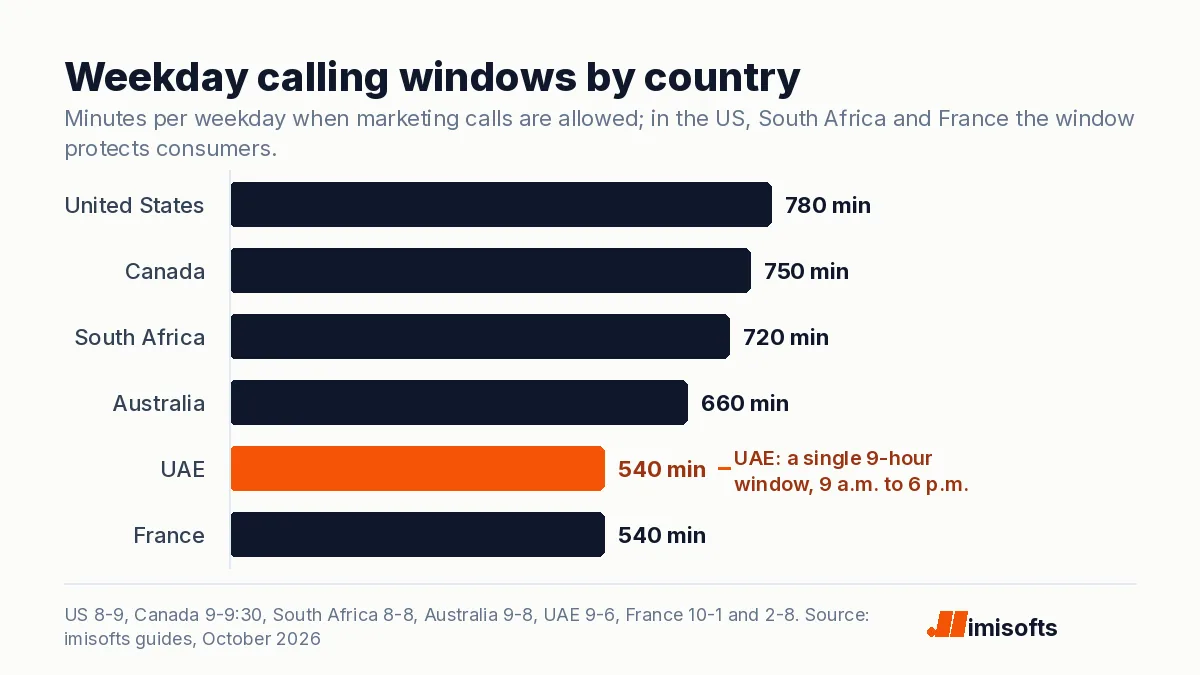
Where a statutory window exists, it is measured in the recipient's time zone, not yours. The UAE allows nine hours, 9 a.m. to 6 p.m., and France's consumer window is also nine hours split around lunch. Australia allows 11 hours on weekdays and bans Sundays and national public holidays, Canada allows 12 and a half, and the US rule for consumer solicitations allows 13. South Africa's consumer window is 12 hours on weekdays and four on Saturdays. We found no statutory hours for the UK, Germany or Austria in the laws we reviewed, though calling at antisocial times is the quickest way to earn a complaint. A dialer that schedules by the caller's clock will drift outside these windows unless someone sets the time zone per number.
Registers you must check
- Australia: the Do Not Call Register; a wash is valid for 30 days, and mixed-use mobiles can be listed.
- Canada: the National DNCL for consumer numbers, downloaded no more than 31 days before calling, plus registration with the operator even for exempt B2B calls.
- UK: TPS and CTPS together; a number is protected 28 days after it is listed.
- UAE: the Do Not Call Registry, and only from numbers registered to your trade licence.
- US: the National Do Not Call Registry for consumer numbers, plus your own internal do not call list.
- South Africa: the Consumer Protection Act opt-out registry under the April 2026 regulations.
Keep your own do not call list in every market and act on a refusal at once. Several countries make that a legal duty with fixed timing; in Canada, a do not call request must be added to your list within 14 days and kept for three years and 14 days.
Where the rules moved in 2026
- UK, February 5, 2026: the maximum penalty rose to 17.5 million pounds or 4 percent of worldwide turnover, and an unanswered dialer attempt now counts as a call.
- South Africa, April 15, 2026: regulations for the Consumer Protection Act opt-out registry were gazetted, with draft compliance guidelines following on October 2, 2026.
- Canada, June 11, 2026: the CRTC opened a review of its telemarketing rules, including whether its automated-call definition captures AI voices and how to define a business consumer.
- EU, August 2, 2026: the AI Act's transparency duties began to apply, which matters for AI voice agents calling Germany, Austria and France.
- France, August 11, 2026: consumer telephone prospecting became opt-in and the Bloctel register closed.
Expect more of the same: each change that took effect this year added consent, records, transparency or penalties, and none of them loosened the rules.
What it means for a multi-country program
- Tag every number with its country and whether it is a business, a consumer or a sole trader.
- Schedule calls by the recipient's time zone and the strictest window that applies.
- Check each country's register before every campaign, not once a year.
- Keep AI voices to consented and inbound calls unless the country's rule clearly allows more.
- Script the identification line each country requires, and record consent and refusals.
- Put a compliance clause in every contract with a call center or dialer vendor; in several countries the business that hires the caller is liable too.
Email has its own rules in each of these markets; see our cold email laws by country table, which covers 31 countries, and our newest country guides, Colombia, Malaysia and Israel.
Frequently Asked Questions
In most of the markets we cover, yes. Six of the nine countries in our table allow live calls to businesses without prior consent. Austria requires consent for businesses too, Germany requires at least presumed consent, and South Africa's regulator reads its data protection law as allowing one call to a non-customer, only to ask for consent. Wherever a register or calling hours exist, you must respect them, along with any objection.
Usually only with consent. Australia, Canada, the UK, Germany, the US and South Africa all have rules on recorded, synthetic or automated voices that can reach AI agents. The UAE expressly allows automated systems but applies every licensing, hours and registry rule to them.
Austria requires prior consent for every advertising call, businesses included, and South Africa's regulator allows only one call to a non-customer, to ask for consent. The UK's maximum fine is among the highest, up to 17.5 million pounds or 4 percent of worldwide turnover. France made consumer telephone prospecting opt-in from August 11, 2026.
It depends on the recipient's country: 9 a.m. to 6 p.m. in the UAE, 9 a.m. to 8 p.m. on weekdays in Australia, 9 a.m. to 9:30 p.m. on weekdays in Canada, 8 a.m. to 9 p.m. for consumer solicitations in the US, and 10 a.m. to 1 p.m. and 2 p.m. to 8 p.m. for consumers in France. We found no statutory window for the UK, Germany or Austria in the laws we reviewed.
In some countries. The UK's TPS and CTPS register covers companies. Canada exempts business consumers from its National DNCL but requires registration with the operator. Australia does not let business numbers be listed but does accept mixed-use mobiles. The UAE's registry applies to all marketing calls.
Often both. Canada's rules put duties on the client of a telemarketer, the UK regulator treats the business that instigates calls as responsible, and the UAE rules require calls from numbers on the calling company's own trade licence. Put compliance obligations in every calling contract.