November 2, 2026. Six of the seven US states read statute by statute today charge between $50 and $1,500 to register a telemarketer, four demand security of up to $100,000 before the first call, and in each registration state, calling someone located there is enough, wherever the caller sits. Pennsylvania's registration, $500 every two years with a $50,000 bond, now sits inside a law amended by Act 47 of 2026, in force since 18 October 2026, that also bans Sunday calls. New York wants $500 and a $25,000 bond for two years. Texas wants $200 and $10,000 in security per registration, with a certificate for each calling location, renewed yearly. Florida charges $1,500 for the seller plus $50 per salesperson. Washington's state endorsement is $82 per location. California charges only $50 but requires a $100,000 bond, and only from sellers whose pitch matches a list of prize, discount and investment claims. Georgia has no general registration in the sections we read, but makes recorded-message dialers hold a permit from its Public Service Commission. Each registration state also writes its own business-to-business exemption, and no two match. Here is the table, the exemption each state offers a business seller, and what to file before a dialer goes live.
Key numbers
| Item | Number |
|---|---|
| Highest seller licence fee in the table (Florida, plus $50 per salesperson) | $1,500 |
| Lowest registration fee (California, annual) | $50 |
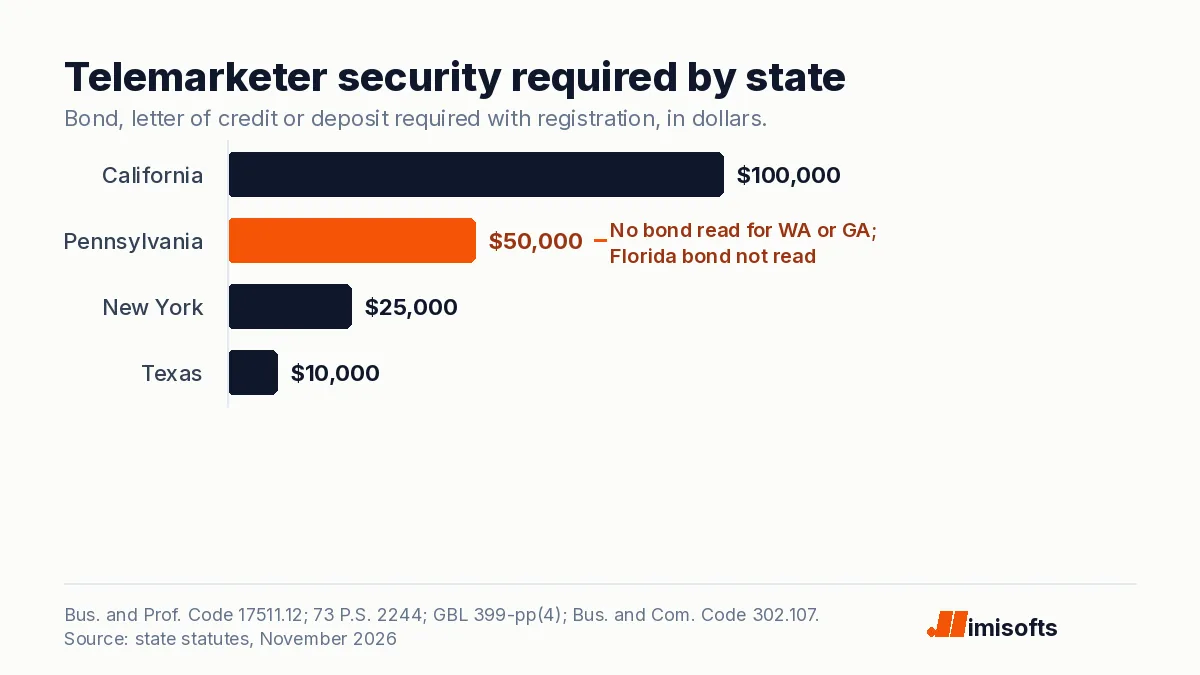
| Largest bond (California telephonic sellers) | $100,000 |
| Pennsylvania bond (with $500 biennial fee) | $50,000 |
| New York bond (with $500 fee for two years) | $25,000 |
| Texas security per registration (with $200 fee, one year; certificate per location) | $10,000 |
| Washington endorsement per location (Department of Revenue) | $82 |
| Days before calling that Pennsylvania registration is due (California: 10 days) | 30 |
| Face value of security, four states with a bond amount read (Texas, New York, Pennsylvania, California) | $185,000 |
| States in the table with a general telemarketer registration (Georgia: ADAD permit only, in the sections read) | 6 of 7 |
Florida Statutes 501.604 to 501.607; Pennsylvania Act 147 of 1996 as amended by Act 47 of 2026; New York GBL 399-pp; Texas Bus. and Com. Code ch. 302; RCW 19.158 and the Washington Department of Revenue; California Bus. and Prof. Code 17511.1 to 17511.12; O.C.G.A. 46-5-23; all read on 2 November 2026.
The table
| State | Registers with | Fee | Security | Term |
|---|---|---|---|---|
| Florida | Department of Agriculture and Consumer Services, Fla. Stat. 501.605 and 501.607 | $1,500 seller licence; $50 per salesperson | Set by statute sections not read today | Not read today |
| Pennsylvania | Office of Attorney General, 73 P.S. 2243 and 2244, as amended by Act 47 of 2026 | $500 | $50,000 surety bond, or cash, CD or government bonds | Two years |
| New York | Department of State, GBL 399-pp | $500, non-refundable | $25,000 bond, letter of credit or CD | Two years |
| Texas | Secretary of State, Bus. and Com. Code 302.101 to 302.107 | $200 per registration statement; certificate per calling location | $10,000 bond, letter of credit or CD per registration | One year |
| Washington | Department of Licensing registration, RCW 19.158.050; separately, a Department of Revenue state endorsement | $82 per location, plus business licence fee | None stated on the endorsement page | With the business licence |
| California | Attorney General, Consumer Protection Section, Bus. and Prof. Code 17511.3 | $50, plus $50 annual renewal | $100,000 surety bond, Bus. and Prof. Code 17511.12 | One year |
| Georgia | No general registration in the sections read; Public Service Commission permit for ADAD equipment, O.C.G.A. 46-5-23(c) | Set by the commission | None | Permit renewed biennially |
The table covers the seven states whose statutes we read today; it is not a list of every state with a registration law. The per-state pages linked below carry the full text and the calling-hour rules that travel with registration.
What "doing business in the state" means
Every registration statute reaches out of state. Florida: "Doing business in this state includes either telephone solicitation from a location in Florida or solicitation from other states or nations of purchasers located in Florida." Texas: a seller may not solicit "from a location in this state or to a purchaser located in this state" without a certificate. Washington: "Doing business in this state includes both commercial telephone solicitation from a location in Washington and solicitation of purchasers located in Washington." New York defines a telemarketer by calls "to or from a customer when the customer is in this state." California: "A seller shall be deemed to do business in this state if the seller solicits prospective purchasers from locations in this state or solicits prospective purchasers who are located in this state." Pennsylvania's telemarketer is anyone who calls "a residential, business or wireless telephone subscriber in this Commonwealth" or who is located in Pennsylvania when calling. A dialer in another country is as covered as one down the street; where the phone rang is enough on its own.
The business-to-business exemption, state by state
Business sellers are not exempt as a class anywhere in this table. Each registration state writes a narrower rule:
- Florida, 501.604(10): exempt where the seller "has been lawfully operating continuously for at least 3 years under the same business name and has at least 50 percent of its dollar volume consisting of repeat sales to existing businesses," or where the buyer will resell the goods or use them in manufacturing. The 8 a.m. to 8 p.m. window, the three-calls-per-24-hours cap and the caller ID rules still apply to exempt sellers. Detail in the Florida Telephone Solicitation Act.
- Pennsylvania, section 3(b.1)(4) and (13): exempt where the B2B seller "has operated continuously for at least three years under the same business name and at least 50% of its dollar volume consists of repeat sales to existing businesses," and, more broadly, where the calls do not solicit "consumer goods or services," which the Act defines as property or services used for personal, family or household purposes. Detail in Pennsylvania telemarketing laws after Act 47.
- New York, 399-pp(10)(b)(4): exempt are "telephone calls between a telemarketer and any for-profit business, except calls involving the retail sale of nondurable office or cleaning supplies." The cleanest B2B exemption in the table. Detail in New York telemarketing laws.
- Texas, 302.056 and 302.058: exempt are sales to a business that "intends to: (1) resell the item purchased; or (2) use the item purchased in a recycling, reuse, remanufacturing, or manufacturing process," and calls to former or current customers by a seller with two years under one name. Selling a service to a new business customer for its own use is not within either. Detail in Texas telemarketing laws.
- Washington, RCW 19.158.020 and the Department of Revenue: the statute's exclusions cover isolated transactions, prior purchasers, appointment setting that closes face to face and specific licensed trades; the Department of Revenue adds that businesses which "sell to businesses who either resell the product or use it for manufacturing" are excepted. Detail in Washington telemarketing laws.
- California, 17511.1: the "telephonic seller" definition applies only where the pitch makes one of the listed representations, such as free gifts, prizes, below-regular-price claims, office-supply price increases, investments, loans or credit cards, so an ordinary B2B software or services call usually falls outside the definition. Sellers calling prior purchasers, closing face to face, or regulated as financial institutions or by the Public Utilities Commission are exempt by name.
- Georgia: no registration to be exempt from; the no-call law protects "residential, mobile, or wireless" subscribers and the ADAD use rules cover goods for "personal, family, or household use," but the (c) permit applies to any ADAD calling into Georgia. Detail in Georgia telemarketing laws.
Two patterns hold across the states. The three-years-and-50-percent-repeat-sales test, written to exempt established suppliers rather than new entrants, appears in Florida and Pennsylvania in nearly identical words. And the resale-or-manufacturing test appears in Florida, Texas and Washington, which means a company selling software, marketing or staffing services to other companies for their own use fits none of those three and has to look elsewhere in each statute.
What the security is for
The bonds are not fees. Texas conditions its $10,000 on "the seller's compliance with this chapter." New York's $25,000 bond, letter of credit or certificate of deposit is kept for three years after the telemarketer stops, or three years from registration termination if earlier. Pennsylvania's $50,000 surety bond, or cash, certificate of deposit or government bonds in that amount, carries a 60-day cancellation notice, and the registration is treated as lapsed if the security falls below the amount. California's $100,000 bond runs "in favor of the State of California for the benefit of any person suffering pecuniary loss."
Penalties for calling unregistered
- Pennsylvania: "Failure to register as required by this act constitutes a misdemeanor of the second degree," and any violation is also a violation of the consumer protection law, with civil penalties of up to $1,000 per wilful violation and $3,000 where the victim is 60 or older.
- New York: knowingly acting without registration is a class B misdemeanour; courts may impose $1,000 to $2,000 per violation; the Secretary of State may fine up to $1,000 per violation in lieu of revocation.
- Texas: "a civil penalty of not more than $5,000 for each violation," and every violation is a deceptive trade practice under Subchapter E, Chapter 17 of the Business and Commerce Code.
- Washington: a salesperson who solicits for an unregistered solicitor "is guilty of a misdemeanor," and an unregistered solicitor cannot "maintain or defend a lawsuit" in the state.
- Florida: section 501.616(4) says a commercial telephone seller or salesperson "must be licensed"; the part IV penalty sections were not read today.
A filing sequence that works
- Map the list by state before anything else. Registration follows the called number as well as your own location. A list with 3 percent Pennsylvania numbers still needs the Pennsylvania answer.
- Test each state's exemption against what you sell and to whom. Write down which clause you rely on; Texas and Pennsylvania both put the burden of proving an exemption on the seller.
- Budget the bonds, not the fees. The fees we could confirm total $2,832, before per-salesperson, per-location and Georgia permit fees; the security totals $185,000 at face value across Texas, New York, Pennsylvania and California.
- Register the entity, list the callers. Texas wants quarterly salesperson updates; New York wants principals named; Pennsylvania wants principal owners and a list of its telemarketers; Florida licenses each salesperson for $50.
- File before the first call. Pennsylvania says "at least 30 days prior"; California says "Not less than 10 days before doing business"; Washington and Texas say before.
- Check the robocall layer separately. Texas requires a separate permit for recorded or synthesized voices and Georgia for prerecorded-message equipment, Washington bans unsolicited commercial robocalls, and Florida, New York and Pennsylvania require prior express written consent. An AI voice agent that dials is in that layer.
For the calling windows and no-call lists that sit on top of registration, see telemarketing laws by state; for the federal consent and liability rules that apply everywhere, see TCPA vicarious liability and the TCPA abandonment rate rule. For how we set up calling around these rules, see TCPA-compliant AI calling; the best AI voice agents in 2026 compares platforms. This is general information, not legal advice.
Frequently Asked Questions
Of the seven states whose statutes we read today, Florida, Pennsylvania, New York, Texas, Washington and California require registration or licensing before soliciting their residents, and Georgia requires only a Public Service Commission permit for recorded-message dialing equipment. Other states also have registration laws; this page covers the seven read on 2 November 2026.
Florida charges $1,500 for the seller licence plus $50 per salesperson; Pennsylvania and New York charge $500 for two years; Texas charges $200 per registration statement per year, with a certificate for each calling location; Washington's state endorsement is $82 per location; California charges $50 a year. Pennsylvania adds a $50,000 bond, New York $25,000, Texas $10,000 and California $100,000.
Yes, in all six registration states, unless an exemption applies. Florida, Texas, Washington and California define doing business to include soliciting purchasers located in the state from elsewhere, New York defines a telemarketer by calls to a customer in New York, and Pennsylvania by calls to a subscriber in the Commonwealth.
Not as a class. New York exempts calls between a telemarketer and any for-profit business except retail sales of nondurable office or cleaning supplies. Florida and Pennsylvania exempt B2B sellers with three years under one name and at least 50 percent repeat sales to existing businesses. Texas, Florida and Washington exempt sales to businesses that will resell the goods or use them in manufacturing. Pennsylvania's Act also covers only consumer goods and services, and California's definition applies only to specific sales pitches.
Pennsylvania treats failure to register as a second-degree misdemeanour and a consumer protection violation; New York makes knowingly acting without registration a class B misdemeanour with $1,000 to $2,000 civil penalties per violation; Texas allows civil penalties of up to $5,000 per violation and treats violations as deceptive trade practices; Washington makes soliciting for an unregistered firm a misdemeanour and bars the firm from suing in state court.
Where it dials consumers with a synthesized voice, Texas requires a separate automatic dial announcing device permit, Georgia a permit for prerecorded-message equipment, Washington bans unsolicited commercial robocalls, and Florida, New York and Pennsylvania require prior express written consent. Registration of the seller is a separate requirement that applies whether a human or an agent makes the call.