From 1 October 2026, the National Do Not Call Registry costs a seller $85 a year for each area code after the first five, which are free, up to $23,425 for every area code. The fee is owed by the seller, not by its dialer. A dialer or agency may pay it on the seller’s behalf, but the subscription account must be the seller’s own, and splitting one between clients is banned. A company whose every call is exempt, such as calls to people who signed a written agreement to be called, can register as an Exempt Organization and pay nothing.
Your dialer can run the scrub. It cannot own the list for you. Retell’s terms, updated 7 October 2026, say the customer “is responsible for maintaining an active subscription to the Registry”, and smrtPhone’s help center says the dialer “does not issue or manage SANs”. In our comparison of five AI calling platforms, none said in its documentation that it scrubs your list against the registry for you.
The registry bills by area code, and it bills the seller. Nobody else’s subscription covers your calls.
Key numbers
| Item | Number |
|---|---|
| Annual fee per area code, from 1 October 2026 (up from $82) | $85 |
| Area codes free to any person | 5 |
| Maximum for every area code (up from $22,626) | $23,425 |
| Area code added in the second six months (up from $41) | $43 |
| Area codes at which the cap applies | 281 or more |
| Fee for an Exempt Organization (its SAN comes after three days) | $0 |
| Oldest registry copy a call can rely on (under the FTC and FCC safe harbors) | 31 days |
| FTC civil penalty per violation | Up to $53,088 |
| TCPA damages per do-not-call violation (up to three times if willful or knowing) | Up to $500 |
| Texas statewide no-call list | $200 a quarter |
| Active registrations on the registry (at 30 September 2025) | About 258.5 million |
| Inflation measured for the fiscal 2027 increase (since the last increase) | 3.5% |
Read on 23 October 2026 from the FTC’s fee rule of 26 August 2026 in the Federal Register, 16 CFR 310.4, 310.8 and 1.98 and 47 CFR 64.1200 on eCFR, 47 U.S.C. 227, the FTC’s registry Q&A, fee release and fiscal 2025 data book release, and the Texas no-call list FAQ.
What the Do Not Call list costs from 1 October 2026
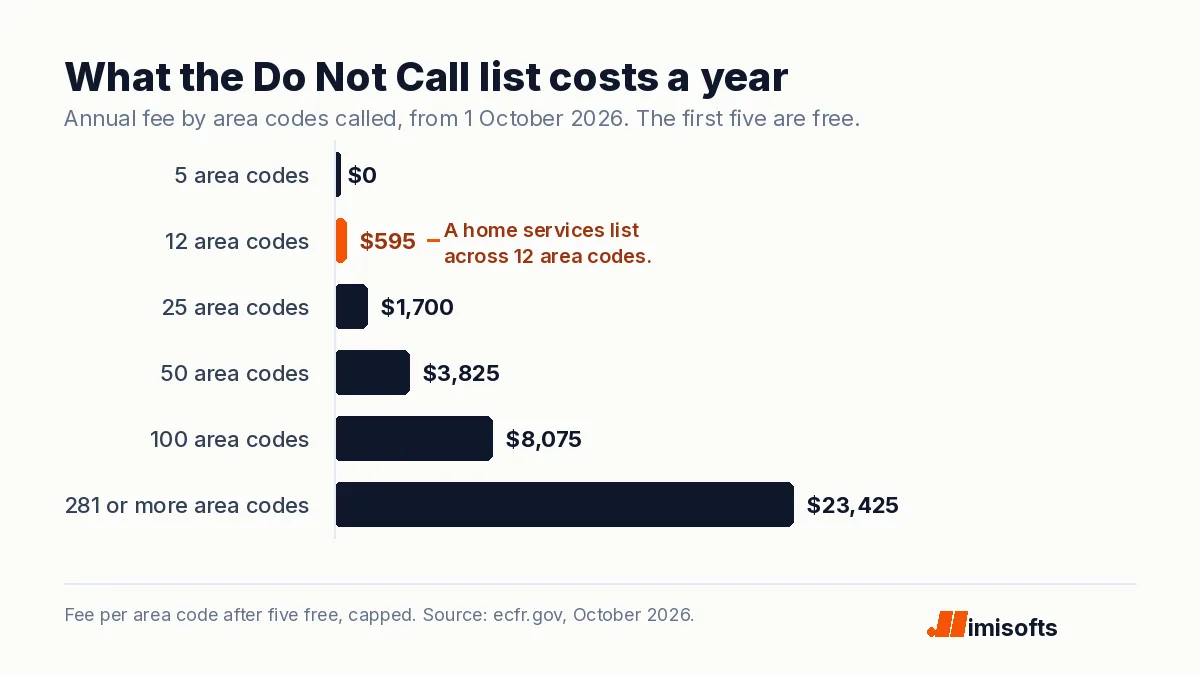
The FTC set the fiscal 2027 fees in a final rule published on 26 August 2026. The registry, which held about 258.5 million active registrations at 30 September 2025, is sold by area code: each now costs $85 a year, up from $82, and the first five are free for any person. No single entity pays more than $23,425, up from $22,626. An area code added in the second six months of a subscription year costs $43, up from $41. The increase follows inflation, which the FTC measured at 3.5% since the last one.
So the bill depends on how many area codes you call, not how many calls you make. Five area codes cost nothing. Ten cost $425, 25 cost $1,700, 50 cost $3,825 and 100 cost $8,075. From 281 area codes up, the $23,425 cap applies. A home services company whose list spans 12 area codes pays $595 a year.
The fee is keyed to the area code, not to whether a number is registered. The rule bars a seller from calling anyone in an area code it has not paid for, unless it calls only people who signed a written agreement or have an established business relationship with it, and uses the registry for nothing else.
Who pays: the seller, not the dialer
The Telemarketing Sales Rule makes it a violation for a seller to call, or have a telemarketer call, into an area code it has not paid for, and a violation for the telemarketer too. The seller may pay directly or through another person, such as a telemarketer or service provider. Either way, the FTC lists the seller as the owner of the subscription account number, or SAN, and the seller shares it with each telemarketer or service provider that buys a list for it, scrubs one or makes its calls.
So a dialer’s do-not-call feature does not settle it. A dialer can enforce a suppression list and a scrubbing service can clean one, but anyone accessing the registry on behalf of sellers must name each seller and give each seller’s account number.
Why an agency cannot share one subscription
For an agency, the costly shortcut is the pooled list: one subscription, every area code, used to scrub every client’s campaigns. The rule says no person may take part in any arrangement to share the cost of accessing the registry, including one with a telemarketer or service provider that divides the cost among its clients. Eight clients each calling 12 area codes need eight subscriptions at $595, $4,760 a year in total, each in its client’s name.
The FCC wrote the same condition into its TCPA do-not-call safe harbor, and there it costs more than a fine. A seller is not liable for a call to a registered number if it shows the call was an error and that it routinely meets five standards; the fifth is buying registry access from its administrator with no arrangement to share the cost, including telemarketers dividing it among client sellers. The defence matters because the TCPA lets a person who got more than one such call from the same company within 12 months sue for up to $500 per violation, and a court may award up to three times that if the violation was willful or knowing. FTC civil penalties run up to $53,088 per violation.
We hold one subscription for every area code and scrub all our clients against it.
Banned by the FTC rule, and it fails the fifth standard of the FCC safe harbor.
Each client subscribes in its own name and shares its SAN with us to scrub and dial.
A client calling 12 area codes pays $595 a year for its own subscription.
When a seller pays nothing
The FTC lets a for-profit company register as an Exempt Organization if all of its calls fall in exempt categories: most calls to businesses, calls to people who gave written agreement, calls within an established business relationship, informational calls, surveys, political calls and charitable appeals. Exempt Organizations pay no fee and wait three days for their SAN. The written agreement must name the number and carry the person’s signature, which can be electronic, and the relationship lasts 18 months after the last purchase, payment or delivery, or three months after an inquiry.
An AI calling program can qualify. The FCC confirmed in February 2024 that AI-generated voices are artificial voices under the TCPA, so an AI agent’s marketing call to a mobile or residential line needs the called person’s prior express written consent before it is placed. A seller that calls only people who signed one may fit the exempt categories. The exemption is all or nothing. Add one cold list for a human team and the seller owes the fee for every area code it calls. The FTC warns that subscribing as exempt when you are not can bring civil or criminal penalties.
How I would set it up
I have delivered 500+ projects, and before any outbound program dials, I would settle four things:
Put the SAN in the seller’s name
Register the seller at telemarketing.donotcall.gov, pay on Pay.gov, then share the SAN with each dialer, scrubbing service or agency that works for you. If an agency, us included, runs your scrub, it should run on your SAN.
Count area codes from the list
Take the area codes from the numbers you will dial, not from your service map. Pay early in a month, since the year starts on the 1st, and add a late area code at $43 in months seven to twelve.
Check whether you owe nothing
If every call goes to people who signed a written agreement, customers inside the relationship window or businesses, register as an Exempt Organization. Switch to a paid subscription before the first cold list goes in.
Sync every 31 days and keep the log
Both safe harbors want a registry copy no more than 31 days old and records of the process. The registry allows one download in any 24 hours and includes no state list: Texas’s statewide no-call list costs $200 a quarter, and Texas has its own rules, covered in telemarketing laws by state.
That check sits inside the TCPA-compliant AI calling setup we build, including for home services companies: consent captured at the source, the national registry, your internal opt-outs and litigator lists checked before the dialer, and a log you could hand to a regulator.
The bottom line
Budget $85 a year for each area code past five on your call list, and no more than $23,425 for all of them. Keep the subscription in the seller’s name, share the SAN with whoever dials or scrubs for you, and never pool one across clients, because that breaks the FTC rule and gives up the FCC safe harbor. If every call is exempt, register as an Exempt Organization and pay nothing, until the day a cold list goes in. I am not a lawyer, and this is not legal advice.