November 2, 2026. Under the FCC's telemarketing rules, a sales call is "abandoned" when a person answers and no live sales representative is on the line within two seconds of their completed greeting, and a campaign may abandon no more than three percent of the calls a person answers live, measured over each 30-day period. When no live representative is on the line within two seconds of the greeting, the call must then carry a recorded identification and opt-out message that names the business, gives a working opt-out number and offers an automated way to opt out on the spot. The FTC's Telemarketing Sales Rule carries the same 3 percent and two-second figures, asks, as a condition of its safe harbor, for at least 15 seconds or four rings before a dialer hangs up on an unanswered call, and exempts most business-to-business calls. On our reading, an AI voice agent that starts talking within two seconds is not an abandoned call when the person gave prior express written consent, and it is a different, larger problem when they did not. This is how the two rules read on 2 November 2026 and what they mean for a predictive or AI dialer.
Key numbers
| Item | Number |
|---|---|
| Maximum abandonment rate, calls answered live by a person (per campaign, per 30-day period) | 3 percent |
| Time to connect a live sales representative (after the completed greeting) | 2 seconds |
| Measurement window for a single campaign (successive periods if longer) | 30 days |
| Minimum ring time before disconnecting, TSR safe harbor (16 CFR 310.4(b)(4)(ii)) | 15 seconds or 4 rings |
| Statutory damages per violation, 47 U.S.C. 227(b)(3) (for section 227(b) violations; whether an abandonment breach qualifies is not settled in our sources) | $500 |
| TSR civil penalty per violation cited by the FTC (FTC warning letters, 29 October 2026) | $53,088 |
47 CFR 64.1200 and 16 CFR 310.4 as published on eCFR, current to 29 October 2026; 47 U.S.C. 227 on LII; FTC warning letter template of 29 October 2026; all read on 2 November 2026.
What the FCC rule says, word for word
The abandonment rule for calls is 47 CFR 64.1200(a)(7), read on eCFR (current to 29 October 2026). It bars anyone from abandoning "more than three percent of all telemarketing calls that are answered live by a person, as measured over a 30-day period for a single calling campaign." A campaign that runs longer than 30 days is measured "separately for each successive 30-day period or portion thereof." The definition is the key sentence: "A call is 'abandoned' if it is not connected to a live sales representative within two (2) seconds of the called person's completed greeting."
Three details sit under that definition:
- The denominator is calls answered live by a person. On the text, a busy signal, a no answer or a voicemail pickup is not a call "answered live by a person", so none of those is in it. Only answered calls count, and only the ones a dialer dropped or held past two seconds count against the 3 percent.
- The message is mandatory, not optional. Whenever a live representative is not available within two seconds, the telemarketer or seller "must provide" a prerecorded identification and opt-out message "limited to disclosing that the call was for 'telemarketing purposes'", the name of the business the call was placed for, and a telephone number that lets the person make a do-not-call request "during regular business hours for the duration of the telemarketing campaign." That number may not be a 900 number or any other number that costs more than a normal call.
- The opt-out must work inside the call. The rule requires "an automated, interactive voice- and/or key press-activated opt-out mechanism" with brief instructions. When the person uses it, the mechanism "must automatically record the called person's number to the seller's do-not-call list and immediately terminate the call."
Paragraph (a)(7)(iii) adds that "the seller or telemarketer must maintain records establishing compliance", and (a)(7)(iv) carves out calls "made by or on behalf of tax-exempt nonprofit organizations."
The FTC version: same numbers, plus a ring rule
The FTC's Telemarketing Sales Rule bars abandonment in 16 CFR 310.4(b)(1)(iv), using the same two-second definition, and then offers a safe harbor in 310.4(b)(4). A seller or telemarketer is not liable if it does four things: uses "technology that ensures abandonment of no more than three (3) percent of all calls answered by a person, measured over the duration of a single calling campaign, if less than 30 days, or separately over each successive 30-day period"; "allows the telephone to ring for at least fifteen (15) seconds or four (4) rings before disconnecting an unanswered call"; "promptly plays a recorded message that states the name and telephone number of the seller on whose behalf the call was placed" whenever no representative is available within two seconds; and "retains records establishing compliance."
The two rules differ in reach. The TSR's business-to-business exemption in 310.6(b)(7) covers "telephone calls between a telemarketer and any business to induce the purchase of goods or services or a charitable contribution by the business", with carve-backs for nondurable office and cleaning supplies and for the misrepresentation rules in 310.3(a)(2) and (4). The FCC rule's text speaks of "telemarketing calls that are answered live by a person", and paragraph (a)(7), as we read it, carries no such exemption. We suggest running one abandonment standard on every list, business or consumer, because a single dialer setting is easier to prove than two.
How much room 3 percent gives you
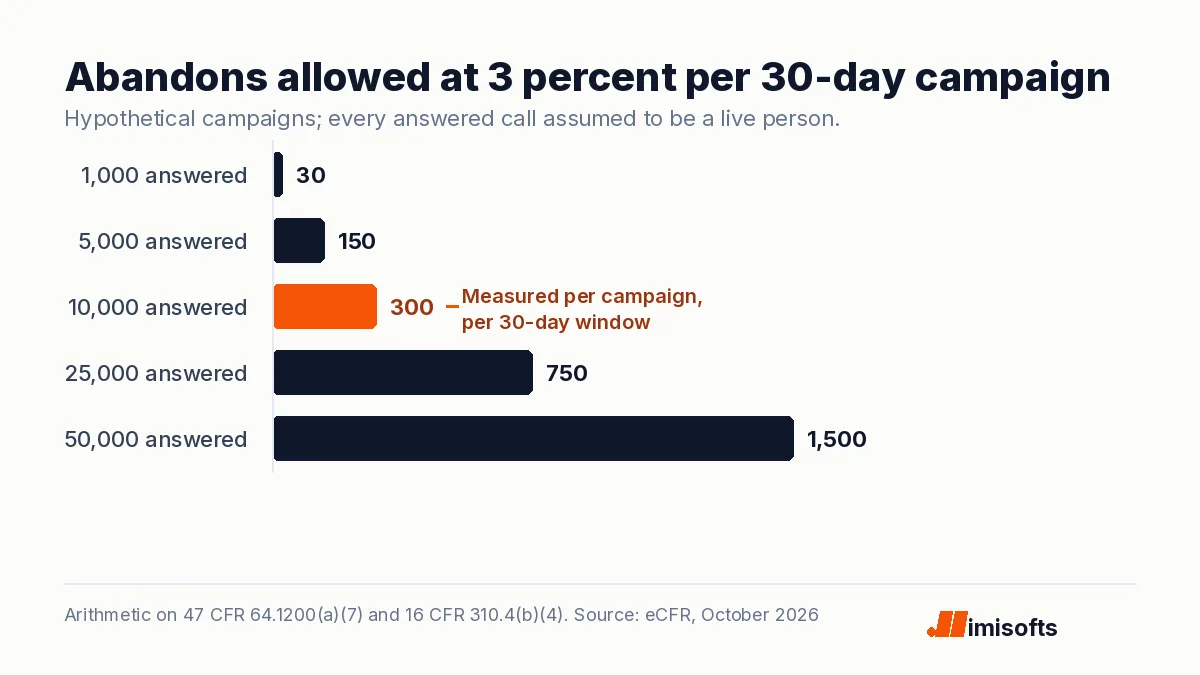
Three percent sounds like a margin. In a campaign it is a hard budget that a predictive dialer spends for you, and the arithmetic is simple: 3 percent of the calls answered live. The figures below are hypothetical and assume every answered call is a live person.
| Calls answered live in a 30-day campaign | Abandons allowed at 3 percent |
|---|---|
| 1,000 | 30 |
| 5,000 | 150 |
| 10,000 | 300 |
| 25,000 | 750 |
| 50,000 | 1,500 |
A dialer set to an aggressive pacing ratio can burn 30 abandons in a morning. The 30-day window helps and hurts: a bad Monday can be diluted by a quiet month, but under the TSR's text a campaign shorter than 30 days is measured over its own duration, and the FCC rule's "portion thereof" reads the same way to us. Keep the campaign definition in writing, because the rule measures "a single calling campaign" and a regulator or plaintiff will ask what yours was.
Where an AI voice agent fits
The definition turns on a "live sales representative." On our reading an AI agent is not one, and its speech is an artificial voice for the purposes of paragraph (a)(7)(ii), which handles the gap: a telemarketing call that "delivers an artificial or prerecorded voice message" to a residential line or to the other lines and numbers listed in paragraphs (a)(1)(i) through (iii) "after the subscriber to such line has granted prior express written consent for the call to be made shall not be considered an abandoned call if the message begins within two (2) seconds of the called person's completed greeting."
So, on our reading, the compliance question for an AI dialer is not abandonment. It is consent. With prior express written consent on file, an agent that begins speaking within two seconds of the greeting is not counted as an abandoned call under (a)(7)(ii); the rest of 64.1200 still applies to it. Without that consent, the call is an artificial-voice telemarketing call that the rest of 64.1200 restricts, and the abandonment math never gets a chance to save it. We set out the two-second opening in is AI cold calling legal and the opt-out mechanics in TCPA opt-out requirements.
The practical settings we would ask any vendor to show you:
- Time to first word. Measure from the end of the called person's greeting to the agent's first syllable, not from connect. Two seconds is the whole budget.
- Consent gate before dial. The agent should not be allowed to dial a number without a stored consent record attached to it.
- A fallback message. If the agent cannot start, the dialer must play the identification and opt-out message and offer the voice or key-press opt-out, exactly as (a)(7)(i) requires for a human campaign.
- Campaign-level reporting. Answered-live count, abandoned count, the ratio, and the ring-time setting, exported per 30-day window, because both rules ask you to keep records.
What the TCPA's private remedies look like
The TCPA gives private plaintiffs "$500 in damages for each such violation" of section 227(b) or its regulations, which a court may raise to three times that amount for a willful or knowing violation, under 47 U.S.C. 227(b)(3). The FCC can also impose forfeitures. On the FTC side, the warning letters the agency sent to healthcare lead generators on 29 October 2026 put the civil penalty for violating the Telemarketing Sales Rule at "up to $53,088 per violation," with "each unlawful call" able to count as a separate violation, in the letter's own words. Which private remedy attaches to an abandonment breach depends on the facts and the court; what does not vary is that the records in (a)(7)(iii) are what you will be asked for first.
If you want outbound AI calls built with a consent gate, a two-second start and campaign-level abandonment reporting, see AI calling built around TCPA consent. For inbound demand, our AI call answering agent is inbound only, so the abandonment rule does not arise. Vendors are compared in best AI voice agents, and the AI answering service for HVAC comparison shows the inbound side. This is general information, not legal advice.
Frequently Asked Questions
Under 47 CFR 64.1200(a)(7) a telemarketer may abandon no more than 3 percent of calls that a person answers live, measured over a 30-day period for a single campaign. A call is abandoned when no live sales representative is connected within two seconds of the person's completed greeting.
When no live sales representative is connected within two seconds of the greeting, the dialer must provide a recorded message that says the call was for telemarketing purposes, names the business it was placed for and gives a telephone number for do-not-call requests, and it must offer an automated voice or key-press opt-out that adds the number to the do-not-call list and ends the call.
The FTC's Telemarketing Sales Rule exempts most calls between a telemarketer and a business in 16 CFR 310.6(b)(7). The FCC rule in 64.1200(a)(7) speaks of telemarketing calls answered live by a person and, as we read it, carries no such exemption, so we suggest applying one abandonment standard to every list.
The TSR safe harbor in 16 CFR 310.4(b)(4)(ii) is available only if the telephone rings for at least 15 seconds or four rings before an unanswered call is disconnected. Paragraph (a)(7) of the FCC rule states no ring time.
On our reading, not when the person gave prior express written consent and the agent begins speaking within two seconds of their greeting, because 64.1200(a)(7)(ii) says such an artificial or prerecorded voice call is not considered abandoned. Without that consent the call is an artificial-voice telemarketing call with its own restrictions.
Both rules require records establishing compliance: 47 CFR 64.1200(a)(7)(iii) for the FCC rule and 16 CFR 310.4(b)(4)(iv) for the TSR safe harbor. In practice we would keep answered-live counts, abandoned counts, the ratio per 30-day window and the ring-time setting, per campaign.