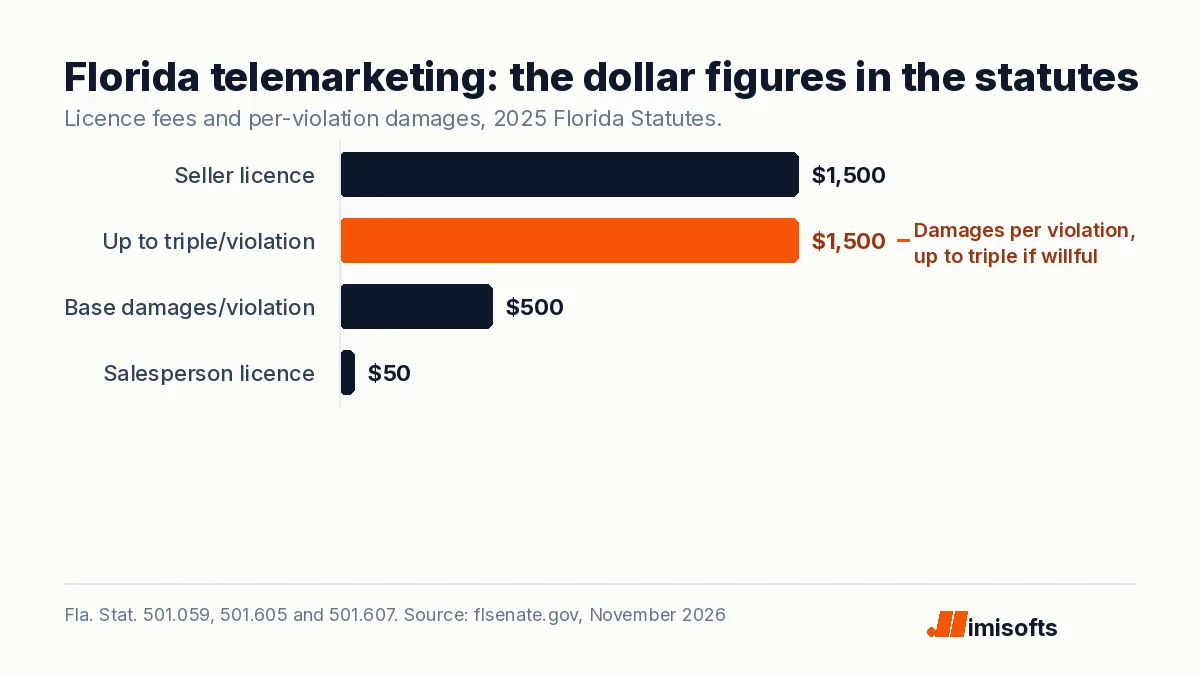
November 2, 2026. Florida runs two telemarketing statutes at once, and a sales team calling or texting into the state has to satisfy both. The Florida Telephone Solicitation Act, section 501.059 of the Florida Statutes, bans unsolicited sales calls to numbers on the state's "no sales solicitation calls" list, requires prior express written consent before an unsolicited consumer sales call uses an automated system to select and dial numbers or plays a recorded message, and gives the called party a private right to actual damages or $500 per violation, whichever is greater, which a court may raise up to threefold if the violation was willful or knowing. The Florida Telemarketing Act, in part IV of the same chapter, requires commercial telephone sellers to hold a $1,500 licence from the Department of Agriculture and Consumer Services, plus $50 per salesperson, and limits solicitation calls to 8 a.m. to 8 p.m. in the called person's time zone and three calls per 24 hours on the same subject. Under the current text, a text message plaintiff has to reply "STOP" first and can sue only if texts continue more than 15 days later, and only the regular user of the number can sue. Below, every rule as the 2025 statute text states it, what counts as a sales call, and what a business-to-business caller can and cannot skip.
Key numbers
| Item | Number |
|---|---|
| Calling window, called person's time zone (501.616(6)(a)) | 8 a.m. to 8 p.m. |
| Calls to one person in 24 hours on the same subject (501.616(6)(b)) | 3 |
| Statutory damages per violation (actual damages if greater) | $500 |
| Possible award per violation if willful or knowing (up to three times $500, at the court's discretion) | $1,500 |
| Commercial telephone seller licence fee (501.605, FDACS) | $1,500 |
| Salesperson licence fee (per salesperson, 501.607) | $50 |
| Cure period after a STOP text before a lawsuit (texts only, 501.059(10)(c)) | 15 days |
| Years of operation for the B2B licensing exemption (plus 50 percent repeat B2B sales) | 3 |
Florida Statutes 2025, sections 501.059, 501.604, 501.605, 501.607 and 501.616, read on flsenate.gov on 2 November 2026.
What section 501.059 covers
The Act defines a "telephonic sales call" as "a telephone call, text message, or voicemail transmission to a consumer for the purpose of soliciting a sale of any consumer goods or services, soliciting an extension of credit for consumer goods or services, or obtaining information that will or may be used for the direct solicitation of a sale of consumer goods or services or an extension of credit for such purposes." Three things in that sentence set the scope. Texts and voicemail drops count as calls. "Consumer goods or services" means property "normally used for personal, family, or household purposes." And a call made only to gather information for a later pitch is already a sales call. A "telephone solicitor" is any person or firm "doing business in this state," which the statute defines to include calls made "from other states or nations to consumers located in Florida."
A call is "unsolicited" unless it is made in response to an express request, primarily in connection with an existing debt or contract still being performed, or "to a person with whom the telephone solicitor has a prior or existing business relationship." The definition adds a fourth carve-out for newspaper publishers, and subsection (4) exempts real estate licensees under chapter 475 calling a property seller or lessor in response to a yard sign or advertisement.
The seven operating rules
- Identify yourself at once. On any unsolicited sales call to a residential, mobile or paging number, the caller must give "his or her true first and last names and the business on whose behalf he or she is soliciting immediately upon making contact." Subsection (2).
- Scrub against the state list. Subsection (4) bans unsolicited sales calls to any residential, mobile or paging number that "appears in the then-current quarterly listing published by the department." The Department of Agriculture and Consumer Services sells the list to solicitors for a fee, and it folds in the Florida numbers from the FTC's national registry, so a national scrub is not enough on its own.
- Honour company-specific requests. Subsection (5) says a solicitor "may not initiate an outbound telephone call, text message, or voicemail transmission to a consumer, business, or donor or potential donor who has previously communicated" that they do not want contact from or on behalf of that seller. Note the word "business": this is the one rule in 501.059 that names businesses as protected recipients.
- Get written consent before automation. Subsection (8)(a): no unsolicited sales call "if such call involves an automated system for the selection and dialing of telephone numbers or the playing of a recorded message when a connection is completed to a number called without the prior express written consent of the called party." The consent must be signed, clearly authorize automated or recorded sales calls to a named number, and disclose that signing authorizes them and is not a condition of purchase. The statute's definition of "signature" includes "checking a box indicating consent or responding affirmatively to receiving text messages."
- Send real caller ID. Subsection (8)(b) makes it unlawful to fail to transmit "the originating telephone number and, when made available by the telephone solicitor's carrier, the name of the telephone solicitor." Substituting the seller's name and its customer service number is allowed, but that number must be one "answered during regular business hours," the solicitor "must ensure that telephone number is capable of receiving telephone calls," and it must connect the recipient back to the solicitor or seller.
- Do not disguise the voice. Subsection (8)(c) bans intentionally altering the caller's voice to conceal identity "in order to defraud, confuse, or financially or otherwise injure the recipient."
- Assume Florida area codes are Florida residents. Subsection (8)(d): "There is a rebuttable presumption that a telephonic sales call made to any area code in this state is made to a Florida resident or to a person in this state at the time of the call." A dialer that keys hours and consent to the person's billing address, not the area code, carries the burden of rebutting that.
Contracts made on the phone
Subsection (6) says a contract made during a telephonic sales call "is not valid and enforceable against a consumer" unless it is reduced to writing, signed by the consumer, and contains the sentence "You are not obligated to pay any money unless you sign this contract and return it to the seller." Subsection (7) adds that a merchant using a telephone solicitor may not charge the consumer's card or take an electronic transfer until it has the signed contract back, with exceptions that include a seven-day full refund right. A software company closing an annual plan on an outbound call to a Florida household is inside these rules; the same call to a company buying for its own use is outside the consumer definition.
Penalties and the private right of action
| Who enforces | What they can seek | Statute |
|---|---|---|
| Department of Agriculture and Consumer Services or Department of Legal Affairs | Civil penalty "in the Class IV category pursuant to s. 570.971 for each violation" plus an injunction, or an administrative fine in the Class III category per act | 501.059(9) |
| The called party | An injunction; "actual damages or $500, whichever is greater"; up to three times that amount if the violation was willful or knowing | 501.059(10) |
| Prevailing party in any resulting civil case | Reasonable attorney fees and costs from the losing side, after judgment and appeals | 501.059(11) |
The current text narrows the private action in two ways. Only the "called party," defined as "the regular user of the telephone number that receives a telephonic sales call," can sue. And for text messages, subsection (10)(c) requires the recipient to reply "STOP" first; the solicitor then has 15 days to stop, may send one confirmation text, and can be sued only if texts keep arriving after those 15 days. There is no equivalent cure period for voice calls.
Hours, frequency and licensing under the Telemarketing Act
The second statute, section 501.616, sets the operating limits. A commercial telephone seller or salesperson may not make a solicitation call "before 8 a.m. or after 8 p.m. local time in the called person's time zone," and may not make "more than three commercial telephone solicitation phone calls from any number to a person over a 24-hour period on the same subject matter or issue, regardless of the phone number used to make the call." Both limits apply to "calls made through automated dialing or recorded messages." Subsection (7) adds a caller ID rule with teeth: using technology that "deliberately displays a different caller identification number than the number the call is originating from to conceal the true identity of the caller" is a second-degree misdemeanour.
Licensing is in section 501.605: "Before doing business in this state, a commercial telephone seller ... shall obtain a license from the department," with "A fee for licensing in the amount of $1,500," and section 501.607 adds "$50 per salesperson." Doing business again includes "solicitation from other states or nations of purchasers located in Florida."
What a business-to-business caller can skip, and what it cannot
Section 501.604 lists the exemptions from the Telemarketing Act's licensing scheme. Item (10) exempts a business-to-business sale where the seller "has been lawfully operating continuously for at least 3 years under the same business name and has at least 50 percent of its dollar volume consisting of repeat sales to existing businesses," or where the buyer intends to resell the goods or use them in manufacturing. Item (3) exempts a seller who "does not make the major sales presentation during the telephone solicitation" and closes at a later face-to-face meeting. But the opening words of the section carve two things back in: the exemptions apply "except ss. 501.608 and 501.616(6) and (7)." So the 8 a.m. to 8 p.m. window, the three-calls-in-24-hours cap and the caller ID rules bind every seller, licensed or exempt, consumer or business.
On the 501.059 side, the definitions are built around a "consumer" and "consumer goods or services," so a call to a company about software for its own operations is generally outside the no-call list rule and the written-contract rule. The exception is subsection (5), which protects a "business" that has already said no. A practical reading for an outbound team: scrub business numbers against your own do-not-call list, respect Florida hours and frequency on every call, send true caller ID, and treat any Florida area code as a Florida number unless you can prove otherwise. We compare the other states with their own calling windows in telemarketing laws by state.
What changes when the caller is an AI agent
Subsection (8)(a) does not mention artificial intelligence; it is triggered by "an automated system for the selection and dialing of telephone numbers or the playing of a recorded message." An AI voice agent that automatically selects and dials numbers fits the first half, so an unsolicited AI call to a Florida consumer needs prior express written consent in the statute's form. Inbound is different: an agent answering calls the customer placed is not making a telephonic sales call at all. So consent capture comes before any automated sales call to a Florida consumer; see TCPA-compliant AI calling. For the federal layer that sits on top of all of this, see who is liable when a vendor makes the call and how opt-outs must be honoured; for which platforms can enforce hours by area code, see the best AI voice agents in 2026. This is general information, not legal advice.
Frequently Asked Questions
Under section 501.616(6), a commercial telephone seller may not make a solicitation call before 8 a.m. or after 8 p.m. local time in the called person's time zone, and may not make more than three solicitation calls to a person in 24 hours on the same subject. These limits apply to automated and recorded calls as well and bind sellers that are otherwise exempt from licensing.
Yes. A telephonic sales call is defined to include a telephone call, text message or voicemail transmission to a consumer. Under the current text, a text recipient must reply STOP first and can sue only if texts continue more than 15 days later; the solicitor may send one text confirming the notice.
The called party may seek an injunction and actual damages or $500 per violation, whichever is greater. If the court finds the violation was willful or knowing it may increase the award to not more than three times that amount, which is up to $1,500 on the $500 figure. The prevailing party in any resulting civil case also recovers reasonable attorney fees and costs.
Section 501.604(10) exempts business-to-business sales from the Telemarketing Act's licensing scheme where the seller has been lawfully operating continuously for at least three years under the same business name with at least 50 percent of its dollar volume from repeat sales to existing businesses, or where the buyer will resell or use the goods in manufacturing. The hours, frequency and caller ID rules in section 501.616(6) and (7) still apply to exempt sellers.
Section 501.605 sets the licensing fee at $1,500, and section 501.607 adds $50 per salesperson. Doing business in Florida includes soliciting Florida purchasers from other states or countries.
Only with prior express written consent if the call is an unsolicited sales call to a consumer and uses an automated system to select and dial numbers or plays a recorded message, under section 501.059(8)(a). The consent must be signed, clearly authorize automated or recorded sales calls to a named number, and disclose that signing authorizes them and is not a condition of purchase. An agent answering inbound calls is not making a telephonic sales call.