Affiliate disclosure: some links in this article are partner links. If you start a paid plan through them, imisofts may earn a commission at no extra cost to you. We only recommend tools we actually use to run client campaigns.
Short answer. Under federal law, an autodialer (an "automatic telephone dialing system", or ATDS) is equipment with the capacity to store or produce telephone numbers "using a random or sequential number generator" and to dial them. The Supreme Court settled that reading in Facebook v. Duguid on 1 April 2021, and in 2022 the Ninth Circuit held that an autodialer "must generate and dial random or sequential telephone numbers", finding no autodialer where a sequential number generator was alleged only to pick the order in which to text customers who had given their numbers. On that one court's test, a dialer that only calls a saved list does not meet the definition, on our reading, though the test turns on what the system can do. Three things do not turn on the federal ATDS test: the artificial or prerecorded voice rules (AI voices, and on our reading voicemail drops), the do-not-call and abandoned-call rules, and state laws such as Florida's and Oklahoma's, which write their own "automated system" test.
We earn a commission if you buy Close or Apollo through our links; the courts, the FCC and the state legislatures pay us nothing. We read the statutes, opinions and vendor pages linked below on 5 November 2026 (64.1200(a)(6) and (a)(7) on 3 November 2026). This is general information, not legal advice.
Key numbers
| Item | Number |
|---|---|
| Facebook v. Duguid decided (opinion by Justice Sotomayor for eight justices; Alito concurred in the judgment) | 1 April 2021 |
| Federal damages per violation, TCPA 227(b)(3) (or actual loss; up to three times ($1,500) if willful or knowing) | $500 |
| Ninth Circuit list-dialer ruling (Borden) (the generator must produce telephone numbers; a texting case) | 16 November 2022 |
| FCC ruling on AI voices and the voice rules (FCC 24-17, released; AI-generated voices are within them) | 8 February 2024 |
| Florida 501.059 damages (2025 statutes) (or actual damages; up to three times if willful or knowing) | $500 |
| Oklahoma same-subject sales calls in 24 hours (HB 3168 (2022, as enrolled); none before 8 a.m. or after 8 p.m. local time) | 3 at most |
| Cheapest Close plan with the Power Dialer (Growth, billed yearly; $109 monthly) | $99 a user a month |
| Close plan with the Predictive Dialer (Scale, billed yearly; $149 monthly) | $139 a user a month |
| Apollo Advanced Dialer add-on (billed yearly; $149 monthly; on top of a paid plan) | $119 a team a month |
| ATDS mentions in Close and Apollo dialer guides (neither says whether its dialer is an autodialer) | 0 |
Read on 5 November 2026 from the US Code, the Supreme Court opinion, the Ninth Circuit, eCFR, the FCC, the Florida and Oklahoma legislatures, and the Close and Apollo pricing and help pages.
What the TCPA says an autodialer is
The statute, 47 U.S.C. 227(a)(1), defines an automatic telephone dialing system as "equipment which has the capacity" (A) "to store or produce telephone numbers to be called, using a random or sequential number generator; and" (B) "to dial such numbers." The FCC's rule, 47 CFR 64.1200(f)(2), uses nearly the same words: "equipment which has the capacity to store or produce telephone numbers to be called using a random or sequential number generator and to dial such numbers."
- Calls to cell phones. Section 227(b)(1)(A) bars any call "using any automatic telephone dialing system or an artificial or prerecorded voice" to "any telephone number assigned to a ... cellular telephone service" and the other lines it lists, unless the call is for emergency purposes, made "with the prior express consent of the called party", or within its narrow federal-debt exception. For such ATDS or artificial or prerecorded voice calls that include an advertisement or constitute telemarketing, the FCC's 64.1200(a)(2) asks for "the prior express written consent of the called party" (with carve-outs for tax-exempt nonprofits and certain health care messages).
- Multi-line businesses. 64.1200(a)(5) bars using an ATDS "in such a way that two or more telephone lines of a multi-line business are engaged simultaneously".
- Damages. Under 227(b)(3) a person can sue for actual loss or "$500 in damages for each such violation, whichever is greater", and if the violation was willful or knowing a court "may, in its discretion" raise that to not more than three times (up to $1,500 on the $500 figure).
What Facebook v. Duguid decided in 2021
The opinion (No. 19-511) reversed and remanded the decision below (926 F. 3d 1146). Justice Sotomayor wrote for eight justices, and Justice Alito concurred in the judgment. The syllabus sums up the holding: "To qualify as an “automatic telephone dialing system” under the TCPA, a device must have the capacity either to store a telephone number using a random or sequential number generator, or to produce a telephone number using a random or sequential number generator." Applied to Facebook's login notifications: "Because Facebook’s notification system neither stores nor produces numbers “using a random or sequential number generator,” it is not an autodialer."
Two passages matter for sales teams. First, the voice rules: "The statute separately prohibits calls using “an artificial or prerecorded voice” to various types of phone lines, including home phones and cell phones, unless an exception applies. ... Our decision does not affect that prohibition." Second, footnote 7: "an autodialer might use a random number generator to determine the order in which to pick phone numbers from a preproduced list. It would then store those numbers to be dialed at a later time." On our reading, that footnote is the passage someone suing over a list dialer would point to.
List dialers after Duguid: what the Ninth Circuit held
In Borden v. eFinancial (16 November 2022), the plaintiff said eFinancial used a "sequential number generator" to pick the order in which to call customers who had provided their phone numbers. The court disagreed that this was enough: "We hold that an “automatic telephone dialing system” must generate and dial random or sequential telephone numbers under the TCPA’s plain text." It added that Duguid "supports that reading" and that eFinancial "has not used an autodialer".
Three limits on that answer. The case was about text messages to customers who had given their numbers; applying it to calls to prospects is our reading. It is one federal appeals court, and we did not review whether or how other circuits have read footnote 7. And the definition is about capacity ("has the capacity"), so on our reading what a system can do counts, not only how you set it up.
Is a power, predictive or parallel dialer an autodialer?
On our reading, the question is whether the system has the capacity to store or produce numbers using a random or sequential number generator, not how many lines ring at once. How each vendor describes where its dialer gets numbers:
| Dialer | Where the numbers come from (vendor's words) | Says if it is an ATDS? |
|---|---|---|
| Close Power Dialer | "The Dialer will call through a Smart View"; leads "get slotted in at the appropriate spot based on your Smart View’s sort parameter" | No (0 mentions of ATDS, autodialer or TCPA) |
| Close Predictive Dialer | "calls several Leads in a Smart View at the same time and connects you only when a person answers" | No (0 mentions) |
| Apollo parallel dialer | "calls multiple contacts at the same time and connects you to the first person who answers"; only "saved contacts, not net-new prospects" | No (TCPA named once, ATDS 0) |
| Apollo power dialer | "calls one contact at a time in your queue and automatically moves to the next" | No (same page) |
| Nooks (not a partner) | "does not utilize a random or sequential number generator to store or produce numbers for dialing" | Yes: "Nooks is not considered an ATDS" |
Sources: Close Power Dialer, Close Predictive Dialer, Apollo parallel and power dialing, Nooks compliance guide. On the Ninth Circuit's test alone, calling saved contacts in an order you choose is not generating telephone numbers, so on our reading none of these modes is an ATDS as the vendors describe them; other circuits may differ, and we did not review them. That is not a ruling on these products: neither Close nor Apollo says whether its system can generate numbers, and a vendor's own statement, like Nooks', does not bind a court. Apollo does tell users to "seek consent to call prospects if required in your state or country."
Two FCC telemarketing rules do not use the ATDS term at all: do not "Disconnect an unanswered telemarketing call prior to at least 15 seconds or four (4) rings", and do not "Abandon more than three percent of all telemarketing calls that are answered live by a person, as measured over a 30-day period for a single calling campaign". Close's Predictive Dialer plays an abandonment message when no user is free, and Apollo's dialing FAQ puts latency at "approximately three seconds if you use a voicemail drop" and says that without drops "latency is significantly reduced." The two rules are covered in is parallel dialing legal and the TCPA abandonment rate.
What still applies when your dialer is not an ATDS
- AI voices. In FCC 24-17 (released 8 February 2024) the FCC confirmed "that the TCPA’s restrictions on the use of “artificial or prerecorded voice” encompass current AI technologies that generate human voices." On our reading, an AI voice agent therefore needs the consent the voice rules ask for even if its dialer is not an autodialer. See is AI cold calling legal.
- Voicemail drops. Apollo describes its drops as a way "to automatically leave a recorded message" and warns on the same help center: "Voicemail drops may be subject to local laws and regulations governing prerecorded messages. In some regions, you may need prior consent before leaving a prerecorded voicemail message." Close calls its version a "pre-recorded Voicemail Drop", on Growth and Scale (Close calling guide); that guide does not mention consent. On our reading a drop is a recorded message on a call your dialer placed, so 64.1200(a)(2) (cell phones and the other listed lines) and (a)(3) (residential lines) apply to sales drops. Ringless voicemail is covered in is ringless voicemail legal.
- Do-not-call. 64.1200(c)(2) bars telephone solicitations to a residential subscriber on the national registry, with no reference to equipment. Under 47 U.S.C. 227(c)(5), a person who receives more than one such call within any 12-month period "by or on behalf of the same entity" may receive "up to $500 in damages for each such violation". See TCPA opt-out requirements.
State laws that write their own autodialer test
Two examples, quoted from the legislatures' own texts:
- Florida. Section 501.059(8)(a) of the 2025 Florida Statutes bars an unsolicited telephonic sales call that "involves an automated system for the selection and dialing of telephone numbers or the playing of a recorded message when a connection is completed to a number called" without prior express written consent. A telephonic sales call is "a telephone call, text message, or voicemail transmission to a consumer" about goods or services "normally used for personal, family, or household purposes". Damages are "actual damages or $500, whichever is greater", up to three times if willful or knowing. More in our Florida Telephone Solicitation Act guide.
- Oklahoma. The Telephone Solicitation Act of 2022 (HB 3168 as enrolled) bars a commercial telephonic sales call that "involves an automated system for the selection or dialing of telephone numbers or the playing of a recorded message" without prior express written consent. It also bars a commercial telephone seller or salesperson from making commercial telephone solicitation calls before 8 a.m. or after 8 p.m. "local time in the called person's time zone", or "More than three commercial telephone solicitation phone calls from any number to a person over a twenty-four-hour period on the same subject matter or issue", "including calls made through automated dialing or recorded messages". The act's definitions section (775C.2) as enrolled does not define "commercial telephonic sales call", and we did not verify whether it reaches business-to-business calls.
Florida says "selection and dialing"; Oklahoma's 2022 text says "selection or dialing". Neither provision uses the federal generator test. On our reading Oklahoma's wording is the wider, but we did not review court decisions under either statute, and we read Oklahoma's act as enrolled, not as codified today. Both create a "rebuttable presumption" that a sales call to an in-state area code is made to a state resident or to a person in the state at the time of the call. Other states are in telemarketing laws by state.
What the dialers cost, and the number that matters most
| Plan | Dialer features listed | Billed yearly | Billed monthly |
|---|---|---|---|
| Close Growth | Power Dialer, Voicemail Drop | $99 a user a month | $109 |
| Close Scale | adds Predictive Dialer | $139 a user a month | $149 |
| Apollo Advanced Dialer add-on | parallel, power (with voicemail drop), local presence, international | $119 a team a month | $149 |
| Apollo Basic / Professional (needed first) | a paid plan; the page lists "US Dialer (credits apply)" | $49 / $79 a seat a month | $59 / $99 |
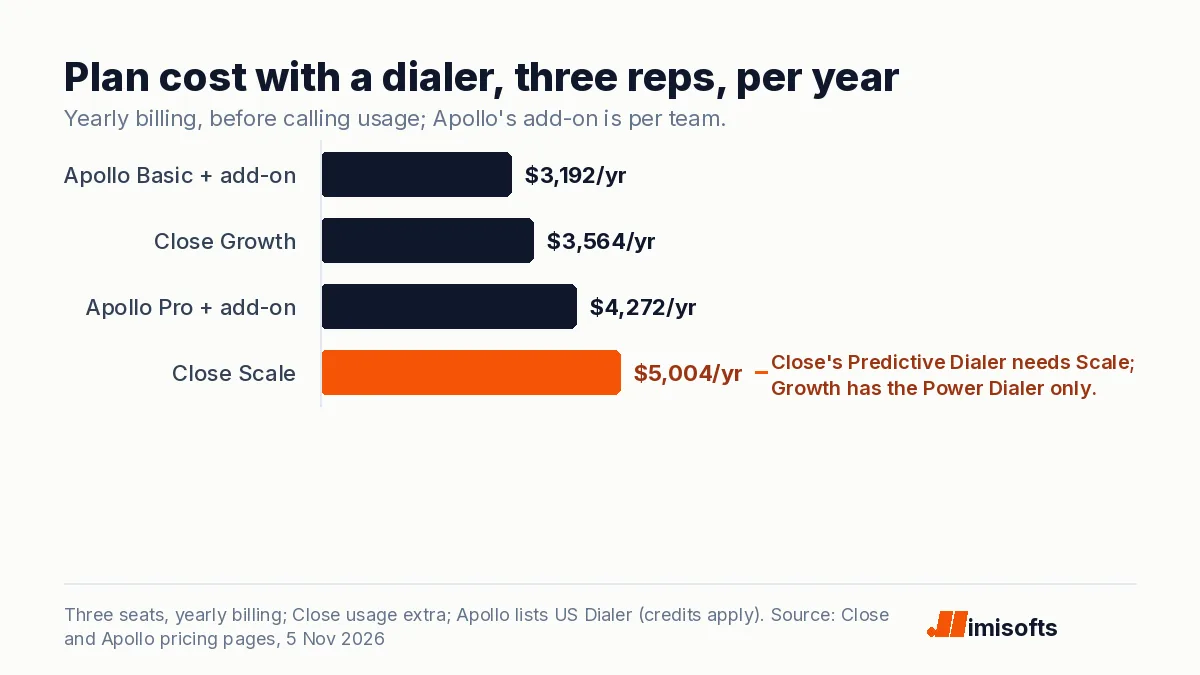
Prices from the Close pricing page and Apollo pricing page on 5 November 2026. Close's Solo and Essentials plans do not include the Power Dialer, and Close says calling usage is extra ("most outbound calls around $0.02/minute"). Apollo's page shows "Introductory pricing" with a note that prices may change. On yearly billing, before calling usage or credits, three reps cost $3,564 a year on Close Growth, $5,004 on Close Scale, $3,192 on Apollo Basic plus the add-on and $4,272 on Apollo Professional plus the add-on. Team size changes the order: one rep costs $1,188 on Close Growth against $2,016 on Apollo Basic plus the add-on, and five reps cost $5,940 against $4,368, because Apollo prices the add-on per team and Close prices per user.
The number that matters most is not on either pricing page: $500 per violation. A hypothetical: if, as we read the rules, a sales voicemail drop is a prerecorded-voice call, 1,000 drops to cell phones without consent could mean $500,000 at $500 a violation, and up to $1,500,000 if a court finds them willful or knowing. Switching dialer modes does not change that; on our reading, only consent you can prove does.
Close's pricing page offers a "14-day free trial"; we did not check which dialer features the trial includes. Start a Close trial (partner link). If you already prospect in Apollo, compare Apollo's dialer add-on (partner link).
A checklist before you switch on a dialer
We suggest:
- Know which numbers on your list are cell phones. 227(b)(1)(A)(iii) covers "any telephone number assigned to a ... cellular telephone service"; on our reading that includes cell phones used for work.
- Dial only lists you built from contacts, and ask your vendor in writing whether the system can generate random or sequential numbers; neither Close's nor Apollo's guides say either way.
- Treat AI voices and voicemail drops as artificial or prerecorded voice calls, and hold the written consent the rules ask for before using them on sales calls.
- Scrub the national registry before every session, and keep your own do-not-call list; check reassigned numbers too (see the reassigned numbers database).
- Check state rules for each area code you call, starting with the Florida and Oklahoma presumptions above.
- Keep consent records and call logs for each campaign (see the TCPA compliance checklist).
If your outbound runs on an AI voice agent instead of reps, on our reading the voice rules matter most, because FCC 24-17 brings AI voices within them whatever the dialer. Our page on AI calling built around TCPA consent describes the consent, suppression and opt-out layer we build under an AI dialer; see also AI calling for home services, the AI voice agents comparison and the HVAC answering service guide. Outside the US, see for example cold calling laws in South Africa.
To see Close's calling tools for yourself, start a Close trial (partner link). This is general information, not legal advice.
Frequently Asked Questions
Under 47 U.S.C. 227(a)(1), an automatic telephone dialing system is equipment with the capacity to store or produce telephone numbers to be called using a random or sequential number generator, and to dial them. The FCC's rule, 47 CFR 64.1200(f)(2), uses nearly the same words. In Facebook v. Duguid (1 April 2021) the Supreme Court held that the generator applies to both storing and producing numbers.
On our reading, not if it only dials a list of contacts you saved and cannot generate numbers. The Ninth Circuit held in Borden v. eFinancial (2022) that an autodialer must generate and dial random or sequential telephone numbers, and found no autodialer where a sequential number generator was alleged only to order texts to customers who had given their numbers. That case was about texts, it is one appeals court, and the test turns on the system's capacity. This is general information, not legal advice.
On our reading, the question is whether the system has the capacity to store or produce numbers using a random or sequential number generator, not how many lines ring at once. Close's Predictive Dialer and Apollo's parallel dialer both call contacts from your own list, and neither vendor's guide says whether it is an ATDS. Other FCC rules apply to telemarketing calls either way: 64.1200(a)(6) on ringing an unanswered call for at least 15 seconds or four rings, and 64.1200(a)(7), which limits abandoned calls to three percent of calls answered live by a person, measured over 30 days per campaign.
Any artificial or prerecorded voice call to a cell phone needs prior express consent under 47 U.S.C. 227(b)(1)(A), with narrow exceptions, and for telemarketing 64.1200(a)(2) and (a)(3) ask for prior express written consent. Duguid said it does not affect the voice prohibition, and FCC 24-17 (February 2024) says the voice restrictions encompass current AI technologies that generate human voices. On our reading voicemail drops count too; Apollo's own page says that in some regions you may need prior consent for them.
Yes. 47 CFR 64.1200(c)(2) bars telephone solicitations to residential subscribers on the national registry and does not mention dialing equipment. Under 47 U.S.C. 227(c)(5), a person who receives more than one such call within any 12-month period by or on behalf of the same entity may receive up to $500 in damages for each violation.
Under 47 U.S.C. 227(b)(3), actual monetary loss or $500 for each violation, whichever is greater, and a court may in its discretion raise that to not more than three times (up to $1,500) if the violation was willful or knowing. Florida's 501.059 also allows actual damages or $500, whichever is greater, and up to three times for willful or knowing violations.