Affiliate disclosure: some links in this article are partner links. If you start a paid plan through them, imisofts may earn a commission at no extra cost to you. We only recommend tools we actually use to run client campaigns.
Short answer. Maryland's Stop the Spam Calls Act, in force since 1 January 2024 and codified mainly at Commercial Law 14-4501 to 14-4503, requires prior express written consent before a telephone solicitation (a sales, prize, poll or sales-survey call) that uses an automated system for "the selection or dialing" of numbers or plays a recorded message. It bars solicitations between 8 p.m. and 8 a.m. in the called party's time zone and more than three to the same person in 24 hours on the same subject, "regardless of the telephone numbers used". The Act's seven exemptions, including one for business-to-business sales, sit in its consent subsection, so on our reading even an exempt caller must keep to the hours and the call cap. A called party who is aggrieved can sue for up to $500 or actual damages, whichever is greater, up to three times that if the violation was willful or knowing; a separate Maryland law, 14-3202, allows $500 per violation plus attorney's fees for breaking the federal telemarketing rules.
We earn a commission if you buy Close or Apollo through our links, and we also sell AI calling services, which compete with Close's AI voice agent; Maryland's legislature pays us nothing. We read every Maryland section below in the General Assembly's own statute database, the bill pages for SB 90 of 2023 and HB 1228 of 2024, the federal rules and the Close and Apollo help pages on 11 November 2026; the Oklahoma comparisons come from our 9 November reading. We did not search case law. This is general information, not legal advice.
Key numbers
| Item | Number |
|---|---|
| Stop the Spam Calls Act in force since (Chapter 413 of 2023 (SB 90); amended by Chapter 214 of 2024) | 1 January 2024 |
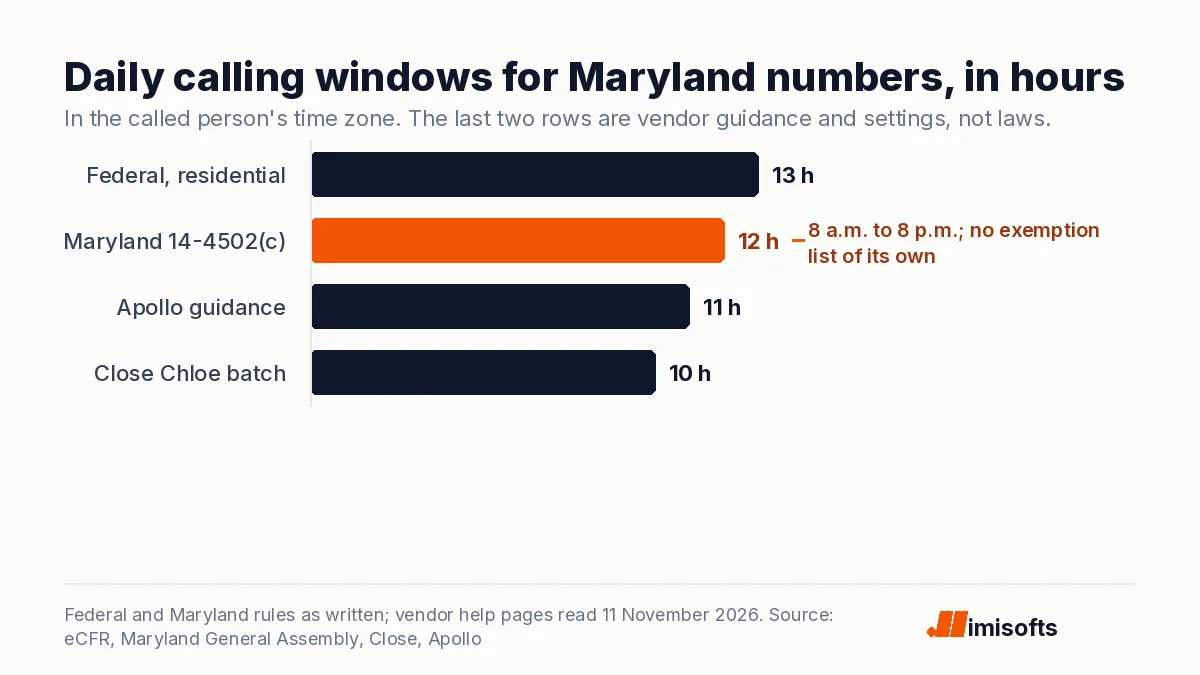
| Solicitation call window, called party's time zone (14-4502(c); federal rule for residential subscribers: 8 a.m. to 9 p.m.) | 8 a.m. to 8 p.m. |
| Same-subject solicitations per person in 24 hours (regardless of the numbers used) | 3 at most |
| Exemptions in 14-4502(a)(1) (they sit in the consent subsection; on our reading they do not lift the hours or call cap) | 7 |
| B2B exemption from Maryland's consent rule (lawful, continuous operation) | At least 3 years under the same name |
| Damages under the Act (14-4503) (whichever is greater; up to 3 times if willful or knowing) | Up to $500 or actual damages |
| Damages for breaking federal rules (14-3202) (or actual damages if greater, plus reasonable attorney's fees) | $500 per violation |
| State civil penalty (13-410) (up to $25,000 per repeat) | Up to $10,000 per violation |
| Recorded message machine must disconnect (8-204) (after either side ends the call) | Within 5 seconds |
| Call recording consent (10-402) (violation: felony, up to 5 years, up to $10,000, or both) | All parties |
| Close Chloe batch call window (contact's time zone; not currently configurable; Workflow and one-off calls not covered) | 8 a.m. to 6 p.m. |
| Apollo's suggested US calling window (guidance with a time zone filter, not an enforced limit) | 9 a.m. to 8 p.m. |
Statutes read on 11 November 2026 in the Maryland General Assembly's statute database; federal rule from eCFR; vendor figures from Close's and Apollo's help pages the same day.
What the Stop the Spam Calls Act requires
The Act is Chapter 413 of 2023 (SB 90, cross-filed with HB 37), approved on 3 May 2023. Section 14-4502 says that "without the prior express written consent of the called party, a person may not make or cause to be made a telephone solicitation that involves" an automated system for the selection or dialing of numbers, or "the playing of a recorded message when a connection is completed to the number called."
Under 14-4501, that consent is a written agreement that bears the called party's signature (electronic signatures count where federal law or Maryland contract law recognizes them), authorizes solicitations "by telephone call, text message, or voicemail" using a dialer, "a recorded or artificial voice message" or a prerecorded voicemail, and names the number to be called. It must disclose clearly and conspicuously that signing authorizes those calls, and that the person is not required to sign it, or to agree to it "as a condition of purchasing any property, goods, or services".
Three more rules in 14-4502 apply to every telephone solicitation, "including a call made through automated dialing or a recorded message":
- Hours. No calls "between 8 p.m. and 8 a.m. in the called party's time zone". The federal rule allows calls to residential subscribers until 9 p.m. under 47 CFR 64.1200(c)(1), so Maryland ends the day an hour earlier.
- Call cap. No more than "three times to the same called party during a 24-hour period on the same subject matter or issue, regardless of the telephone numbers used to make the call." Rotating numbers does not reset the count.
- Caller ID and voice. The caller must transmit the originating number, and its name when the carrier provides it, and may not block it or display a different number to conceal who is calling; showing the seller's name and customer service number instead is allowed. Nor may a caller intentionally alter their voice to disguise their identity in order to defraud, confuse or injure the person, or to obtain personal information for fraudulent or unlawful use.
"Telephone solicitation" takes its meaning from Public Utilities 8-205: "an organized activity, program, or campaign to communicate by telephone with residents of Maryland" in order to sell, lease or rent goods or services, offer a gift or prize, conduct a poll, or request survey information that will be used directly to sell. Government units are outside that section. Under 14-4503, a call to any Maryland area code is presumed, unless rebutted, to reach someone who lives or has a place of business in the state.
Two points are open. The consent definition names text messages, but the "communicate by telephone" definition does not say whether a text is a solicitation; we would treat marketing texts under all of the Act's rules (see TCPA rules for text messages). And the consent rule names "a recorded message", while the definition covers "a recorded or artificial voice message". The FCC, in a ruling announced on 8 February 2024, treats AI-generated voices as "artificial" under the federal TCPA, so we would get written consent before any AI voice solicitation to a Maryland number. For our own service, see AI calling built around TCPA consent; for tools, see AI voice agents compared.
The exemptions are written for the consent rule
Section 14-4502(a)(1) lists seven exemptions: an isolated transaction; noncommercial religious, charitable, political or educational calls by a nonprofit registered with the Secretary of State and tax-exempt under section 501(c)(3), (4) or (6); "A business-to-business sale where the telephone solicitor has been lawfully operating continuously for at least 3 years under the same business name"; maintenance or repair of goods bought from the seller; a single call answering the customer's own request; an informational call to an existing customer that becomes a solicitation at the customer's request; and noncommercial public opinion research.
The list opens with "This subsection does not apply to", and the subsection is (a), which holds Maryland's written-consent rule. Subsections (b) and (c), which carry the caller ID rules, the 8 p.m. stop and the three-call cap, have no exemption list of their own, apart from (b)(2)'s permission to show the seller's name and number. On our reading, then, a B2B seller that has operated lawfully and continuously for at least three years under one name is free of Maryland's own consent rule only. It still cannot call a Maryland number at 8:30 p.m. or a fourth time within 24 hours on the same subject, and other rules can still require consent: the federal rule in 64.1200(a)(2) asks for prior express written consent before dialer or artificial or prerecorded voice telemarketing calls to numbers that include cellular ones, and Public Utilities 8-204 (below) covers recorded sales messages.
Oklahoma took the other route: its 26 exemptions apply "from this act", as we covered in the Oklahoma Telephone Solicitation Act guide. We know of no Maryland court decision on this point and did not search for one. The public opinion research exemption was added by Chapter 214 of 2024 (HB 1228), an emergency bill approved on 25 April 2024 and effective on enactment. Under 14-4503(d), the Act's requirements and remedies cannot be waived by agreement "except as provided in" the consent rule, or as part of a settlement of a legal dispute.
Who can sue in Maryland, and for how much
Under 14-4503, a violation of the Act is an unfair, abusive or deceptive trade practice, enforced under the Maryland Consumer Protection Act, per the SB 90 bill page. A called party "who is aggrieved" may sue "in accordance with § 13-408" to stop further violations and "to recover damages up to $500 or actual damages, whichever is greater", and a court that finds a willful or knowing violation may award "up to three times" that, so up to $1,500 where the $500 figure applies. Section 13-408 lets a person who is awarded damages ask for reasonable attorney's fees, which on our reading reaches these suits too, and lets a court order fees against a party who sues in bad faith or frivolously. The Act does not say whether the $500 is per call. HB 1228's synopsis credits the 2024 law with authorizing this suit.
A separate Maryland law reaches further. Under Commercial Law 14-3201, a person "may not violate" the FTC's Telemarketing Sales Rule (16 CFR Part 310) or the FCC's telemarketing rules (47 CFR Part 64, Subpart L). Under 14-3202, an individual affected by a violation can recover reasonable attorney's fees and the greater of "$500 for each violation" or actual damages, and "each prohibited telephone solicitation and each prohibited practice during a telephone solicitation is a separate violation." The federal do not call claim in 47 U.S.C. 227(c)(5) needs "more than one telephone call within any 12-month period" and allows a due-care defense; on its text, 14-3202 states no such call minimum and no such defense, and we did not check how Maryland courts apply it. In a hypothetical case where one person receives three telephone solicitations that each break an FCC rule, the text counts three violations: $1,500 at the $500 figure, plus fees.
The state can act too. Under 13-410, a merchant faces a civil penalty of up to $10,000 for each violation and up to $25,000 for each repeat of the same violation, and 13-411 makes a violation a misdemeanor with a fine of up to $1,000, up to a year in prison, or both, unless another criminal penalty applies.
| Maryland law | Who acts | Amount |
|---|---|---|
| Stop the Spam Calls Act, 14-4503 | Aggrieved called party | Up to $500 or actual damages, whichever is greater; up to 3 times if willful or knowing |
| 14-3202 (breach of federal rules) | Affected individual | $500 per violation or actual damages, whichever is greater, plus reasonable attorney's fees |
| Consumer protection, 13-410 | The state | Up to $10,000 per violation; up to $25,000 per repeat |
| Consumer protection, 13-411 | Criminal case | Misdemeanor: up to $1,000, up to 1 year, or both |
| Public Utilities 8-204 and 8-205 | Criminal case | Misdemeanor: up to $1,000 first offense, up to $5,000 each after |
For deadlines on federal claims, see the TCPA statute of limitations.
Does Maryland have a do not call list?
None of the Maryland sections we read creates a state do not call registry or a fee to access one, and we did not check the Attorney General's pages. What they do instead: 14-3201 makes a breach of the FCC's telemarketing rules a Maryland violation, and those rules bar telephone solicitations to residential subscribers registered on the national do not call registry, subject to the rule's exceptions (64.1200(c)(2)). So at minimum, scrub the national registry; calling a registered number in breach of the federal rule can, on the text of 14-3202, be sued on under Maryland law at $500 per violation plus fees. Oklahoma, by contrast, sells telemarketers access to its own list for $600 a year (see the Oklahoma guide). For the national list's price, see do not call registry cost, and for numbers that change hands, the reassigned numbers database.
Robocalls, caller ID and recording: other Maryland rules
Three more laws still apply, and 14-4503(c) says the Act "does not preclude" the first two:
- Prerecorded solicitations. Public Utilities 8-204 bars using an automated dialing system "with a prerecorded message" to sell, offer a gift or prize, conduct a poll, or request survey information used to sell, unless the caller has a preexisting business relationship with, or the consent of, the person called. The machine must disconnect "within 5 seconds" after either side ends the call. Because the Act asks for written consent before a recorded-message solicitation, we would treat written consent as the bar.
- Caller ID blocking. Under 8-205(c), if your equipment lets you choose, you may not intentionally block your number. See local presence dialing for the federal caller ID rules. Each of these two is a misdemeanor with a fine of up to $1,000 for a first offense and up to $5,000 for each one after.
- Recording. Courts and Judicial Proceedings 10-402 makes it unlawful to willfully intercept a call, and its exception for a person who is a party to the call requires that "all of the parties to the communication have given prior consent". A violation is a felony with up to 5 years in prison, a fine of up to $10,000, or both. See call recording laws by state.
Phone sales to consumers need a signed contract
Under Commercial Law 14-2201 to 14-2205, when a merchant starts the call and makes a sale "entirely by telephone" to a consumer in Maryland, the contract "is not valid and enforceable against a consumer" unless it is in writing, signed by the consumer, states the seller's address and phone number, the total price and a detailed description, and carries, in at least 12 point type above the signature: "You are not obligated to pay any money unless you sign this contract and return it to the seller." The merchant may not charge the consumer's credit account before it receives the signed copy. The rule covers purchases "primarily for personal, household, family, or agricultural purposes", so most B2B sales fall outside it. Its six exemptions include a previous sale or preexisting business relationship, and a full refund on goods returned within 7 days of receipt, paid within 30 days.
What Close and Apollo do, and do not do, for Maryland rules
Close. Close's AI voice agent, Chloe, places batch calls between 8 a.m. and 6 p.m. in the contact's time zone, every day, a window its FAQ says is "not currently configurable"; contacts with no time zone set are skipped. That sits inside Maryland's 8 a.m. to 8 p.m., but it depends on the contact's time zone field, and the Chloe pages we read describe no per-person or 24-hour call cap. Its compliance page says Workflow and one-off calls "are not subject to the same automatic restriction", that "Close does not verify consent on your behalf", and that Chloe does not automatically check the national registry. Chloe tells every person it calls, at the start, that it is an AI and that the call is being recorded, and Close notes that "some states require all-party consent". Maryland is one; the exception we quote above asks for "prior consent" from all parties, so we would ask for consent rather than rely on a notice.
For human reps, Close's Power Dialer guide says "Continue Calling" will call any lead "that has yet to be called, or has not been reached in the last hour." The guide does not mention time zones, consent or do not call lists, and describes no per-person daily limit, so the three-call cap and the 8 p.m. stop are yours to enforce. The Power Dialer is not on the Solo or Essentials plans; it comes with Growth at $109 per user a month billed monthly, or $99 per user a month billed annually, with calling and SMS billed separately; Close lists a 14-day free trial with no credit card. You can start a Close trial (partner link).
Apollo. Apollo's caller reputation guide says legally permitted US calling hours "generally" mean "between 9 a.m. and 8 p.m." in the contact's local time, and points to its time zone filter. That fits inside Maryland's window, but it is advice and a filter you apply. It says not to "repeatedly call the same contact in a short period" without setting a number. By default it disables call recording in stricter-consent regions, naming Maryland, plays a recording announcement by default when recording is turned on there, and warns that location detection "isn't guaranteed". When enabled, its do not call screening flags Apollo-provided numbers on "certain supported DNC lists" and, in the dialer, customer-provided numbers on supported lists; power and parallel dialing skip flagged numbers, but the feature is "provided for convenience only". You can compare Apollo's plans (partner link).
A Maryland calling checklist
What we suggest for any team calling Maryland numbers:
- Call only from 8 a.m. to 8 p.m. in the called party's time zone, B2B calls included.
- Count same-subject solicitations per person across every number you use, and stop at three in 24 hours.
- Get signed written consent with the 14-4501(d) disclosures before dialer, recorded or AI voice solicitations, unless an exemption clearly fits, and check the federal consent rule even then.
- Show your own number or the seller's customer service number, never a blocked or false one.
- Scrub the national do not call registry; a breach of the FCC's or FTC's telemarketing rules is also a Maryland violation under 14-3201.
- Get every party's consent before recording a call.
- For consumer sales closed by phone, send a written contract with the 12 point statement and wait for the signed copy before charging a card.
The TCPA compliance checklist covers the federal side. Close's Chloe compliance page suggests Custom Fields to track consent status, date and method, and Smart Views to filter lists to consented contacts before a batch call; if you run Close, you can try it free for 14 days (partner link) and set those up first.
Compare the Florida Telephone Solicitation Act, the summary in telemarketing laws by state and how state laws word the dialer test in our autodialer guide. For calls abroad, start with cold calling laws by country and South Africa's POPIA rules.
Frequently Asked Questions
It is Chapter 413 of 2023, codified mainly at Commercial Law 14-4501 to 14-4503 and in force since 1 January 2024. It requires prior express written consent before telephone solicitations that use an automated system for the selection or dialing of numbers or a recorded message, bars calls between 8 p.m. and 8 a.m. in the called party's time zone, caps same-subject calls at three per person in 24 hours from any number, and bars displaying a different number to conceal who is calling. A 2024 amendment added a public opinion research exemption and, per its synopsis, the called party's right to sue.
From 8 a.m. to 8 p.m. in the called party's time zone, under Commercial Law 14-4502(c). That is an hour shorter than the federal 8 a.m. to 9 p.m. window for residential subscribers. On our reading the hours apply even to callers exempt from Maryland's consent rule, including B2B sellers, because the exemptions sit in the consent subsection.
None of the Maryland laws we read creates one, and we did not check the Attorney General's pages. Commercial Law 14-3201 makes it a Maryland violation to break the federal telemarketing rules, which include the national do not call registry, so scrub that list at minimum. Under 14-3202, an individual affected can recover $500 per violation or actual damages, whichever is greater, plus reasonable attorney's fees.
Under the Stop the Spam Calls Act, up to $500 or actual damages, whichever is greater, and up to three times that for willful or knowing violations, so up to $1,500 where the $500 figure applies. Under 14-3202, a breach of the federal rules allows $500 per violation or actual damages, whichever is greater, plus attorney's fees, and each prohibited telephone solicitation is a separate violation. The state can also seek up to $10,000 per violation.
Partly. A B2B sale is exempt from Maryland's written-consent rule if the caller has been lawfully operating continuously for at least 3 years under the same business name. On our reading that exemption does not reach the 8 a.m. to 8 p.m. hours, the three-call cap or the caller ID rules, and federal consent rules can still apply. Maryland's signed-contract rule for phone sales covers consumer and agricultural purchases, not most B2B sales.
Yes, on the statute's text. Courts and Judicial Proceedings 10-402 makes it unlawful to willfully intercept a call, and the exception for a party to the call requires that all parties have given prior consent. A violation is a felony with up to 5 years in prison, a fine of up to $10,000, or both.