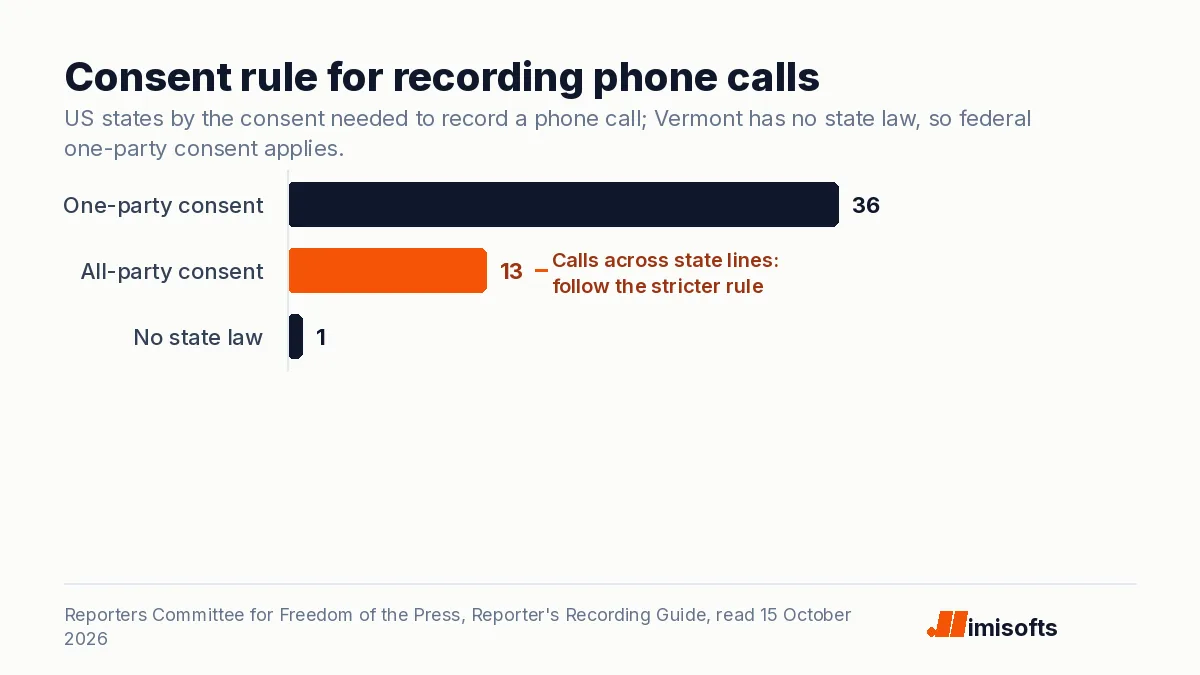
October 15, 2026. By the count of the Reporters Committee for Freedom of the Press, 13 US states require the consent of everyone on a phone call before it is recorded: California, Connecticut, Delaware, Florida, Illinois, Maryland, Massachusetts, Michigan, Montana, Nevada, New Hampshire, Pennsylvania and Washington, with Michigan's rule confirmed at least for recordings by someone outside the conversation. Federal law and the other states need only one party's consent, and Vermont has no state law at all. In California a recording made without the required consent can cost $5,000 per violation in a civil suit. For any business that records calls, and especially one using an AI receptionist or an AI notetaker, the safe default is a clear recording notice at the start of every call. We build AI call answering for home services and other businesses, so this guide covers the state rules, a sample disclosure line, and the newer risk that AI vendors themselves can be treated as eavesdroppers.
The state-by-state summary comes from the Reporters Committee for Freedom of the Press's Reporter's Recording Guide, which reviews every state's recording law, with California details from its California chapter, read 15 October 2026. Recording laws carry criminal penalties and private lawsuits, so treat this as a map, not legal advice.
Key numbers
| Item | Number |
|---|---|
| States requiring all-party consent for phone calls (Michigan at least for third-party recordings) | 13 |
| Federal rule (18 U.S.C. 2511) | one-party consent |
| States with no recording law (federal rule applies) | 1 (Vermont) |
| California civil damages per violation (Penal Code 637.2) | $5,000 or 3x actual damages |
| California criminal fine, first offense (or up to a year in jail) | up to $2,500 |
| California criminal fine, later offenses | up to $10,000 |
| Consent by continuing after a notice (Alexander v. Pathfinder) | generally presumed |
Reporters Committee for Freedom of the Press, Reporter's Recording Guide (introduction and California chapter); Goodwin Procter alert on Ambriz v. Google; all read 15 October 2026.
One-party vs all-party consent
Under a one-party rule, you can record a call you are part of without telling anyone. Federal law, in 18 U.S.C. 2511, sets this as the national minimum, with one exception: a recording made to commit a crime or a tort is unlawful even with one party's consent. States can be stricter, and the all-party states are. They are often called "two-party" states, but the rule covers everyone on the line, including a third person on a conference call.
The states that require everyone's consent
| State | Phone calls | Notes |
|---|---|---|
| California | All parties | Confidential calls under Penal Code 632; any call involving a cell or cordless phone under 632.7, confidential or not |
| Connecticut | All parties | Phone calls only; in-person conversations need one party |
| Delaware | All parties | Listed by RCFP as an all-party state |
| Florida | All parties | |
| Illinois | All parties | |
| Maryland | All parties | |
| Massachusetts | All parties | |
| Michigan | All parties for outsiders | RCFP notes the rule applies at least to recordings by someone not in the conversation |
| Montana | All parties | |
| Nevada | All parties | Phone calls only; in-person conversations need one party |
| New Hampshire | All parties | |
| Pennsylvania | All parties | |
| Washington | All parties |
A few more states have split rules: Missouri and Oregon require all parties' consent for in-person conversations but only one party for phone calls, and Hawaii and Maine require everyone's consent in particularly private places. Vermont has no state recording law, so the federal one-party rule applies there. Everywhere else, one party's consent is enough to record a phone call.
Calls that cross state lines
Calls across state lines are the tricky part. A company in Texas, a one-party state, that records a customer calling from California has to think about California law. The Reporters Committee's advice is to assume the stricter state's law applies, because courts have split on whether the law of the state where the recording is made or where the person being recorded is located governs. For a business that takes calls from anywhere in the country, that means running every call as if it were in an all-party state.
What consent looks like in practice
You do not need a signature. The Reporters Committee notes that when the parties are told a call is being recorded and carry on talking, consent is generally presumed, citing a federal appeals decision, Alexander v. Pathfinder. That is why the familiar line at the start of a support call is the standard approach, and recording a clear verbal yes is safer still. For a business, a good notice:
- Plays at the very start of the call, before any substantive conversation.
- Says plainly that the call is recorded, and if an AI system is answering or transcribing, says that too.
- Gives the caller a choice, such as asking to continue unrecorded or to call back another way.
- Repeats on outbound calls, where the person you call has not chosen to dial a number that announces recording.
For an AI receptionist, a workable opening is: "Hi, you've reached [business]. I'm an AI assistant, and this call is recorded to help us serve you. How can I help?" It covers recording consent and also AI disclosure, which Utah requires when a caller asks and Maine requires whenever a person could mistake the AI for a human; our guide to AI caller disclosure laws by state covers that second rule, and California's AI caller disclosure law has its own guide.
What California can cost you
California's recording law is the California Invasion of Privacy Act. According to the Reporters Committee's California chapter:
- Civil claims: anyone recorded unlawfully can recover $5,000 per violation or three times actual damages, whichever is greater, under Penal Code 637.2, and a court can issue an injunction to stop the violation.
- Criminal penalties: a first offense can bring a fine of up to $2,500 or up to a year in jail; later offenses up to $10,000.
- Cell phones: under section 632.7 the all-party rule applies to calls involving a cell or cordless phone whether or not the conversation is confidential, and the California Supreme Court held in Smith v. LoanMe (2021) that it binds participants, not only eavesdroppers.
Because the civil amount is per violation, and the statute says a plaintiff does not need to show actual damages, the exposure for a business that records thousands of calls without a notice grows with call volume.
The new risk: AI vendors as eavesdroppers
The law firm Goodwin reported in February 2025 that a federal court in Northern California refused to dismiss a lawsuit, Ambriz v. Google, alleging that Google's Contact Center AI acted as an unlawful third-party wiretap on calls between consumers and the businesses using it. The court applied a "capability" test: a vendor whose system is capable of using call data for its own purposes, for example to improve its models, can be treated as a third party listening in. That was a ruling at the pleading stage, not a final judgment, but Goodwin's summary draws the practical lesson: disclose the technology and get the consent of both parties.
For anyone deploying an AI receptionist, voice agent or meeting notetaker, that means the notice should mention that an AI service is involved, and your contract with the vendor should say whether it may use call data to train or improve its models. Where you can, choose settings that keep your call data out of the vendor's training.
Recording checklist for businesses
- Play a recording and AI notice at the start of every inbound and outbound call, regardless of where the caller is.
- Offer a way to continue without recording, or to reach you another way.
- Check your AI vendor's data-use terms and turn off model training on your calls where possible.
- Decide how long you keep recordings and who can access them; our guide to call recording storage costs covers the budget side.
- For healthcare calls, add HIPAA safeguards on top; see our comparison of HIPAA-compliant AI receptionists.
- For outbound AI calls, recording consent is only one rule; the TCPA's consent and calling rules apply as well, which our TCPA-compliant AI calling guide covers.
If you run a trades or service business and want an AI receptionist that plays these notices from the first ring, our HVAC answering service guide shows what a good setup looks like, and our team builds and runs AI call answering with the notices built in.
Frequently Asked Questions
For phone calls, 13 states require the consent of everyone on the call: California, Connecticut, Delaware, Florida, Illinois, Maryland, Massachusetts, Michigan (at least for recordings by someone outside the conversation), Montana, Nevada, New Hampshire, Pennsylvania and Washington. They are often called two-party states, but the rule covers all parties.
Under federal law and in most states, yes, if you are a party to the call and the recording is not made to commit a crime or tort. In the all-party states you need everyone's consent, and because courts are split on calls that cross state lines, the safe course is to get everyone's consent whenever someone on the call may be in an all-party state.
Usually. The Reporters Committee notes that when people are told a call is being recorded and keep talking, consent is generally presumed. The notice should play at the start of the call, before anything substantive is said, and recording a clear verbal yes is safer still.
Courts are split between the law of the state where the recording is made and the state where the recorded person is. The safe approach is to follow the stricter state's rule, which for most businesses means giving a recording notice on every call.
Under the California Invasion of Privacy Act, a person recorded unlawfully can recover $5,000 per violation or three times actual damages, whichever is greater. Criminal penalties include a fine of up to $2,500 or up to a year in jail for a first offense, and fines of up to $10,000 for later offenses.
Yes, if they record calls with people in all-party states, and as a best practice everywhere. A 2025 federal ruling at the pleading stage in Ambriz v. Google also suggests the AI vendor itself can be treated as a third-party listener, so the notice should mention the AI service and you should check the vendor's data-use terms.