The FCC’s Reassigned Numbers Database (RND) is not free. On the RND’s interim price table, read on 2 November 2026, checks cost from $8 for 1,000 a month (0.8 cents each), and one-month blocks run up to $28,000 for 50 million (0.056 cents each). It is the only lookup tied to the TCPA safe harbor for reassigned numbers in 47 CFR 64.1200(m): if you had consent, queried the most recent data with your consent date, got a “no” and called because that “no” was wrong, you are not liable under the FCC’s autodialer and artificial or prerecorded voice consent rules. The burden of proof and persuasion is yours.
The mistake to avoid is treating a phone validation or carrier lookup, which is a commercial database, as that check. In its December 2018 order (FCC 18-177), the FCC wrote: “We also decline to extend the safe harbor to other commercial databases.”
A number that still rings is not proof it still belongs to the person who said yes. The FCC’s database is the check with a safe harbor attached.
Key numbers
| Item | Number |
|---|---|
| Cheapest subscription, Tier 1 for one month (1,000 checks, 0.8 cents each) | $8 |
| Largest one-month block, Tier 10 (50 million checks, 0.056 cents each) | $28,000 |
| Tier 1 for twelve months (12,000 checks) | $86 |
| Twelve-month discount (10% on Tiers 1 to 6, 15% on Tiers 7 to 10) | 10% or 15% |
| FCC price cut on existing tiers, effective (20%, plus two new tiers, 3A and 4A) | 28 April 2025 |
| Top-off when you run short (for 10% more queries) | 10% of the price |
| Statutory damages per violation (or actual loss if greater; a court may treble it if willful or knowing) | $500 |
| No data, no safe harbor, for query dates before (when the number has no disconnect record) | 27 January 2021 |
| Minimum wait before a number is reassigned (up to 90 residential, 365 business) | 45 days |
| Day of the month providers report disconnections (to the RND Administrator) | 15th |
| Numbers disconnected for reassignment a year (FCC estimate, 2018) | About 35 million |
| Numbers in the database (per the undated RND FAQ, read 2 November 2026) | Over 361 million |
Read on 2 November 2026 from the RND interim price table, FAQ and April 2025 pricing notice on reassigned.us, the FCC’s 7 April 2025 release and FCC 18-177 on fcc.gov, 47 CFR 64.1200 and 52.15 on eCFR, and 47 U.S.C. 227 on LII.
What a Reassigned Numbers Database check costs
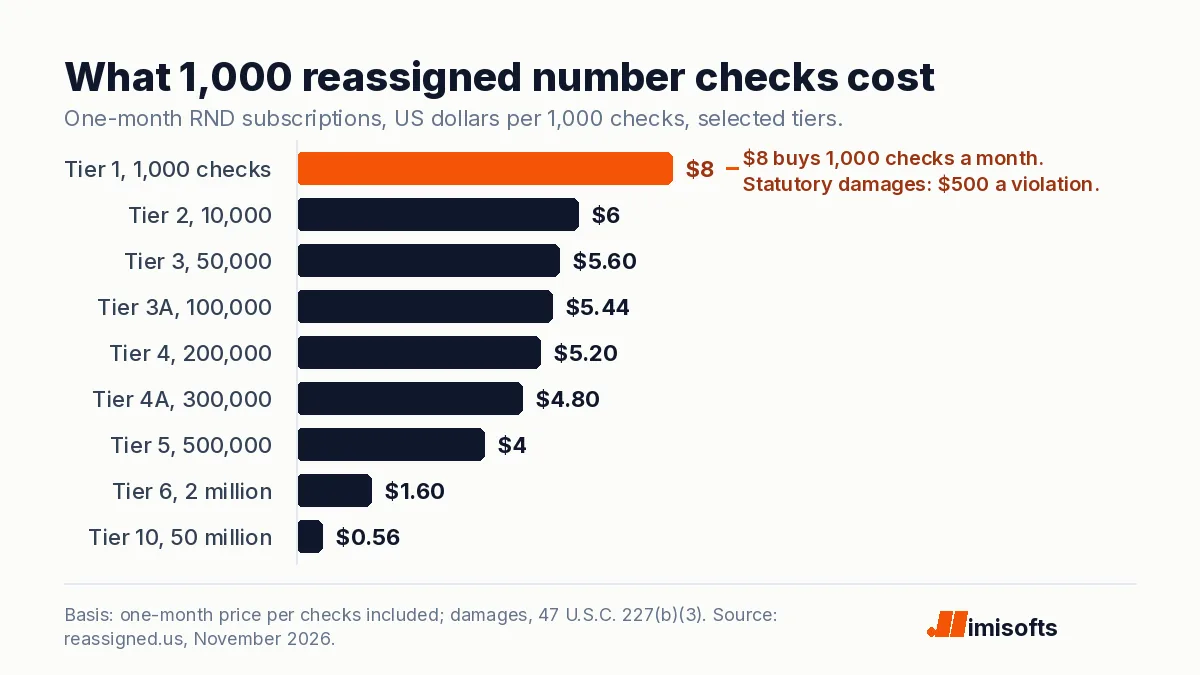
You prepay a flat price for a block of checks (the RND calls them queries) lasting one, three, six or twelve months. Three- and six-month blocks are three and six times the one-month block.
| Tier | Checks in one month | One-month price | Per 1,000 checks (one month) | Twelve months: checks and price |
|---|---|---|---|---|
| Tier 1 | 1,000 | $8 | $8.00 | 12,000 for $86 |
| Tier 2 | 10,000 | $60 | $6.00 | 120,000 for $648 |
| Tier 3 | 50,000 | $280 | $5.60 | 600,000 for $3,024 |
| Tier 3A | 100,000 | $544 | $5.44 | 1,200,000 for $5,875 |
| Tier 4 | 200,000 | $1,040 | $5.20 | 2,400,000 for $11,232 |
| Tier 4A | 300,000 | $1,440 | $4.80 | 3,600,000 for $15,552 |
| Tier 5 | 500,000 | $2,000 | $4.00 | 6,000,000 for $21,600 |
| Tier 6 | 2,000,000 | $3,200 | $1.60 | 24,000,000 for $34,560 |
| Tier 7 | 6,000,000 | $6,400 | $1.07 | 72,000,000 for $65,280 |
| Tier 8 | 10,000,000 | $9,600 | $0.96 | 120,000,000 for $97,920 |
| Tier 9 | 30,000,000 | $19,200 | $0.64 | 360,000,000 for $195,840 |
| Tier 10 | 50,000,000 | $28,000 | $0.56 | 600,000,000 for $285,600 |
Source: the RND price table on reassigned.us, an image, read on 2 November 2026; per-1,000 figures are my arithmetic, rounded to the cent.
The FCC announced “a 20% savings on all existing subscription tiers” from 28 April 2025, plus two new tiers (3A and 4A in the RND’s pricing notice). Twelve-month blocks carry a 10% discount on Tiers 1 to 6 and 15% on Tiers 7 to 10. Run short and you can top off: 10% of the price buys 10% more queries.
What a “no” answer buys you
Under the rule, each query is the number and the date you got consent. The RND’s FAQ also allows “a past date on which you are reasonably certain that the consumer could still be reached at that number,” such as when you last spoke. It answers:
- Yes: permanently disconnected on or after your date. No safe harbor.
- No: not permanently disconnected since then. The safe harbor may apply.
- No data: no disconnect record for the number, and your date is before 27 January 2021, which the FAQ gives as the date all providers had to keep disconnect records. No safe harbor.
Under paragraph (m) you must show, “bearing the burden of proof and persuasion,” that you queried the most recent data, got a “no” and called because that “no” was wrong.
Our carrier lookup says the number is live, so we are covered.
A live number can belong to someone new, and a lookup outside the RND gets no paragraph (m) safe harbor.
“We also decline to extend the safe harbor to other commercial databases.”
The safe harbor covers a wrong “no” from the FCC’s own database, checked at its most recent update.
What the safe harbor does not cover
Paragraph (m) names only the consent rules in paragraphs (a)(1) to (a)(3), for calls made with an autodialer or an artificial or prerecorded voice. In FCC 24-17 (February 2024) the FCC confirmed that “the TCPA’s restrictions on the use of ‘artificial or prerecorded voice’ encompass current AI technologies that generate human voices.” My reading: AI voice calls to numbers you had consent for fall within the rules paragraph (m) names. Outside it:
- Numbers you never had consent for. Paragraph (m) covers only numbers for which you “previously had obtained prior express consent,” so a list that never gave you consent gets nothing (see phone number finder cost).
- The calling-hours and do-not-call rules in paragraphs (c) and (d) (see what the Do Not Call Registry costs) and state laws (telemarketing laws by state).
- A “no data” answer, which comes back for a date before 27 January 2021 when the number has no disconnect record.
- A “yes”: the number was permanently disconnected on or after your date.
The database holds US geographic and toll-free numbers: over 361 million, its undated FAQ said when read on 2 November 2026. Outside the US, see our guides to Canada and South Africa.
How often to check before you dial
In its 2018 order the FCC estimated that “approximately 35 million numbers are disconnected and made available for reassignment to new consumers each year.” Under 47 CFR 52.15, a disconnected residential number waits 45 to 90 days before it can be reassigned, and a business number 45 to 365 days. Providers report disconnections to the Administrator on the 15th of each month.
The FCC refused a three-month window after a check and would not extend the gap between checking and calling “beyond the most recent update to the database.” My reading: a list in a running campaign needs checking again after each monthly provider report.
What a year of checks costs: a worked example
A hypothetical: an AI calling campaign contacts the same 5,000 consented leads each month and checks every number before each send. That is 60,000 checks a year. Twelve monthly Tier 2 blocks cost $720; the twelve-month Tier 2 block, 120,000 checks for $648, is the cheapest single block that covers the year. A list of 800 numbers a month fits the twelve-month Tier 1 block: 12,000 checks for $86.
Under 47 U.S.C. 227(b)(3), a person can sue for actual loss or $500 per violation, whichever is greater, and a court may, in its discretion, raise that up to three times for willful or knowing violations. A year of checks on that 5,000-number list costs less than $1,000, the statutory damages for two violations.
How I would wire it into an AI dialer
I would set it up in four steps:
Store a consent date with every number
The query needs one. Use the opt-in date, or the date you last spoke to the person at that number. A home services company calling back past quote requests would store the consent date and wording from each quote form, if the form captured consent.
Check before every campaign, and after each monthly provider report
Query the list before the first dial, query running lists again after each report on the 15th, and keep the query date and answer with the call record, whichever of the AI voice agent platforms places the call.
Act on the answer
Suppress every “yes” before it reaches the dialer. Treat “no data” as no cover and re-confirm consent first. The same check is worth running before outbound callbacks from an AI answering service for HVAC.
Caller agents: query once per client
The RND’s FAQ says each query “must be made against the respective CompanyID for the client.” Its April 2025 pricing notice says a Caller Agent must provide a Letter of Authorization for each client, approved by the RND Administrator, and that Caller Agent discounts are available for Tiers 6 to 10.
My team has delivered 500+ projects across 30 countries. In the AI calling built around TCPA consent we set up, consent records log when and how each consent was captured, which is the date an RND query asks for.
The bottom line
Store consent dates, check against the most recent data before you dial, keep the answers and suppress every “yes”. The check does not replace consent, the do-not-call rules or state law. I am not a lawyer. This is general information, not legal advice.