November 2, 2026. New York regulates telemarketing through three sections of the General Business Law, and together they add up to one of the most demanding state regimes for an outbound team. Section 399-pp requires anyone acting as a telemarketer to hold a certificate of registration from the Department of State, with a non-refundable $500 fee, a $25,000 bond and a two-year term, before calling customers in New York. Section 399-z sets the operating rules for consumer calls: 8 a.m. to 9 p.m. at the customer's location, five disclosures within 30 seconds of the call starting, a 31-day scrub of the national do-not-call registry, a written and signed agreement before any prerecorded sales call, a ban on sharing a customer's contact details without written consent, and fines of up to $20,000 per violation after a hearing. Section 399-p governs automatic dialing-announcing devices and gives anyone who receives a call breaking its content, random-dialing or emergency-line rules a claim for actual damages or $50, raised up to $1,000 if wilful. Texts count as calls under 399-z. The business-to-business exemption lives in 399-pp and leaves out one odd category: "the retail sale of nondurable office or cleaning supplies." Below is each section as the 2025 statute text reads.
Key numbers
| Item | Number |
|---|---|
| Registration fee, non-refundable (GBL 399-pp(3)(f)) | $500 |
| Bond, letter of credit or certificate of deposit (held three years after ceasing) | $25,000 |
| Registration term (399-pp(3)(d)) | 2 years |
| Calling window at the customer's location (399-z(2)) | 8 a.m. to 9 p.m. |
| Seconds to complete the five opening disclosures (name and seller first) | 30 |
| Days on the national registry before calls must stop (399-z(5)) | 31 |
| Record retention (399-z(11), 399-pp(8)) | 24 months |
| Maximum fine per 399-z violation after a hearing (Secretary of State) | $20,000 |
| Court penalty per 399-pp violation (399-pp(11)(b)) | $1,000 to $2,000 |
| Private robocall claim under 399-p, floor (or actual damages; up to $1,000 if wilful) | $50 |
New York General Business Law sections 399-p, 399-pp and 399-z, 2025 edition as reproduced by Justia, read on 2 November 2026.
Section 399-pp: registration, bond and the B2B exemption
Subdivision 3 of section 399-pp: "No person shall act as a telemarketer without first having received a certificate of registration from the secretary [of state]." Employees of a registered telemarketer are exempt, so the entity registers, not each caller. A "telemarketer" is a person who "initiates, or initiates and receives telephone calls to or from a customer when the customer is in this state," and "telemarketing" involves more than one telephone call. The application asks for every business name, every location, every principal, and any convictions or injunctions. The certificate is valid "for a period of two years from the effective date," and "Each application for a certificate of registration shall be accompanied by a fee of five hundred dollars, which shall not be refundable."
Subdivision 4 adds the security: "The principal sum of the bond, letter of credit, or certificate of deposit shall be twenty-five thousand dollars," maintained for three years after the telemarketer stops telemarketing, or three years from registration termination, whichever is earlier. Subdivision 5 lets the Secretary deny, suspend or revoke a registration, "or in lieu thereof assess a fine not to exceed one thousand dollars per violation."
The exemptions in subdivision 10 are the part a business seller reads first. Exempt from registration and bonding: government bodies, degree-granting colleges, a retailer that has run "a retail business establishment in this state" for at least three years under the same name with most of its business done in store, and not-for-profit and charitable organisations. Exempt from the whole section: debt collection calls under the federal Fair Debt Collection Practices Act; calls where no sale is completed and no payment taken "until after a face-to-face sales presentation"; customer-initiated calls that did not result from a solicitation; and "telephone calls between a telemarketer and any for-profit business, except calls involving the retail sale of nondurable office or cleaning supplies." So a software or services company calling other companies is outside 399-pp, unless it is selling toner and paper towels.
Section 399-z: the rules for consumer calls and texts
Section 399-z is built around a "customer," defined as "any natural person who is a resident of this state," so it governs consumer outreach, and its definition of a "telemarketing sales call" includes "a telephone call or electronic messaging text ... or by any outbound telephone calling technology that delivers a prerecorded message to a customer or to a customer's voicemail." An "unsolicited" call is any call other than one made "in response to an express written or verbal request by the customer" or "in connection with an established business relationship, which has not been terminated by either party," and even that relationship ends for these purposes once the customer says they no longer want the calls.
| Rule | Statute text | Subdivision |
|---|---|---|
| Hours | No telemarketing "at any time other than between 8:00 A.M. and 9:00 P.M. at the location of the customer unless the customer has given their express consent to the call at a different time" | 2 |
| Opening disclosures | Within 30 seconds, the telemarketer's name and the seller it represents and the option to be added to the seller's do-not-call list, both given first, then whether the call is being recorded, the purpose of the call, and the goods or services "for which a fee will be charged" | 2 |
| Caller ID | Unlawful "to knowingly cause any caller identification service to transmit misleading, inaccurate, or false caller identification information"; substituting the seller's name and number is allowed | 2-a |
| Price and negative options | Before purchase, disclose the cost and, for a negative option feature, the dates charges will be submitted and the specific steps to avoid the charge | 3 |
| Do-not-call | No unsolicited call to a customer whose number "has been on the national 'do-not-call' registry ... for a period of thirty-one days prior to the date the call is made" | 5 |
| Emergencies | No knowing unsolicited call "to any person in a county, city, town or village under a declared state of emergency or disaster emergency" | 5-a |
| Prerecorded calls | Only with a written express agreement, not a condition of purchase, naming a specific seller and including "such customer's telephone number and signature"; the call must offer a keypress or voice opt-out that "immediately ends the call" | 6, 7, 8 |
| Live calls | Tell the customer they may ask to join the seller's do-not-call list; if they do, "immediately end the call" and add the number | 9 |
| Data sharing | No transmitting or sharing a customer's name, number or email without the customer's express agreement in writing or electronic format | 10 |
| Records | Keep telemarketing records for 24 months | 11 |
New York uses the FTC's national registry as its state list (subdivision 4(b)), so there is no separate New York list to buy, but the 31-day refresh cycle is written into state law and enforceable by the Department of State. The disclosure rule is also unusual in its ordering: the statute puts the name and seller and the do-not-call option first, before the purpose of the call. A script that opens with the pitch and names the company later is out of order under New York law even if every item is eventually said. Section 399-pp(6)(b) adds its own 30-second list for registered telemarketers, including that the purpose is to offer goods or services for a fee and what they cost.
Penalties and the safe harbour
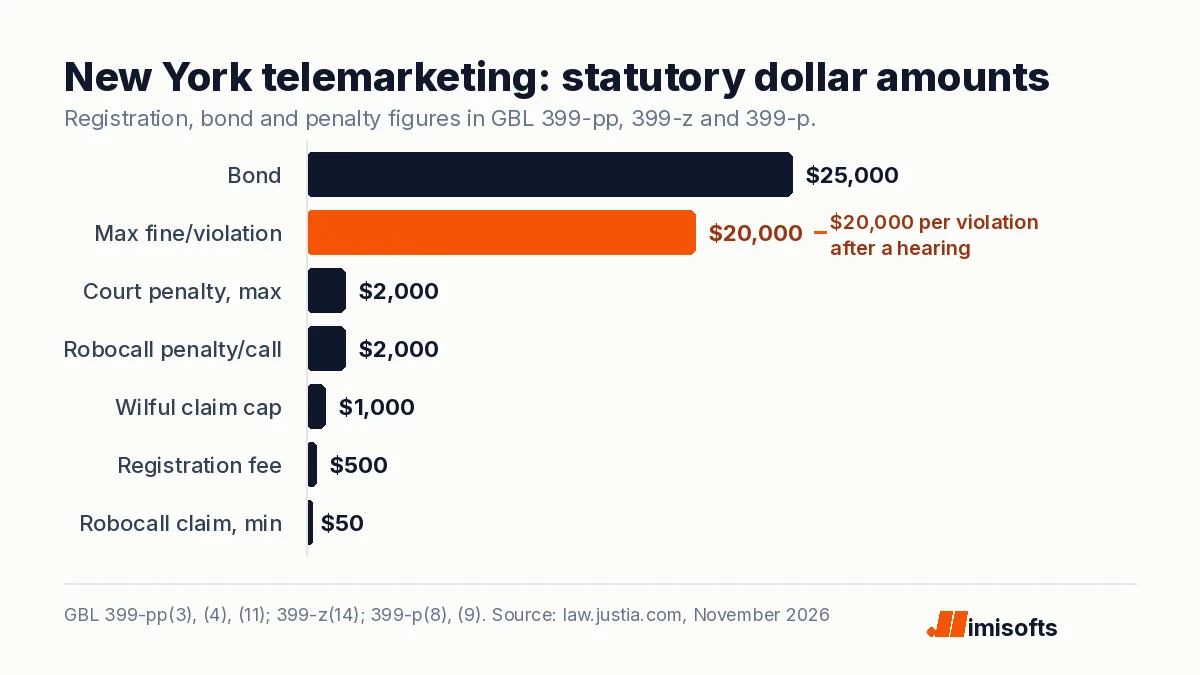
After a hearing, "the secretary ... may assess a fine not to exceed twenty thousand dollars for each violation" of 399-z (subdivision 14). Section 399-pp carries its own court-imposed "civil penalty of not less than one thousand dollars nor more than two thousand dollars for each violation" ($1,000 to $2,000, subdivision 11), and a person who hires a telemarketer with "actual knowledge" of its violations is deemed in violation unless it takes reasonable measures to prevent and correct them. Knowingly acting without registration is a class B misdemeanour (subdivision 12).
Subdivision 15 of 399-z gives a defence: a person is not liable if it obtained the national registry no more than thirty-one days before the call, can show "written policies and procedures" that were "established, implemented and updated," has trained its personnel, and "maintains and can produce records demonstrating compliance." The records half of that sentence matters: a scrub that happened but cannot be evidenced earns no protection.
Section 399-p: robocalls and the $50 private claim
Section 399-p regulates any "automatic dialing-announcing device," defined as equipment that stores numbers and disseminates "a prerecorded message to the telephone number called without the use of an operator," and any "consumer telephone call" for personal, family or household goods. A device must state at the beginning of the call the nature of the call and the name of the person on whose behalf the message is transmitted, give that person's address and telephone number at the end, and disconnect when either party hangs up. Subdivision 4: "No person shall operate an automatic dialing-announcing device which uses a random or sequential number generator to produce a number to be called." Calls to emergency lines, hospitals, nursing homes and law enforcement are banned. Subdivision 6-a bars any solicitor from using "any blocking device or service" to hide its name or number from caller ID.
Enforcement runs two ways. The attorney general can seek an injunction and "a civil penalty of not more than two thousand dollars per call, up to a total of not more than twenty thousand dollars, for calls placed in violation ... within a continuous seventy-two hour period," that is, $2,000 a call and $20,000 per 72 hours. And any person who received a call violating the content, random-dialing or emergency-line rules has a private action for "actual damages or fifty dollars, whichever is greater," which the court may raise "to an amount not to exceed three times the actual damages up to one thousand dollars" for wilful or knowing violations, plus attorney's fees. The New York private claim is small; the regulatory fines are where the money is.
What this means for AI voice and outsourced calling
- Treat outbound AI to consumers as needing the 399-z(6) agreement. A call "by any outbound telephone calling technology that delivers a prerecorded message" is a telemarketing sales call, and subdivision 6 requires a signed written agreement that names the seller before any such call. An AI agent that generates speech on the fly is not literally "prerecorded," but it is "outbound telephone calling technology," and the safer reading is to treat it as covered until a court says otherwise.
- B2B AI calling sits outside 399-pp and mostly outside 399-z. The registration exemption for calls to any for-profit business and the consumer-only definition of "customer" in 399-z mean a company-to-company campaign is governed mainly by federal law, by 399-p's caller ID rule and, for automatic dialing-announcing devices, its content, random-dialing and emergency-line rules. See is AI cold calling legal for the federal side.
- Hiring a vendor does not move the risk. Under 399-pp(11)(c), actual knowledge of a vendor's violations makes the hiring company liable too, unless it takes reasonable measures to prevent and correct them; see TCPA vicarious liability for the federal parallel.
- Build the New York opening into the script. Name and seller and the do-not-call option first, then recording notice, purpose and paid goods or services, all inside 30 seconds.
Our AI calling setup covers state-specific openings, hours and suppression lists, and the best AI voice agents in 2026 compares platforms. For the other states with their own windows and registries, see telemarketing laws by state. This is general information, not legal advice.
Frequently Asked Questions
Under General Business Law 399-pp, no person may act as a telemarketer without a certificate of registration from the Department of State. The fee is $500, non-refundable, the certificate lasts two years, and the applicant must post a $25,000 bond, letter of credit or certificate of deposit. Employees of a registered telemarketer do not register separately.
Section 399-pp(10)(b)(4) exempts telephone calls between a telemarketer and any for-profit business, except calls involving the retail sale of nondurable office or cleaning supplies. Section 399-z applies only to customers who are natural persons resident in New York, so most B2B calls are outside both, though the federal rules, the 399-p caller ID rule and, for automatic dialing-announcing devices, its content, random-dialing and emergency-line rules still apply.
Section 399-z(2) allows telemarketing only between 8:00 A.M. and 9:00 P.M. at the location of the customer, unless the customer has expressly consented to a call at a different time. Section 399-pp(7)(d) repeats the same window for calls to a residence.
The telemarketer's name and the seller it represents, then the option to be added to the seller's do-not-call list, both given first, followed by whether the call is being recorded, the purpose of the call and the goods or services for which a fee will be charged. All five must come within 30 seconds of the call starting.
A prerecorded telemarketing sales call to a New York customer is allowed only with a written express agreement that was not a condition of purchase, names a specific seller and includes the customer's telephone number and signature, and the call must offer an automated opt-out that immediately ends it. Separately, section 399-p bans random or sequential dialing and gives recipients of calls breaking its content, random-dialing or emergency-line rules a claim for actual damages or $50, which a court may raise up to $1,000 for wilful violations.
The Secretary of State may fine up to $20,000 per violation of section 399-z after a hearing. Courts may impose $1,000 to $2,000 per violation of section 399-pp, and the Secretary may fine up to $1,000 per violation in lieu of revoking a registration. The attorney general can seek up to $2,000 per call, capped at $20,000 per 72-hour period, for robocall violations under section 399-p.