November 2, 2026. Texas regulates sales calls through four chapters of the Business and Commerce Code plus a Utilities Code permit, and which apply depends on who is called, from where and how. Chapter 302 of the Business and Commerce Code requires a seller to hold a registration certificate from the Secretary of State for each location it calls from, with a $200 filing fee and $10,000 in security per registration statement, before making "a telephone solicitation from a location in this state or to a purchaser located in this state." For consumer calls to residential numbers, chapter 301 sets the calling window: after 9 a.m. and before 9 p.m. on weekdays and Saturdays, and after noon on Sundays, with the caller's name, company and purpose stated "immediately after making contact." Chapter 304 bans telemarketing calls to numbers on the Texas no-call list more than 60 days after they appear. And chapter 305 lets a person who receives a communication that violates the federal TCPA sue in Texas for the greater of $500 per violation or actual damages, which the court may raise to up to $1,500 per violation if knowing or intentional. Recorded-message dialers need a separate permit from the Public Utility Commission under the Utilities Code, capped at $500. Here is each chapter as the 2024 statute text reads, and where a business-to-business seller fits.
Key numbers
| Item | Number |
|---|---|
| Registration statement filing fee (Bus. and Com. Code 302.106; certificate per location) | $200 |
| Security required with each registration (bond, letter of credit or CD) | $10,000 |
| Weekday and Saturday calling window (301.051(b)(2)) | 9 a.m. to 9 p.m. |
| Sunday calling start (until 9 p.m.) | noon |
| Days after a number joins the no-call list before calls stop (304.052) | 60 |
| Life of a no-call list entry (renewable) | 3 years |
| Damages per violation in a chapter 305 claim (or actual damages; court may raise to up to $1,500) | $500 |
| Civil penalty per chapter 302 violation, maximum (302.302) | $5,000 |
| ADAD permit fee, maximum (renewal up to $100) | $500 |
| ADAD disconnect deadline after either party hangs up (Utilities Code 55.126) | 5 seconds |
Texas Business and Commerce Code chapters 301, 302, 304 and 305 and Utilities Code chapter 55, subchapter F, 2024 edition as reproduced by Justia, read on 2 November 2026.
Chapter 302: registration before the first call
Section 302.101 is the gate: "A seller may not make a telephone solicitation from a location in this state or to a purchaser located in this state unless the seller holds a registration certificate for the business location from which the telephone solicitation is made," and "A separate registration certificate is required for each business location from which a telephone solicitation is made." Section 302.106 fixes the filing fee for a registration statement at $200. Section 302.107 requires the registration statement to be accompanied by security of $10,000 in the form of a surety bond, an irrevocable letter of credit from a federally insured institution, or a certificate of deposit withdrawable only on the Secretary of State's order, "conditioned on the seller's compliance with this chapter."
The reach is wide because either location triggers it: calling from Texas or calling a purchaser in Texas. A firm in another state or country that calls Texans is covered unless an exemption in subchapter B applies, and section 302.051 sets a burden of proof for exemptions. Our hub on telemarketing laws by state covers the other states; the detail below is Texas.
Who is exempt from registration
| Section | Exempt seller or sale |
|---|---|
| 302.053 | Securities sellers; publicly traded corporations registered with the SEC or the State Securities Board; Insurance Code licensees for insurance transactions; supervised financial institutions and their affiliates; businesses regulated by the Public Utility Commission, except as to automated dial announcing devices |
| 302.054 | Media subscriptions, certain merchandise and catalogue sales |
| 302.055 | Educational and nonprofit solicitations |
| 302.057 | Food sales |
| 302.056 | "a sale in which the purchaser is a business that intends to: (1) resell the item purchased; or (2) use the item purchased in a recycling, reuse, remanufacturing, or manufacturing process" |
| 302.058 | Maintenance or repair contracts for items the seller previously sold; a seller "soliciting business from a former or current customer" that "has operated under the same business name for at least two years" |
| 302.059 to 302.061 | Certain sales presentations and established retail locations; solicitation services working predominantly for exempt persons; isolated solicitations |
Read the business exemption carefully. Section 302.056 exempts sales to a business that will resell the item or use it in manufacturing. It does not exempt every business-to-business call. A software subscription, a marketing service or an AI phone agent sold to a Texas company for that company's own use is not a resale and is not manufacturing, so the registration requirement can still apply unless another exemption fits, such as 302.058 for former or current customers of a seller with two years under the same name.
Chapter 301: hours and identification
Section 301.051 applies to a "consumer telephone call," defined in section 301.001 as "an unsolicited call made to a residential telephone number by a telephone solicitor" to sell a consumer good or service, extend credit for one, or gather information for such a sale. A consumer good or service is property "normally used for personal, family, or household purposes." Within that scope, a solicitor may not call unless three conditions hold:
- The solicitor, "immediately after making contact with the consumer," identifies "himself or herself by name," "the business on whose behalf the telephone solicitor is calling," and "the purpose of the call."
- The call is made "after 12 noon and before 9 p.m. on a Sunday or after 9 a.m. and before 9 p.m. on a weekday or a Saturday."
- If an automated dial announcing device is used, it disconnects the line within the period set by section 55.126 of the Utilities Code once either party hangs up.
The section does not apply to calls made at the consumer's express request, calls about an existing debt or contract still being performed, or calls to "a consumer with whom the telephone solicitor has a prior or existing business relationship." Because chapter 301 is built on residential numbers and consumer goods, a true business-to-business call is outside it; the registration chapter, which turns on where the seller or purchaser is located rather than the type of goods, is the one that reaches business sellers.
Chapter 304: the Texas no-call list
The Public Utility Commission maintains the Texas no-call list. Section 304.052: "A telemarketer may not make a telemarketing call to a telephone number published on the Texas no-call list more than 60 days after the date the telephone number appears on the current list." Entries expire on the third anniversary of first publication and can be renewed for successive three-year periods, or are deleted earlier on written request or when the number changes. Consumers pay no more than $3 to register, and nothing online. Section 304.056 covers placing entries on the national Do Not Call registry; we could not confirm the current purchase price of the list for telemarketers today.
Chapter 305: a state-court claim for federal violations
Section 305.053 is the provision that turns federal TCPA violations into Texas lawsuits. "A person who receives a communication that violates 47 U.S.C. Section 227, a regulation adopted under that provision, or Subchapter A may bring an action in this state against the person who originates the communication" for an injunction, damages or both. The plaintiff gets "the greater of: (1) $500 for each violation; or (2) the plaintiff's actual damages," and if the court finds the violation "knowingly or intentionally," it may raise the award "to not more than the greater of: (1) $1,500 for each violation; or (2) three times the plaintiff's actual damages." For how the federal consent and opt-out rules work underneath this, see TCPA opt-out requirements and how long a TCPA claim stays alive.
Recorded messages: the ADAD permit
Recorded-message dialing sits in the Utilities Code, chapter 55, subchapter F. An "automated dial announcing device" is equipment that can store or generate numbers and "convey, alone or in conjunction with other equipment, a prerecorded or synthesized voice message to the number called without the use of a live operator." Section 55.129: "A person may not use an automated dial announcing device to make a telephone call in which the device plays a recorded message when the connection is completed unless the person has a permit under Section 55.130." The original permit fee "may not exceed $500" and renewal "may not exceed $100," per section 55.131. Section 55.125 repeats the calling window for recorded solicitations: not "before noon or after 9 p.m. on a Sunday" or "before 9 a.m. or after 9 p.m. on a weekday or a Saturday." Section 55.127 requires the recording to state, within the first 30 seconds, "the nature of the call," "the identity of the person, company, or organization making the call" and "the telephone number from which the call is made," and section 55.126 requires disconnection "not later than five seconds after the call is terminated by either party." The commission can fine "an amount not to exceed $1,000 for each day or portion of a day during which the device operates in violation."
A "synthesized voice message" delivered "without the use of a live operator" can fit an AI voice agent making outbound calls, so the safe reading is that an AI outbound campaign into Texas with no live operator needs the permit in addition to the federal consent rules. Inbound AI answering is not a telephone solicitation and is outside subchapter F. For how that split works in practice, see TCPA-compliant AI calling; for platforms that let you set hours by state, see the best AI voice agents in 2026.
Penalties for registration violations
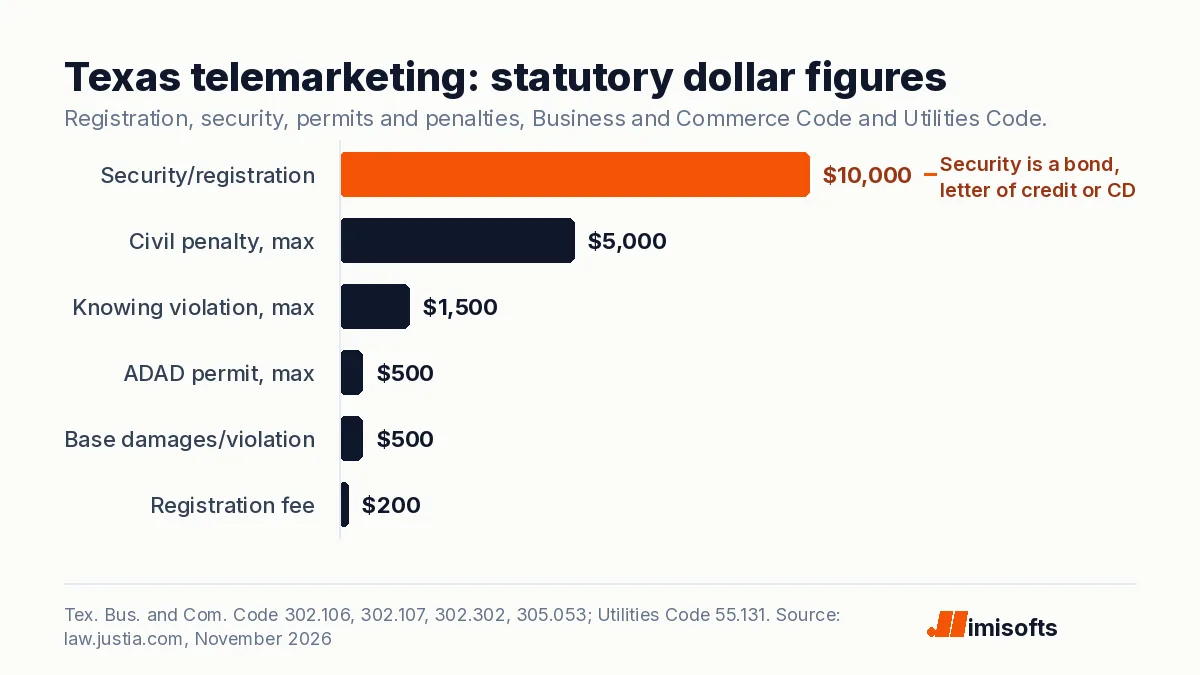
Section 302.302: "A person who violates this chapter is subject to a civil penalty of not more than $5,000 for each violation," rising to $25,000 per violation of an injunction and $50,000 for all violations of one, with the party bringing the action also entitled to recover "all reasonable costs of prosecuting the action." Section 302.303 then makes a violation "a false, misleading, or deceptive act or practice" under Subchapter E, Chapter 17, so the remedies of that subchapter can be used too.
A checklist for a team calling Texas
- Decide whether chapter 302 applies before you dial. If you sell to businesses, confirm you fit 302.056 (resale or manufacturing) or 302.058 (existing customers, two years under one name); if not, register, hold a certificate for each calling location, pay $200 and post $10,000.
- Set the dialer to Texas hours. 9 a.m. to 9 p.m. Monday to Saturday, noon to 9 p.m. Sunday.
- Script the opening line. Name, company, purpose, immediately after contact.
- Scrub both lists. The Texas no-call list often enough that no number is called more than 60 days after it is listed, and the national registry.
- Treat any recorded or synthesized voice as a permit question. Live operator, or permit plus the 30-second disclosures and five-second disconnect.
This is general information, not legal advice.
Frequently Asked Questions
Under Business and Commerce Code section 302.101, a seller may not make a telephone solicitation from a location in Texas or to a purchaser located in Texas unless it holds a registration certificate from the Secretary of State for each location it calls from. The filing fee for a registration statement is $200 and it must be accompanied by $10,000 in security, unless an exemption in sections 302.053 to 302.061 applies.
Section 301.051 allows consumer telephone calls only after 9 a.m. and before 9 p.m. on weekdays and Saturdays, and after noon and before 9 p.m. on Sundays. Section 55.125 of the Utilities Code applies the same window to recorded-message solicitation calls.
Only partly. Section 302.056 exempts sales to a business that intends to resell the item or use it in a recycling, reuse, remanufacturing or manufacturing process, and section 302.058 exempts calls to former or current customers by a seller that has used the same business name for two years. Selling a service to a company for its own use is not within 302.056, so registration can still be required.
The Public Utility Commission publishes the list. A telemarketer may not call a number more than 60 days after it appears on the current list. Entries last three years and can be renewed; consumers pay at most $3 to register, or nothing online.
Yes. Section 305.053 lets a person who receives a communication that violates 47 U.S.C. 227 sue in Texas for an injunction and the greater of $500 per violation or actual damages, which the court may raise to up to $1,500 per violation or three times actual damages for knowing or intentional violations.
The Utilities Code defines an automated dial announcing device as equipment that conveys a prerecorded or synthesized voice message without a live operator. An AI agent making outbound solicitation calls can fit that description, so the safe reading is that section 55.129 requires a Public Utility Commission permit, with an original fee of up to $500 and renewal of up to $100, plus the 30-second identification and five-second disconnect rules. Inbound AI answering is not a solicitation.