November 2, 2026. Pennsylvania's telemarketing law changed on 18 October 2026. Act 47 of 2026, signed by Governor Josh Shapiro on 20 July 2026 and effective 90 days later, rewrote large parts of the Telemarketer Registration Act. The calling window is now 9 a.m. to 7 p.m., Monday to Saturday, with Sundays and legal holidays off limits; the old text allowed calls until 9 p.m. from 8 a.m. Robocalls to any residential, business or wireless line now need "prior express written consent," a defined term with four required elements. Text messages, voicemails and ringless voicemails are now "telephone solicitations" in their own right. A new prohibition bans "any technology or any synthetic or computer-generated messaging to defraud, deceive or mislead." Registration with the Office of Attorney General stays at $500 every two years with a $50,000 bond, now with a list of 13 exemptions written into the statute, including a business-to-business sale exemption (three years under one name, 50 percent repeat sales) and a catch-all for calls that are not telephone solicitations. Here is the amended Act as the General Assembly publishes it, what changed, and what to reset.
Key numbers
| Item | Number |
|---|---|
| Effective date of Act 47 of 2026 (90 days after 20 July 2026 approval) | 18 October 2026 |
| Calling window, Monday to Saturday (section 5(a)(1); no Sundays or legal holidays) | 9 a.m. to 7 p.m. |
| Previous window under the 1996 text (deleted by Act 47) | 8 a.m. to 9 p.m. |
| Elements of prior express written consent (number, disclosure, not a condition, signature) | 4 |
| Words that count as a text opt-out (stop, quit, end, revoke, opt out, cancel, unsubscribe) | 7 |
| Registration fee (biennial, Office of Attorney General) | $500 |
| Surety bond (or cash, CD or government bonds) | $50,000 |
| Registration lead time before offering consumer goods (section 3(a)) | 30 days |
| Statutory exemptions from registration (section 3(b.1)) | 13 |
| UTPCPL civil penalty per wilful violation ($3,000 if the victim is 60 or older) | $1,000 |
| Opt-out mechanism due after the robocall identifies itself (section 5.2(l)) | 2 seconds |
Pennsylvania Act 147 of 1996 as amended by Act 47 of 2026 (approved 20 July 2026) and the Unfair Trade Practices and Consumer Protection Law, read on palegis.us on 2 November 2026.
What Act 47 of 2026 is
The General Assembly's law information page describes Act 47 as "TELEMARKETER REGISTRATION ACT - OMNIBUS AMENDMENTS," "Enacted from SB 992 on Monday Jul. 20, 2026," "Effective 90 DAYS." Its long title says it amends the 1996 Act "further providing for definitions, for registration requirement, for unlawful acts and penalties, for blocking of caller identification and other telemarketing screening products or services prohibited, for unwanted telephone solicitation calls prohibited, for violations and for investigation." Ninety days from 20 July is 18 October 2026. The amending act shows deleted text in brackets and new text in bold, which is how the changes below were read.
The new definitions that widen the Act
- "Telephone solicitation" is new: "A telephone call, voicemail, ringless voicemail or text message made to a residential, business or wireless telephone subscriber for the purpose of soliciting the sale of consumer goods or services," or to gather information for such a sale. Five carve-outs: a message sent in response to the subscriber's prior express written consent; one "in reference to an existing debt, contract, payment or performance"; one to a subscriber with whom the seller has "an established business relationship within the past 12 months"; calls for 501(c)(3), (5) or (8) organisations and congressionally chartered veterans groups; and calls "on behalf of a political candidate or a political party."
- "Prior express written consent" is new: a written agreement between the called party and a seller that (1) identifies the telephone number, (2) contains a clear and conspicuous disclosure that the called party consents to receive telephone solicitations from the seller, including a robocall or text message, (3) states that the consent is not a condition of purchasing, and (4) is signed by the called party, which may be an electronic or digital signature consistent with the federal E-SIGN Act.
- "Robocall" now means "A telephone solicitation that uses an automated dialing system to deliver prerecorded or artificial voice calls or messages." The words "artificial voice" reach a synthesized AI voice.
- "Telemarketer" now covers any person or business that "initiates or receives telephone calls or messages to or from a residential, business or wireless telephone subscriber in this Commonwealth," or that is located in Pennsylvania when the calls are made. Business lines are named throughout.
- "Consumer goods and services" means property or services "used for personal, family or household purposes," including rentals and investments. That phrase is the main limit on the Act's reach for sales calls: the Act regulates solicitation of consumer goods and services, even when the number dialled is a business line.
Hours, days and the other prohibited acts
| Section 5(a) item | Rule from 18 October 2026 |
|---|---|
| (1) Hours | "Initiating or causing to be initiated a telephone solicitation on a Sunday or after 7 p.m. or before 9 a.m." The deleted 1996 text read "Conducting telemarketing after 9 p.m. or before 8 a.m." |
| (2) Company do-not-call | No solicitation, "including a robocall," to a subscriber who said no; for texts, "stop," "quit," "end," "revoke," "opt out," "cancel" or "unsubscribe" all count; safe harbour for written procedures, training, lists and error |
| (5) Disclosure | "Failing to disclose promptly to any residential, business or wireless telephone subscriber during the initial telephone contact the purpose of the call, the name of the telemarketer or telemarketing business and, if applicable, what the telemarketer or telemarketing business is selling" |
| (8) Hang up | "Failing to end a telephone solicitation when a called party indicates the called party wants to end the call or message" |
| (9) Federal rules | Covers 16 CFR 310, 47 U.S.C. 227(e) (Truth in Caller ID) and FCC caller identification regulations |
| (10) Holidays | "Initiating or causing to be initiated a telephone solicitation on a legal holiday" |
| (11) Robocalls, added 2026 | "Initiating or causing to be initiated a robocall to any residential, business or wireless telephone line without the prior express written consent of a called party," unless for emergency purposes or otherwise exempt |
| (12) Consent, added 2026 | Using any unfair or deceptive act or practice to obtain a subscriber's consent |
| (13) Synthetic messaging, added 2026 | "Using or causing to be used any technology or any synthetic or computer-generated messaging to defraud, deceive or mislead a residential, business or wireless subscriber" |
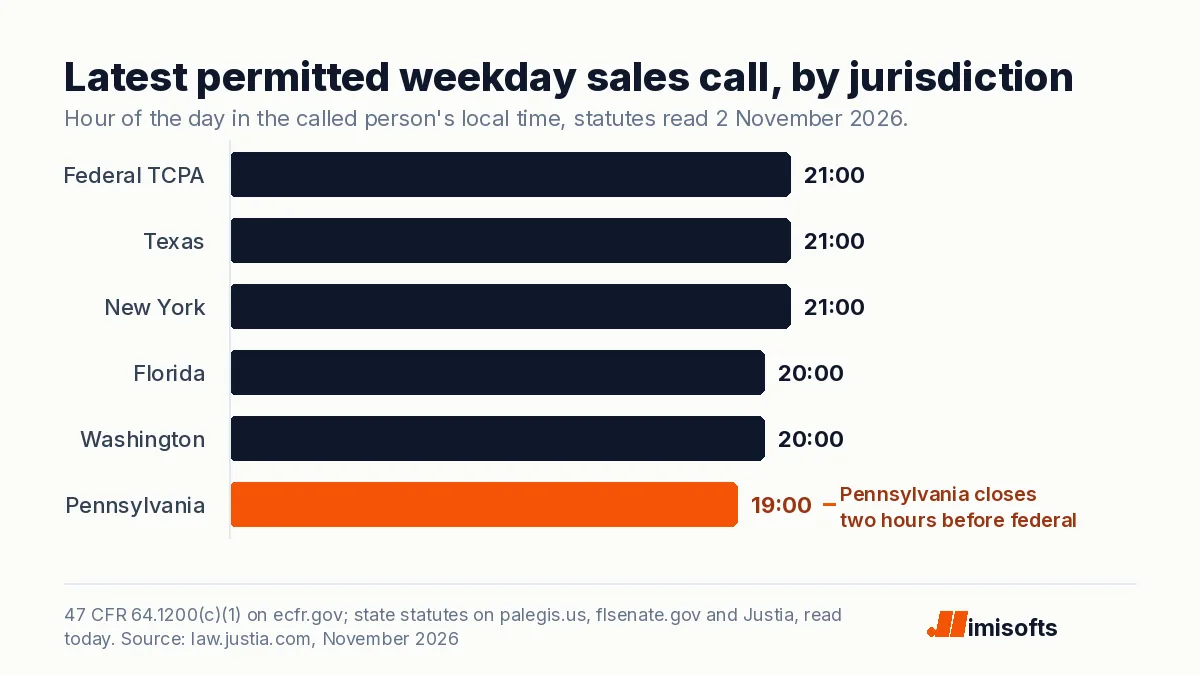
The hours change is the one that breaks existing dialer settings. Pennsylvania now closes at 7 p.m., two hours before the federal 9 p.m. limit in 47 CFR 64.1200(c)(1) and an hour before Florida and Washington, and it opens at 9 a.m., an hour after the federal 8 a.m. start. Sunday, previously not listed in item (1), is now a no-call day for solicitations of consumer goods and services. Our hub on telemarketing laws by state was written before this change; Pennsylvania now has the shortest weekday window of the states in the chart below. In 24-hour terms, the federal rule, Texas and New York stop at 21:00, Florida and Washington at 20:00, and Pennsylvania at 19:00.
Registration: who files, who is exempt
Section 3(a), as amended: a telemarketer or the business that employs it "shall be required to register with the Office of Attorney General at least 30 days prior to offering for sale consumer goods or services through any medium," and "any business which provides telemarketing services to other entities and has been under the same ownership and control for less than five years shall register." Section 4 keeps the mechanics: a biennial application listing the business, its principals and its telemarketers; "a surety bond in the sum of $50,000," or cash, a certificate of deposit or government bonds in that amount; and "The biennial fee for those persons or businesses registering under subsection (a) shall be $500." Failure to register "constitutes a misdemeanor of the second degree."
Act 47 moved the exemptions out of the definition of "telemarketer" and into a new section 3(b.1), with 13 entries. The ones an outbound team will reach for: a seller who does not complete the sale on the call but completes the sale at a later face-to-face meeting, or who sends literature without requiring payment first; "A person or business conducting a business-to-business sale if the selling business has operated continuously for at least three years under the same business name and at least 50% of its dollar volume consists of repeat sales to existing businesses"; businesses licensed or registered with a federal or state agency acting within that scope; sellers calling their own prior purchasers after three years under one name; retailers with two years in Pennsylvania and mostly in-store sales; telemarketing providers with five years under one ownership and 75 percent of revenue from exempt clients; and, in item (13), anyone whose calls do not meet the definition of telephone solicitation, which is where a pure business-to-business campaign for business services lands, since the definition is limited to consumer goods and services. The burden of proving an exemption stays on the person claiming it (section 8).
The do-not-call list and robocall mechanics
Section 5.2 bans solicitations to any "residential, wireless or business telephone subscriber" on the list kept by the Attorney General's list administrator, effective 30 days after the quarterly list first carrying the number. Telemarketers "shall quarterly obtain listings" or use a provider that does, and since the 2019 amendment a listing stays on until the number is no longer valid or the subscriber asks to be removed. The list may be used only to scrub. Complainants get 10 percent of any civil penalty collected, capped at $100. The robocall mechanics in section 5.2(l) now require the opt-out notice at the beginning of the call with an automated voice or keypress mechanism available "within two seconds of disclosing the name of the caller and the name of the person or entity on whose behalf the call is being made," available throughout the call, with no written consent required to opt out and a toll-free callback number on any voicemail.
Penalties
Section 6(a) still provides that "A violation of this act is also a violation of" the Unfair Trade Practices and Consumer Protection Law, and Act 47 deleted the subsections on second offences and procedure. Under section 8 of that law, wilful violations carry "a civil penalty of not exceeding one thousand dollars ($1,000) per violation," and "Where the victim ... is sixty years of age or older, the civil penalty shall not exceed three thousand dollars ($3,000) per violation." Section 9.2 gives a private action to a person who bought "primarily for personal, family or household purposes" for "actual damages or one hundred dollars ($100), whichever is greater," which the court may raise to "up to three times the actual damages sustained, but not less than one hundred dollars ($100)," plus costs and fees. Caller ID spoofing is separately banned by section 5.1, now without the old qualifier about equipment capability.
What to reset this week
- Dialer hours for Pennsylvania numbers: 9 a.m. to 7 p.m., Monday to Saturday, no Sundays or legal holidays.
- Consent records for any robocall or AI voice campaign. The four-element prior express written consent is now required for an outbound robocall selling consumer goods or services to a Pennsylvania line, residential or business, unless the call is for emergency purposes, otherwise exempt, or not a telephone solicitation (for example an established business relationship within the past 12 months). A consent form that does not say the words about not being a condition of purchase does not qualify.
- Text opt-out vocabulary. Seven terms count as a stop request; a system that only recognises "STOP" will miss six of them.
- Registration review. If you sell consumer goods or services into Pennsylvania and are not exempt under section 3(b.1), file with the Attorney General at least 30 days before offering consumer goods or services for sale, pay $500, post the $50,000 bond.
- Synthetic voice disclosure. Item (13) does not ban AI voices; it bans using them "to defraud, deceive or mislead." An agent that denies being automated when asked is the obvious failure case.
For the federal consent layer that still applies on top, see the TCPA revoke-all rule and is ringless voicemail legal, which Pennsylvania now treats as a telephone solicitation. Our AI calling setup covers state hours, consent capture and opt-out handling; the best AI voice agents in 2026 compares platforms. This is general information, not legal advice.
Frequently Asked Questions
From 18 October 2026, section 5(a)(1) of the Telemarketer Registration Act prohibits initiating a telephone solicitation on a Sunday or after 7 p.m. or before 9 a.m. The deleted 1996 text had prohibited telemarketing after 9 p.m. or before 8 a.m. Calls on legal holidays remain prohibited under section 5(a)(10).
The General Assembly's page shows Act 47 enacted from Senate Bill 992 on 20 July 2026 and effective in 90 days, which is 18 October 2026. Governor Josh Shapiro approved it on 20 July 2026.
Yes. New section 5(a)(11) prohibits initiating a robocall to any residential, business or wireless telephone line without the prior express written consent of a called party, unless the call is for emergency purposes or otherwise exempt. Consent must identify the number, disclose that the signer agrees to receive solicitations including robocalls or texts, state that consent is not a condition of purchase, and be signed, electronically or otherwise.
Section 4 sets a biennial fee of $500 and requires a $50,000 surety bond, or cash, a certificate of deposit or government bonds in that amount. Registration must be filed with the Office of Attorney General at least 30 days before offering consumer goods or services. Failing to register is a second-degree misdemeanour.
The Act regulates telephone solicitations for consumer goods and services, meaning goods used for personal, family or household purposes, so a call selling business services to a company is generally outside the definition and exempt from registration under section 3(b.1)(13). A separate exemption covers business-to-business sellers with three years under the same name and at least 50 percent of dollar volume from repeat sales to existing businesses. The burden of proving an exemption is on the seller.
A violation is also a violation of the Unfair Trade Practices and Consumer Protection Law, which allows civil penalties of up to $1,000 per wilful violation, or $3,000 where the victim is 60 or older, and gives a person who bought or leased primarily for personal, family or household purposes a private action for actual damages or $100, up to three times actual damages, plus costs and attorney fees.