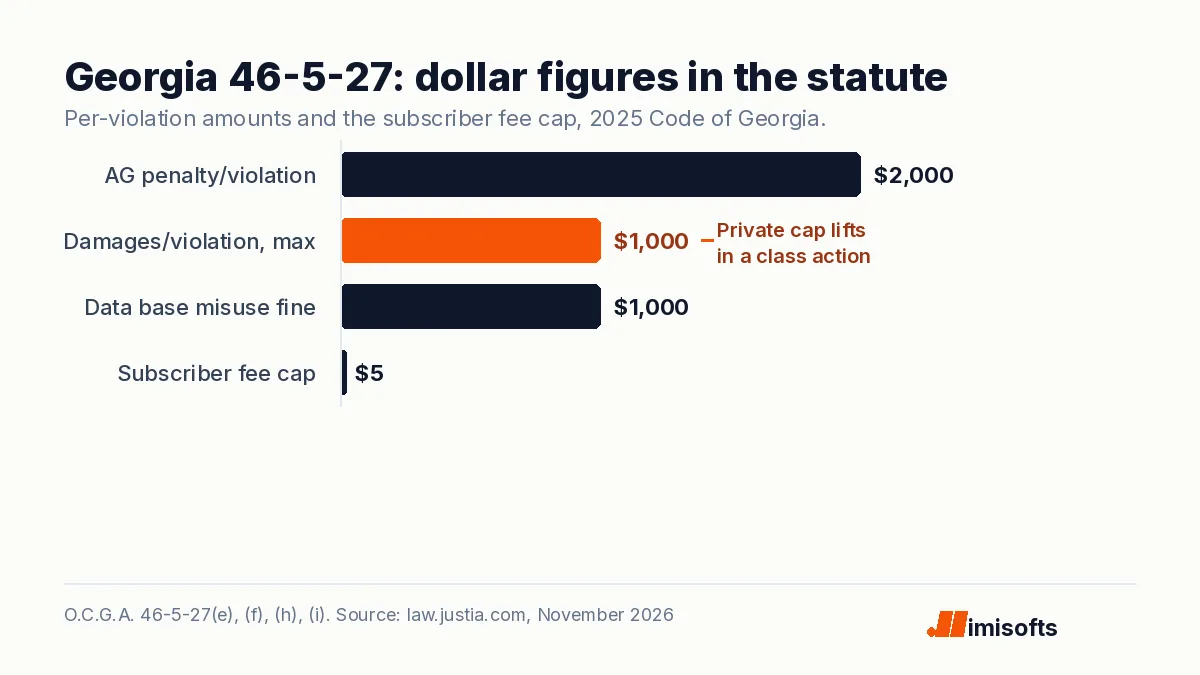
November 2, 2026. Georgia's no-call law became a class action statute on 1 July 2024, and that is the fact every outbound team calling the state should start from. Senate Bill 73 rewrote O.C.G.A. 46-5-27 so that a person who receives more than one unlawful telephone solicitation in 12 months can sue both the caller and the business it called for, for up to $1,000 per violation, and the damages cap "shall not apply" when the claim is brought as a class action. The same amendment deleted "knowing" from the Attorney General's $2,000-per-violation civil penalty and "knowingly" from the caller ID rule, and added a vicarious liability clause: it is no defence that the defendant did not make the call if it was made on the defendant's behalf under "a written or verbal agreement, contract, request, or employment relationship." The statutes reviewed set no general telemarketer registration, but recorded-message dialing needs a permit from the Public Service Commission under O.C.G.A. 46-5-23, which also fixes robocall hours at 8 a.m. to 9 p.m. and makes violations a misdemeanour. Here is the 2025 Code text and what it means for live, recorded and AI calls.
Key numbers
| Item | Number |
|---|---|
| Effective date of the SB 73 rewrite (Ga. L. 2024, p. 912) | 1 July 2024 |
| Private damages per violation (or actual loss if greater; uncapped in class actions) | $1,000 |
| Violations in 12 months needed for a private suit (same seller or its agents) | more than 1 |
| Attorney General civil penalty per violation (no knowledge requirement since 2024) | $2,000 |
| Limitation period (from knowledge or end of a state proceeding) | 2 years |
| Robocall hours for consumer advertising (46-5-23(a)(2)(B)) | 8 a.m. to 9 p.m. |
| Seconds to identify in a recorded message (and again at the end) | 25 |
| Seconds to disconnect after a refusal (46-5-23(a)(2)(F)) | 10 |
| Written robocall consent validity (withdrawal effective on day 15) | 2 years |
| ADAD permit renewal (fee set by the commission) | biennial |
| Maximum subscriber fee to join the state list (46-5-27(e)) | $5 |
O.C.G.A. 46-5-27, 46-5-23, 10-5B-4, 10-5B-6 and 10-1-393.5, 2025 Code of Georgia as reproduced by Justia with amendment notes, read on 2 November 2026.
What 46-5-27 covers
The statute protects a "residential, mobile, or wireless subscriber," defined as a person who subscribes to telephone service "or other persons living or residing with such person." A "telephone solicitation" is "any voice communication over a telephone line for the purpose of encouraging the purchase or rental of, or investment in, personal property, real property, goods, or services," and the section says the communication "may be from a live operator, through the use of ADAD equipment as defined in Code Section 46-5-23, or by other means." Four kinds of call are excluded from the definition:
- Calls made with the subscriber's "prior express invitation or permission."
- Calls "by or on behalf of any person or entity with whom the subscriber has a prior or current business or personal relationship."
- Calls for registered or exempt charitable organisations.
- Calls "by any person who is licensed or regulated pursuant to Chapter 40 or Chapter 41 of Title 43 or Chapter 19 of Title 15," a 2023 addition effective 1 January 2024.
Subsection (c) is the operative rule: "No person or entity shall make or cause to be made on behalf of any person or entity any telephone solicitation to the telephone line of any residential, mobile, or wireless subscriber in this state who has given notice to the commission ... of such subscriber's objection to receiving telephone solicitations." The Public Service Commission runs the data base, may charge subscribers no more than $5.00 to join, and charges solicitors a fee for access or electronic copies that is set by rule rather than in the statute. Under subsection (d)(4), if the FCC establishes a single national data base, the commission must include its Georgia part in the state data base.
Two rules on every call
Subsection (g) applies to any telephone solicitation to a Georgia residential, mobile or wireless line, listed or not. First: the caller "shall, at the beginning of such call, state clearly the identity of the person or entity initiating the call." Second: no caller may use any method to block or otherwise circumvent the subscriber's caller identification service. The 2024 amendment removed "knowingly" from the caller ID rule, so knowledge no longer has to be proved.
What SB 73 changed on 1 July 2024
| Provision | From 1 July 2024 | What the amendment notes show |
|---|---|---|
| Who can be sued (subsection (i)) | "the person or entity that made the telephone solicitation or the person or entity that the telephone solicitation was made on behalf of, or both" | Subsection rewritten by SB 73 |
| Damages (subsection (i)) | Actual loss "or up to $1,000.00 in damages for each such violation, whichever is greater" | Formerly up to $2,000 per knowing violation |
| Class actions (subsection (i)) | Allowed under Code Section 9-11-23, "for which the damages limitation ... shall not apply" | No class action language before SB 73 |
| Attorney General penalty (subsection (h)) | Up to $2,000.00 "for each violation" | "knowing" deleted |
| Vicarious liability (subsection (j)) | No defence that the defendant did not make or know about the call if it was made on the defendant's behalf under an agreement, contract, request or employment relationship; defence if the defendant established policies and procedures to effectively prevent violations and "mandated and enforced compliance" | Subsection rewritten by SB 73 |
| Caller ID (subsection (g)(2)) | No method to block or otherwise circumvent the subscriber's caller identification service | "knowingly" deleted |
The threshold for a private suit is "more than one telephone solicitation within any 12 month period by or on behalf of the same person or entity." One unlawful call can draw an Attorney General penalty; a second within 12 months opens a private suit. Claims must be filed within two years of when the plaintiff knew or should have known of the violation, or two years after any state proceeding ends, whichever is later (subsection (k)), and Georgia courts may exercise personal jurisdiction over non-residents who call into the state (subsection (l)).
Robocalls: the ADAD permit and the 8 a.m. to 9 p.m. rule
O.C.G.A. 46-5-23 governs "ADAD equipment," meaning any device used "for the purpose of automatically selecting or dialing telephone numbers and disseminating prerecorded messages to the numbers so selected or dialed." For calls advertising goods or services "primarily for personal, family, or household use," or for polls, it is unlawful to use such equipment where any of eight conditions holds, including: consent was not received before the calls; use is "other than between the hours of 8:00 A. M. and 9:00 P. M."; the dialing is random or sequential; the device does not hang up "within ten seconds after the person called fails to give consent for the playing of a recorded message or hangs up"; the message does not state "the name and telephone number of the person or organization initiating the call within the first 25 seconds of the call and at the conclusion of the call"; or the calls go to unlisted numbers, hospitals, nursing homes, fire or law enforcement agencies.
Consent works two ways. A live operator may introduce the call and ask permission to play a recording, which applies to one call only. Or the subscriber gives written consent on a form that states its purpose and how to withdraw, valid for two years, with records kept and available to the commission. Subsection (c) then adds the permit: "It shall be unlawful for any person to connect any ADAD equipment to any telephone line in this state for the purpose of making telephone calls to persons in this state through the use of ADAD equipment unless a permit has been issued for such ADAD equipment by the commission," renewed biennially for a fee that covers administrative cost. Violations are a misdemeanour under subsection (e), and violators face disconnection if the violation continues 10 days after the local exchange company's notice. Exempt from the operating rules, though not the consent rule or the bans on calls to unlisted numbers and institutions, are non-commercial calls, calls about payment or warranty on goods already bought, and debt collection.
Fraud statutes that sit alongside
Two further provisions reach telemarketers without a no-call element. O.C.G.A. 10-1-393.5, part of the Fair Business Practices Act, adopts the FTC Telemarketing Sales Rule's definition of telemarketing "except that the term 'telemarketing' shall also include those calls made in intrastate as well as interstate commerce," and makes it unlawful for anyone engaged in telemarketing to "employ any device, scheme, or artifice to defraud" or to engage in a practice that operates as a fraud or deceit. Intentional violations carry criminal penalties and reach officers and directors with prior knowledge. Chapter 5B of Title 10, enforced by the Secretary of State, applies to telephone sellers already regulated under the securities, commodities, electrical, plumbing, conditioned air, low voltage or utility contractor licensing, or charitable solicitation laws, and requires them to state the business name "before any sales solicitation can begin," give a contact number or address, and not block caller ID; wilful violations are a felony and penalties double when an elder or disabled person is targeted.
What this means for outbound teams
- Scrub the Georgia data base, not only the national registry. The statute bans calls to anyone who objected to the commission, and the commission sells access to that list.
- Treat your vendor's calls as your own. Subsection (j) makes the seller liable for a contractor's calls unless it both wrote prevention policies and "mandated and enforced compliance." A contract clause is the first half; audit logs are the second. The federal version of this is covered in TCPA vicarious liability.
- Count to two. Because the private claim needs more than one violation in 12 months, a suppression process that blocks any second call to a listed number removes the private-suit trigger, not Attorney General exposure.
- Recorded and AI voices: permit, consent, hours, 25 seconds, 10 seconds. An AI agent that dials consumers and speaks fits "disseminating prerecorded messages" only loosely, but the safer reading for an outbound consumer campaign is to hold the ADAD permit, capture written consent, stay inside 8 a.m. to 9 p.m., identify in the first 25 seconds and again at the end, and hang up within 10 seconds of a refusal.
- Business-to-business calls. The no-call rule protects residential, mobile and wireless subscribers, and the ADAD rule is limited to goods for personal, family or household use, so a call to a company's main line about business software is probably outside both, though no business exemption is stated and the ADAD permit covers any ADAD calling. The identification and caller ID rules in subsection (g) still apply whenever the line is a mobile or wireless one, which many small business owners use.
Our AI calling setup covers per-state suppression, consent capture and identification scripts; the best AI voice agents in 2026 compares platforms. For the other states' windows and registries, see telemarketing laws by state, and for how a company-specific opt-out must be honoured under federal law, TCPA opt-out requirements. This is general information, not legal advice.
Frequently Asked Questions
Yes. O.C.G.A. 46-5-27 directs the Public Service Commission to keep a data base of residential, mobile and wireless subscribers who object to telephone solicitations, and bans solicitations to those numbers. Solicitors pay a fee set by the commission for access to it.
Since 1 July 2024, a person who receives more than one unlawful telephone solicitation within 12 months from or on behalf of the same business can sue the caller, the business it called for, or both, for actual monetary loss or up to $1,000 per violation, plus attorney fees and costs. The $1,000 cap does not apply in a class action under Code Section 9-11-23.
Under 46-5-27(j) it is not a defence that the defendant did not make the call or did not know it was unlawful if the call was made on its behalf under a written or verbal agreement, contract, request or employment relationship. A business has a defence if it established policies and procedures to effectively prevent violations and mandated and enforced compliance with them.
O.C.G.A. 46-5-23 makes it unlawful to use automatic dialing and recorded message equipment for consumer advertising other than between 8:00 A.M. and 9:00 P.M. The recording must state the caller's name and telephone number within the first 25 seconds and at the end of the call, and the device must disconnect within ten seconds of a refusal or hang-up.
There is no general telemarketer registration in the sections read. Anyone connecting automatic dialing and recorded message (ADAD) equipment to a Georgia line must hold a permit from the Public Service Commission under 46-5-23(c), renewed every two years. Telephone sellers already regulated under Georgia's securities, commodities, electrical, plumbing, conditioned air, low voltage or utility contractor licensing, or charitable solicitation laws are also subject to Chapter 5B of Title 10, enforced by the Secretary of State.
The law protects residential, mobile and wireless subscribers who object to solicitations, and the ADAD rules cover goods primarily for personal, family or household use. A call to a company's main line about business services is probably outside both, but a listed mobile line is also covered by the no-call rule, and the duty to identify the caller and not block caller ID in 46-5-27(g) applies to any solicitation to a Georgia mobile or wireless line.