Short answer. The Virginia Telephone Privacy Protection Act (Code of Virginia sections 59.1-510 to 59.1-518.01) covers sales calls and, as amended in 2025, sales texts to Virginia residents and to any phone with a Virginia area code. It allows calls and texts only between 8 a.m. and 9 p.m. at the recipient's location unless they consented, bars numbers on the National Do Not Call Registry, makes a stop request binding for at least 10 years, and lets any aggrieved person sue for $500 for a first violation, $1,000 for a second and $5,000 for each one after that, plus attorney fees. The seller is jointly liable with whoever made the call.
We sell AI calling and texting services that have to follow rules like these, so we read every section in the General Assembly's own Code of Virginia, chapter 44 and the enrolled text of SB 1339 (2025 Acts, chapter 626) on 23 November 2026. We did not search case law. This is general information, not legal advice.
Key numbers
| Item | Number |
|---|---|
| Calling and texting hours (recipient's local time, unless prior consent) | 8 a.m. to 9 p.m. |
| Damages, first violation (up to $5,000 if willful) | $500 |
| Damages, second violation (up to $5,000 if willful) | $1,000 |
| Damages, each later violation (plus attorney fees and costs) | $5,000 |
| Civil penalty in a state or local action (per willful violation) | up to $5,000 |
| How long a stop request lasts (at least) | 10 years |
| Registry copy for the safe harbor (no older than) | 31 days |
| Live rep or recorded ID message (after the person's greeting) | 2 seconds |
Code of Virginia sections 59.1-510 to 59.1-518 and SB 1339 (2025) read on 23 November 2026.
Who and what the Act covers
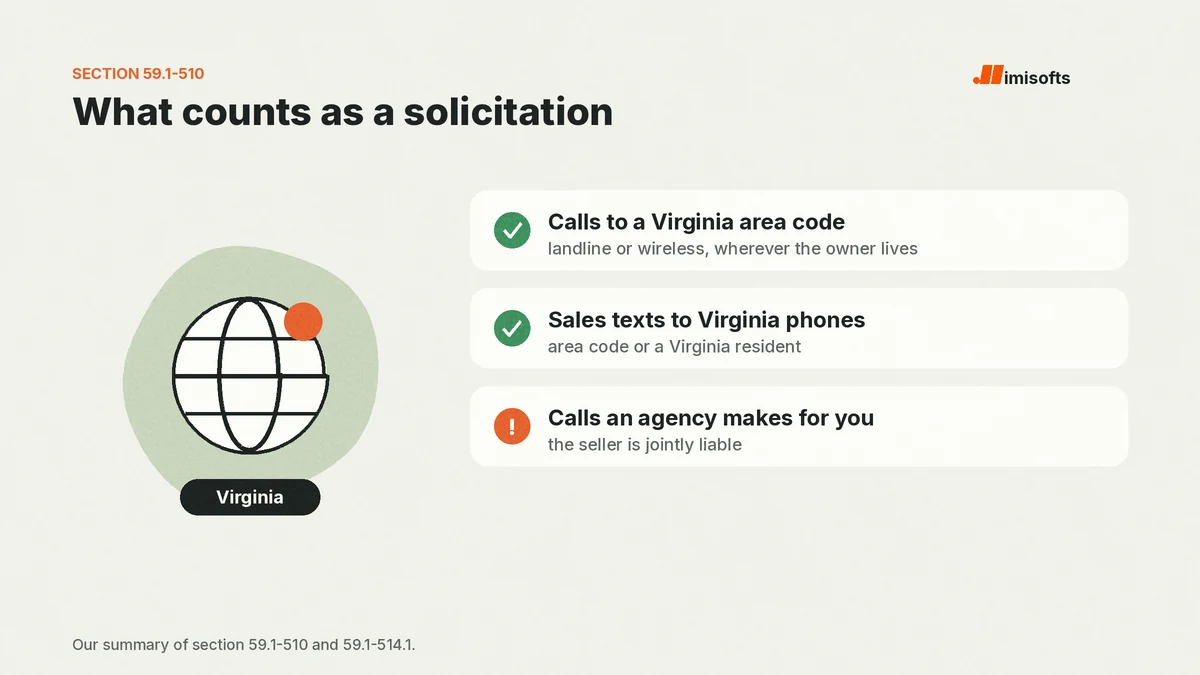
Section 59.1-510 defines a "telephone solicitation" as a call to any natural person's residence in Virginia, to "any landline or wireless telephone with a Virginia area code", or to a phone registered to a Virginia resident, and any text message to a wireless phone with a Virginia area code or registered to a Virginia resident, "for the purpose of offering or advertising any property, goods, or services for sale, lease, license, or investment", including credit offers.
Three consequences follow from that wording:
- Area code reach. On our reading, a number with a Virginia area code is covered even if its owner now lives in another state.
- Texts count the same as calls. Every rule below applies to texts unless the section says "via telephone call".
- Who is liable. A "telephone solicitor" is anyone who "makes or initiates, or causes another person to make or initiate" a solicitation. That includes an agency or anyone else who places the calls for you.
The definition does not exclude business lines. On our reading, a sales call to a wireless phone with a Virginia area code is covered even when the person who answers uses it for work.
Calling hours and identification rules
Section 59.1-511: no solicitation "at any time other than between 8:00 a.m. and 9:00 p.m. local time at the contacted person's location, unless the telephone solicitor has obtained the prior consent of the contacted person." These are the same hours as the federal rule in 47 CFR 64.1200(c)(1), but here they also apply to texts, and breaking them is a private right of action under Virginia law.
Section 59.1-512: on a call, the caller must give "his first and last names and the name of the person on whose behalf the telephone solicitation is being made promptly upon making contact". An AI voice agent therefore needs a scripted opening that names the business it calls for; how a first and last name applies to an automated agent is not addressed in the text.
Section 59.1-513: you must transmit your telephone number and, when your carrier allows, your name, and that number must accept do-not-call requests during regular business hours. For texts, the rule is met if the number accepts a reply-text opt-out. You may not block your caller ID or display "false or misleading" information, but you may show the seller's name and customer service number instead.
Section 59.1-513.1: if no live sales representative is on the line "within two seconds of the person's completed greeting", you must play a recorded message with the seller's name and telephone number. That matters for predictive dialers and for AI agents with a slow first response.
Do not call, stop requests and the 10-year rule
Section 59.1-514 sets three rules:
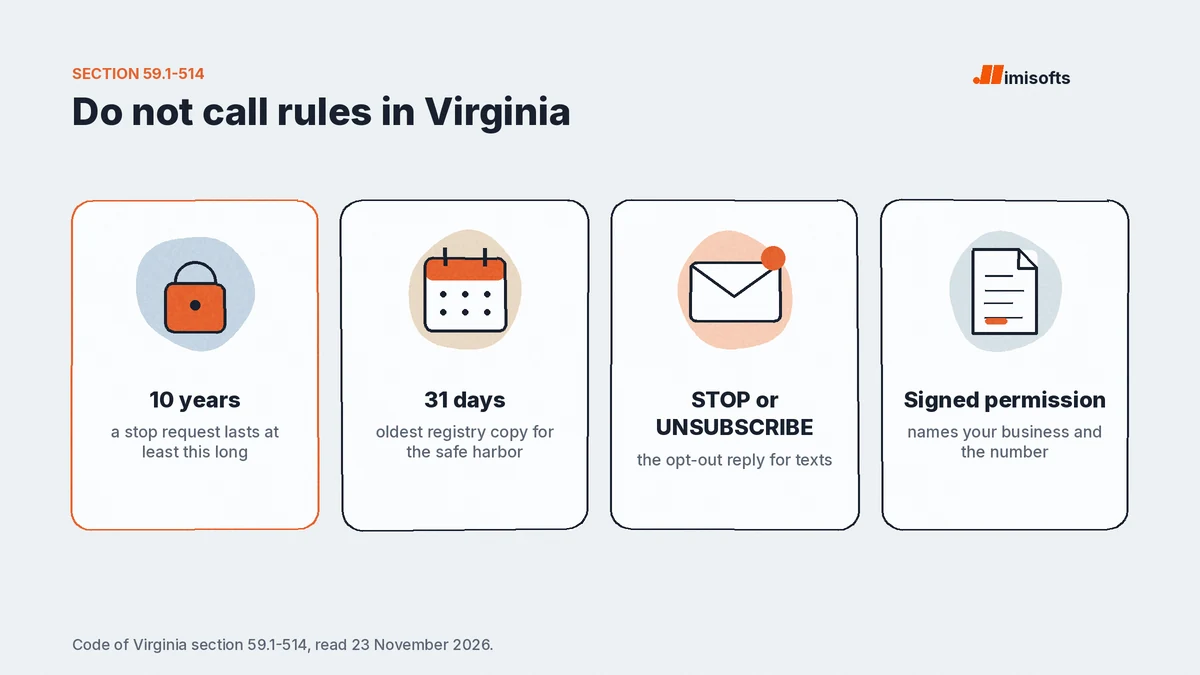
- Company-specific opt-outs. Once a person says they do not want solicitations from or for a seller, you may not call or text that number again. For texts the statement is made by replying "UNSUBSCRIBE" or "STOP". The request must "be honored for at least 10 years". The federal company-specific rule in 47 CFR 64.1200(d)(6) is 5 years, so Virginia numbers need the longer retention in your suppression list.
- National registry. No solicitation to a number on the National Do Not Call Registry.
- Safe harbor. It is an affirmative defense that you set up and followed, with due care, reasonable procedures, "including using ... a version of the National Do Not Call Registry obtained from the administrator of the registry no more than 31 days prior" to the call. Our DNC scrubbing guide covers the 31-day download.
For the do-not-call rules only, three kinds of contact are not solicitations: a call with prior express permission "evidenced by a signed, written agreement" that names the party and the number; a call to someone with an established business relationship (a purchase or transaction in the last 18 months, or an inquiry or application in the last 3 months); and a call from someone with a personal relationship. The business relationship and personal exemptions end once the person has asked not to be contacted.
Note what the exemptions do not cover: they apply only to section 59.1-514. The calling hours of 59.1-511 and the caller ID rules of 59.1-513 apply to every solicitation, and the identification and abandoned-call rules apply to every solicitation by phone call.
How the Act treats text messages
The 2025 amendment, SB 1339, replaced "telephone solicitation call" with "telephone solicitation" across sections 59.1-510 to 59.1-514.1, so the hours, caller ID, opt-out, registry and liability rules now read the same for calls and texts. Its title says it relates to "telephone solicitations via text message".
For an SMS program into Virginia, that means:
- send only between 8 a.m. and 9 p.m. recipient time unless the person consented;
- accept STOP and UNSUBSCRIBE replies and honor them for at least 10 years;
- scrub against the national registry, with a copy no more than 31 days old to keep the safe harbor, unless you hold signed written permission or an established business relationship;
- send from a number that accepts the opt-out reply.
Our guides to SMS opt-in language and TCPA rules for text messages cover the federal side.
Damages, penalties and who pays
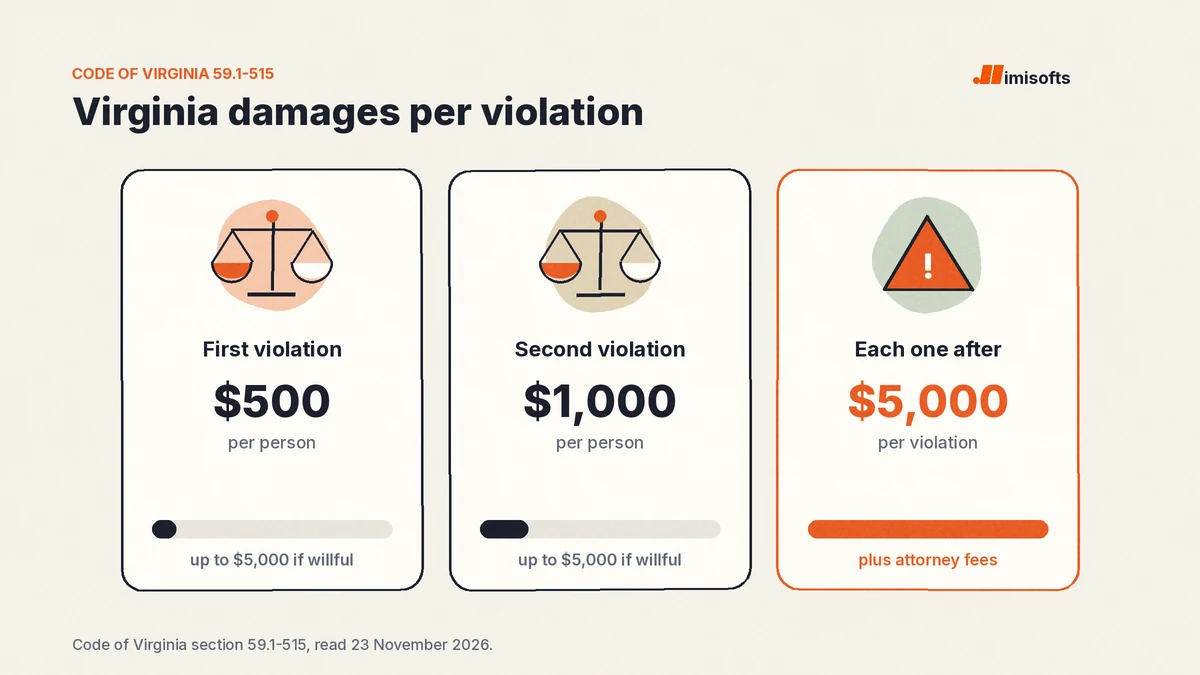
Section 59.1-515 lets "any natural person who is aggrieved" sue any responsible person for an injunction and "$500 for a first violation, $1,000 for a second violation, and $5,000 for each subsequent violation". If the violation is willful, the court may raise the first and second awards to up to $5,000 each. Attorney fees and court costs may be added, and claims within the limits can go to general district court or small claims court.
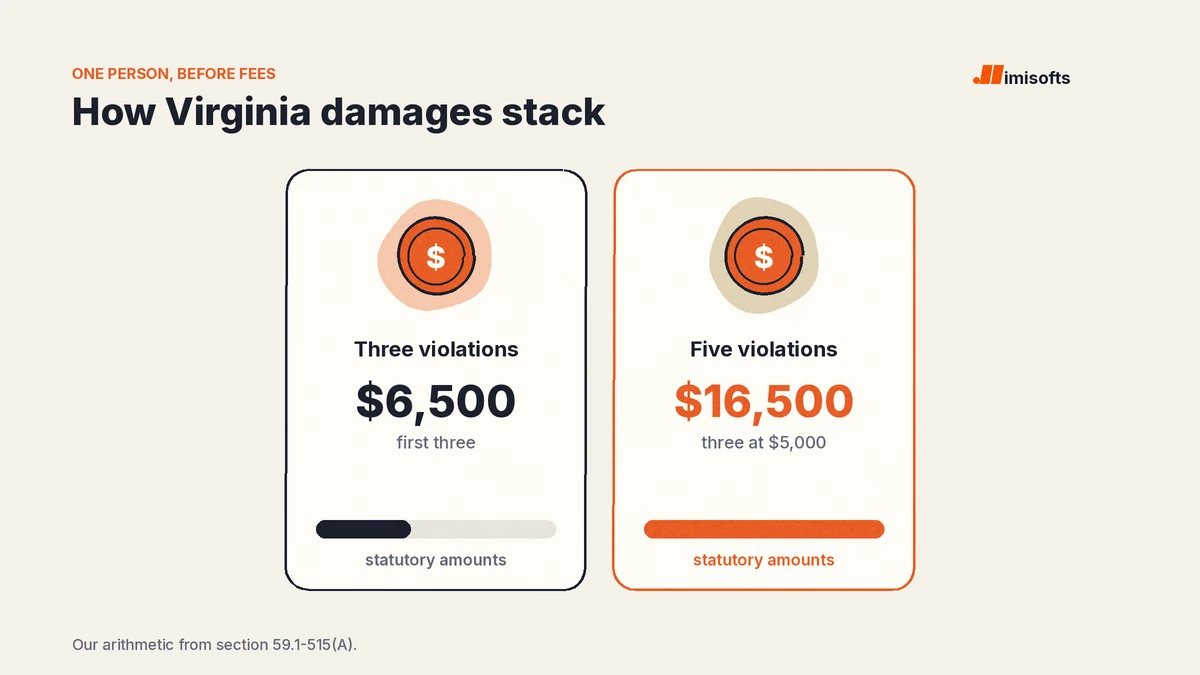
The amounts stack per violation. Three unwanted texts to one person after a stop request are $500, $1,000 and $5,000: $6,500 before fees. Five are $16,500.
Section 59.1-517 lets the Attorney General, a Commonwealth's attorney or a locality's attorney sue for the same damages on behalf of aggrieved persons, plus a civil penalty of up to $5,000 per willful violation, reasonable expenses of investigating and preparing the case, and attorney fees.
Section 59.1-514.1 makes the seller and the solicitor "jointly and severally liable" for breaches of the hours, identification, caller ID and do-not-call rules. A call that offers your products is presumed to be made for you "whether or not any agency relationship exists", and you can rebut that only "by clear and convincing evidence" that you did not hire the caller and did not know. Hiring an outside agency does not move the risk off your business.
A compliance checklist for calls and texts into Virginia
- Treat every Virginia area code and every known Virginia resident as covered.
- Gate dialing and texting to 8 a.m. to 9 p.m. in the recipient's time zone.
- Open every call with the caller's name and the business name; send texts from a number that takes STOP replies.
- Keep company opt-outs for at least 10 years, across every vendor and number you use.
- Download the national registry at least every 31 days and keep proof of the download.
- Keep signed written permission that names your business and the number, if you call registered numbers on consent.
- Write the joint-liability risk into your agency and vendor contracts.
Virginia is one of the stricter states in our telemarketing laws by state table; Maryland next door has shorter hours and a three-call cap. If your list came from a vendor, check it against the FCC reassigned numbers database too. For how we plan these rules into a calling or texting program, see our TCPA-compliant AI calling service for how we set that up.
Frequently Asked Questions
It is chapter 44 of Title 59.1 of the Code of Virginia, sections 59.1-510 to 59.1-518.01. It regulates sales calls and texts to Virginia residents and Virginia area codes: hours, caller identification, do not call, and damages of $500, $1,000 and $5,000 per violation.
Between 8 a.m. and 9 p.m. local time at the recipient's location, unless the caller has the person's prior consent. Under the 2025 amendment the same hours apply to sales texts.
Yes. The definition covers any text message to a wireless phone with a Virginia area code or registered to a Virginia resident, and SB 1339 of 2025 rewrote the Act so its rules apply to texts. Recipients opt out by replying STOP or UNSUBSCRIBE.
$500 for a first violation, $1,000 for a second and $5,000 for each later violation, plus attorney fees and court costs. A court may raise the first two to up to $5,000 each if the violation was willful.
At least 10 years from the time it is made, under section 59.1-514(A). That is longer than the 5-year federal company-specific rule, so keep Virginia opt-outs in your suppression list for a decade.
Yes. Section 59.1-514.1 makes the seller and the telephone solicitor jointly and severally liable, and presumes a call offering your products was made for you unless you prove by clear and convincing evidence that you did not hire the caller and did not know.