Short answer. DNC scrubbing means removing from a call list every number on the National Do Not Call Registry and on your own do-not-call list before you dial. Both federal rules that give a seller a safe harbor require a registry copy no more than 31 days old (the FCC's text: "no more than 31 days prior to the date any call is made"), plus written procedures, trained staff, a recorded internal list and records of the process. A consumer's request to stop calling must be honored within 10 business days and kept for 5 years, and registry access costs $85 per area code after the first five, up to $23,425 a year.
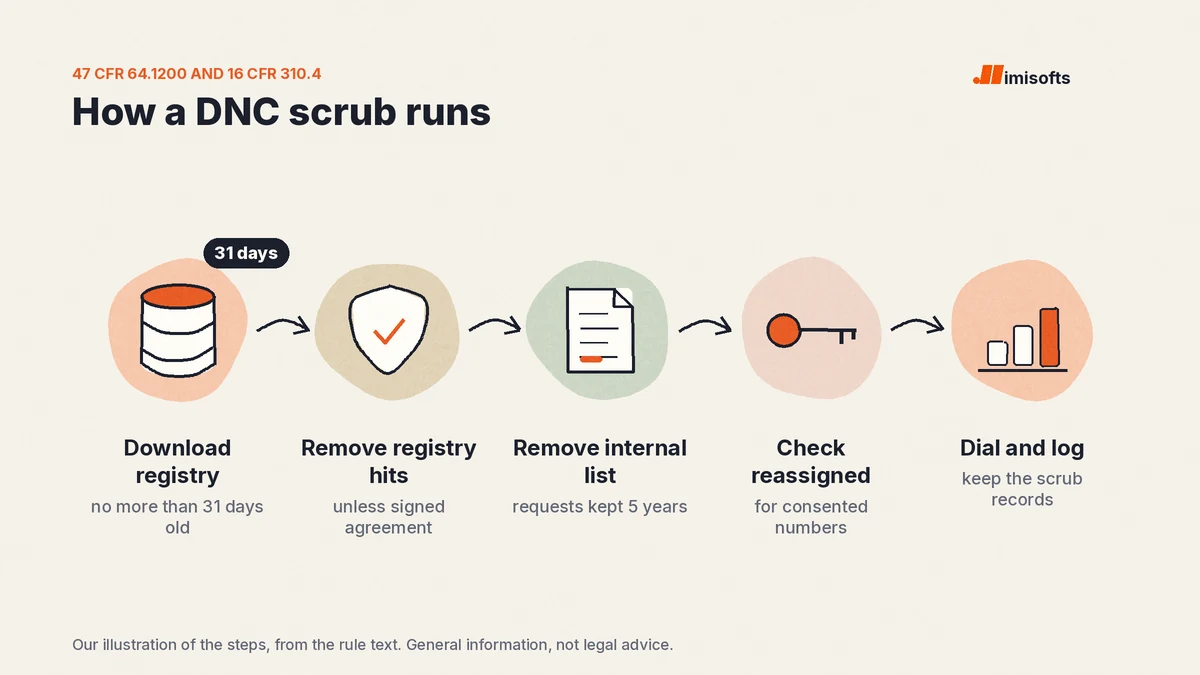
This guide walks through the scrub step by step from the text of the FCC's rule, 47 CFR 64.1200, and the FTC's Telemarketing Sales Rule, 16 CFR 310.4, both read on eCFR on November 22, 2026 (each page "up to date as of 11/19/2026"). This is general information, not legal advice.
Key numbers
| Item | Number |
|---|---|
| Maximum age of the registry copy you scrub against (64.1200(c)(2)(i)(D) and 310.4(b)(3)(iv)) | 31 days |
| Deadline to honor a do-not-call request (64.1200(d)(3)) | 10 business days |
| How long a do-not-call request lasts (64.1200(d)(6)) | 5 years |
| Registry downloads allowed (FTC Q and A) | Once per 24 hours |
| Registry fee per area code (after the first five, which are free) | $85 |
| Annual registry fee cap (16 CFR 310.8(c)) | $23,425 |
| Calling window at the called party's location (64.1200(c)(1)) | 8 a.m. to 9 p.m. |
| Times litigator appears in either rule (64.1200 and Part 310, word check) | 0 |
Rule text read on eCFR (up to date as of 19 November 2026) and the FTC's Q and A on 22 November 2026.
What a DNC scrub has to remove
Under 64.1200(c)(2), no telephone solicitation may go to "a residential telephone subscriber who has registered his or her telephone number on the national do-not-call registry," and a registration "must be honored indefinitely, or until the registration is cancelled by the consumer or the telephone number is removed by the database administrator." Under 64.1200(d), a seller that makes telemarketing calls must also keep its own list of people who asked it not to call. A scrub that checks only the national registry misses the second list.
| List | What the rule says | How long it lasts |
|---|---|---|
| National Do Not Call Registry | No telephone solicitation to a registered residential number (64.1200(c)(2)) | Indefinitely, until cancelled or removed |
| Your internal do-not-call list | Record the request "at the time the request is made" and honor it within 10 business days (64.1200(d)(3)) | 5 years from the request (64.1200(d)(6)) |
| Reassigned Numbers Database | A safe harbor for calls made with consent to a number that was since reassigned (64.1200(m)) | Checked against the consent date |
Paragraph (e) applies the do-not-call rules to "telephone solicitations or telemarketing calls or text messages to wireless telephone numbers" as described in the FCC's 2003 order, so texts to wireless numbers are in scope to the extent that order describes. Calling hours are a separate rule: (c)(1) bars solicitations before 8 a.m. or after 9 p.m. at the called party's location. This is general information, not legal advice.
The 31-day rule and how often to scrub
The FCC's safe harbor requires "a version of the national do-not-call registry obtained from the administrator of the registry no more than 31 days prior to the date any call is made, and maintains records documenting this process" (64.1200(c)(2)(i)(D)). The TSR has the same 31-day test in 310.4(b)(3)(iv). The FTC's Q and A for telemarketers puts it plainly: "If you are required to use the registry, you must synchronize your lists with an updated version of the registry at least every 31 days."
So the clock runs from when the registry copy was obtained: a copy downloaded on the 1st is too old for calls made more than 31 days later. The FTC's Q and A also says you can access your area codes "as often as you like during your annual period," but "you may download data files from the national registry only once in any 24-hour period." On our reading, the practical rule is to scrub every list again before each campaign and at least every 31 days, and to keep the download date with the list. This is general information, not legal advice.
The safe harbor: five things to show
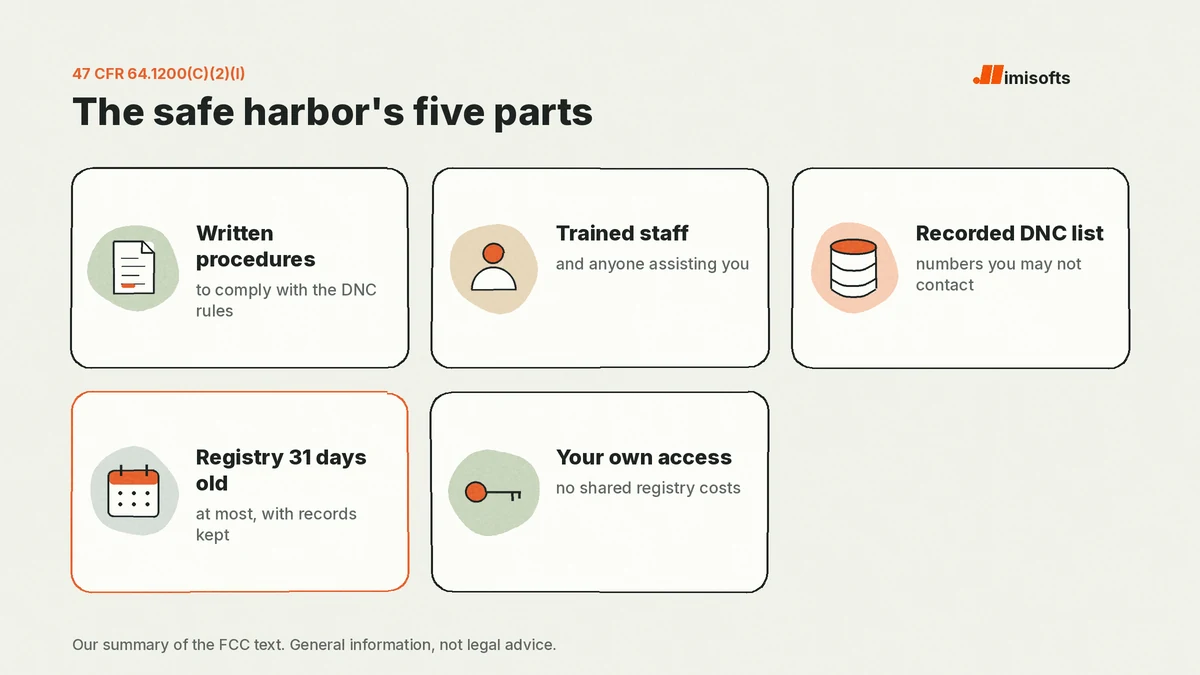
The safe harbor in 64.1200(c)(2)(i) protects a seller only if it "can demonstrate that the violation is the result of error and that as part of its routine business practice, it meets the following standards":
- Written procedures to comply with the national do-not-call rules.
- Training of its personnel, "and any entity assisting in its compliance."
- A recorded list of numbers the seller may not contact.
- A registry version no more than 31 days old, with records documenting the process.
- Its own access to the registry: it uses the data only for compliance and "does not participate in any arrangement to share the cost of accessing the national database."
The TSR's version in 310.4(b)(3) adds that the seller "monitors and enforces compliance with the procedures." Two other routes avoid the registry rule under the FCC text: the person's "prior express invitation or permission," evidenced by "a signed, written agreement" that names the seller and the phone number, or a personal relationship between the caller and the person called. This is general information, not legal advice.
Your internal list: 10 business days, 5 years
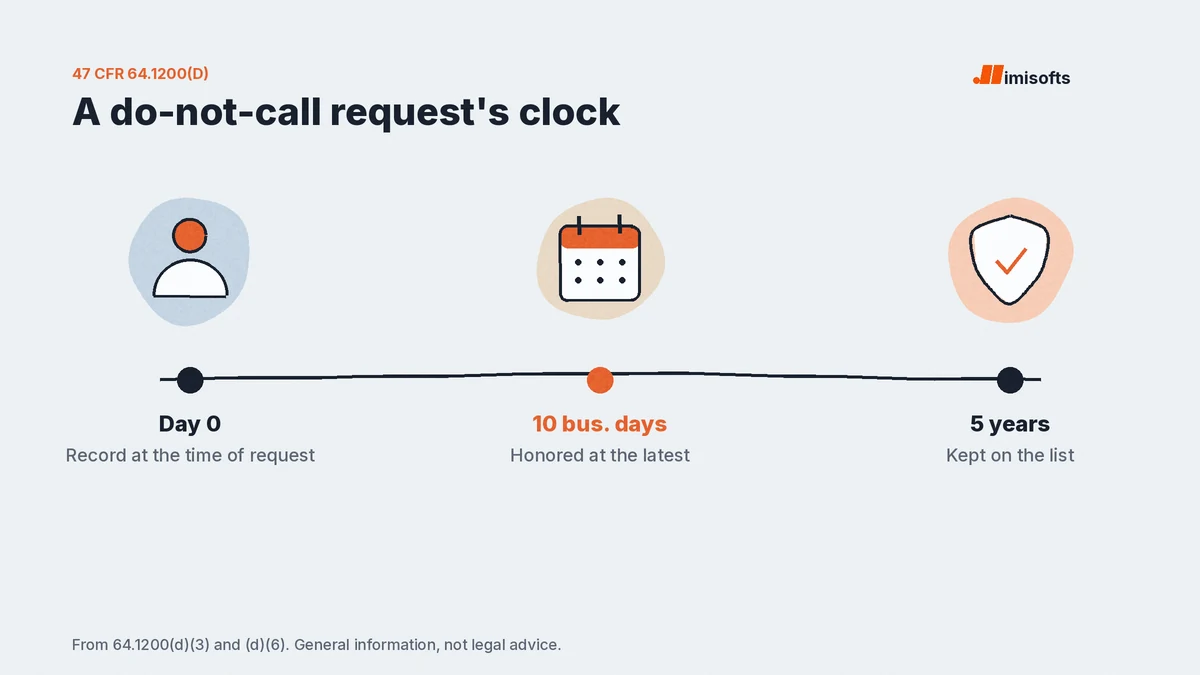
Paragraph (d)(3) works outside the registry download: no national file contains the requests made to you. The text says a seller "must record the request and place the subscriber's name, if provided, and telephone number on the do-not-call list at the time the request is made," and must honor it "within a reasonable time," which "may not exceed ten (10) business days from the receipt of such request."
Three more lines matter for agencies and outsourced callers:
- If the list is kept by another party, "the person or entity on whose behalf the call is made will be liable for any failures to honor the do-not-call request."
- A request cannot be shared with a party other than the seller or an affiliate without "a consumer's prior express permission."
- A request covers the entity that called, and affiliates only if "the consumer reasonably would expect them to be included" (d)(5).
Under (d)(6), "A do-not-call request must be honored for 5 years from the time the request is made." On our reading, the internal list should be one master file per seller that every dialer, CRM and texting tool reads from before each send. This is general information, not legal advice.
What registry access costs
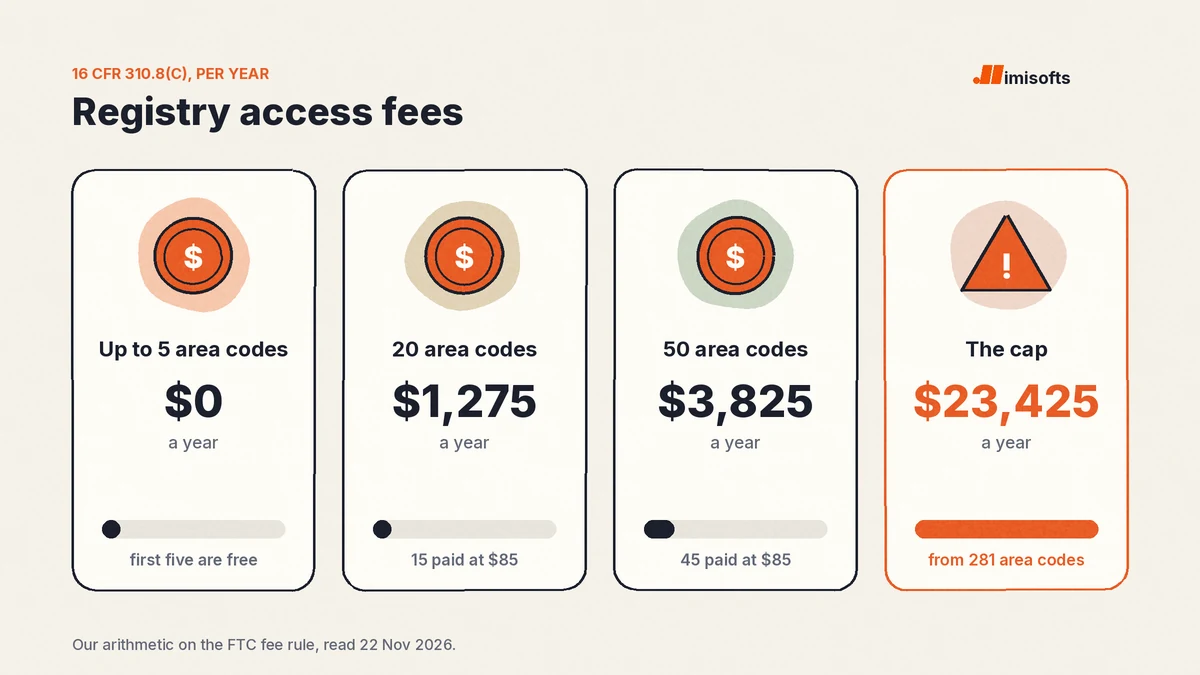
The FTC's fee rule, 16 CFR 310.8(c), sets the annual fee at "$85 for each area code of data accessed, up to a maximum of $23,425," with "no charge to any person for accessing the first five area codes of data." The same paragraph bars "any arrangement to share the cost of accessing the National Do Not Call Registry," including a telemarketer dividing the cost "among various clients."
| Area codes accessed | Annual fee |
|---|---|
| 1 to 5 | $0 |
| 10 | $425 |
| 20 | $1,275 |
| 50 | $3,825 |
| 281 or more | $23,425 (the cap) |
Our arithmetic: (area codes minus 5) times $85, capped at $23,425, which is reached at 276 paid area codes. Who has to pay, and why an agency cannot share one subscription across clients, is covered in our Do Not Call Registry cost guide.
Reassigned numbers, B2B calls and litigator lists
Reassigned numbers. Paragraph (m) protects a caller that had consent for a number that was later reassigned, if it queried "the database operated by the Administrator," got a response of "no" (the number has not been permanently disconnected since the consent date), and the call resulted from the database wrongly returning that answer. The paragraph's full text was cut at our read, so check it before relying on it. Our Reassigned Numbers Database guide covers how the query works.
Business numbers. The FTC's Q and A says "Most phone calls to a business made with the intent to solicit sales from that business are exempt from the Do Not Call provisions." Our Do Not Call list for businesses guide covers where that exemption ends.
Litigator lists. Neither text we read names one: the word "litigator" appears 0 times in 47 CFR 64.1200 and 0 times in 16 CFR Part 310. They are commercial products that neither rule names. On our reading, they can be an extra filter, but they are not part of either safe harbor and do not replace the registry or the internal list.
State lists. We did not review state do-not-call lists for this guide; see our telemarketing laws by state guide before calling into a new state. This is general information, not legal advice.
A scrub checklist before each campaign
Our suggestions, built on the text above:
- Download the registry for every area code on the list, and record the date (no more than 31 days before any call).
- Remove registry matches unless you hold a signed, written agreement for that seller and number.
- Remove every number on the seller's internal list; add new requests the moment they are made.
- Check consented numbers against the Reassigned Numbers Database.
- Keep the written procedures, training records and scrub logs; the safe harbor depends on showing them.
- Dial only between 8 a.m. and 9 p.m. at the called party's location.
Missing a step can be expensive; our TCPA fines guide lists the per-call amounts. If you run AI calling, our AI calling built around TCPA consent page covers our calling service. This is general information, not legal advice.
Frequently Asked Questions
At least every 31 days. The FCC safe harbor in 47 CFR 64.1200(c)(2)(i)(D) and the FTC rule in 16 CFR 310.4(b)(3)(iv) both require a registry version obtained no more than 31 days before any call, and the FTC's Q and A says to synchronize your lists at least every 31 days.
For a residential subscriber, within a reasonable time that may not exceed 10 business days from the receipt of the request, and the request must be honored for 5 years from when it is made, under 47 CFR 64.1200(d)(3) and (d)(6).
The first five area codes are free. After that the FTC charges $85 per area code per year, up to $23,425, under 16 CFR 310.8(c). The rule bars any arrangement to share the cost of registry access.
The FTC's Q and A says most sales calls to a business are exempt from the Do Not Call provisions. On our reading, scrub any number you cannot confirm is a business line; our Do Not Call list for businesses guide covers the edge cases.
No federal text we read requires one. The word litigator appears 0 times in 47 CFR 64.1200 and in 16 CFR Part 310. A litigator list is a commercial product; it is not part of either safe harbor and does not replace the registry or your internal list.
Yes, to the extent the FCC's 2003 order describes. 47 CFR 64.1200(e) applies the do-not-call rules to telephone solicitations and telemarketing calls or text messages to wireless numbers.