Short answer. For A2P 10DLC campaign review, Twilio lists six things SMS opt-in language should tell people before they agree: your brand name, the type of texts, how often they come, that "Message and data rates may apply", how to stop ("Reply STOP to unsubscribe") and how to get help ("Reply HELP for help"). Those items come from Twilio's error 30924 page, the code for campaigns rejected over consent language. For marketing texts sent with an autodialer or an artificial or prerecorded voice, the FCC's rule at 47 CFR 64.1200 also requires prior express written consent, with two disclosures of its own.
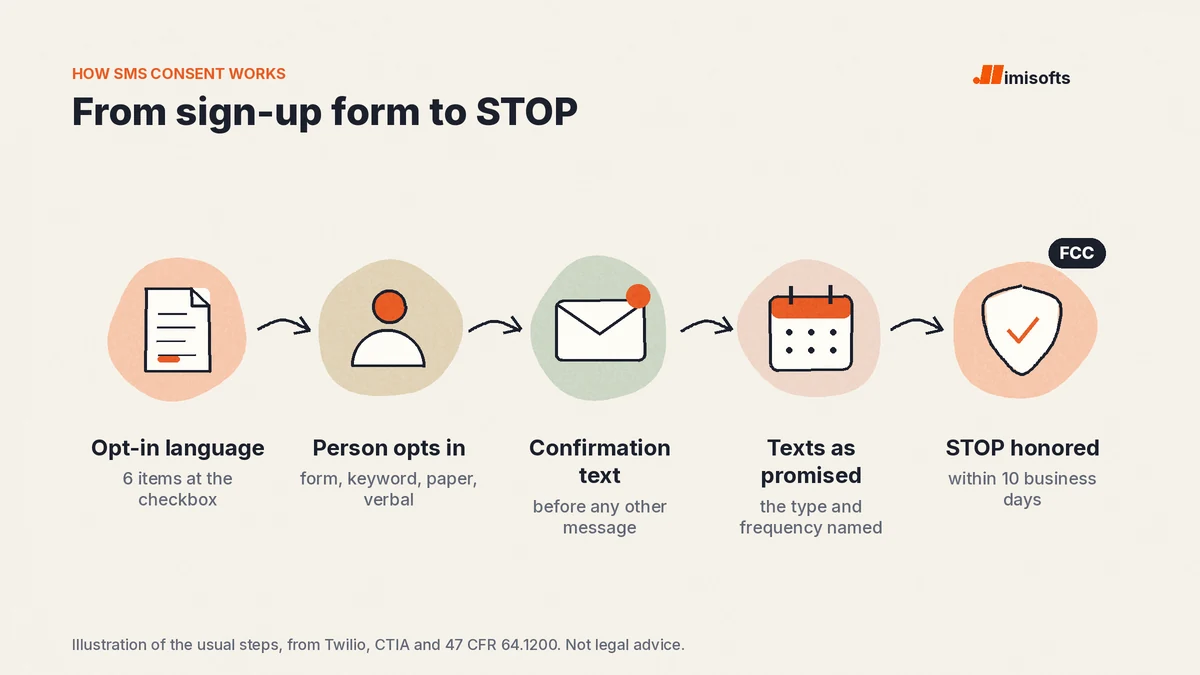
This guide covers the six disclosures with sample wording, what the TCPA adds for marketing texts, the confirmation text after sign-up, the records to keep, and the opt-out rule. Sources: Twilio's documentation, CTIA's Messaging Principles and Best Practices (May 2023) and the eCFR text of 47 CFR 64.1200, up to date as of November 16, 2026, all read on November 18, 2026. This is general information, not legal advice.
Key numbers
| Item | Number |
|---|---|
| Items Twilio lists for compliant consent language (brand, type, frequency, rates, STOP, HELP) | 6 |
| Twilio rejection code for missing consent language (A2P 10DLC campaigns) | 30924 |
| Call-to-action points in CTIA's guidance (May 2023 edition) | 5 |
| Items in a CTIA confirmation text (for recurring programs) | 5 |
| Consent records CTIA lists (retain where applicable) | 7 |
| Disclosures in TCPA written consent (authorization; not a condition of purchase) | 2 |
| Opt-out words named in 47 CFR 64.1200(a)(10) (stop, quit, end, revoke, opt out, cancel, unsubscribe) | 7 |
| Time to honor an opt-out request (a reasonable time, not more than this) | 10 business days |
| eCFR text current as of (read on November 18, 2026) | November 16, 2026 |
Read on 18 November 2026 from Twilio's error 30924 page, CTIA's Messaging Principles and Best Practices (May 2023) and the eCFR text of 47 CFR 64.1200.
The six items Twilio lists for opt-in language
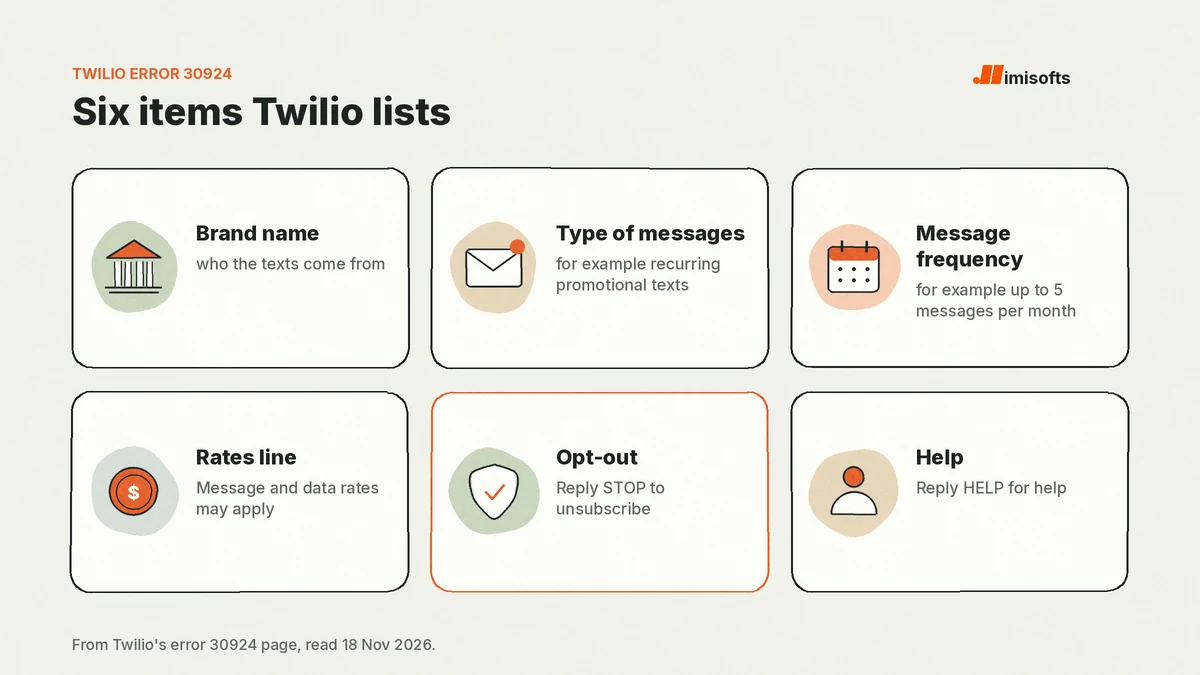
Twilio's error page says carriers "require that consumers are clearly informed about what types of messages they will receive, the frequency of messages, and how to opt out before they provide consent." Its fix lists six items, with these examples:
| # | Item | Twilio's example wording |
|---|---|---|
| 1 | Your brand name | "from Acme Co." |
| 2 | Type of messages | "recurring promotional text messages" |
| 3 | Message frequency | "Message frequency varies" or "Up to 5 messages per month" |
| 4 | Rates disclosure | "Message and data rates may apply." |
| 5 | Opt-out instructions | "Reply STOP to unsubscribe." |
| 6 | Help instructions | "Reply HELP for help." |
CTIA's guidance on calls-to-action overlaps with Twilio's list in five points of its own. A call-to-action, it says, "should ensure that Consumers are aware of: (1) the program or product description; (2) the telephone number(s) or short code(s) from which messaging will originate; (3) the specific identity of the organization or individual being represented in the initial message; (4) clear and conspicuous language about opt-in and any associated fees or charges; and (5) other applicable terms and conditions (e.g., how to opt-out, customer care contact information, and any applicable privacy policy)." CTIA also names the number or short code the texts will come from and the privacy policy, and its call-to-action list does not mention frequency. We would name the number in the opt-in whenever you know it.
Twilio's accepted example, and two it rejects
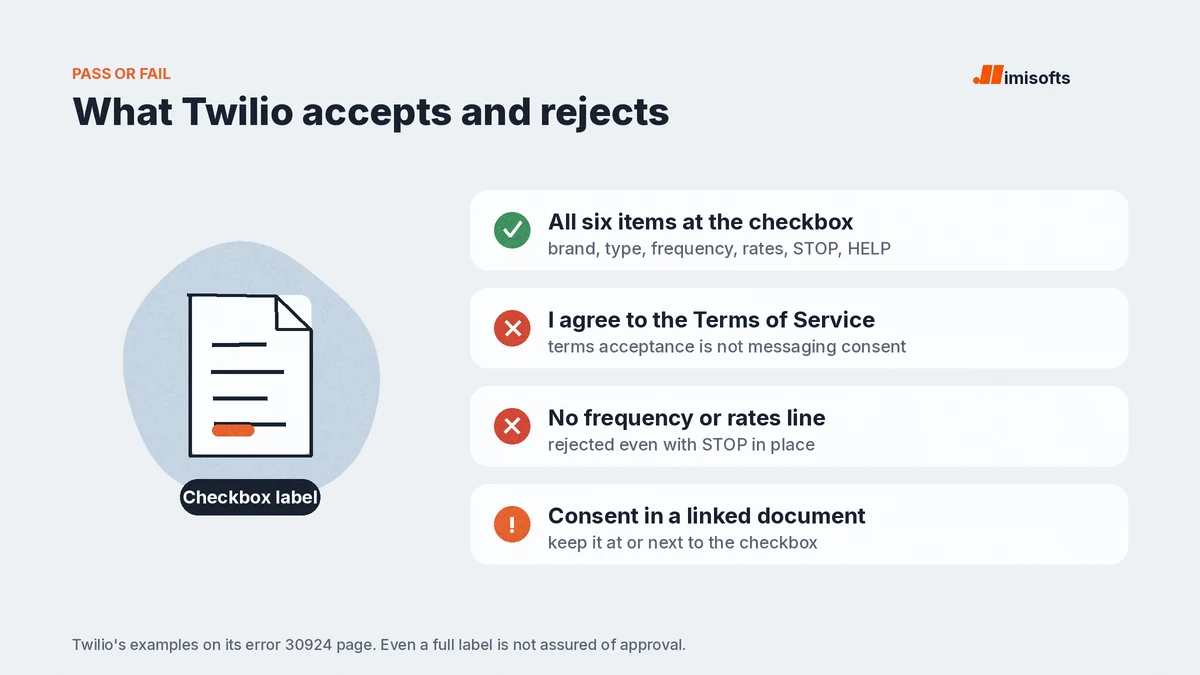
Twilio's own example of consent language at a checkbox, with the consent details it describes, reads: "I agree to receive recurring promotional text messages from Acme Co. Message frequency varies. Message and data rates may apply. Reply STOP to unsubscribe. Reply HELP for help. Terms: www.acme.com/terms. Privacy: www.acme.com/privacy."
Twilio adds that even this example does not assure approval. It shows two labels that would be rejected:
- "I agree to the Terms of Service." Twilio's verdict: "General Terms of Service acceptance does not constitute messaging consent."
- "By checking this box you agree to receive text messages from Acme Co. Reply STOP to cancel." Twilio says this one has opt-out instructions but is missing the message frequency and the rates disclosure.
For a non-promotional use, here is our own version for appointment reminders, built only from the six items. Set the frequency to what you actually send: "I agree to receive appointment reminder texts from [Brand] at the number above. Up to 4 messages per month. Message and data rates may apply. Reply STOP to opt out, HELP for help. Terms: [link]. Privacy: [link]."
Where the words sit matters as much as what they say. Twilio's checklist asks that the consent language appear at the checkbox or button, or right next to it, rather than inside a linked document. It also expects a website opt-in URL to be public, or else a URL with hosted screenshots of the full consent flow. CTIA puts it this way: "opt-in details should not be obscured in terms and conditions (especially terms related to other services)." Twilio also wants your privacy policy to state "that mobile numbers are not shared with third parties", along with the message frequency and the rates line.
What the TCPA adds for autodialed marketing texts
Carrier review is one gate and the TCPA is another. 47 CFR 64.1200 is the FCC's rule implementing the Telephone Consumer Protection Act. Under section 64.1200(a)(2), a call that "includes or introduces an advertisement or constitutes telemarketing", made "using an automatic telephone dialing system or an artificial or prerecorded voice" to the numbers the rule lists, needs "the prior express written consent of the called party". The rule's revocation paragraph refers to "calls or text messages made pursuant to paragraphs (a)(1) through (3)". We read that as covering such texts; confirm the point with counsel.
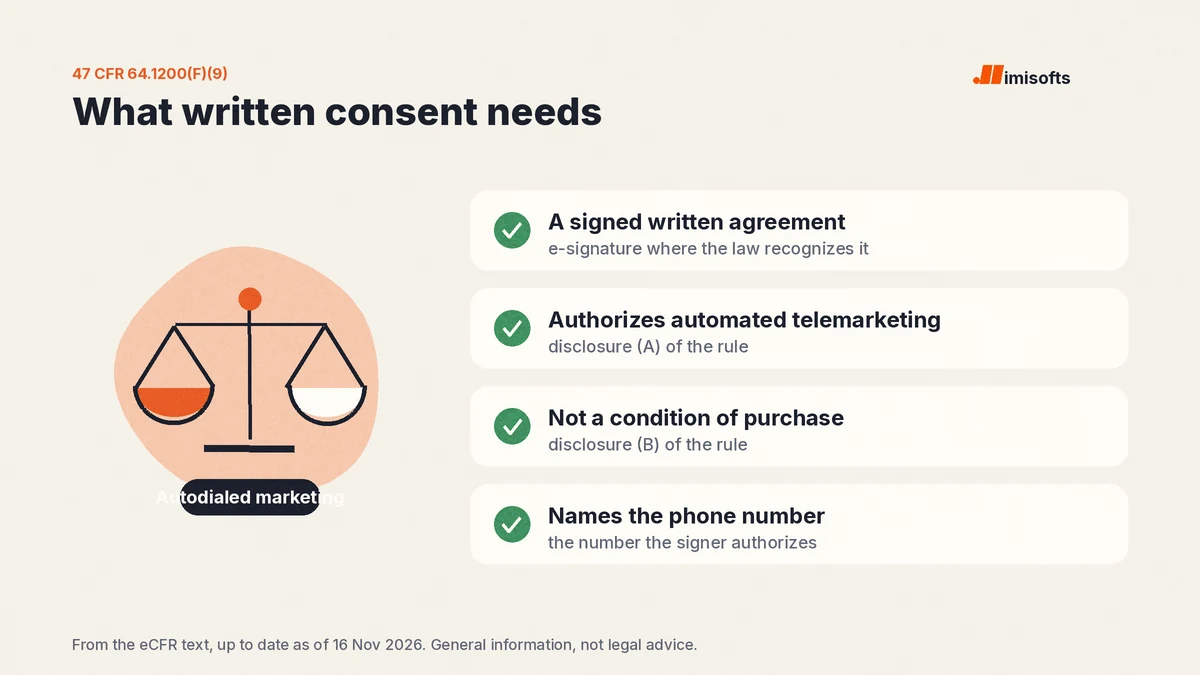
The regulation defines prior express written consent as "an agreement, in writing, bearing the signature of the person called" that authorizes the seller to send such messages and names "the telephone number to which the signatory authorizes such advertisements or telemarketing messages to be delivered." The written agreement must include "a clear and conspicuous disclosure" of two things:
- that by signing, the person "authorizes the seller to deliver or cause to be delivered to the signatory telemarketing calls using an automatic telephone dialing system or an artificial or prerecorded voice"; and
- that the person "is not required to sign the agreement (directly or indirectly), or agree to enter into such an agreement as a condition of purchasing any property, goods, or services."
An electronic or digital signature counts "to the extent that such form of signature is recognized as a valid signature under applicable federal law or state contract law."
Our suggestion for autodialed marketing texts: keep Twilio's six items, and add the rule's two disclosures, tracking the rule's own wording for (A) and (B) rather than a looser paraphrase. Have your lawyer check the final text. CTIA's guidance points the same way for promotional texts: "the Consumer should agree in writing to receive promotional texts." This is general information, not legal advice.
The confirmation text after sign-up
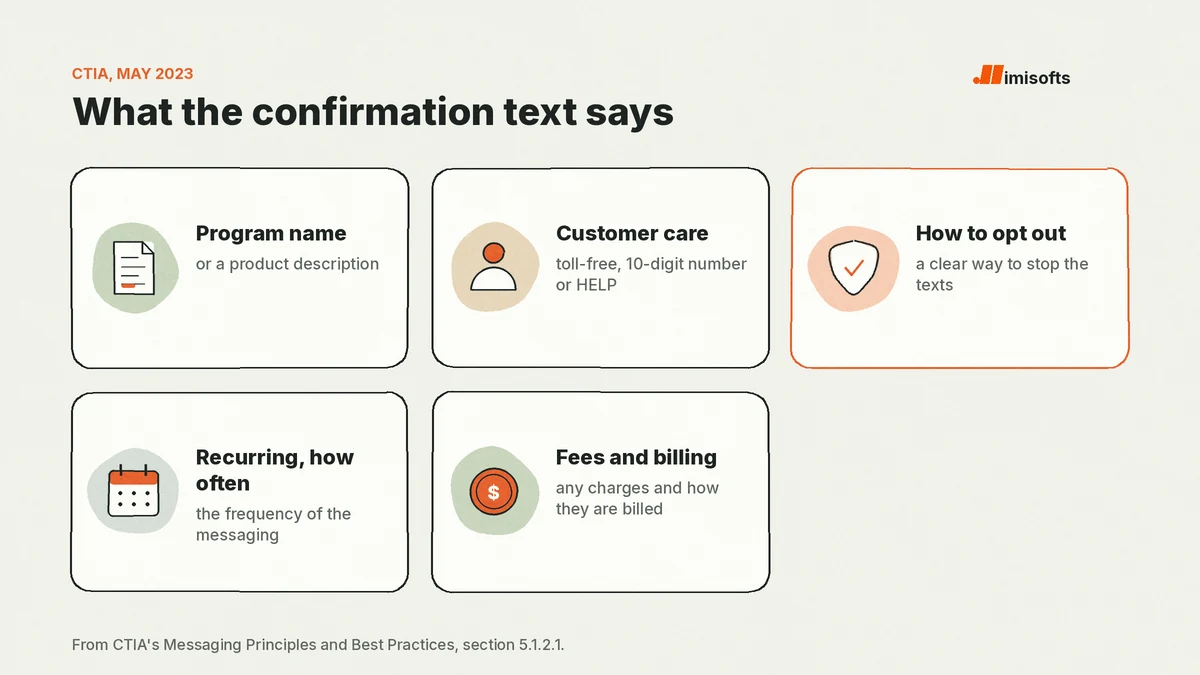
For recurring programs, CTIA says the sender "should send the Consumer an opt-in confirmation message before any additional messaging is sent." It lists what that message should include: "(1) the program name or product description; (2) customer care contact information (e.g., a toll-free number, 10-digit telephone number, or HELP command instructions); (3) how to opt-out; (4) a disclosure that the messages are recurring and the frequency of the messaging; and (5) clear and conspicuous language about any associated fees or charges and how those charges will be billed."
Twilio's checklist says the campaign's opt_in_message "includes the brand name, confirmation of enrollment, message frequency, and opt-out instructions." Our own sample, which covers Twilio's four items for the reminder label above: "[Brand]: You're signed up for appointment reminders. Up to 4 msgs/month. Msg and data rates may apply. Reply HELP for help, STOP to opt out."
What to keep as proof of consent
CTIA lists seven data points to retain "where applicable":
- the timestamp of consent;
- the consent acquisition medium, such as a cell-submit form, a physical sign-up form or an SMS keyword;
- a capture of the experience, meaning the language and action used to secure consent;
- the specific campaign the opt-in was for;
- the IP address used to grant consent;
- the phone number for which consent was granted; and
- the identity of the person who consented, such as a name, online user name or session ID.
We would store these with the contact record in your CRM, so the timestamp and the exact wording travel with the number. CTIA notes that opt-in procedures "can also help prevent messages from being sent to a phone number that does not belong to the Consumer who provided that phone number"; for numbers that change hands later, see our page on the reassigned numbers database.
Opt-out wording and the FCC's revocation rule
The opt-in language promises STOP, but for calls and texts made under paragraphs (a)(1) through (3) and (c)(2), the rule decides what counts as stopping. Under 47 CFR 64.1200(a)(10), a reply of "stop," "quit," "end," "revoke," "opt out," "cancel," or "unsubscribe" to an incoming text "constitutes a reasonable means per se to revoke consent." Other wording counts too, "if a reasonable person would understand those words to have conveyed a request to revoke consent." Requests "must be honored within a reasonable time not to exceed ten business days from receipt of such request", and senders "may not designate an exclusive means to request revocation of consent."
So while your opt-in text names STOP, we would set up the system to catch the other six words too, and to treat a plain reply asking you to stop texting as an opt-out. This is general information, not legal advice. Our page on TCPA opt-out requirements covers the rest of the opt-out side.
Opt-in mistakes to avoid
The first two are Twilio's rejected examples; the next four are items on Twilio's pre-submission checklist; the last is CTIA guidance.
- Terms of Service as consent. Accepting general terms is not messaging consent.
- No frequency or rates line. STOP alone is not enough.
- Consent in a linked document. Put it at or next to the checkbox.
- A private opt-in page. If the page is not public, provide a URL with hosted screenshots of the full flow.
- Missing opt-in paths. The campaign's message flow should name every method: website, keyword, paper form, verbal, QR code or other.
- A thin privacy policy. It should say mobile numbers are not shared with third parties and include the frequency and the rates line.
- One opt-in reused. CTIA: "A Consumer opt-in should apply only to the campaign(s) and specific Message Sender for which it was intended or obtained."
Twilio's other rejection reasons are on our page on Twilio's A2P 10DLC rejection codes, and the form problems behind them in A2P 10DLC campaign rejected.
What it means for teams that text leads
In our view, if your texts come from a CRM or an AI agent, the consent wording lives in at least four places: the opt-in point (web form, keyword reply or script), the campaign registration, the privacy policy and the first confirmation text. They should say the same thing, and the record of who agreed to what should sit with the contact. For how we approach consent when we set up AI calls and texts, see our page on TCPA compliant AI calling.
Frequently Asked Questions
For A2P 10DLC review, Twilio's error 30924 page lists six items: your brand name, the type of messages, the message frequency, "Message and data rates may apply", opt-out instructions such as "Reply STOP to unsubscribe", and help instructions such as "Reply HELP for help". CTIA's May 2023 guidance also asks for the number or short code the texts come from.
For Twilio's A2P 10DLC review, yes: Twilio lists a missing "message and data rates may apply" disclosure as one of the causes of error 30924, and its checklist wants the same line in your privacy policy.
Twilio's example reads: "I agree to receive recurring promotional text messages from Acme Co. Message frequency varies. Message and data rates may apply. Reply STOP to unsubscribe. Reply HELP for help. Terms: www.acme.com/terms. Privacy: www.acme.com/privacy." Twilio says even this example does not assure approval.
For telemarketing sent with an autodialer or an artificial or prerecorded voice, 47 CFR 64.1200 accepts an electronic or digital signature where federal law or state contract law recognizes it. The agreement must name the phone number and clearly disclose that the person authorizes such telemarketing and that signing is not a condition of purchase. CTIA's guidance lists checking a box online as one way to give written consent. This is general information, not legal advice.
For recurring programs, CTIA says the sender should send an opt-in confirmation before any other message. It should name the program, give customer care contact or HELP instructions, say how to opt out, disclose that messages recur and how often, and state any fees.
For calls and texts covered by 47 CFR 64.1200(a)(10), replying stop, quit, end, revoke, opt out, cancel or unsubscribe is a reasonable means per se, and other words count if a reasonable person would understand them as a request to revoke consent. Requests must be honored within a reasonable time, not more than ten business days. This is general information, not legal advice.