Ringless voicemail to a mobile number is legal only with the recipient’s consent, unless it is for an emergency. In a declaratory ruling released on 21 November 2022 (FCC 22-85), the FCC found that a message dropped straight into a mobile voicemail box is a “call” made with a prerecorded voice, so it needs prior express consent, and written consent under the FCC’s rules if it sells. On two vendors’ price lists I read on 28 October 2026, a drop costs 3.5 to 12 cents; the statute sets damages at $500 for each violation.
Slybroadcast, which sells ringless voicemail, says in its FAQ that it is “less intrusive than a phone call.” In 2022 the FCC rejected a petitioner’s argument that ringless voicemail is non-invasive; as commenters and complainants explained, “consumers cannot block these messages.”
No ring does not mean no call. A voicemail drop is a prerecorded call, and a cloned voice does not change that.
Key numbers
| Item | Number |
|---|---|
| FCC ruling that ringless voicemail is a call, released (FCC 22-85, effective on release) | 21 November 2022 |
| Petition the FCC denied, filed (All About the Message, LLC) | 31 March 2017 |
| Comments and replies on that petition (almost all opposed) | Over 8,000 |
| FCC ruling that AI voices fall under voice rules, released (FCC 24-17) | 8 February 2024 |
| Opt-out offer after the business name, marketing drops (47 CFR 64.1200(b)(3)) | Within 2 seconds |
| Opt-out a marketing voicemail must give (connects to the automated opt-out) | Toll-free number |
| Statutory damages per violation (up to three times if willful or knowing) | $500 |
| Drop Cowboy Starter plan (2,083 voicemails or texts) | $125 a month |
| Slybroadcast smallest pack (100 delivered drops) | $12 |
| Per delivered drop on the plans read | 3.5 to 12 cents |
| Florida damages, section 501.059 (whichever is greater) | $500 or actual damages |
| Opt-out designation rule takes effect (existing marketing opt-outs unchanged) | 25 November 2026 |
Read on 28 October 2026 from FCC 22-85 and FCC 24-17 on fcc.gov, 47 CFR 64.1200 on eCFR, 47 U.S.C. 227 on LII, the Federal Register (91 FR 67214), Florida Statutes 501.059 on flsenate.gov and the Drop Cowboy and Slybroadcast pricing pages.
What the FCC ruled in 2022
The ruling answered a petition All About the Message, LLC filed on 31 March 2017. The company asked the FCC to find that its messages needed no consent. It drew over 8,000 comments and replies, almost all opposed, and the FCC denied the petition.
The reasoning: the sender addresses the message with the consumer’s wireless number, as with an Internet-to-phone text, which the FCC had already treated as a call in 2015. The ruling applies to “any entity that provides ringless voicemail using the end user’s mobile telephone number,” took effect on release, and leaves the autodialer definition out of it, because ringless voicemail uses “an artificial or prerecorded voice.”
A cloned or AI voice is still a prerecorded call
Drop Cowboy, which also sells ringless voicemail, lists “AI voice included” on its pricing page and offers to personalize each drop “in your cloned voice.” In a ruling released on 8 February 2024 the FCC confirmed that the TCPA’s limits on an “artificial or prerecorded voice” cover “current AI technologies that generate human voices” (FCC 24-17). My reading: a drop in a clone of your voice is an artificial or prerecorded voice call, as an AI cold call is.
A message delivered straight to a cell phone’s voicemail is not covered by the TCPA, so it needs no consent.
The FCC denied the petition in FCC 22-85, effective on release in November 2022.
It is a “call” made using an artificial or prerecorded voice.
So it needs consent, the business name and a callback number; a marketing drop also owes the opt-out and a toll-free opt-out line.
What consent you need before the first drop
For a drop to a mobile number, 47 CFR 64.1200(a)(1)(iii) requires the called party’s prior express consent unless the message is for an emergency or fits one of the rule’s listed exemptions. If the drop advertises or is telemarketing, paragraph (a)(2) requires prior express written consent (with exceptions for tax-exempt nonprofits and HIPAA health care messages): an agreement bearing the person’s signature that authorizes the seller to deliver advertisements or telemarketing messages using an artificial or prerecorded voice to a named phone number.
My reading: a number typed into a contact form does not meet that test on its own, so if a drop mentions a price, an offer or a listing, plan for written consent. A reminder with no offer sent to a mobile number, such as a home services company’s appointment reminder, falls under the prior express consent rule, not the written one.
What every drop has to say
Paragraph (b) decides the script: the message must open with the business’s name as registered with its state and give a callback number during or after the message. For advertising or telemarketing, it must offer an automated voice or key press opt-out within two seconds of that introduction.
For drops, the last sentence of (b)(3) matters most: a message left on “an answering machine or a voice mail service” must also give a toll-free number that connects directly to that automated opt-out and records the number on the caller’s do-not-call list. A ringless drop always lands in a voice mail box, so every marketing drop owes that toll-free line.
From 25 November 2026 callers may designate an exclusive means to revoke consent, but the order “does not alter the existing opt-out methods” for calls made under an exemption or that advertise or telemarket (see TCPA opt-out requirements).
What a drop costs, and what it costs without consent
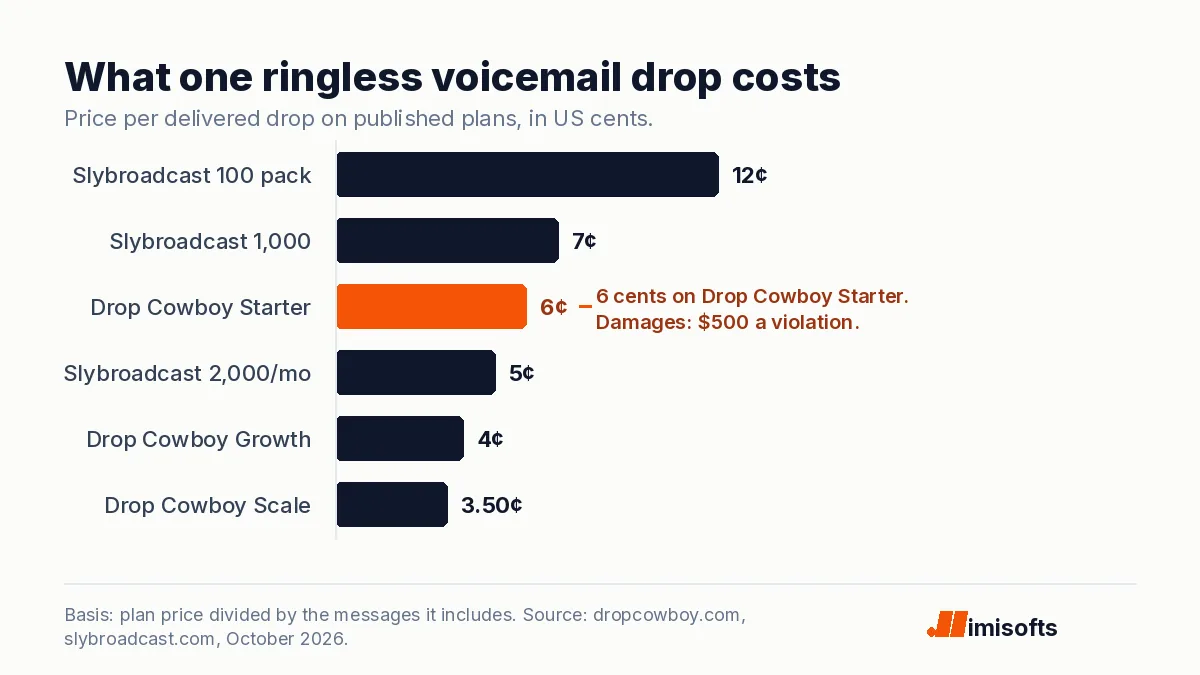
On the two price lists I read on 28 October 2026, a delivered drop costs between 3.5 and 12 cents:
| Plan | Price | Per drop |
|---|---|---|
| Slybroadcast, 100 drops | $12 once | 12 cents |
| Slybroadcast, 1,000 drops | $70 once | 7 cents |
| Drop Cowboy Starter, 2,083 messages | $125 a month | 6 cents |
| Slybroadcast, 2,000 drops | $100 a month | 5 cents |
| Drop Cowboy Growth, 4,375 messages | $175 a month | 4 cents |
| Drop Cowboy Scale, 7,143 messages | $250 a month | 3.5 cents |
Sources: Drop Cowboy (US rates; a message is a voicemail or text) and Slybroadcast; price divided by messages included.
47 U.S.C. 227(b)(3) lets a person sue for $500 for each violation, or actual losses if higher, and a court may award up to three times that if it finds the violation willful or knowing. $500 is what about 8,300 drops cost on Drop Cowboy’s Starter plan. In a hypothetical 2,000-drop campaign to mobile numbers on Slybroadcast’s $100 monthly plan, if every drop were a violation, statutory damages at $500 each could reach $1,000,000.
Both vendors put the law on you. Drop Cowboy’s pricing footnote says its US plans come “with AI voice and compliance included,” while its Acceptable Use Policy tells customers to “obtain and retain verifiable consent appropriate for your channel and jurisdiction before messaging any contact.” Slybroadcast’s terms make customers “solely responsible” for complying with laws including the TCPA.
Florida names voicemail in its own law
Florida’s section 501.059 defines a “voicemail transmission” as technology that delivers “a voice message directly to a voicemail application, service, or device,” counts one as a telephonic sales call when it sells, and bars unsolicited sales calls that involve “the playing of a recorded message” without prior express written consent. Calls at the person’s request or to an existing business relationship are not “unsolicited.” A Florida recipient can sue for $500 or actual damages, whichever is greater (hours and call caps: telemarketing laws by state).
How I would run a voicemail drop
My team has delivered 500+ projects across 30 countries, and before any ringless campaign I would settle four things:
Match consent to the message
Keep a consent record for every number: written consent for anything that sells, prior express consent for reminders and the booking confirmations an AI answering service for HVAC sends. No record, no drop.
Script the opening of every drop
For a marketing drop I would open with the registered business name, give the opt-out instructions and the toll-free opt-out number within two seconds, then your callback number.
Treat AI voices as prerecorded
A cloned voice changes nothing about consent or the script, whichever of the AI voice agent platforms or drop vendors you use.
Wire the opt-out to your list
The toll-free line has to record the number on your do-not-call list by itself. Test it, as you would spoken opt-outs on live AI calls, and suppress opted-out numbers before every send.
Consent records and a working opt-out are the layer we focus on in AI calling built around TCPA consent.
The bottom line
Ringless voicemail is a call. Hold the right consent for each number, open with your registered name and give every marketing drop a toll-free opt-out that writes to your do-not-call list. Cents to send, $500 a violation to get wrong. For calls outside the US, see our guides to Canada and South Africa. I am not a lawyer, and this is not legal advice.