Short answer. Standard contractual clauses (SCCs) are a fixed contract text, adopted by the European Commission on June 4, 2021 in Implementing Decision (EU) 2021/914, that lets a company send personal data from the EU to a country without an EU adequacy decision. They come in 4 modules (controller to controller, controller to processor, processor to processor, processor to controller), and the parties may not modify the text beyond picking modules and filling in the appendix.
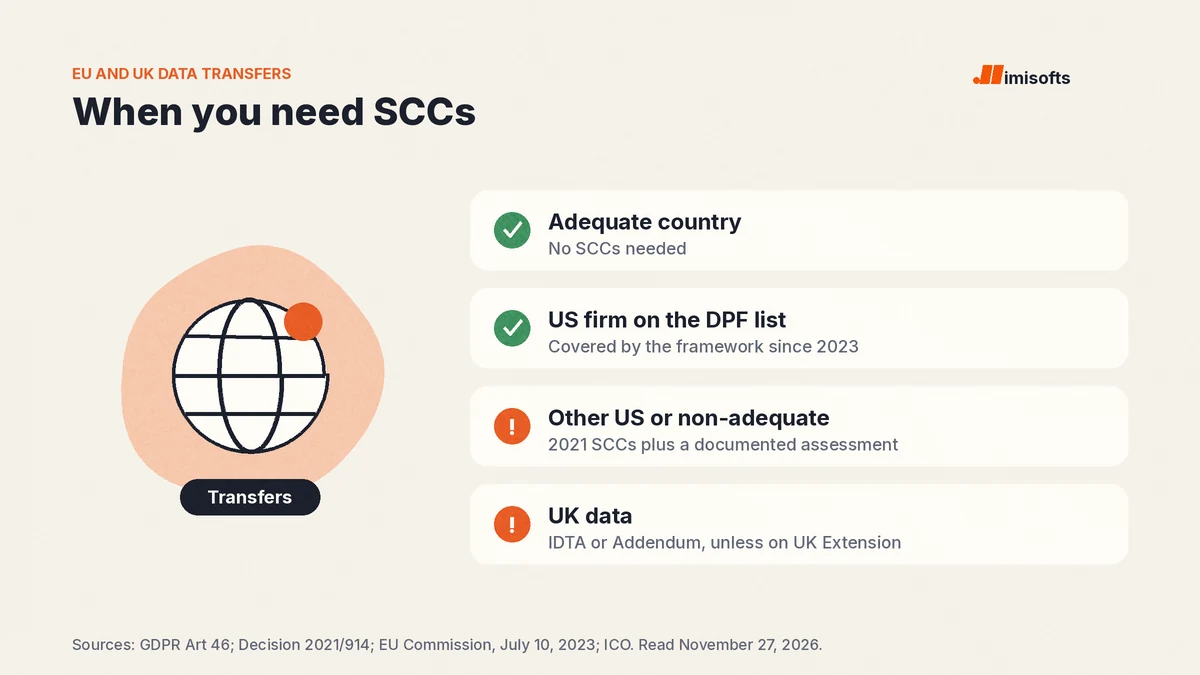
You need them when a transfer leaves the EU for a country without an adequacy decision and no other Article 46 safeguard covers it. For US recipients, transfers to a company certified under the EU-U.S. Data Privacy Framework (in force since July 10, 2023) need no additional safeguards, according to the Commission. Getting transfers wrong is costly: Ireland's regulator fined Meta €1.2 billion in May 2023 over US transfers made on the 2021 SCCs.
This guide covers what the clauses are, when you need them, the four modules, the transfer impact assessment, the US framework, the UK versions and a checklist for an outbound email stack. If your sending setup runs on US tools, our email infrastructure service sets up the domains and mailboxes. Sources were read on November 27, 2026. This is general information, not legal advice.
Key numbers
| Item | Number |
|---|---|
| SCC modules (Decision 2021/914) | 4 |
| New SCCs adopted (European Commission) | Jun 4, 2021 |
| Old SCC contracts valid until (Decision 2021/914, Art 4(4)) | Dec 27, 2022 |
| EU-U.S. Data Privacy Framework (Adequacy decision adopted) | Jul 10, 2023 |
| UK Extension (data bridge) (dataprivacyframework.gov) | Oct 12, 2023 |
| Meta transfer fine (Irish DPC decision, May 12, 2023) | €1.2B |
| Maximum GDPR transfer fine (Of an undertaking's turnover, or €20M if higher) | 4% |
Commission Decision (EU) 2021/914 and GDPR (EUR-Lex); European Commission IP/23/3721; dataprivacyframework.gov; ICO; Irish Data Protection Commission. Read November 27, 2026.
What standard contractual clauses are
Article 1(1) of the Commission's decision says the clauses "provide appropriate safeguards within the meaning of Article 46(1) and (2)(c)" of the GDPR for a transfer by a controller or processor (the data exporter) to a controller or (sub-)processor "whose processing of the data is not subject to that Regulation" (the data importer).
That matters because Article 46(1) of the GDPR allows a transfer to a third country without an adequacy decision "only if the controller or processor has provided appropriate safeguards, and on condition that enforceable data subject rights and effective legal remedies for data subjects are available." Commission clauses are one of the safeguards listed in Article 46(2), and they need no "specific authorisation from a supervisory authority". The others include binding corporate rules and approved codes of conduct.
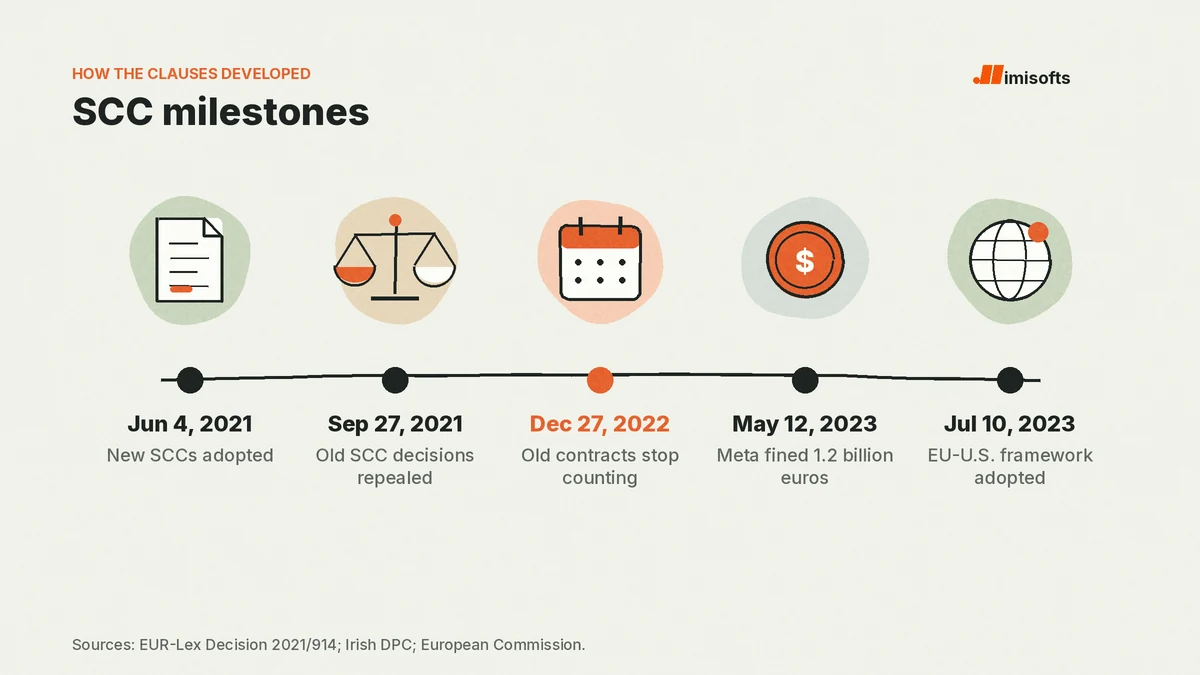
The 2021 clauses replaced two older sets. The decisions behind them (2001/497/EC and 2010/87/EU) were repealed from September 27, 2021. Contracts signed on the old clauses before that date stayed valid until December 27, 2022, 456 days later, provided the processing did not change. A transfer can no longer rely on the old clauses.
| Date | What happened | Source |
|---|---|---|
| June 4, 2021 | Commission adopts the new SCCs (Decision 2021/914) | EUR-Lex |
| September 27, 2021 | Old SCC decisions repealed | Decision 2021/914, Art 4 |
| December 27, 2022 | End of the grace period for contracts on the old clauses | Decision 2021/914, Art 4(4) |
| May 12, 2023 | Irish DPC decision: Meta fined €1.2 billion over US transfers | DPC |
| July 10, 2023 | EU-U.S. Data Privacy Framework adequacy decision | European Commission |
Done for you by imisofts
Need your cold email infrastructure set up properly?
We buy and configure the domains and inboxes, set SPF, DKIM and DMARC, and warm everything up, so sending starts in about 14 days.
When a transfer needs SCCs
Work through three questions for each tool, vendor or partner that receives EU personal data:
- Does the data go to a third country? Article 46 governs transfers to a third country or an international organisation.
- Is the destination covered by an adequacy decision? If so, no SCCs are needed. For the US, adequacy covers only companies that have joined the Data Privacy Framework.
- Do the 2021 clauses fit this importer? They are drafted for importers whose processing is not subject to the GDPR, in the words of Article 1(1). If yours is, ask your adviser which tool fits.
If the data goes to a third country with no adequacy decision, you need a safeguard under Article 46, and the SCCs are the one that needs no approval from a regulator and no group structure. Clause 2(a) lets them sit inside a wider contract, such as a vendor's data processing agreement. Our guide to the data processing agreement explains the Article 28 terms that usually sit next to them.
The four SCC modules
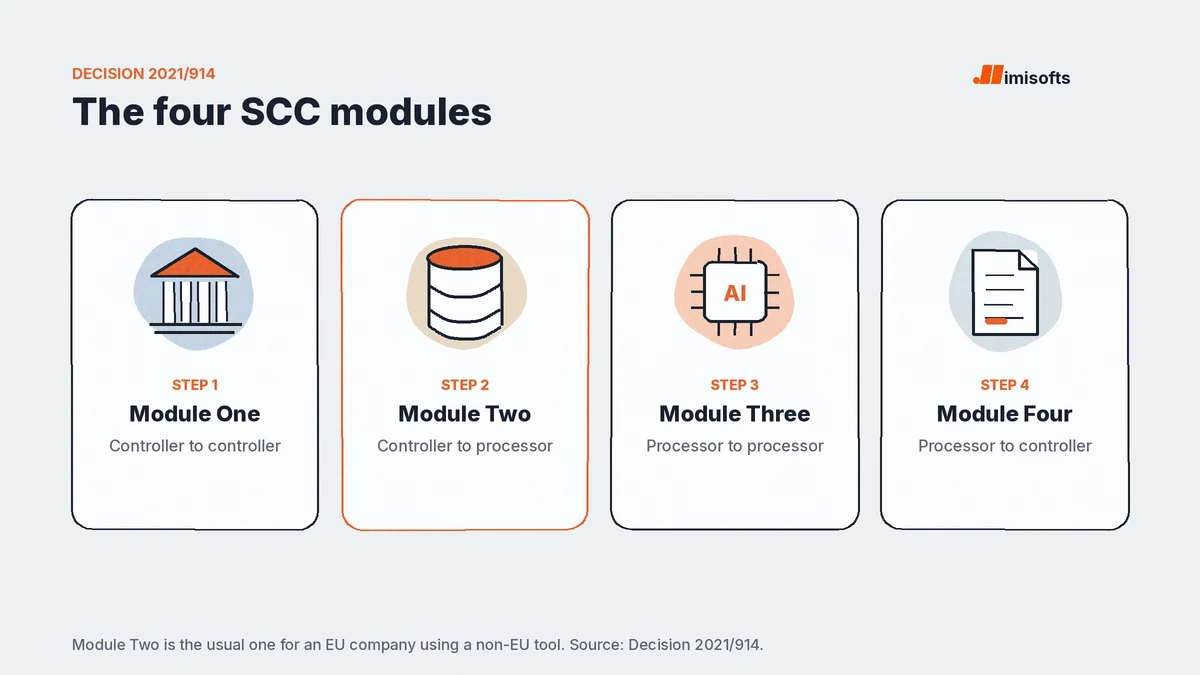
The decision sets out one text with four modules. You pick the one that matches each party's role. If you are unsure which role you play, our guide to data controller vs data processor walks through the tests.
| Module | Exporter to importer | Typical example |
|---|---|---|
| Module One | Controller to controller | Two companies that each decide how they use shared customer data |
| Module Two | Controller to processor | An EU company using a non-EU software tool or service provider |
| Module Three | Processor to processor | An EU agency passing client data to a non-EU sub-processor |
| Module Four | Processor to controller | An EU processor sending data back to its controller outside the EU |
The examples are ours, for illustration. Article 1(2) adds that for controller to processor and processor to sub-processor transfers, the clauses also cover the matters in GDPR Article 28(3) and (4), the usual processor contract terms.
What the clauses require
A few clauses do most of the work:
- Clause 2: no rewriting. The clauses give safeguards "provided they are not modified, except to select the appropriate Module(s) or to add or update information in the Appendix." You may put them inside a wider contract and add safeguards, as long as nothing contradicts them.
- Clause 3: rights for the people in the data. "Data subjects may invoke and enforce these Clauses, as third-party beneficiaries, against the data exporter and/or data importer", with some listed exceptions.
- Clause 7: the docking clause (optional). A new party can join later "by completing the Appendix and signing Annex I.A", which suits a growing group of vendors or affiliates.
- Clause 14: local laws. The parties warrant they have no reason to believe the destination's laws and practices, including rules on access by public authorities, stop the importer from complying.
- Clause 17: governing law. Option 1 is the law of an EU Member State that allows third-party beneficiary rights; Modules Two and Three also have an Option 2.
The Appendix is where the details go, starting with the parties in Annex I.A. A record of your data flows, such as a record of processing activities, makes the annexes quick to fill.
The transfer impact assessment
Signing the clauses is not enough on its own. Under Clause 14(b), the warranty must take account of "the specific circumstances of the transfer", including "the length of the processing chain", "intended onward transfers", "the type of recipient", "the purpose of processing", "the categories and format of the transferred personal data" and "the storage location of the data".
Clause 14(d) then says the parties "agree to document the assessment" and "make it available to the competent supervisory authority on request." This written record is often called a transfer impact assessment. The European Data Protection Board has also published Recommendations 01/2020 on measures that supplement transfer tools (final version, June 18, 2021).
For high-risk processing, the transfer assessment often sits alongside a DPIA, but the two answer different questions: one is about the destination's laws, the other about risk to people from the processing itself.
SCCs vs the EU-U.S. Data Privacy Framework
On July 10, 2023 the European Commission adopted an adequacy decision for the EU-U.S. Data Privacy Framework. Its press release says personal data "can flow safely from the EU to US companies participating in the Framework, without having to put in place additional data protection safeguards." US companies join by self-certifying to the International Trade Administration and publicly committing to the framework's principles, according to the Department of Commerce's program site.
| Question | Data Privacy Framework | Standard contractual clauses |
|---|---|---|
| Who it covers | Only US companies that have self-certified | Importers not subject to the GDPR, in non-adequate countries |
| Contract to sign | None for the transfer itself | The 2021 SCCs with the right module and annexes |
| Transfer impact assessment | No additional safeguards needed (Commission) | Required and documented (Clause 14) |
| UK data | UK Extension, from October 12, 2023 | Only with the ICO Addendum, or use the IDTA |
| Swiss data | Swiss-U.S. DPF, from September 15, 2024 | Not covered in this guide |
The quick test: look the vendor up on the framework's list before you sign anything. If it is certified for the data you send, the framework covers the transfer. If not, you need SCCs. The Commission also notes that the US safeguards adopted for the framework "also apply when data is transferred by using other tools, such as standard contractual clauses", which is relevant to a US transfer assessment. The framework itself is subject to periodic reviews by the Commission. If you also sell into Switzerland, see our note on Swiss cold calling rules for the outbound side.
The UK version: the IDTA and the Addendum
The EU clauses do not work on their own for UK data. The ICO says it has issued "two sets of standard data protection clauses for restricted transfers": the International Data Transfer Agreement (IDTA) and the International Data Transfer Addendum. "The EU SCCs are not valid on their own for restricted transfers under the UK GDPR. However, using the Addendum lets you rely on the EU SCCs".
The ICO says you can choose either, and the Addendum "may appeal to you" if you operate in both the UK and the EEA and already use the EU SCCs. It also says it plans "to update the IDTA and Addendum in the course of 2026" and that organisations "should continue to use the current versions" until then. For other UK changes, see our guide to the Data (Use and Access) Act.
Fines, and the Meta case
Under GDPR Article 83(5)(c), breaking the transfer rules in Articles 44 to 49 carries fines of up to €20 million or, for an undertaking, 4% of worldwide annual turnover, whichever is higher. For a hypothetical company with €1 billion in turnover, 4% is €40 million.
The Meta case shows that signing SCCs is not the end of the job. In its May 22, 2023 announcement, the Irish Data Protection Commission said Meta Ireland had transferred personal data to the US "on the basis of the updated Standard Contractual Clauses" with supplementary measures, but that these "did not address the risks" set out in the EU Court of Justice's judgment in Data Protection Commissioner v Facebook Ireland and Schrems. The decision of May 12, 2023 imposed a fine of €1.2 billion and ordered Meta to suspend future transfers to the US within five months. For more cases, see our roundup of GDPR fines.
SCCs in a cold email or outbound stack
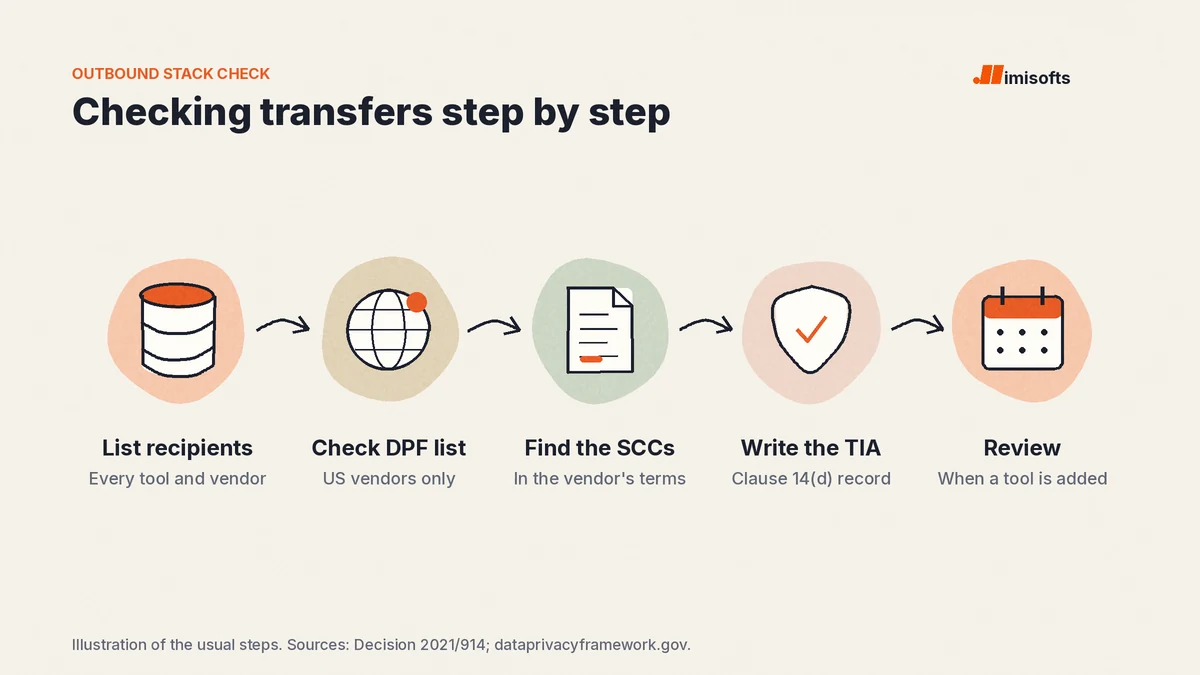
A typical outbound team targeting EU prospects might use a US data provider, a US sending platform, a CRM and an agency. This is how we would approach the transfers:
- List every recipient. Each tool, vendor and contractor that stores or can access prospect data, and the country it processes in.
- Check the framework list. For each US vendor, confirm it is certified under the Data Privacy Framework (and the UK Extension, for UK data).
- Find the SCCs in the vendor's terms. For vendors that are not certified, or outside the US and any adequate country, look for the 2021 SCCs (Module Two for a tool acting as your processor) and, for UK data, the IDTA or the Addendum.
- Write the transfer impact assessment. Short and specific: what data, where it goes, the destination's laws, and the measures in place.
- Keep it current. Repeat the check when you add a tool. The same inventory feeds your GDPR cold email compliance work and your notice to prospects.
Mailbox hosting can involve a transfer too, if the provider processes data outside the EEA. Our guide to email hosting cost compares the main providers.
How imisofts can help
Our email infrastructure work sets up sending domains and mailboxes for B2B outbound teams. On a stack we set up, we can help list each tool and where it says it processes data, so your adviser has the facts in one place. The legal judgment on your transfers stays with you and your adviser. See our email infrastructure service or talk to us about your setup.
Frequently Asked Questions
They are a contract text adopted by the European Commission on June 4, 2021 (Decision 2021/914) that counts as an appropriate safeguard under GDPR Article 46 for sending personal data to a country without an adequacy decision. The parties pick one of 4 modules and fill in the annexes, but may not change the clauses.
No. The old decisions were repealed from September 27, 2021, and contracts signed on them before that date were valid only until December 27, 2022, if the processing did not change. Transfers can no longer rely on the old clauses.
Not if the vendor is certified under the EU-U.S. Data Privacy Framework, which has covered transfers to participating US companies since July 10, 2023. If the vendor is not certified, you need a safeguard such as the 2021 SCCs, which require a documented assessment of the destination's laws (Clause 14(d)).
It depends on the roles. Module One is controller to controller, Module Two controller to processor, Module Three processor to processor and Module Four processor to controller. An EU company using a non-EU software tool is usually on Module Two.
Not on their own. The ICO says the EU SCCs are not valid alone for restricted transfers under the UK GDPR. You can use the UK International Data Transfer Agreement, or attach the ICO's Addendum to the EU SCCs.
GDPR Article 83(5) allows fines of up to 20 million euros or, for an undertaking, 4% of worldwide annual turnover, whichever is higher. Ireland's regulator fined Meta 1.2 billion euros in May 2023 over US transfers made on the 2021 SCCs.