How much are GDPR fines? For a breach of the lawful basis rule (Article 6) or the right to object to marketing (Article 21), Article 83(5) allows fines up to 20 million euros or, for an undertaking, 4% of total worldwide annual turnover of the preceding financial year, whichever is higher. There is no per-email or per-record rate. The European Data Protection Board’s fine guidelines (version 2.1, adopted 24 May 2023) call their starting figures “not fixed amounts (price tags)”.
My view: the 4% headline scares the wrong people. For a small sender, the seriousness rating and, where the authority applies it, the EDPB’s size adjustment matter more. In the UK, marketing email to individual subscribers falls under a separate law, PECR.
In my view, the €20m or 4% cap is the ceiling, not the price. For a small sender, the seriousness rating and, if applied, the size adjustment shape the starting range.
Key numbers
| Item | Number |
|---|---|
| GDPR Article 83(5) cap (for an undertaking, whichever is higher; principles, lawful basis, consent, rights) | €20m or 4% of turnover |
| GDPR Article 83(4) cap (for an undertaking, whichever is higher; Articles 8, 11, 25 to 39, 42 and 43) | €10m or 2% of turnover |
| EDPB starting amount, low seriousness (of the applicable legal maximum) | 0 to 10% |
| EDPB starting amount, medium seriousness (of the applicable legal maximum) | 10 to 20% |
| EDPB starting amount, high seriousness (of the applicable legal maximum) | 20 to 100% |
| EDPB size adjustment, turnover up to €2m (of the starting amount; authorities may consider it, no obligation) | 0.2% to 0.4% |
| EDPB size adjustment, €2m up until €10m (of the starting amount; authorities may consider it, no obligation) | 0.3% to 2% |
| EDPB size adjustment, €10m up until €50m (of the starting amount; authorities may consider it, no obligation) | 1.5% to 10% |
| UK higher maximum, listed PECR regulations (since 5 February 2026; for an undertaking, whichever is higher; includes regulation 22) | £17.5m or 4% of turnover |
| ICO PECR fine on ZMLUK (announced 20 January 2026) (67,772,285 marketing emails sent in 2023) | £105,000 |
| CNIL fine on KASPR (5 December 2024) (database of about 160 million contacts) | €240,000 |
| EDPB Guidelines 04/2022, version 2.1, adopted | 24 May 2023 |
Read on 16 November 2026 from GDPR Article 83 on EUR-Lex, EDPB Guidelines 04/2022 version 2.1, section 157 of the Data Protection Act 2018, Schedule 13 of the Data (Use and Access) Act 2025, S.I. 2026/82, PECR regulation 22, and ICO and CNIL releases.
The GDPR fine caps, and where cold email lands
Article 83 sets its fines in paragraphs 4, 5 and 6; for cold email the two caps that matter are 83(4) and 83(5). All are “whichever is higher” caps for an undertaking. Under Article 83(3), if a controller or processor intentionally or negligently infringes several provisions for the same or linked processing operations, the total “shall not exceed the amount specified for the gravest infringement.”
| Tier | Cap for an undertaking | What it covers |
|---|---|---|
| GDPR Article 83(4) | €10m or 2% of worldwide annual turnover | The obligations of the controller and the processor under Articles 8, 11, 25 to 39, 42 and 43 |
| GDPR Article 83(5) | €20m or 4% of worldwide annual turnover | Articles 5, 6, 7 and 9 (principles, lawful basis, consent), rights in Articles 12 to 22, transfers |
| UK PECR, since 5 February 2026 | £17.5m or 4% of total annual worldwide turnover | Listed regulations, including 22 (email to individual subscribers) |
On my reading, a cold email list with no lawful basis, or one that keeps mailing after an objection, sits in the upper tier. Article 21(3) says that where a person objects to processing for direct marketing purposes, the data “shall no longer be processed for such purposes.” An illustrative example in the EDPB guidelines, a telephone company using customer details “for telemarketing purposes without a valid legal basis”, is rated a “high level of seriousness”, where 4 million customers were affected and the company went against its data protection officer’s advice, so the breach was considered intentional. This is general information, not legal advice.
How a GDPR fine is calculated: the EDPB’s five steps
The EDPB’s Guidelines 04/2022 (version 2.1) set five steps: identify the processing operations and evaluate the application of Article 83(3); find a starting point from the tier, the seriousness and the turnover; adjust for aggravating and mitigating circumstances; check the legal maximum; test effectiveness, dissuasiveness and proportionality. For seriousness, the starting amount sits “at a point between 0 and 10% of the applicable legal maximum” for low, between 10 and 20% for medium, and between 20 and 100% for high.
For turnover of up to €2m, authorities “may consider” proceeding on a sum between 0.2% and 0.4% of that starting amount; from €2m up until €10m, 0.3% to 2%; from €10m up until €50m, 1.5% to 10%. Paragraph 68 adds that an authority is “under no obligation to apply this adjustment” if effectiveness, dissuasiveness and proportionality do not need it. These are EU guidelines; I have not checked how the ICO sizes UK fines.
What that means for a €3m sender (hypothetical)
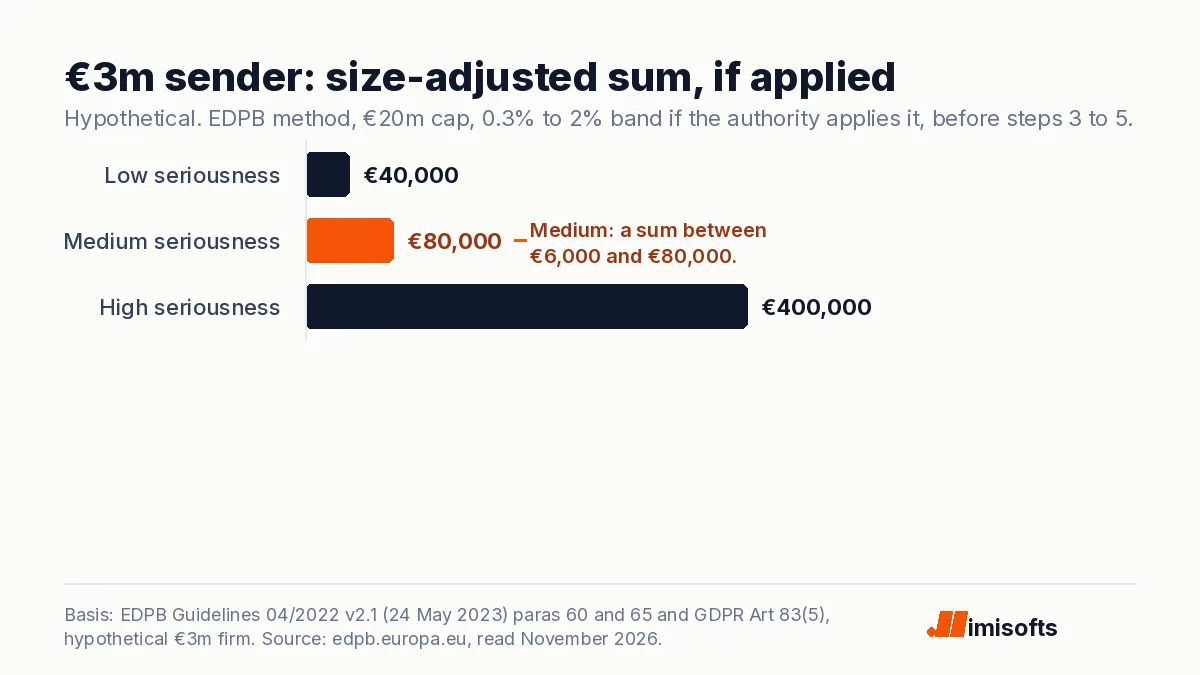
Take a hypothetical sender with €3m annual turnover that emails EU prospects with no lawful basis. 4% of €3m is €120,000, so the €20m figure is higher and becomes the legal maximum. Rated medium, the starting amount would sit between €2m and €4m, and the €2m to €10m size band (0.3% to 2%), if the authority applies it, puts the calculation on a sum between €6,000 and €80,000. On the same basis, rated low, up to €40,000; rated high, between €12,000 and €400,000.
These are starting sums, not a forecast. Steps 3 and 5 can move them up or down; step 4 caps them at €20m. An authority “has the discretion to utilise the full fining range from any amount until the legal maximum”.
The UK: PECR regulation 22 and the higher maximum
PECR regulation 22 “applies to the transmission of unsolicited communications by means of electronic mail to individual subscribers.” Schedule 13 of the Data (Use and Access) Act 2025 gives regulations 5, 6, 7, 8, 14, 19, 20, 21, 21A, 21B, 22, 23 and 24 the Data Protection Act 2018’s “higher maximum amount”. Section 157(5) sets it, for an undertaking, at “£17,500,000 or 4% of the undertaking's total annual worldwide turnover in the preceding financial year, whichever is higher”, and at £17,500,000 in any other case. S.I. 2026/82 brought section 115 of the 2025 Act into force on 5 February 2026, and the ICO’s statement that day says the Act lets it “issue fines of up to £17.5 million or 4% of global turnover” under PECR. See our UK cold email laws and UK cold calling guides. This is general information, not legal advice.
Two real fines, one GDPR and one PECR
On 20 January 2026 the ICO said it fined ZMLUK Limited £105,000 under PECR for 67,772,285 marketing emails sent between January and July 2023 without valid consent. The emails and the fine both predate the 5 February 2026 maximum. People had been shown “a long list of 361 ‘partner’ companies”, with no way to choose. The ICO held ZMLUK responsible “as the sender”, though it sent for another company. That is about 0.15p an email, my division; the ICO’s release states no per-email method.
On 5 December 2024 the CNIL fined KASPR 240,000 euros for four GDPR breaches, including no legal basis under Article 6 and no proportionate retention period (see our GDPR retention period guide). Its database held “about 160 million contacts”, so the fine is about €0.0015 per contact, again my division; the release states no per-contact method. For the US rules, see our guide to CAN-SPAM penalties.
Buy a list that says it is consented, with consent given to a long partner list, and mail it on a client’s behalf (illustrative).
The ICO said people saw 361 ‘partner’ companies “without any mechanism to choose which organisations could contact them”, and fined the sender.
My suggestion: before import, check how each record’s consent or lawful basis was obtained, and keep that evidence with the record.
The ICO said ZMLUK “relied heavily on third-party data without carrying out sufficient due diligence checks to understand how consent was obtained.”
Four checks before your next send
Name your lawful basis per campaign
Article 6 sits in the Article 83(5) tier. My suggestion: if you rely on legitimate interests, write a legitimate interest assessment before the first send. In the UK, email to individual subscribers also needs consent or the soft opt-in under PECR regulation 22.
Honour every objection across tools
Article 21(3): after an objection to direct marketing, the data shall no longer be processed for direct marketing. My suggestion: one suppression list shared by every sending tool.
Vet bought data
My suggestion: ask the vendor how consent was obtained and for whom, and drop records whose consent named a long partner list.
Keep a record of what you fixed
Article 83(2)(k) covers “any other aggravating or mitigating factor”, and the EDPB’s step 3 weighs past or present behaviour. My suggestion: date every fix.
My team’s record: 500+ projects delivered across 30 countries. Our email infrastructure page covers one-click unsubscribe, suppression and list validation; whether your sending is lawful is for you and your lawyer to decide. For the sending side, see email hosting cost and what an email deliverability consultant costs.
The bottom line
Article 83(5) caps GDPR fines at €20m or 4% of an undertaking’s turnover if higher, with no per-email rate. In my view, the cheapest protection for a small sender is a lawful basis you can show and objections that stick. This is general information, not legal advice.