Short answer. A data controller decides why and how personal data is processed. A data processor handles that data on the controller's behalf and only on its instructions. Under Article 4 of the GDPR, the test is who "determines the purposes and means of the processing," and the UK regulator, the ICO, says the label in your contract does not change the answer.
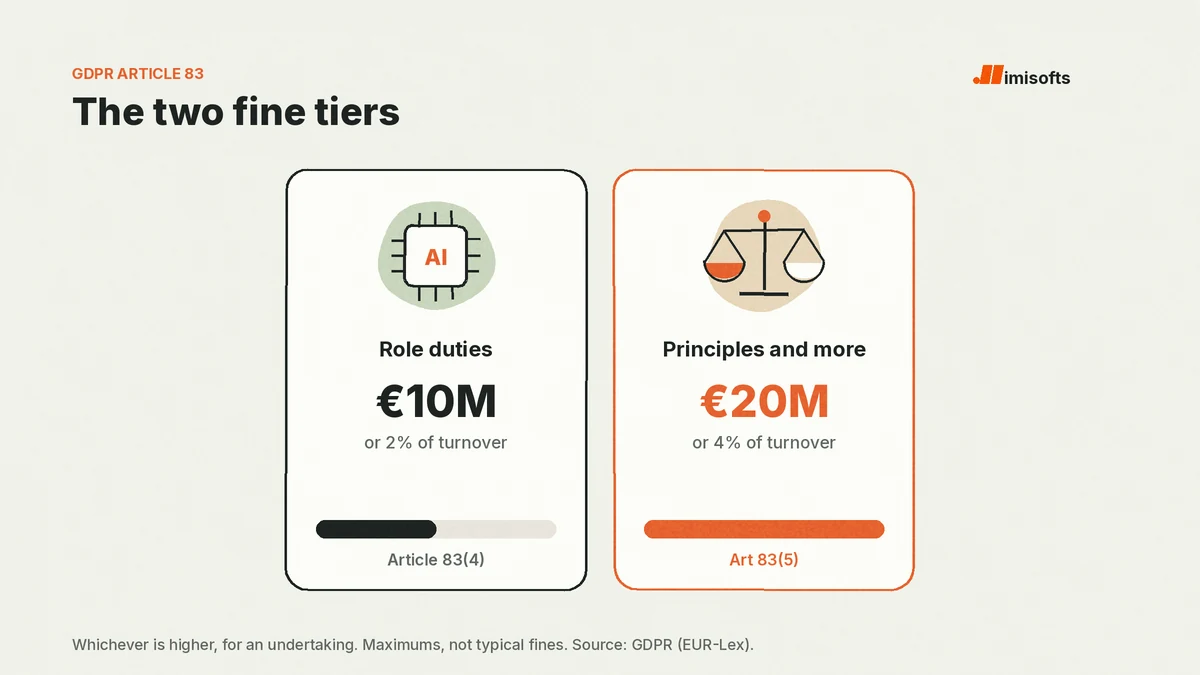
The role decides your duties. Controllers carry the main load: they must be able to demonstrate compliance under Article 24 and use only processors that give "sufficient guarantees." Processors keep their own records, secure the data and report breaches to the controller. Both can be fined up to €10 million or 2% of worldwide annual turnover, whichever is higher, for breaching the controller and processor duties listed in Article 83(4). If you send cold email from your own domains and mailboxes, our email infrastructure page shows how we build that sending layer.
This guide covers the definitions, the ICO's checklists, a side by side table of duties, joint controllers, who is which in a cold email stack, and when a processor turns into a controller. Sources were read on November 26, 2026. This is general information, not legal advice.
Key numbers
| Item | Number |
|---|---|
| ICO controller indicators (By our count of the ICO checklist) | 12 |
| ICO processor indicators (Following instructions, no own purpose) | 10 |
| ICO joint controller indicators (Decide purposes and means together) | 5 |
| Controller breach notice (To the authority where feasible, after becoming aware, Art 33(1)) | 72 hours |
| Processor breach notice (To the controller, Art 33(2)) | Without undue delay |
| Fine for role duties (Arts 8, 11, 25 to 39, 42, 43; whichever is higher) | €10M or 2% |
| Fine for principles and rights (Basic principles and more; whichever is higher) | €20M or 4% |
| Wirtschaftsakademie ruling (Joint responsibility is not necessarily equal) | June 5, 2018 |
GDPR (EUR-Lex); ICO guide to controllers and processors; CJEU C-210/16 and C-40/17; HubSpot DPA; Apollo privacy policy. Read November 26, 2026.
What the GDPR says a controller and a processor are
Article 4(7) defines a controller as the person or body "which, alone or jointly with others, determines the purposes and means of the processing of personal data." Article 4(8) defines a processor as the person or body "which processes personal data on behalf of the controller."
In our words, purposes are the why (selling a service, hiring, billing) and means are the how (which data, about whom, for how long, and who sees it). Article 29 adds the core limit on processors: they "shall not process those data except on instructions from the controller, unless required to do so by Union or Member State law."
The ICO's guide points to the same Articles 4(7) and 4(8) of the UK GDPR. It carries a note that it is under review after the Data (Use and Access) Act, so check it again before relying on UK details. The European Data Protection Board's Guidelines 07/2020 on the two concepts, final version of July 2021, are the EDPB's final guidance.
How to tell which one you are
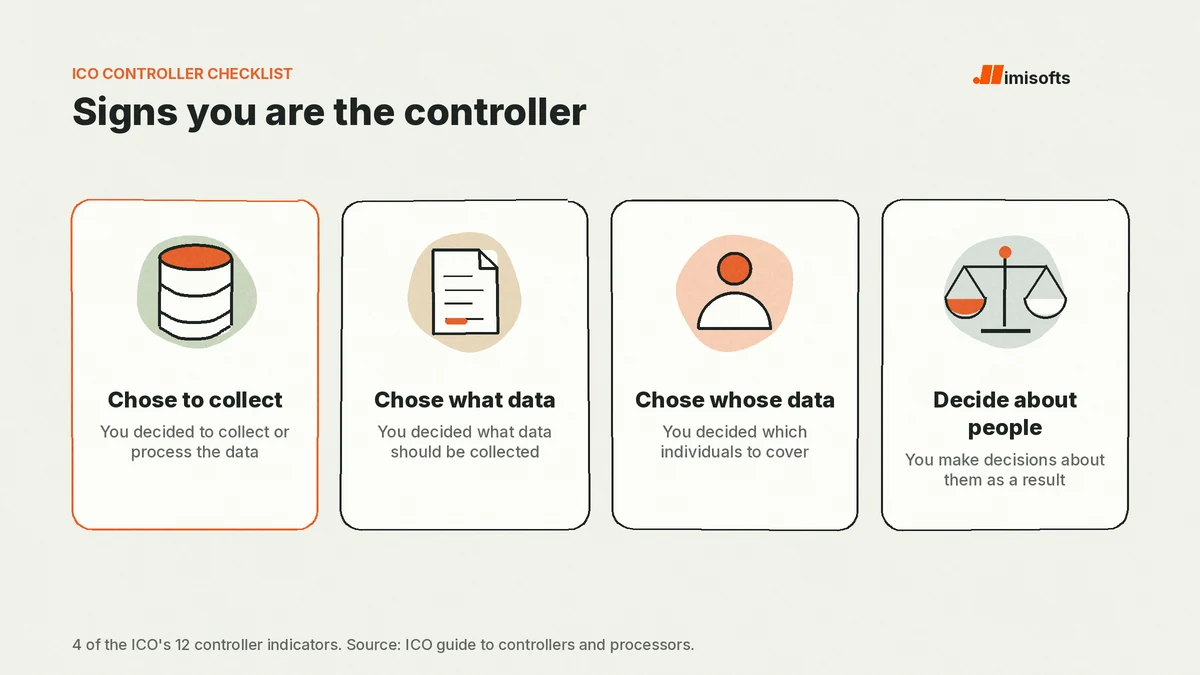
The ICO's guide to controllers and processors puts it in one question: "who determines the purposes for which the data are processed and the means of processing?" It adds that organisations that do so "will be controllers regardless of how they are described in any contract about processing services."
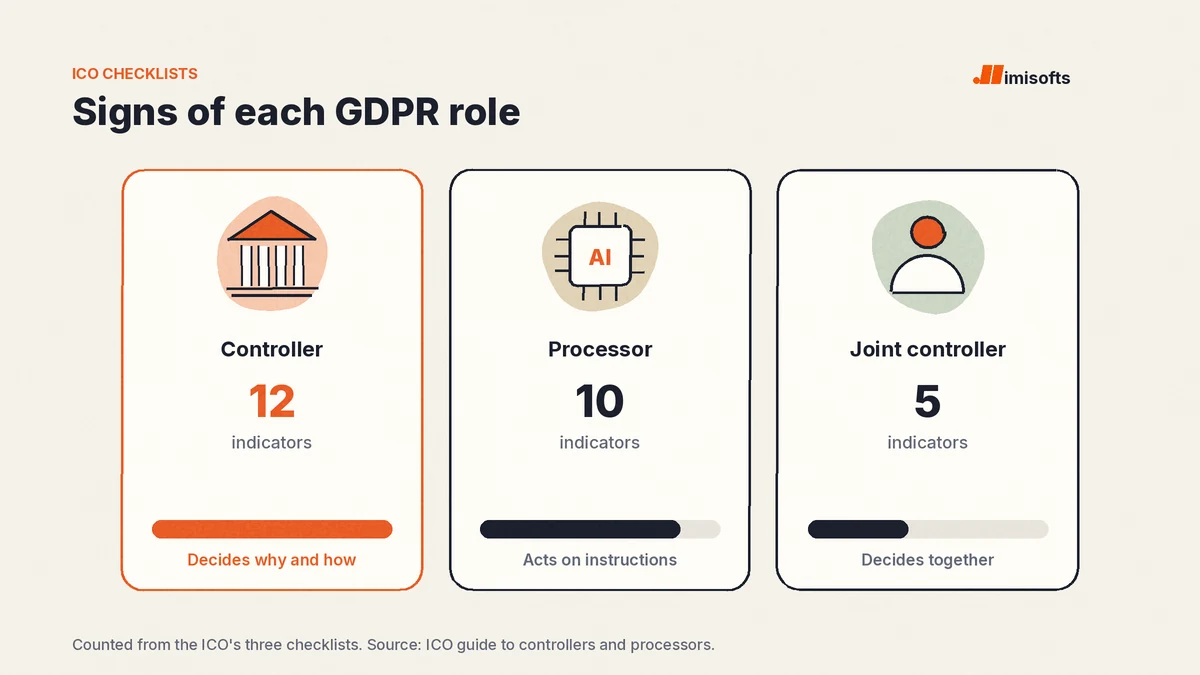
The ICO publishes three checklists. By our count they hold 12 indicators that you are a controller, 5 that you are a joint controller and 10 that you are a processor. "The more boxes you tick, the more likely you are to fall within the relevant category." A selection:
| Question | Points to controller | Points to processor |
|---|---|---|
| Who chose to collect the data? | "We decided to collect or process the personal data." | "We do not decide to collect personal data from individuals." |
| Who chose what data and whose? | "We decided what personal data should be collected." "We decided which individuals to collect personal data about." | "We were given the personal data by a customer or similar third party, or told what data to collect." |
| Who picked the legal basis? | Implied by deciding the purpose | "We do not decide the lawful basis for the use of that data." |
| Who sets retention? | The controller decides | "We do not decide how long to retain the data." |
| Who cares about the result? | "We make decisions about the individuals concerned as part of or as a result of the processing." | "We are not interested in the end result of the processing." |
Technical choices alone do not make a vendor a controller. The ICO says that if you have no purpose of your own and only act on a client's instructions, "you are likely to be a processor", even if you make some technical decisions about how you process the data.
Controller vs processor duties side by side
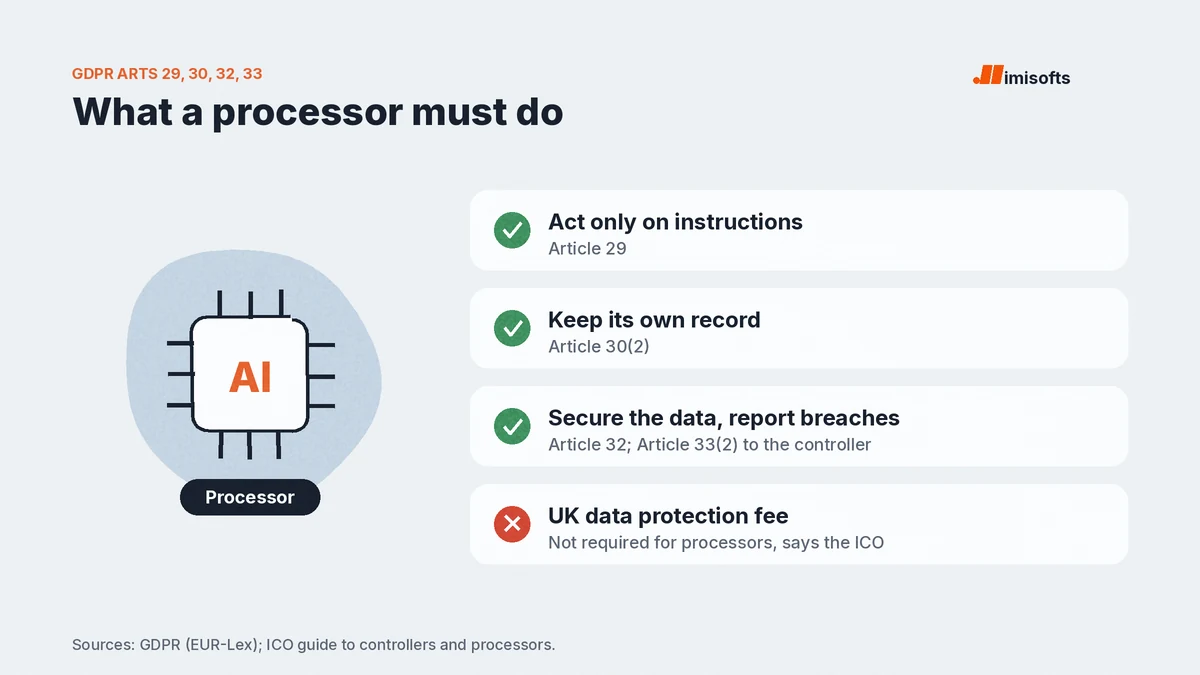
The GDPR gives processors a shorter list of direct duties. The ICO says controllers "shoulder the highest level of compliance responsibility" and are "also responsible for the compliance of your processor(s)."
| Duty | Controller | Processor |
|---|---|---|
| Demonstrate compliance with the GDPR (Art 24) | Yes | Not this article; it has its own duties below |
| Privacy notices, consents and rights requests | Yes | Per the contract; Apollo, for example, leaves these with the customer |
| Use only processors with "sufficient guarantees" (Art 28(1)) | Yes | Must be able to offer them |
| Process only on instructions (Art 29) | Not applicable | Yes |
| Record of processing activities (Art 30) | Yes, with limited exemptions | Yes, its own record, Art 30(2) |
| Security measures (Art 32) | Yes | Yes |
| Breach notice (Art 33) | To the authority without undue delay and, where feasible, within 72 hours of becoming aware | To the controller without undue delay |
| Data protection officer when required (Art 37) | Yes | Yes |
| EU representative where Art 3(2) applies (Art 27) | Yes | Yes |
| UK data protection fee | Yes, unless exempt | No, says the ICO |
The contract that sets the processor's terms is the data processing agreement; our guide covers what goes in it. The records in the fifth row are covered in our guide to the record of processing activities.
Joint controllers: when two businesses decide together
Article 26(1) says that "where two or more controllers jointly determine the purposes and means of processing, they shall be joint controllers." They must set out who does what "by means of an arrangement between them," in particular for rights requests and for the notices of Articles 13 and 14. "The essence of the arrangement shall be made available to the data subject."
The arrangement does not limit the person's rights. Under Article 26(3), the data subject "may exercise his or her rights under this Regulation in respect of and against each of the controllers." The ICO adds a useful limit the other way: businesses "are not joint controllers if they are processing the same data for different purposes."
The EU Court of Justice has shaped the idea in two rulings under the old Directive 95/46. In Wirtschaftsakademie (C-210/16, June 5, 2018), about a Facebook fan page, it held that joint responsibility "does not necessarily imply equal responsibility." In Fashion ID (C-40/17, July 29, 2019), a website that embedded a social plugin could be a controller, but only for "the collection and disclosure by transmission of the data at issue."
Who is which in a cold email stack
Roles follow each processing activity, not each company. Two vendors say so in their own terms. HubSpot's data processing agreement covers customer data "by us as a Processor on your behalf," and data processed "by each party as a Controller in connection with our enrichment products and your use of the HubSpot tracking code." Apollo's privacy policy (last updated August 10, 2026) says Apollo is a controller of the data it uses "to create and maintain its Contributor Database," and a processor when it handles data "on behalf of a Customer and under the Customer's instructions."
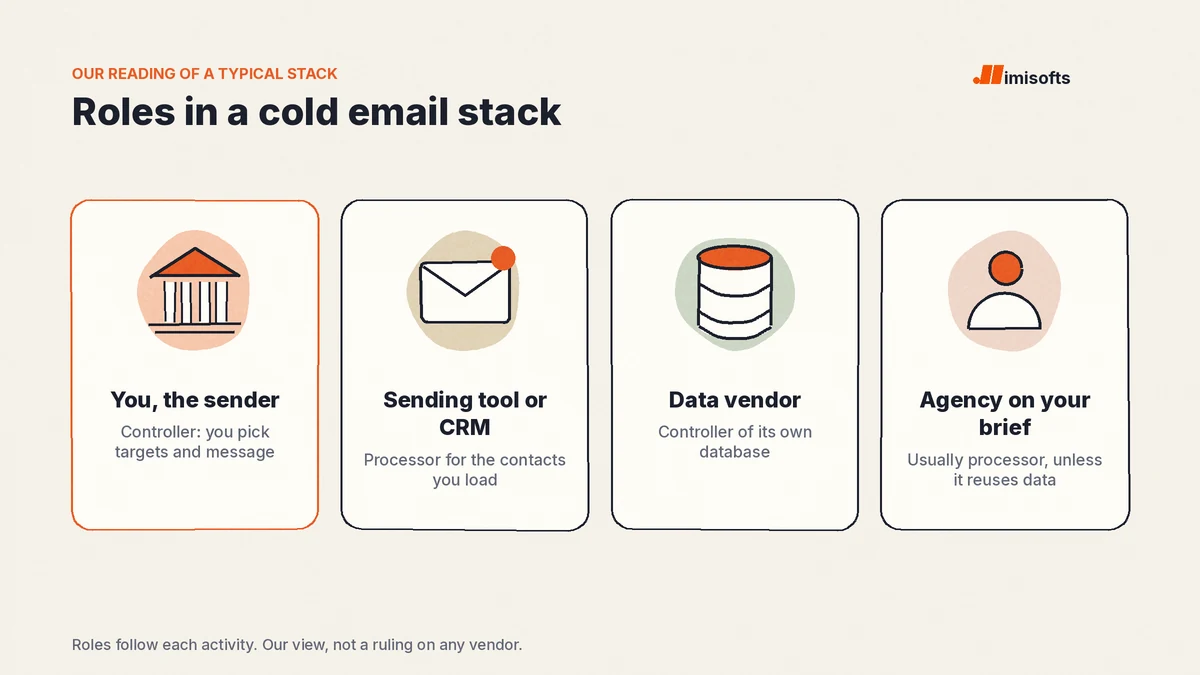
Here is how we would usually read a typical outbound setup. This is our view of a common pattern, not a ruling on any vendor:
| Party | Usual role | Why |
|---|---|---|
| You, the sender | Controller | You pick the targets, the message and the retention |
| Sending tool or CRM holding your contacts | Processor for that data | It stores and sends on your instructions |
| Data vendor that sells or licenses its own database | Controller of that database | It decides what to collect and why, as Apollo states for its Contributor Database |
| Agency running campaigns to your brief | Usually processor | It works on your instructions; any use for its own aims makes it a controller for that use |
| Two firms running one co-branded campaign on a shared list | Possibly joint controllers | They may decide the purposes and means together (Art 26(1)) |
As the controller you will usually owe a privacy notice to people whose data came from a list. Our guide to the GDPR privacy notice covers what it says and when, and is buying email lists legal covers the list side.
When a processor becomes a controller
A processor that decides the purposes and means of processing for itself becomes a controller for that processing. Article 28(10) says that "if a processor infringes this Regulation by determining the purposes and means of processing, the processor shall be considered to be a controller in respect of that processing."
In outbound, the usual trigger is reuse: an agency that copies a client's prospect list into its own database, or a tool that uses customer contacts to enrich a product it sells to others. In our reading of Article 28(10) and the ICO's wording, it takes on controller duties for that reuse. Writing tight instructions into the contract, including deletion or return of data at the end, helps keep the line clear.
Liability and fines for each role
Article 82(2) makes "any controller involved in processing" liable for damage from processing that breaks the GDPR. A processor is liable "only where it has not complied with obligations of this Regulation specifically directed to processors or where it has acted outside or contrary to lawful instructions of the controller." Where several parties are responsible, Article 82(4) makes each one liable "for the entire damage in order to ensure effective compensation."
Fines come in two tiers under Article 83. For an undertaking, the controller and processor duties of Articles 8, 11, 25 to 39, 42 and 43 carry up to €10 million or 2% of total worldwide annual turnover of the preceding financial year, whichever is higher. The basic principles for processing and the other provisions of Article 83(5) carry up to €20 million or 4%. These are maximums; our GDPR fines guide shows how regulators set real amounts.
What to do this week
We suggest five steps for a small outbound team:
- List every tool and partner that touches contact data, from the list source to the inbox.
- Mark each one controller, processor or joint controller for each activity, using the ICO's checklists, and write the reason down.
- Sign a data processing agreement with every processor, and a joint controller arrangement where you share decisions.
- Check that each vendor's own terms match your reading; some, such as HubSpot and Apollo, publish both roles.
- Name your processors as recipients in your privacy notice and in your records.
Senders who also run their own mail servers should keep this map next to the technical setup; our guides to email hosting cost and the email deliverability consultant cost cover that side.
How imisofts can help
We set up and run the sending side of outbound: domains, mailboxes, SPF, DKIM and DMARC, warm-up and monitoring, and the CRM fields that record where each contact came from. The legal wording and the role decisions stay with you and your adviser. See our email infrastructure service or talk to us about your setup.
Frequently Asked Questions
The controller decides why and how personal data is processed. The processor processes it on the controller's behalf and only on its instructions, under GDPR Articles 4(7), 4(8) and 29. The controller carries most duties, including the legal basis, notices and rights requests.
A business can be a controller for one activity and a processor for another. HubSpot's data processing agreement, for example, makes HubSpot a processor for customer data, while each party is a controller for data processed in connection with its enrichment products and the HubSpot tracking code. For any single activity, a party is a controller (alone or jointly) or a processor, depending on who decides the purposes and means.
Usually a processor when it runs campaigns on a client's instructions. If it reuses the client's data for its own purposes, such as adding contacts to its own database, Article 28(10) treats it as a controller for that processing.
For its own database, yes by its own account. Apollo's privacy policy, last updated August 10, 2026, says it acts as a controller for the information it uses to create and maintain its Contributor Database, and as a processor when it handles data on a customer's instructions.
Two or more controllers that jointly determine the purposes and means of processing, under Article 26. They must agree who handles which duties and make the essence of that arrangement available to people, who can still exercise their rights against each controller. Joint responsibility does not necessarily mean equal responsibility, the EU Court of Justice held in 2018 in a ruling under the GDPR's predecessor, Directive 95/46.
Yes. Article 83(4) allows fines of up to €10 million or 2% of worldwide annual turnover, whichever is higher, for breaches of the controller and processor duties in Articles 8, 11, 25 to 39, 42 and 43, which include the processor rules of Articles 28 and 29, records, security and breach notice.