Short answer. A record of processing activities (ROPA) is the written list of what personal data your business processes, why, for whom and for how long. GDPR Article 30 makes a controller record 7 items and a processor 4 items, and the record must be shown to a regulator on request. Firms with fewer than 250 employees are exempt only for processing that is occasional, low risk and free of sensitive data, so a small company that emails prospects every week likely still needs one, because regular processing is not occasional.
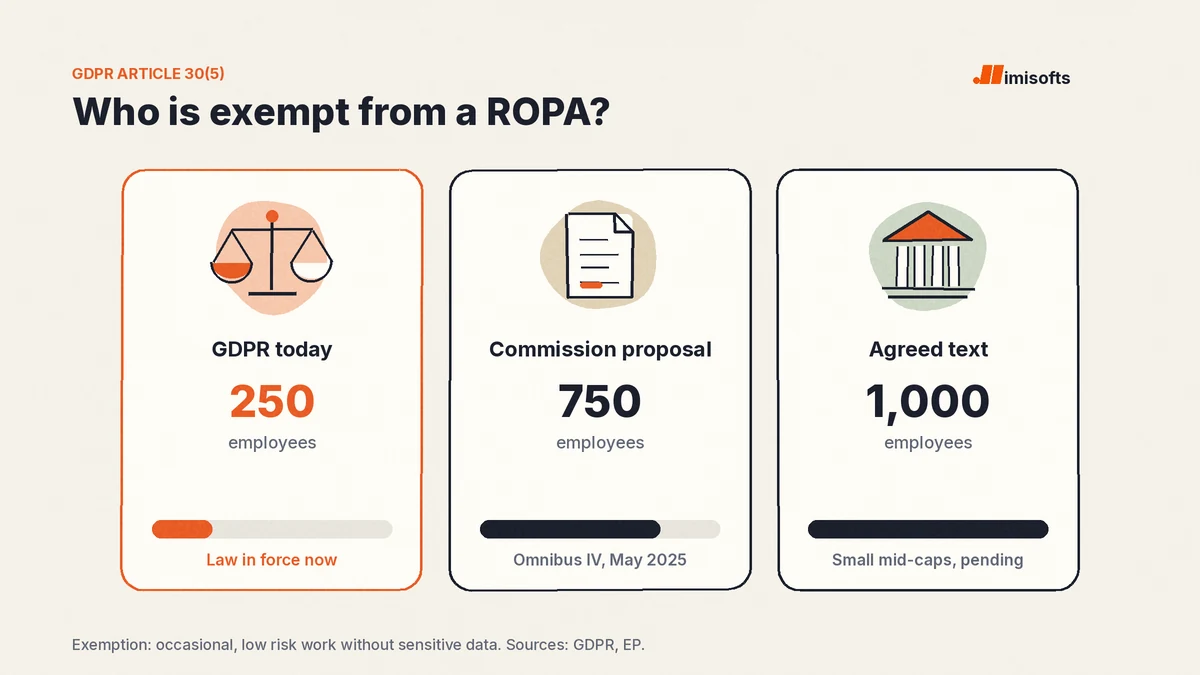
That line may move. On November 24, 2026 the European Parliament adopted at first reading the Omnibus IV small mid-caps regulation, which extends the GDPR record-keeping exemption to "small mid-caps": companies with fewer than 1,000 employees and up to €200 million in turnover or €172 million in total assets, for processing that is not likely to be high risk, according to Parliament's press release on the deal. The Council still has to adopt it and it has to be published before it applies, so the 250 rule is the law today. If your outbound runs on sending domains and mailboxes, our email infrastructure page shows how we set those systems up.
This guide covers who needs a ROPA, what goes in it, the EU change, a sample entry for a cold email program, and the fines. Sources were read on November 26, 2026. This is general information, not legal advice.
Key numbers
| Item | Number |
|---|---|
| Items in a controller's record (GDPR Article 30(1)(a) to (g)) | 7 |
| Items in a processor's record (GDPR Article 30(2)(a) to (d)) | 4 |
| Exemption line today (Art 30(5): occasional, low risk, no sensitive data) | under 250 employees |
| Line in the Parliament text (Small mid-caps in the agreed text, not in force) | under 1,000 employees |
| Line the Commission proposed (May 21, 2025) | 750 employees |
| Parliament first reading vote (P10_TA(2026)0382) | Nov 24, 2026 |
| Committee vote on the agreed text (July 2, 2026, 6 abstentions) | 123 to 10 |
| Maximum fine (of worldwide turnover, whichever is higher, Art 83(4)) | €10M or 2% |
GDPR (EUR-Lex); European Parliament press release of June 9, 2026, EPRS briefing and Legislative Observatory; ICO documentation guidance; CNIL. Read November 26, 2026.
What a record of processing activities is
Article 30(1) says each controller "shall maintain a record of processing activities under its responsibility." A controller is the business that decides why and how personal data is used. A processor, such as an email sending platform or a CRM vendor, handles data on a controller's behalf and keeps its own, shorter record under Article 30(2).
Recital 82 gives the reason: the record exists "to demonstrate compliance" and so that it "might serve for monitoring those processing operations." Regulators can ask to see it at any time. Article 30(3) says the record "shall be in writing, including in electronic form," and Article 30(4) says it must be made "available to the supervisory authority on request."
The UK GDPR applies the same 250-employee test, according to the ICO's guidance carries a note that it is under review after the Data (Use and Access) Act, so check it again before relying on UK details.
Who needs a ROPA: the 250 rule and its 3 exceptions
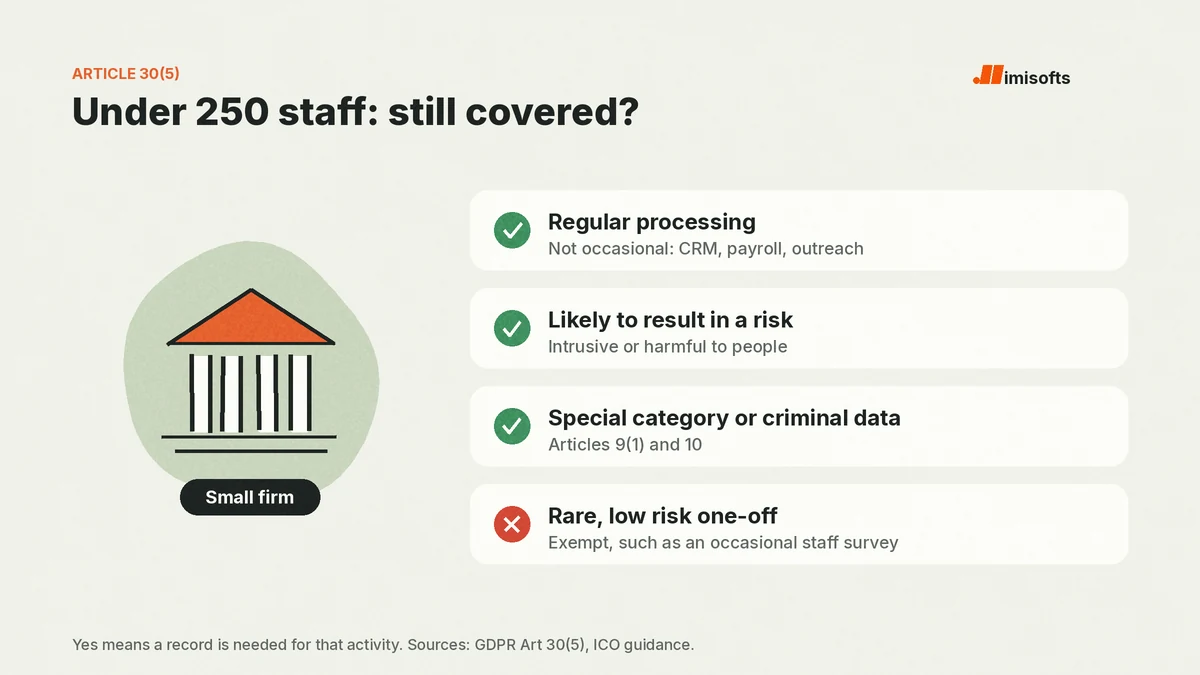
Article 30(5) says the duty does not apply to an organisation "employing fewer than 250 persons" unless one of three things is true:
- the processing "is likely to result in a risk to the rights and freedoms of data subjects";
- the processing "is not occasional"; or
- it includes special category data under Article 9(1), or criminal conviction and offence data under Article 10.
The exceptions are joined by "or", so any one of them brings the activity back in. The ICO reads it the same way: "If you employ fewer than 250 people, you need only document processing activities that" are not occasional, are likely to result in a risk, or involve special category or criminal offence data. Organisations with 250 or more employees "must document all their processing activities."
The ICO's own example is an insurance company with 100 staff. It must still document claims, sales and HR processing "because they are not occasional," but it need not record a staff survey it runs only now and then.
For a sales team the test is usually easy. Payroll, a CRM of customers and a weekly cold email program are regular, so they are not occasional. In our reading, a small business that emails prospects regularly will usually need a record for that activity even below 250 staff.
| Your situation | Do you need a ROPA today? | Basis |
|---|---|---|
| 250 or more employees | Yes, for all processing | Art 30(1) and (2) |
| Under 250, regular processing (CRM, payroll, outreach) | Yes, for those activities | Art 30(5), "not occasional" |
| Under 250, health or other special category data | Yes, for that processing | Art 30(5), Art 9(1) |
| Under 250, a rare one-off, low risk activity | No, for that activity | Art 30(5) exemption |
The EU vote to lift the line to 1,000 staff
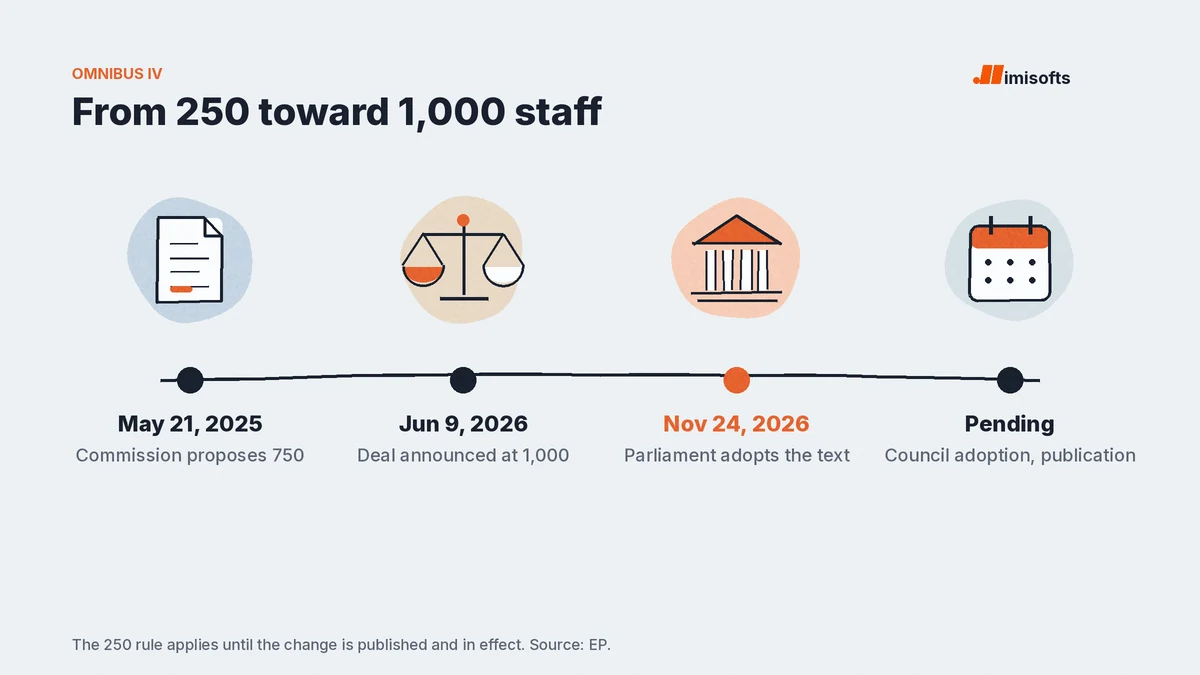
The change comes from the Commission's Omnibus IV package of May 21, 2025, which proposed a new class of "small mid-cap" company with fewer than 750 employees, according to the European Parliament's research service. The figure rose to 1,000 in talks between Parliament and the Council.
In its press release of June 9, 2026 on the provisional agreement, Parliament said small mid-caps are "companies with fewer than 1,000 employees; and either up to €200 million in turnover or up to €172 million in total assets." The Commission had proposed 750 employees, €150 million and €129 million. The release lists among the extended exemptions "record-keeping obligations under the General Data Protection Regulation (GDPR) when processing data that is not likely to be high-risk for the subject's rights."
The joint committee endorsed the regulation text on July 2, 2026 by 123 votes to 10, with 6 abstentions. Parliament then adopted it at first reading on November 24, 2026 as text P10_TA(2026)0382. As of November 26, 2026 the procedure file lists no Council adoption and no publication in the Official Journal.
What it means for you: for companies that qualify as small mid-caps, the employee line would rise from 250 to 1,000, four times higher, with the turnover or asset cap on top. We have not been able to read the final consolidated text of the new Article 30(5) for this guide, so we cannot say exactly which of today's three exceptions survive. Treat the details as pending until the regulation is published and takes effect.
The 7 items a controller must record
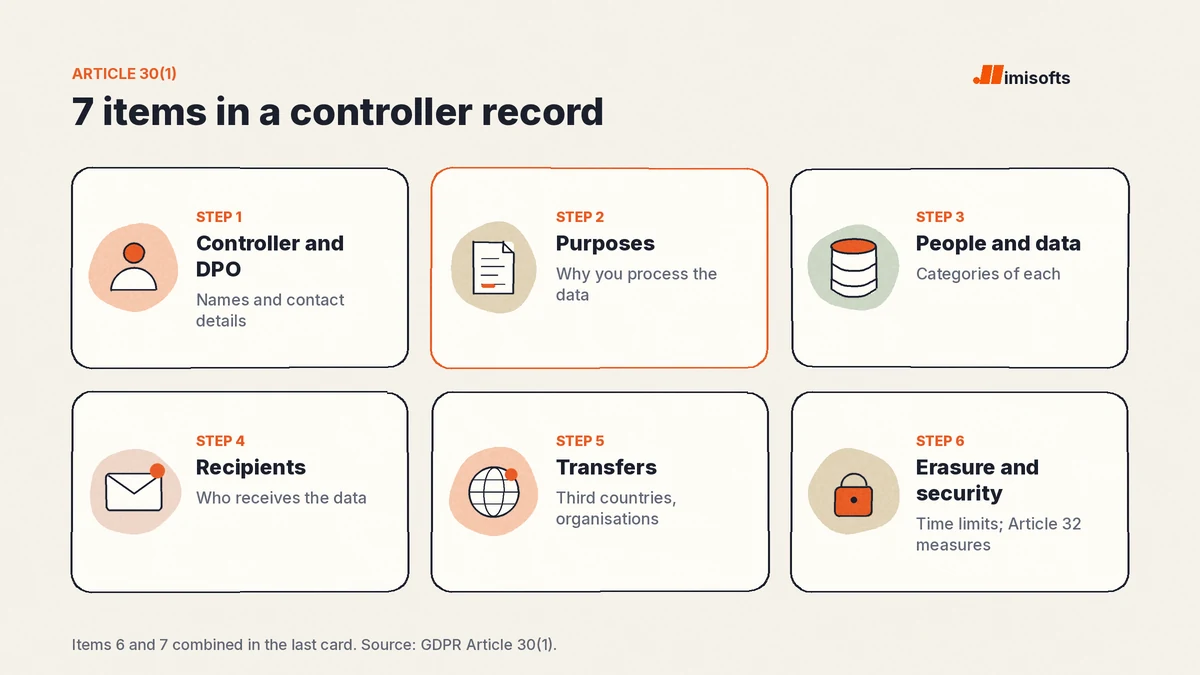
Article 30(1) says the controller's record "shall contain all of the following information":
- The name and contact details of the controller and, where applicable, the joint controller, the controller's representative and the data protection officer.
- The purposes of the processing.
- A description of the categories of data subjects and of the categories of personal data.
- The categories of recipients, including recipients in third countries or international organisations.
- Where applicable, transfers to a third country or international organisation, naming it, and for transfers under the second subparagraph of Article 49(1), the documentation of suitable safeguards.
- Where possible, the envisaged time limits for erasure of each category of data.
- Where possible, a general description of the technical and organisational security measures under Article 32(1).
Items 6 and 7 carry the words "where possible", so include them whenever you can. Lawful basis is not on the Article 30 list. Where you rely on consent, the ICO says you can use the record to indicate this and "to link to where the consent has been documented."
The 4 items a processor must record
An agency or software vendor that processes data for clients keeps a record under Article 30(2) with four items:
| Item | What Article 30(2) asks for |
|---|---|
| (a) Who | Name and contact details of the processor and of each controller it acts for, plus representatives and the data protection officer |
| (b) What | "The categories of processing carried out on behalf of each controller" |
| (c) Transfers | Transfers to a third country or international organisation, with safeguards where Article 49(1) applies |
| (d) Security | Where possible, a general description of the Article 32(1) measures |
The processor record sits beside the contract with each client. Our guide to the data processing agreement covers what that contract must say under Article 28.
A sample ROPA entry for a cold email program
Here is a hypothetical entry for a B2B company that emails prospects in the EU. It follows the seven controller items. The retention period is our example, not a legal rule.
| Article 30(1) item | Sample entry (hypothetical) |
|---|---|
| (a) Controller | Company name, address, privacy contact email, and the DPO if one is appointed |
| (b) Purpose | B2B prospecting by email and follow-up of replies |
| (c) People and data | Prospects at target companies: name, work email, job title, company, reply history |
| (d) Recipients | Email sending platform and CRM vendor (each a processor) |
| (e) Transfers | Any tool that stores the data outside the EU, the country, and the safeguard used |
| (f) Erasure | Example: delete non-responders after 12 months; suppress opt-outs permanently |
| (g) Security | Access limited by role, two-factor login on every tool, encrypted connections |
A record like this also helps when you decide your lawful basis. Many B2B teams rely on legitimate interests, which needs its own written test; see our guide to the legitimate interest assessment. Where a cold email stack gets complicated, our email deliverability consultant cost guide covers who else touches the data.
How to build a ROPA in 5 steps
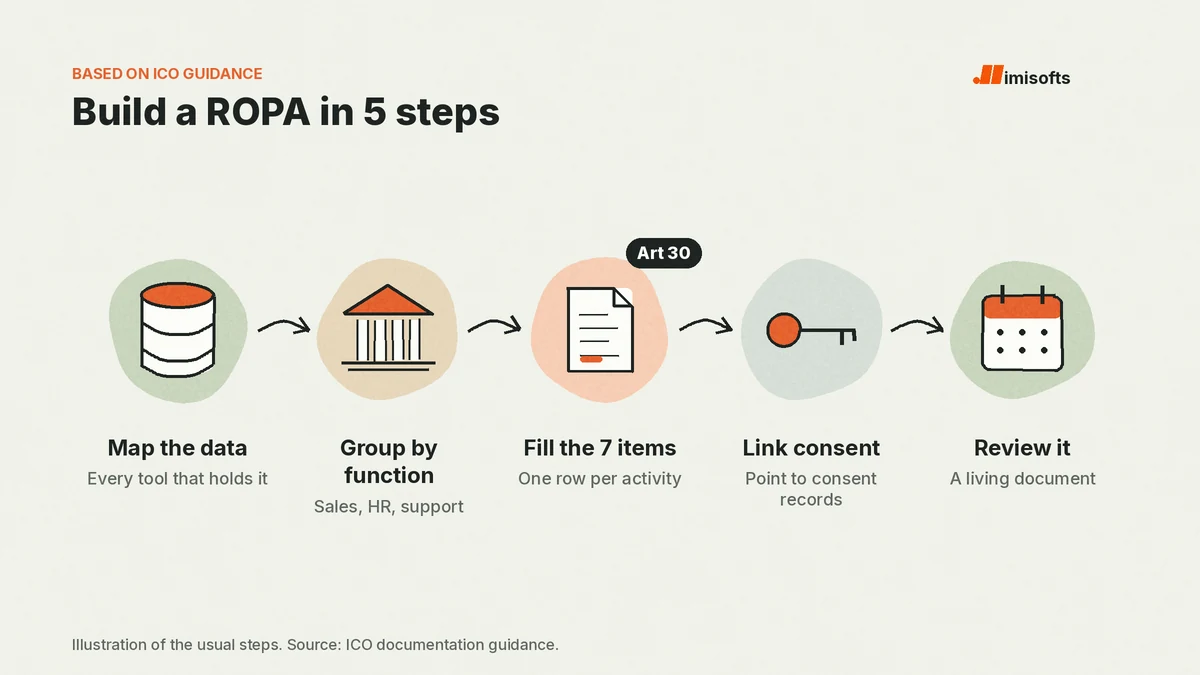
The ICO's how-to guidance suggests starting with "an information audit or data-mapping exercise" and then working one business function at a time, "e.g. HR, Sales, Customer Services." A workable order:
- Map the data. List every tool that holds personal data: CRM, email platform, inbox, spreadsheets, payroll, website forms.
- Group by function. Sales, marketing, HR, customer support. Each function holds one or more processing activities.
- Fill the 7 items per activity. Purpose, people, data, recipients, transfers, erasure, security.
- Add what helps you prove compliance. Note your lawful basis and, where you rely on consent, link to the consent records.
- Review on a schedule. The ICO says the record is "a living document that you update as and when necessary."
You do not need software. The ICO publishes two basic templates, one for controllers and one for processors, and says "Using these templates is not mandatory." The French regulator, the CNIL, offers a simplified register model in ODS format aimed at small organisations.
What happens if you do not keep one
Article 30 falls under Article 83(4), which covers the obligations of controllers and processors in Articles 25 to 39. Breaches there can bring fines of up to €10 million, or for an undertaking up to 2% of total worldwide annual turnover of the preceding year, "whichever is higher."
The 2% figure only exceeds €10 million for a company with turnover above €500 million, so for most small firms the ceiling is €10 million. These are maximums. In our view, a missing record also makes other requests harder to answer, from a breach report to a data subject request. For how regulators have used these powers, see our guide to GDPR fines.
How imisofts can help
Our email infrastructure service covers sending domain setup, mailbox provisioning, SPF, DKIM and DMARC authentication, warm-up and deliverability monitoring. The tools in that setup are among the recipients and processors your record should name. The legal judgment stays with you and your adviser. See our email infrastructure service or talk to us about your setup.
Related reading: the data protection officer guide (item (a) of the record names the DPO) and the email hosting cost guide.
Frequently Asked Questions
A written list of the personal data processing a business does, kept under GDPR Article 30. A controller records 7 items, including purposes, categories of people and data, recipients, transfers, erasure time limits and security measures. It must be shown to a regulator on request.
Often yes. Firms with fewer than 250 employees are exempt only for processing that is occasional, unlikely to result in a risk and free of special category or criminal data. The ICO's example of a 100-staff firm must still record its regular sales, claims and HR processing.
It may. The European Parliament adopted the Omnibus IV small mid-caps regulation on November 24, 2026. Per Parliament's press release, it extends the exemption to companies with fewer than 1,000 employees and up to €200 million turnover or €172 million assets, for processing not likely to be high risk. The Council must still adopt it and it must be published before it applies.
Under Article 30(2), 4 items: its name and contact details and those of each controller it acts for, the categories of processing for each controller, any transfers to third countries or international organisations, and where possible a general description of security measures.
Yes. The UK ICO publishes two basic templates, one for controllers and one for processors, and says using them is not mandatory. The French CNIL offers a simplified register model in ODS format for small organisations.
Article 30 breaches fall under Article 83(4): up to €10 million or, for an undertaking, 2% of worldwide annual turnover of the preceding year, whichever is higher. The 2% figure only exceeds €10 million above €500 million in turnover.