November 2, 2026. Switzerland allows cold calls by default and then puts starred and unlisted numbers off limits to advertising callers with no business relationship. Under article 3, paragraph 1, letter u of the Bundesgesetz gegen den unlauteren Wettbewerb (UWG), the federal unfair competition act, it is unfair to ignore a star (*) next to a person's telephone directory entry, and anyone with no directory entry at all is treated as if they had the star. The State Secretariat for Economic Affairs (SECO) puts the rule plainly on its page about unwanted advertising calls: "Telefonmarketing ist in der Schweiz grundsätzlich erlaubt," telemarketing is allowed in principle, but for a starred or unlisted number "ist eine telefonische Kontaktaufnahme zu Werbezwecken unzulässig." Since 1 January 2021, letter v adds that an advertising call must display a number that is listed in the directory and that the caller is entitled to use, and letter w makes it unfair to act on information obtained by breaking either rule. Intentional breaches are a criminal matter on complaint, with up to three years' imprisonment or a monetary penalty under article 23. SECO's 2025 statistics show what this produces in practice: 5,827 complaints about advertising calls to unlisted numbers and 3,186 about calls despite a star entry, 9,013 of the 13,794 complaints it logged, against three penal orders or decisions for unlawful calls in the year. Here is each rule as the consolidated text on Fedlex states it, what SECO can and cannot do, and what a team calling Swiss numbers should set up.
Key numbers
| Item | Number |
|---|---|
| Complaints about calls to unlisted numbers, 2025 (SECO statistics) | 5,827 |
| Complaints about calls despite a star entry, 2025 (SECO statistics) | 3,186 |
| Share of 2025 complaints about advertising calls (9,013 of 13,794) | 65.3% |
| Penal orders or decisions for unlawful calls, 2025 (of 17 in total) | 3 |
| Maximum penalty for intentional unfair competition (or a monetary penalty, on complaint, art. 23) | 3 years |
| Caller ID and laundered-data rules in force since (art. 3 para. 1 lit. v and w) | 1 January 2021 |
| Current carrier-duty wording in force since (FMG art. 45a) | 1 July 2021 |
| Total complaints to SECO, 2024 to 2025 (SECO statistics) | 16,616 to 13,794 |
UWG (SR 241) and FMG (SR 784.10) consolidated texts on fedlex.admin.ch, SECO page on unwanted advertising calls and SECO statistical report for 2025, read on 2 November 2026.
The directory rule: letter u
The provision reads, in the German text, that a person acts unfairly who "den Vermerk im Telefonverzeichnis nicht beachtet, dass ein Kunde keine Werbemitteilungen von Personen erhalten möchte, mit denen er in keiner Geschäftsbeziehung steht, und dass seine Daten zu Zwecken der Direktwerbung nicht weitergegeben werden dürfen; Kunden ohne Verzeichniseintrag sind den Kunden mit Verzeichniseintrag und Vermerk gleichgestellt." Three things follow. Under letter u, the opt-out is the directory entry itself, not a separate register: the star is the opt-out. It is scoped to callers with whom the customer has no business relationship, so an existing supplier can still call its own customers. And an unlisted number is protected automatically, which means a purchased list of mobile numbers with no directory match is, by default, a list of numbers that cannot be called for advertising. Fedlex's footnotes date the provision to the federal act of 17 June 2011, with its current wording in force since 1 January 2021.
SECO's page describes the two routes a consumer has: "Wer keine Werbeanrufe möchte, kann auf einen Eintrag im Telefonverzeichnis verzichten oder sich mit einem Stern (*) eintragen lassen; dann sind Werbeanrufe verboten." It adds, with some candour, "Technische Filter können zusätzlich helfen. Einen vollständigen Schutz gibt es nicht." The examples it gives of what telemarketing covers are concrete: selling wine or cosmetics, concluding a contract to switch telephone provider, or arranging appointments for insurance consultations. An appointment-setting call is therefore an advertising call for this purpose.
Caller ID and laundered data: letters v and w
Letter v, inserted by the act of 22 March 2019 and in force since 1 January 2021, makes it unfair to make advertising calls "ohne dass eine Rufnummer angezeigt wird, die im Telefonverzeichnis eingetragen ist und zu deren Nutzung er berechtigt ist." The number shown has to be listed and one the caller is entitled to use. A dialer that shows unlisted numbers, or numbers the caller is not entitled to use, is outside the rule, and so is any form of spoofing. Letter w then closes the loophole a lead broker would otherwise exploit: a person acts unfairly who "sich auf Informationen stützt, von denen sie oder er aufgrund eines Verstosses gegen die Buchstaben u oder v Kenntnis erhalten hat." A lead that was generated by an unlawful call cannot be worked by the company that buys it.
The telecommunications act supports this from the carrier side. Article 45a of the Fernmeldegesetz, in its wording since 1 July 2021, says "Die Anbieterinnen von Fernmeldediensten bekämpfen unlautere Werbung nach Artikel 3 Absatz 1 Buchstaben o, u und v" of the UWG, and lets the Federal Council define the measures. Combating unfair advertising is a statutory duty of the carriers, with the measures left to the Federal Council.
Mass advertising by phone or message: letter o
Automated and bulk messages are a separate rule. Letter o covers anyone who "Massenwerbung ohne direkten Zusammenhang mit einem angeforderten Inhalt fernmeldetechnisch sendet oder solche Sendungen veranlasst" without first obtaining the customers' consent, giving the correct sender, and pointing to a free and easy way to refuse. The same letter carries the soft opt-in: a seller that got the contact details in a sale and pointed out the right to refuse may advertise its own similar goods, works or services ("eigene ähnliche Waren, Werke oder Leistungen") to those customers without separate consent. Our sources do not settle whether recorded or AI voice campaigns fall under letter o, so the safe course is to meet its conditions and letters u, v and w at the same time. For the email side of the same article, see cold email laws in Switzerland.
Who enforces, and how
| Route | Who | What the law says |
|---|---|---|
| Civil action | Customers whose economic interests are threatened or injured; trade associations and consumer organisations | Article 10, paragraphs 1 and 2, referring to the actions in article 9 |
| Federal action | The Confederation, through SECO | Article 10, paragraph 3: the Confederation may sue "wenn er es zum Schutz des öffentlichen Interesses als nötig erachtet," notably where Switzerland's reputation abroad is at stake and the affected persons live abroad, or where the interests of several persons, a group within a sector or other collective interests are threatened |
| Criminal complaint | Anyone entitled to a civil action, and the Confederation as private claimant | Article 23: "Wer vorsätzlich unlauteren Wettbewerb nach Artikel 3, 4, 5 oder 6 begeht, wird auf Antrag mit Freiheitsstrafe bis zu drei Jahren oder Geldstrafe bestraft." |
SECO explains its own role in the same terms: "Das SECO kann auf Grund von Beschwerden, die bei ihm eingehen, Strafantrag bei der zuständigen kantonalen Staatsanwaltschaft einreichen," and the cantonal prosecutor then opens criminal proceedings against call centres and companies. Two limits matter. SECO's right to intervene "ist an die Verletzung von Kollektivinteressen geknüpft, was eine bestimmte Anzahl betroffener Personen voraussetzt," so a single complaint rarely moves on its own, and "Das SECO hat keine rechtlichen Kompetenzen, eine Telefonnummer zu blockieren oder zu sperren." Combating unfair advertising is the carriers' duty under article 45a; prosecution is the cantons'.
What the 2025 numbers say
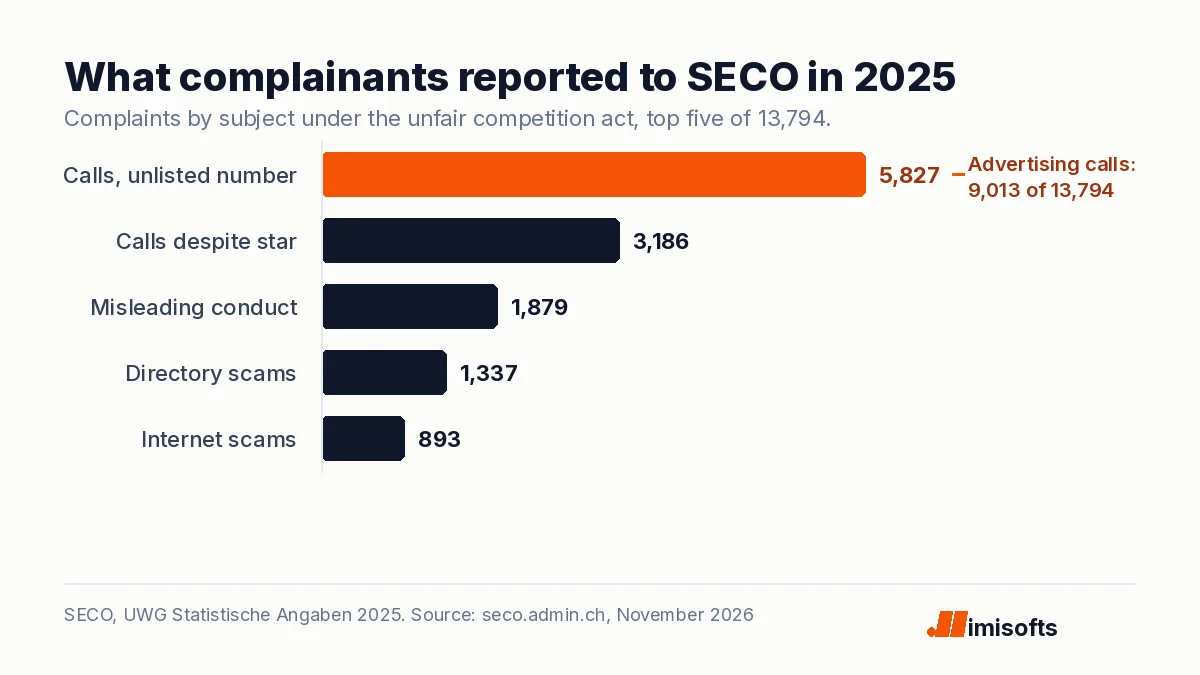
SECO's statistical report for 2025 breaks its 13,794 complaints down by subject. Advertising calls to numbers not in the directory led with 5,827, calls despite a star entry followed with 3,186, then misleading conduct 1,879, directory scams 1,337 and internet scams 893. Spam by message drew 76 complaints and spoofing of a person's own number 2. The call categories together are 9,013 complaints, 65.3 percent of the total. Total complaints fell from 16,616 in 2024 to 13,794 in 2025.
The enforcement side of the same report is thin by comparison. Table 4 lists 17 penal orders, decisions, judgments and upheld complaints for the year, of which "Rechtswidrige Werbeanrufe" account for 3, against 7 for directory scams and 5 for misleading conduct. SECO issued 9 warnings and filed 9 criminal complaints in 2025, none of them listed under advertising calls. The gap between 9,013 complaints and 3 decisions is the reality of a complaint-driven, collective-interest system: few call complaints end in a penal order or decision.
What this means for a team calling Switzerland
- Match every number to the directory before dialling. A number that is unlisted, or listed with a star, cannot receive an advertising call from a company it has no business relationship with. Under letter u, the opt-out is the directory entry itself, not a separate register.
- Show a listed number you are entitled to use. Letter v requires the displayed number to be in the directory and one you are entitled to use.
- Refuse laundered leads. Under letter w, a lead produced by a call that broke u or v cannot be relied on. Ask lead vendors how the number was reached and keep the answer.
- Treat recorded and AI messages as if letter o applied. Our sources do not settle the point, so meet letter o's conditions (consent first, correct sender, free opt-out) and letters u, v and w together. How we set up consent capture and suppression for AI callers is described in TCPA-compliant AI calling, written for the US rules; the best AI voice agents in 2026 compares platforms.
- Existing customers are the open lane. Letter u protects people from callers "mit denen er in keiner Geschäftsbeziehung steht," so calls to current customers are outside it, and letter o's soft opt-in covers messages to customers whose details came from a sale, about the seller's own similar goods, works or services, where the right to refuse was pointed out.
We found no statutory calling hours in the UWG text, and we could not verify today whether a business directory entry can carry the star; both points are noted in our fact base rather than asserted. For how Switzerland sits among its neighbours, see cold calling laws by country. This is general information, not legal advice.
Frequently Asked Questions
In principle yes. SECO states that telemarketing is allowed in Switzerland, but article 3, paragraph 1, letter u of the UWG makes it unfair to call a person whose telephone directory entry carries a star, or who has no directory entry at all, for advertising purposes unless the caller already has a business relationship with them.
A star (*) next to a directory entry records that the customer does not want advertising messages from persons with whom they have no business relationship and that their data may not be passed on for direct marketing. Ignoring it is unfair competition, and customers with no directory entry are treated the same way.
Yes. Since 1 January 2021, letter v of article 3, paragraph 1 makes it unfair to make advertising calls without displaying a number that is listed in the telephone directory and that the caller is entitled to use.
Article 23 of the UWG punishes intentional unfair competition under articles 3 to 6, on complaint, with imprisonment of up to three years or a monetary penalty. Civil actions are open to affected customers, trade and consumer organisations, and the Confederation where collective interests are at stake. In 2025 SECO recorded 9,013 complaints about advertising calls and 3 penal orders or decisions for unlawful calls.
No. SECO says it has no legal power to block or bar a telephone number. It can file a criminal complaint with the competent cantonal prosecutor when complaints show that collective interests are affected. Carriers have a separate duty under article 45a of the telecommunications act to combat unfair advertising.
Mass advertising sent by telecommunication without a direct link to requested content needs prior consent, a correct sender and a free, easy refusal option under letter o of article 3, paragraph 1. A seller that got the contact details in a sale and pointed out the right to refuse may advertise its own similar goods, works or services to those customers without separate consent. Our sources do not settle whether recorded or AI voice calls fall under letter o, so meet its conditions and the directory, caller ID and laundered-data rules in letters u, v and w.