Short answer. A DPIA (data protection impact assessment) is the risk check that GDPR Article 35 requires before you start processing that is likely to result in a high risk to people. The law names 3 cases where one is always required, the UK regulator lists 10 more, and the assessment must contain at least 4 parts. Skipping one sits in the fine tier of up to €10 million or 2% of worldwide turnover, whichever is higher.
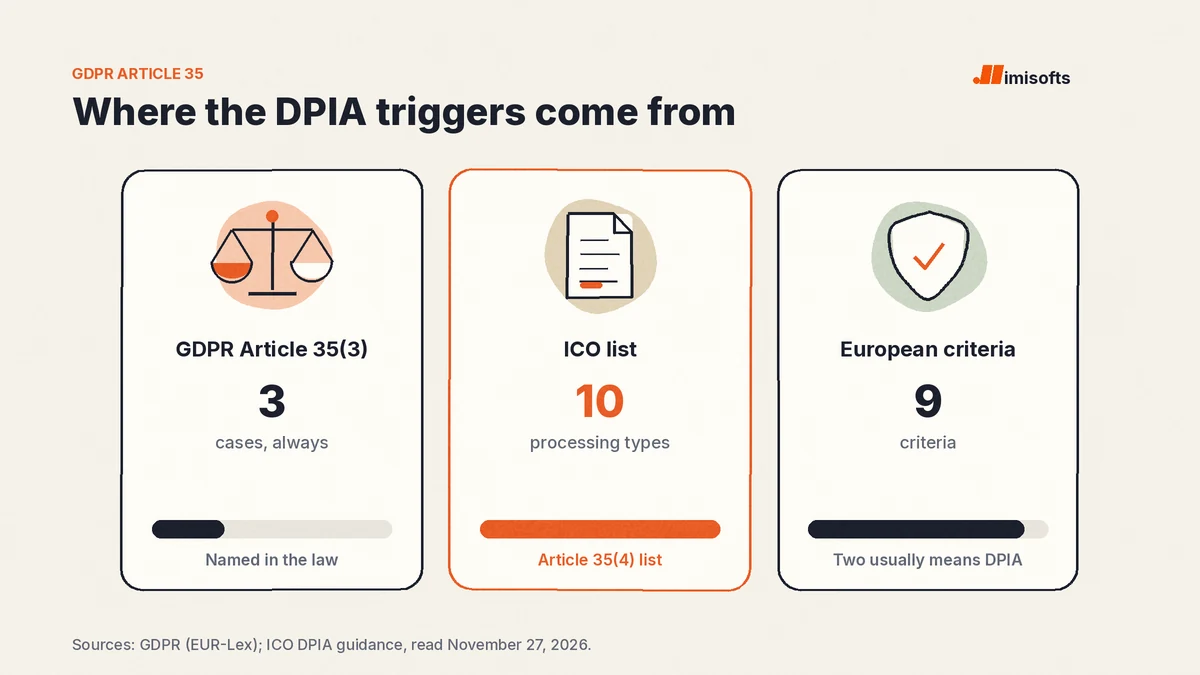
For outbound teams the question is practical. The ICO's own list names direct marketing as an example under data matching and invisible processing, and wealth profiling for direct marketing under tracking, so a cold email program built on bought or enriched lists can fall inside the rule. If your outreach runs on your own domains and mailboxes, our email infrastructure page explains how we build that sending layer.
This guide covers when a DPIA is required, the ICO list, what the assessment must contain, the 7 steps the ICO sets out, prior consultation with the regulator, and fines. Sources were read on November 27, 2026. This is general information, not legal advice.
Key numbers
| Item | Number |
|---|---|
| Cases that always need a DPIA (GDPR Article 35(3)) | 3 |
| Types on the ICO's list (Published under Article 35(4)) | 10 |
| European high risk criteria (Two together usually mean a DPIA, says the ICO) | 9 |
| Minimum parts of a DPIA (Article 35(7)(a) to (d)) | 4 |
| Steps in the ICO's process (From identifying the need to sign off) | 7 |
| Regulator's advice deadline (Plus up to 6, Article 36(2)) | 8 weeks |
| ICO acceptance reply (Whether it accepts a DPIA for prior consultation) | 10 days |
| Fine ceiling for Arts 35 and 36 (Of worldwide turnover, whichever is higher, Art 83(4) (EU GDPR)) | €10M or 2% |
| First fine issued by Sweden's DPA (2019, biometrics in a school, no adequate impact assessment) | SEK 200,000 |
GDPR (EUR-Lex); ICO DPIA guidance (when, how, consultation, examples); IMY news of August 21, 2019. Read November 27, 2026.
What a DPIA is and who must do one
Article 35(1) says that where processing, "in particular using new technologies," is "likely to result in a high risk to the rights and freedoms of natural persons, the controller shall, prior to the processing, carry out an assessment of the impact." The duty sits with the controller, the business that decides why and how the data is used. Our guide to the data protection officer explains when you also need a DPO; if you have one, Article 35(2) says you must seek their advice on the DPIA.
Three details matter for small teams:
- Timing. The assessment comes before the processing starts. The ICO says a DPIA "should begin early in the life of a project."
- One DPIA can cover several operations. Article 35(1) allows "a single assessment" for "a set of similar processing operations that present similar high risks."
- You can outsource it, but not the responsibility. The ICO says: "You can outsource your DPIA, but you remain responsible for it."
The ICO's guidance quotes the same Article 35(1) wording for the UK GDPR. The ICO's pages carry a note that they are under review after the Data (Use and Access) Act, so check them again before relying on UK details.
Done for you by imisofts
Selling to UK businesses?
imisofts runs PECR-aware cold email and appointment setting for UK companies and books qualified meetings into your calendar.
When GDPR requires a DPIA: the 3 cases in Article 35(3)
Article 35(3) says a DPIA "shall in particular be required" in three cases:
- Profiling with significant effects: "a systematic and extensive evaluation of personal aspects" based on automated processing, including profiling, on which decisions are based that produce legal or similarly significant effects.
- Sensitive data at scale: "processing on a large scale" of special category data under Article 9(1), or data on criminal convictions and offences under Article 10.
- Public monitoring: "a systematic monitoring of a publicly accessible area on a large scale."
These are examples, not the full test. Article 35(4) also makes each regulator publish a list of processing that needs a DPIA, and the general rule in Article 35(1) still applies to anything likely to be high risk.
The ICO's list of 10 and the 9 European criteria
The ICO says Article 35(3) gives three examples and "the ICO has published a list under Article 35(4) setting out ten more." Some items need a DPIA on their own; others need one only when combined with one of the nine European criteria below. The ICO's list also gives examples of each.
| ICO list item | When it needs a DPIA | Examples the ICO gives |
|---|---|---|
| Innovative technology | With another European criterion | AI, machine learning and deep learning |
| Denial of service | On its own | Credit checks, mortgage or insurance applications |
| Large scale profiling | On its own | Social networks, AI applied to an existing process |
| Biometrics | With another European criterion | Facial recognition, voice recognition for access |
| Genetic data | With another European criterion | Medical diagnosis, DNA testing |
| Data matching | On its own | Fraud prevention, direct marketing |
| Invisible processing | With another European criterion | List brokering, direct marketing, re-use of public data |
| Tracking | With another European criterion | Web and cross-device tracking, wealth profiling for direct marketing |
| Targeting children or vulnerable people | On its own | Connected toys, social networks |
| Risk of physical harm | On its own | Whistleblowing procedures, social care records |
The nine European criteria, from the Article 29 Working Party guidelines (WP248) as the ICO lists them, are: evaluation or scoring; automated decision making with legal or similar effect; systematic monitoring; sensitive or highly personal data; data processed on a large scale; matching or combining datasets; data about vulnerable people; innovative use of technology; and processing that prevents people from exercising a right or using a service.
The ICO's rule of thumb: "In most cases, a combination of two of these factors indicates the need for a DPIA. However, this is not a strict rule." If you decide you do not need one, the ICO says to "document your reasons."
Does a cold email or AI calling program need a DPIA?
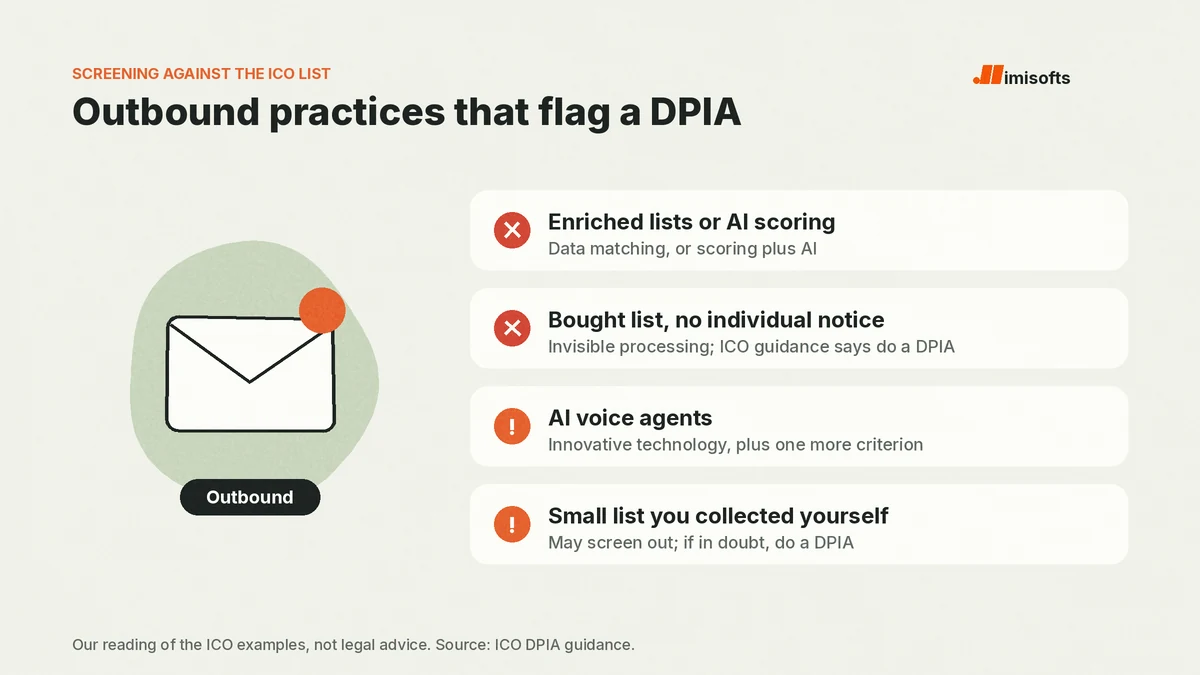
There is no rule that says every cold email campaign needs a DPIA. But several common outbound practices match items on the ICO list, so the screening step matters. Our reading of the ICO's examples:
- Enriched or combined lists. "Combining, comparing or matching personal data obtained from multiple sources" is the ICO's data matching item, and direct marketing is one of its listed examples. Enrichment that joins a bought list with data from other tools fits that description.
- Bought or scraped lists without an individual notice. If you rely on the Article 14(5)(b) "disproportionate effort" exception instead of telling each person, the ICO calls it invisible processing. Its list marks that item as needing another criterion, but its guidance on the exception itself says you "must still publish your privacy information, and carry out a DPIA." Our GDPR privacy notice guide covers that exception.
- AI voice agents. The ICO lists AI as innovative technology. AI alone does not trigger a DPIA under the list; it does when combined with another criterion, such as large scale or combined datasets.
- AI lead scoring. Evaluation or scoring is itself one of the nine criteria, so scoring with AI already brings two together, and the ICO lists "Application of AI to existing process" as an example of large scale profiling. In our reading, that combination is likely to need a DPIA.
- Tracking site visits. In our reading, tracking a person's behaviour online fits the ICO's tracking item ("geolocation or behaviour, including but not limited to the online environment"), which needs another criterion as well.
A small B2B campaign using data you collected yourself may screen out, though the ICO adds: "If in any doubt, we would always recommend that you do a DPIA." Either way, record the screening. The ICO says a decision not to do a DPIA can be recorded simply, for example as "an annotated copy of the checklist." Your legitimate interest assessment and record of processing activities feed straight into it.
What a DPIA must contain: the 4 parts in Article 35(7)
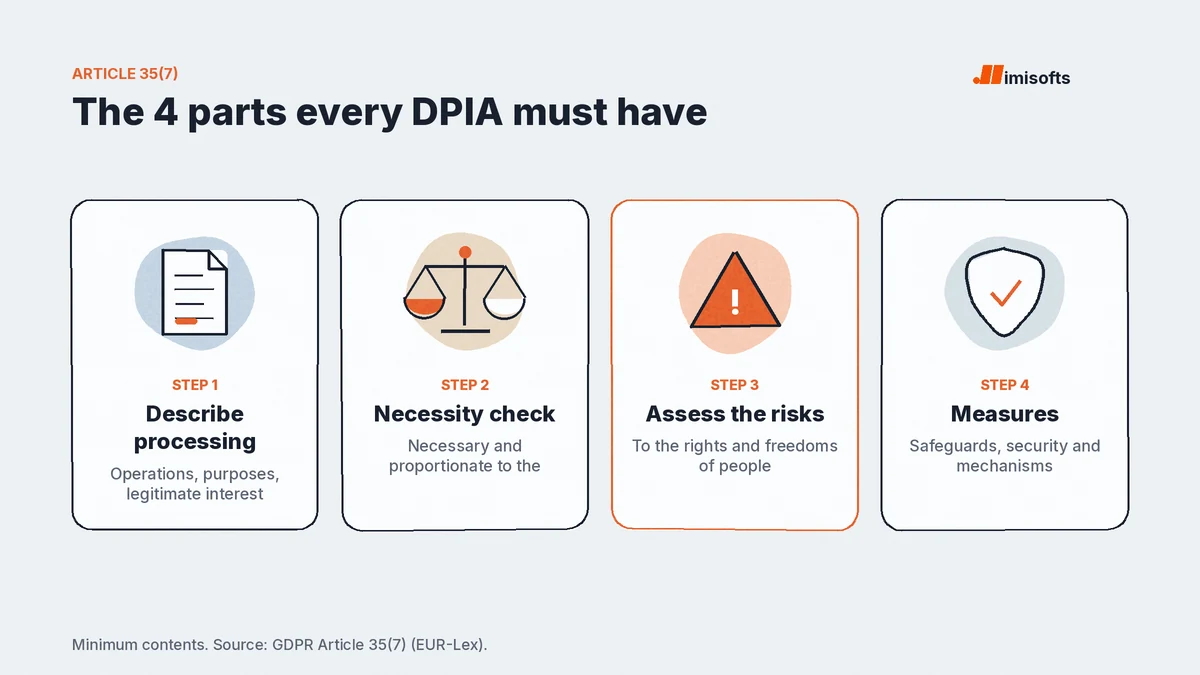
Article 35(7) says the assessment "shall contain at least" four things:
| Part | What Article 35(7) requires | For an outbound program, for example |
|---|---|---|
| (a) Description | A systematic description of the processing and its purposes, including any legitimate interest pursued | Where contacts come from, which tools hold them, how long you keep them |
| (b) Necessity | An assessment of necessity and proportionality in relation to the purposes | Why each data field is needed; whether a smaller list would do |
| (c) Risks | An assessment of the risks to the rights and freedoms of data subjects | Loss of control over data, unwanted contact, breach of a lead file |
| (d) Measures | The measures to address the risks, including safeguards and security | Opt out in every message, suppression lists, shorter retention, access controls |
The right column is our illustration, not text from the law. Article 35(9) adds that, "where appropriate," you should seek the views of the people affected or their representatives, and Article 35(11) asks for a review "where necessary," and "at least when there is a change of the risk."
How to do a DPIA in 7 steps
The ICO's guidance on how to do a DPIA sets out seven steps:
- Identify the need. Screen against Article 35(3), the ICO list and the nine criteria.
- Describe the processing. Nature, scope, context and purposes.
- Consider consultation. The ICO names individuals, internal stakeholders such as information security, and your processors.
- Assess necessity and proportionality. The ICO lists your lawful basis, data minimisation, privacy information, rights handling, processor compliance and transfer safeguards.
- Identify and assess risks. The ICO says to consider "both the likelihood and severity of the possible harm."
- Identify measures to reduce the risks. The ICO's examples include reducing retention periods, offering an opt out where appropriate and changing privacy notices.
- Sign off and record outcomes. Note what you will do, the residual risk and whether you must consult the regulator.
The ICO publishes a sample DPIA template that you "can use or adapt," and says "You don't have to use this template." Processors matter at step 3: the ICO says "Your contracts with processors should require them to assist," which is one of the terms covered in our data processing agreement guide.
When you must consult the regulator first
Under Article 36(1), if the DPIA shows the processing "would result in a high risk in the absence of measures taken by the controller to mitigate the risk," you must consult the supervisory authority before you start. The ICO puts it plainly: if a high risk remains and "you cannot do anything to reduce it," then "You cannot go ahead with the processing until you have consulted us."
The timelines in the law and in the ICO's process:
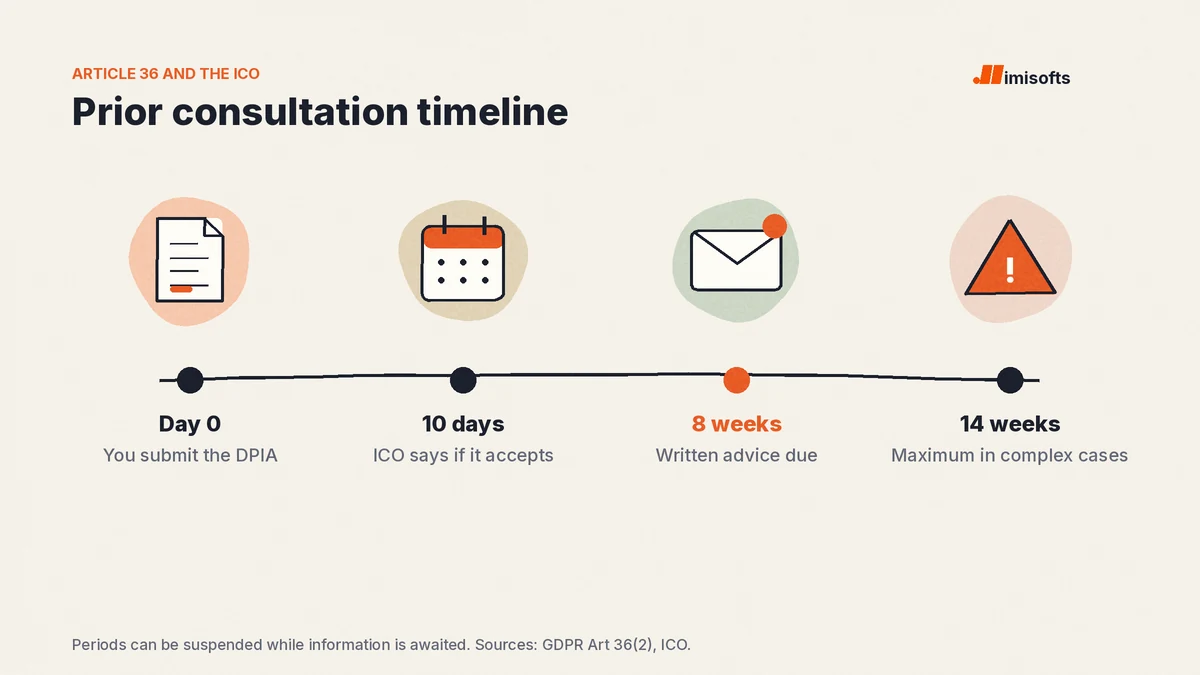
- Up to 8 weeks for the authority's written advice, under Article 36(2), which "may be extended by six weeks," so 14 weeks in all. The ICO says it extends to that maximum in complex cases. Both periods can be suspended while the authority waits for information it has asked for.
- The ICO says it will tell you "within 10 days" whether it has accepted your DPIA for prior consultation.
- Article 36(3) lists 6 items to send, including the DPIA itself and your DPO's contact details where you have one.
Possible outcomes listed in the ICO's consultation guidance range from going ahead, to advice, an official warning, or a limitation or ban on the processing.
Fines for skipping a DPIA
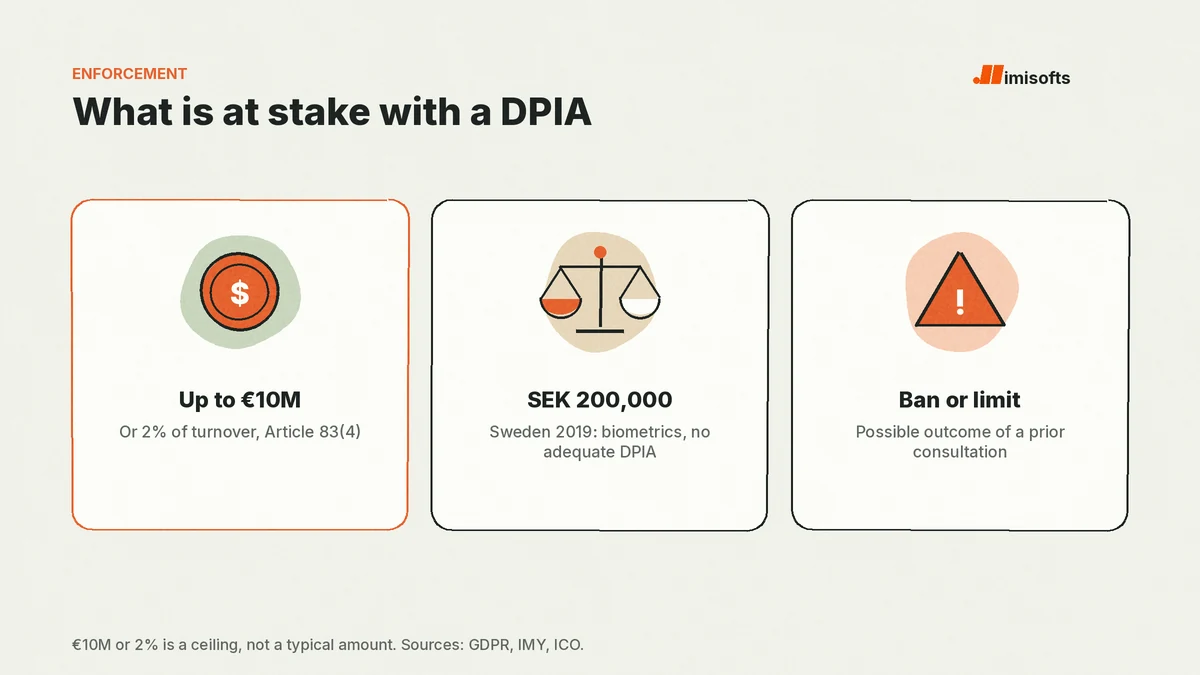
Articles 25 to 39 fall under Article 83(4): up to €10 million, or for an undertaking up to 2% of total worldwide annual turnover of the preceding financial year, "whichever is higher." Articles 35 and 36 fall inside that range. These are maximums; our GDPR fines guide shows how regulators set real amounts.
A real case: on August 21, 2019, Sweden's data protection authority announced it had fined a municipality SEK 200,000 (about €20,000, in its words) over a school pilot that used facial recognition to track attendance in one class. It found the school had processed sensitive biometric data unlawfully and "failed to do an adequate impact assessment including seeking prior consultation with the Swedish DPA." The regulator called it "the first fine issued by the Swedish DPA." In our view, the small size of the pilot shows that scale alone does not settle the question.
How imisofts can help
We set up and run the sending side of outbound: domains, mailboxes, SPF, DKIM and DMARC, warm up and monitoring, suppression lists, and the CRM fields that record where each contact came from. Those are among the facts a DPIA describes. If you are comparing options for that layer, see our guides to email hosting cost and email deliverability consultant cost. The assessment and its legal judgment stay with you and your adviser. See our email infrastructure service or talk to us about your setup.
Frequently Asked Questions
A data protection impact assessment is the risk check Article 35 requires before processing that is likely to result in a high risk to people. It must contain at least 4 parts: a description of the processing, a necessity and proportionality check, a risk assessment and the measures to address the risks.
Article 35(3) names 3 cases: profiling with legal or similar effects, large scale processing of special category or criminal data, and large scale monitoring of public areas. The ICO adds a list of 10 more, and says two of the nine European criteria together usually mean you need one.
Not always. The ICO lists direct marketing as an example of data matching and of invisible processing, so enriched lists, or bought lists where you rely on the disproportionate effort exception instead of telling each person, can trigger one. The ICO suggests recording your screening, and says that if in doubt you should do a DPIA.
The controller is responsible. You can outsource the work or ask a processor to help, but the ICO says you remain responsible for it. If you have a data protection officer, Article 35(2) says you must seek their advice.
If prior consultation is needed, the ICO says it will tell you within 10 days whether it accepts the DPIA, and give written advice within 8 weeks, extendable to a maximum of 14 weeks in complex cases. Article 36(2) allows up to 8 weeks plus a 6 week extension.
Breaches of Articles 35 and 36 fall under Article 83(4): up to €10 million or, for an undertaking, 2% of worldwide annual turnover, whichever is higher. In 2019 Sweden's regulator fined a municipality SEK 200,000 over a school facial recognition pilot, for unlawful biometric processing and failing to do an adequate impact assessment.