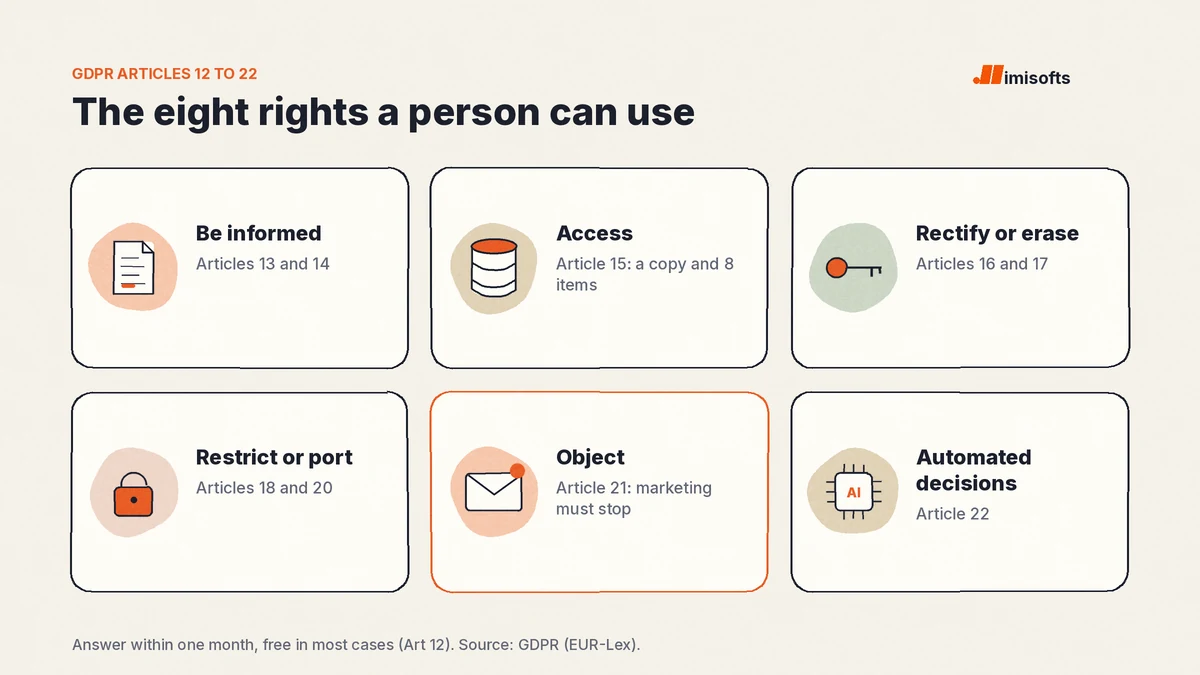
Short answer. The GDPR gives people eight rights over their personal data: to be informed, to access it, to have it corrected, to have it erased, to restrict its use, to take it elsewhere (portability), to object, and not to be subject to decisions made solely by automated means. Under Article 12(3) you must act on a request within one month, extendable by two further months for complex or numerous requests, and in most cases you cannot charge for it.
These rights can apply to B2B prospect data too: in our reading, a work email that names a person, such as [email protected], is personal data, because it relates to an identifiable person. In September 2026 Italy's data protection authority fined a training company EUR 8,000 after a promotional call to a number on Italy's Public Register of Objections and a rights request it "failed to respond adequately and promptly" to for over seven months. If your outreach runs on your own domains and mailboxes, our email infrastructure service builds the sending layer, including suppression lists that make an objection stick.
This guide puts the eight rights in one table, then covers the deadlines, fees and ID checks, the right to object to direct marketing, two 2026 fines, and a simple way for an outbound team to handle requests. Sources were read on November 27, 2026, apart from the UK Act and the fine limits, read on November 10, 2026. This is general information, not legal advice.
Key numbers
| Item | Number |
|---|---|
| Data subject rights in the GDPR (Articles 12 to 22; the ICO lists the same eight) | 8 |
| Deadline to act on a request (From receipt, Article 12(3)) | 1 month |
| Possible extension (Complex or numerous requests; tell the person in month one) | 2 further months |
| Fee for answering (Unless manifestly unfounded or excessive, Art 12(5)) | Free |
| Grounds for erasure (Article 17(1)(a) to (f)) | 6 |
| Maximum fine, EU (4% of worldwide turnover for an undertaking, if higher) | EUR 20M or 4% |
| Business School fine (Italy) (Request not handled properly for over seven months) | EUR 8,000 |
| Barbuti fine (Italy) (Texts continued after an erasure request) | EUR 5,000 |
| Authorities in the 2024 access action (1,185 controllers responded) | 30 |
GDPR text on EUR-Lex, ICO individual rights guidance and EDPB news pages read November 27, 2026; UK Act and GDPR Article 83 read November 10, 2026.
The eight GDPR rights in one table
The rights sit in Articles 12 to 22 of the GDPR, with the right to be informed in Articles 13 and 14. The UK regulator, the ICO, lists the same eight for the UK GDPR. Article 19 is not a separate right: it is the duty to pass corrections, erasures and restrictions on to the people you shared the data with.
| Right | Article | What the person can ask for | Conditions |
|---|---|---|---|
| To be informed | 13, 14 | A privacy notice: who you are, why and on what basis you use the data, their rights | For bought lists, within one month or at first contact (Art 14(3)) |
| Access | 15 | Confirmation, a copy of the data and eight items of information | Always, subject to others' rights |
| Rectification | 16 | Correction of inaccurate data, completion of incomplete data | "Without undue delay" |
| Erasure | 17 | Deletion of the data | One of six grounds, such as an objection to marketing |
| Restriction | 18 | Keep the data but stop using it | One of four cases, such as contested accuracy |
| Portability | 20 | Data they provided, in a machine-readable format | Only consent or contract, and automated processing |
| Object | 21 | Stop processing; for direct marketing, stop at any time | Marketing objections need no reason |
| Automated decisions | 22 | Not to be subject to a solely automated decision with legal or similar effects | Exceptions include contract and law, Art 22(2) |
The full detail of the first right is in our guide to the GDPR privacy notice, and erasure has its own guide on the right to erasure. Who must answer depends on roles (see data controller vs data processor).
Deadlines, fees and ID checks
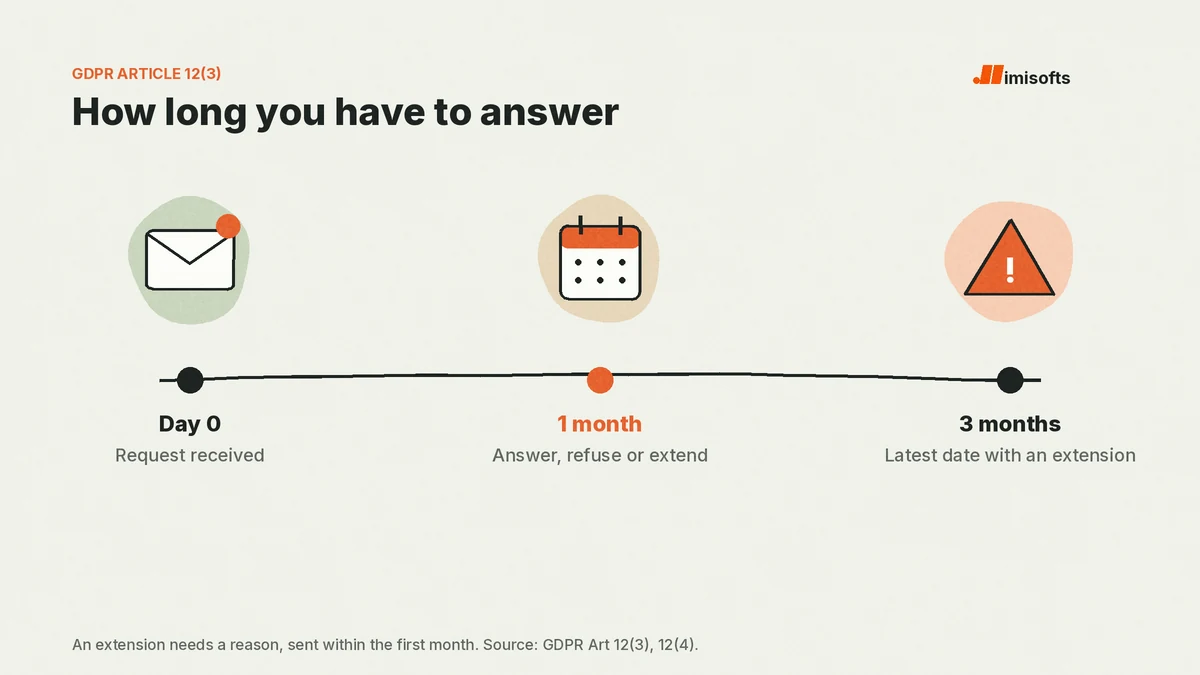
Article 12 sets the rules that apply to every request under Articles 15 to 22.
- One month. Act "without undue delay and in any event within one month of receipt of the request." You may extend "by two further months where necessary, taking into account the complexity and number of the requests," but you must tell the person within the first month, with reasons. That is three months at the outside.
- Saying no. If you will not act, Article 12(4) says you must explain why within one month and tell the person they can complain to a supervisory authority and seek a judicial remedy.
- Free of charge. Article 12(5) makes answers free. Only where requests are "manifestly unfounded or excessive, in particular because of their repetitive character" can you charge a reasonable fee or refuse, and you carry "the burden of demonstrating" that.
- ID checks. Under Article 12(6), where you have "reasonable doubts" about who is asking, you may request the information needed to confirm identity. It is a power for real doubt, not a standard hurdle.
The UK changed its clock. For requests received from 5 February 2026, under the Data (Use and Access) Act 2025, the month runs from the latest of receipt, receipt of ID information, or payment of a fee, and can pause while you ask for further information you reasonably require to answer an access request. The detail is in our guide to DSAR response time.
The right to object to direct marketing
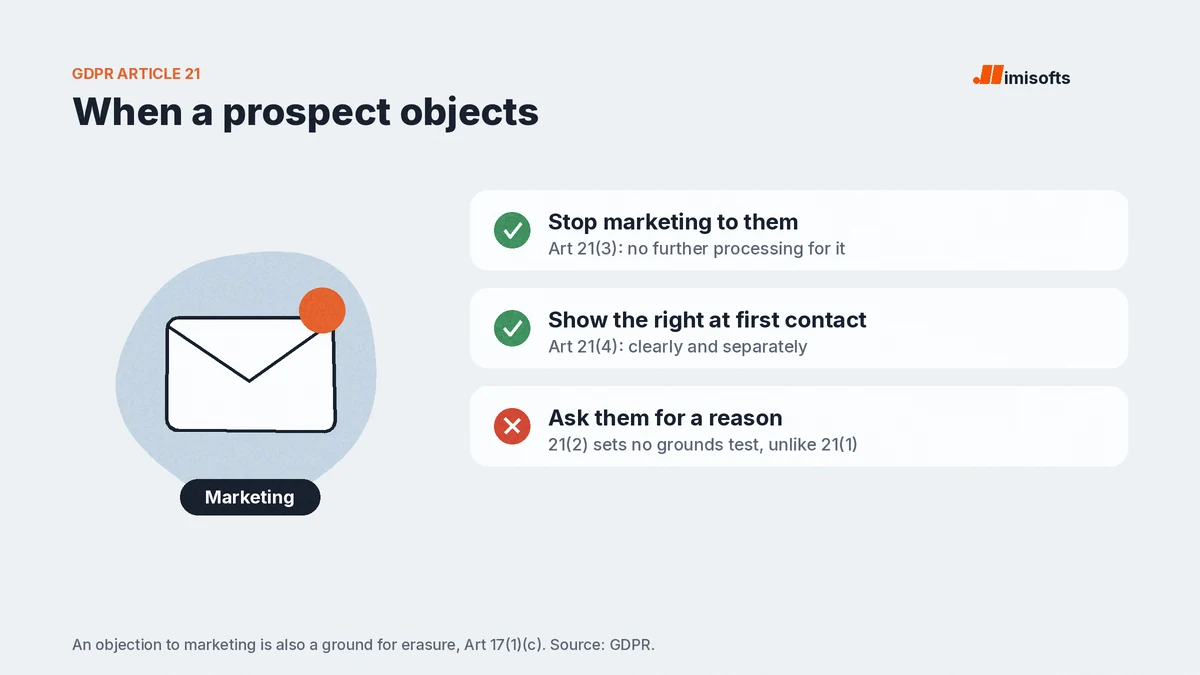
For an outbound team this is the right that matters on day one. Article 21(2) says: "Where personal data are processed for direct marketing purposes, the data subject shall have the right to object at any time." Article 21(3) is short: the data "shall no longer be processed for such purposes."
Two points follow from the text. First, the objection to marketing needs no reason. The general objection in Article 21(1) is made "on grounds relating to his or her particular situation," and the controller's "overriding legitimate grounds" can prevail (Articles 17(1)(c) and 18(1)(d)); Article 21(2) sets no such test. Second, Article 21(4) says the right must be "explicitly brought to the attention of the data subject" at the latest at the first communication, "presented clearly and separately from any other information." In our view, a separate line in the first cold email that says how to object to further emails, and that the request will be honoured, is the practical way to meet it.
An objection to marketing also opens the door to erasure: Article 17(1)(c) lists an objection "pursuant to Article 21(2)" as one of the six grounds.
Access and erasure requests from prospects
An access request under Article 15 entitles the person to confirmation, a copy of the data, and eight items: purposes, categories, recipients, storage period, their other rights, the right to complain, "any available information as to their source," and any automated decision-making. For prospects found on a bought or scraped list, the source item is the one that causes trouble. Our guide on how to answer a subject access request walks through it step by step.
Erasure under Article 17 applies "without undue delay" where a ground applies, for example the data is "no longer necessary" for its purpose, consent is withdrawn and there is no other legal ground, or the person objected to marketing. Article 19 then requires you to tell "each recipient to whom the personal data have been disclosed," such as a list partner, "unless this proves impossible or involves disproportionate effort," and to tell the person who those recipients are if they ask.
Rectification, restriction, portability and automated decisions
These four come up less in outbound work, but they still need an answer within the same month.
- Rectification (Article 16): correct inaccurate data "without undue delay," and complete incomplete data, for example a wrong job title in your CRM.
- Restriction (Article 18): stop using the data while keeping it, in four cases: accuracy is contested, processing is unlawful but the person prefers restriction to erasure, the person needs the data for legal claims, or an Article 21(1) objection is being checked.
- Portability (Article 20): data the person "has provided" to you, "in a structured, commonly used and machine-readable format," only where you rely on consent or a contract and process it by automated means. In our reading, a prospect list held on legitimate interests falls outside it, because Article 20 is limited to consent and contract.
- Automated decisions (Article 22): a right not to be subject to a decision "based solely on automated processing, including profiling," with "legal effects" or a similarly significant effect. In our reading, lead scoring that only decides who gets an email is unlikely to reach that bar.
What regulators fined in 2026
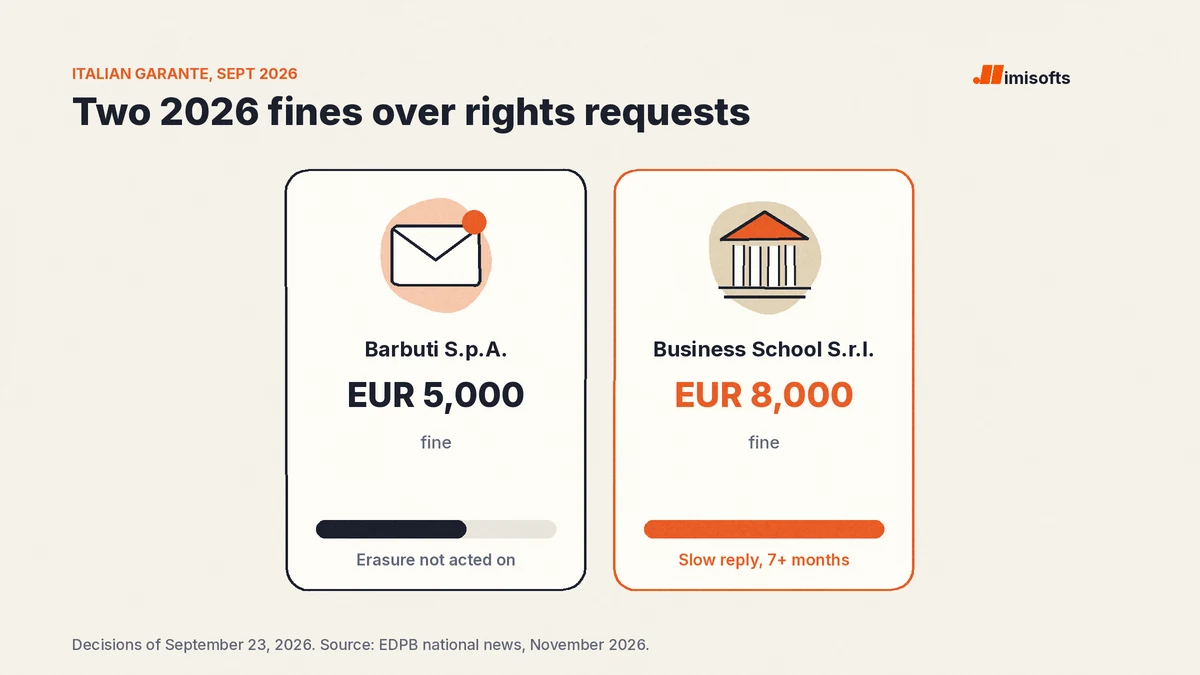
Two Italian decisions of September 23, 2026, summarised by the European Data Protection Board in November, involved marketing messages and requests.
- Barbuti S.p.A., EUR 5,000. A person kept getting promotional text messages after asking for erasure. They had written to the general contact address; the messages did not say how to exercise data protection rights. The company sent an automatic acknowledgement but "failed to respond to the request and continued sending promotional messages." The authority said requests sent through a channel the controller provides, "even if different from the preferred channel indicated in its privacy notice, should generally be considered valid." It found breaches of Articles 5(2), 12 and 17.
- Business School S.r.l., EUR 8,000. A promotional call reached a number on Italy's Public Register of Objections; the company blamed a manual dialling error, which "did not remove its responsibility." It also "failed to respond adequately and promptly to the individual's request for over seven months." Breaches included Articles 12(3) and (4), 15, 17 and 21.
The ceiling is far higher. Article 83(5)(b) puts infringements of "the data subjects' rights pursuant to Articles 12 to 22" in the top tier: up to EUR 20 million or, for an undertaking, 4% of total worldwide annual turnover, whichever is higher. The UK cap is £17.5 million or 4%. Regulators also check in bulk: in 2024, 30 European authorities ran a coordinated action on the right of access, with 1,185 controllers responding. Our GDPR fines guide covers how fines are set.
A simple process for an outbound team
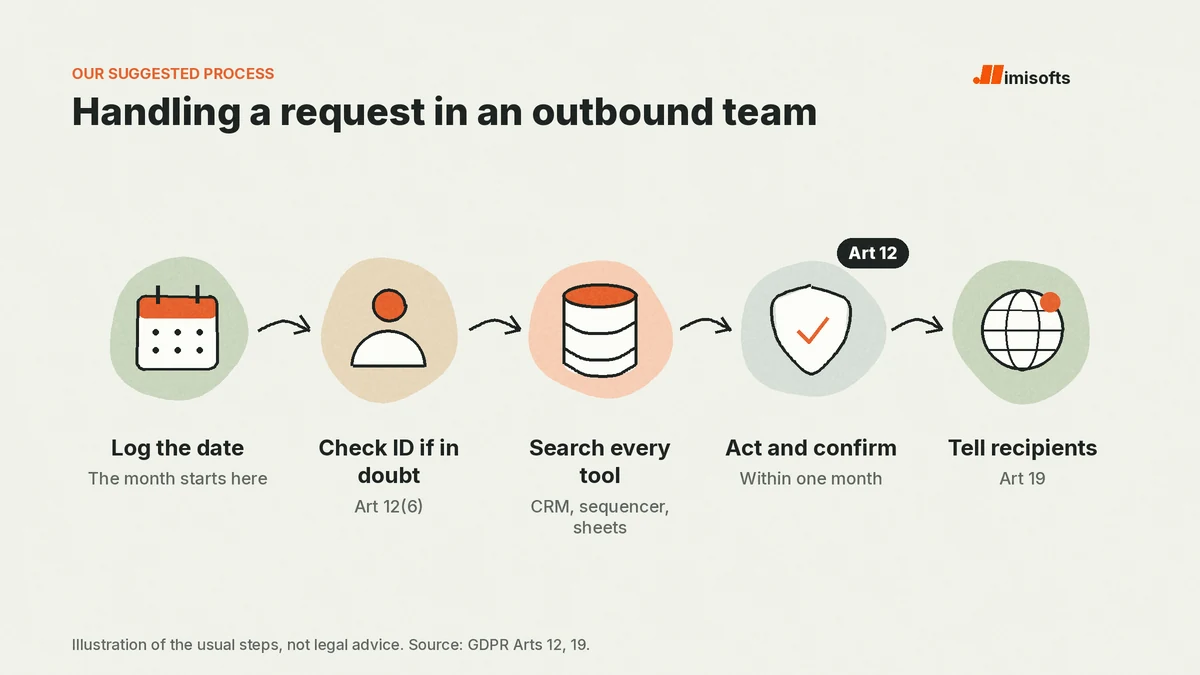
This is the process we suggest, built from the articles above. It is not the only way to comply.
- Treat your own channels as valid. The Italian authority said requests sent through a channel the controller provides "should generally be considered valid." A reply to your cold email or a note to your support inbox can be a request. Route them to one person.
- Log the date. The month starts on receipt. Note it in a simple register.
- Check identity only if in doubt. Article 12(6) ties ID requests to "reasonable doubts."
- Search every tool. CRM, sequencer, enrichment tool, spreadsheets and inboxes. Record the source of each contact.
- Act and confirm. Suppress, delete, correct or send the copy, then tell the person what you did, within the month.
- Pass it on. Tell list partners and any tool that shares the data, as Article 19 requires.
Teams that hire outside help for sending should check who does each step; our page on email deliverability consultant cost lists what such work usually covers.
The bottom line
Eight rights, one month, free of charge in most cases, and an objection to marketing means the data is no longer processed for marketing. The two 2026 Italian fines above were for messages that kept coming after a request and for a request not answered adequately and promptly. A logged request, a search of every tool and a reply within the month answer most of what the GDPR asks. If you want the sending side set up so objections and suppressions carry across every mailbox, see our email infrastructure service.
Frequently Asked Questions
The right to be informed, the right of access, the right to rectification, the right to erasure, the right to restrict processing, the right to data portability, the right to object, and rights related to automated decision-making including profiling. They sit in Articles 12 to 22 of the GDPR, and the ICO lists the same eight for the UK GDPR.
One month from receipt under Article 12(3). You can extend by two further months for complex or numerous requests, but you must tell the person within the first month and give reasons. If you refuse, you must explain why within one month and mention the right to complain.
Not usually. Article 12(5) makes answers free. You can charge a reasonable fee, or refuse, only where a request is manifestly unfounded or excessive, for example repetitive, and you must be able to show that. For access requests, a reasonable fee is also allowed for further copies.
They can. In our reading, a work email or phone number that identifies a person is personal data, so the rights apply to those prospects in your CRM. The right to object to direct marketing under Article 21(2) is the one an outbound team meets most directly.
No. Article 21(2) gives a right to object to direct marketing at any time, and Article 21(3) says the data shall no longer be processed for that purpose. The general objection in Article 21(1) asks for grounds relating to the person's situation.
Regulators fine for it. In September 2026 Italy's authority fined Business School EUR 8,000, in part for failing to respond adequately and promptly to a request for over seven months, and Barbuti EUR 5,000 after promotional texts continued following an erasure request. The EU maximum is EUR 20 million or, for an undertaking, 4% of worldwide turnover if higher.