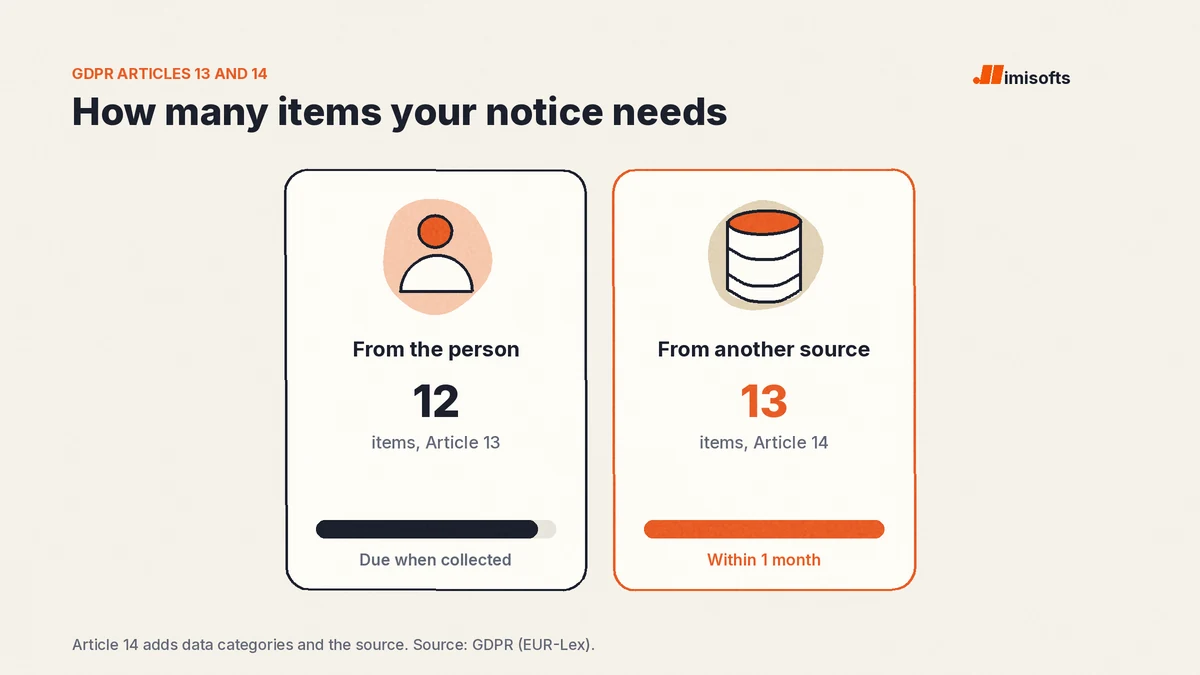
Short answer. A GDPR privacy notice tells people who you are, why you use their data, on what legal basis, who receives it, how long you keep it and what rights they have. Article 13 lists 12 items when you collect data from the person, and Article 14 lists 13 items when you got it elsewhere, such as a bought or scraped B2B list. For that second case the deadline is one month after you obtain the data, or your first email if that comes sooner.
This is being checked right now. On March 19, 2026 the European Data Protection Board launched a coordinated enforcement action on the transparency and information duties of Articles 12, 13 and 14, with 25 data protection authorities taking part during 2026. If your outreach runs on your own sending domains and mailboxes, our email infrastructure page explains how we build that layer.
This guide covers what goes in a notice, the difference between Articles 13 and 14, the deadlines, the exemptions, a Polish case about public registers, and a short sample notice for a cold email. Sources were read on November 26, 2026. This is general information, not legal advice.
Key numbers
| Item | Number |
|---|---|
| Items in an Article 13 notice (Collected from the person: 13(1) and 13(2)) | 12 |
| Items in an Article 14 notice (Obtained elsewhere: 14(1) and 14(2)) | 13 |
| Latest Article 14 deadline (Or the first email or disclosure, if sooner) | 1 month |
| Article 14(5) exemptions (Already informed, impossible or disproportionate, law, secrecy) | 4 |
| Maximum fine (Of worldwide turnover, whichever is higher, Art 83(5)(b)) | €20M or 4% |
| Authorities in the 2026 EDPB action (Transparency, Arts 12 to 14, launched March 19, 2026) | 25 |
| Bisnode fine (Poland) (UODO's first GDPR fine; amount annulled, re-decided amount not found) | just over PLN 943,000 |
| Bisnode appeal dismissed (Supreme Administrative Court, III OSK 2538/21) | September 2023 |
GDPR (EUR-Lex); ICO right to be informed guidance; UODO news of September 20, 2023; EDPB news of March 19, 2026. Read November 26, 2026.
What a GDPR privacy notice is
The GDPR calls it the right to be informed. Article 12(1) says the information must be given "in a concise, transparent, intelligible and easily accessible form, using clear and plain language." It can be given "in writing, or by other means, including, where appropriate, by electronic means," so an email or a web page both work.
Two articles set the content. Article 13 applies when you collect data from the person, for example through a contact form or a demo booking. Article 14 applies when you did not, for example a list you bought, data a partner shared, or contacts gathered from public sources. The UK GDPR uses the same two articles. The ICO's guidance carries a note that it is under review after the Data (Use and Access) Act, so check it again before relying on UK details.
Article 13 vs Article 14: the items side by side
Most items are the same. Article 14 adds two that matter for outbound teams: the categories of personal data you hold, and the source the data came from, including "whether it came from publicly accessible sources." Article 13 instead asks you to say whether giving the data is a statutory or contractual requirement.
| Item | Article 13 (from the person) | Article 14 (from elsewhere) |
|---|---|---|
| Identity and contact details of the controller, and its representative | Yes, 13(1)(a) | Yes, 14(1)(a) |
| Data protection officer contact, where there is one | Yes, 13(1)(b) | Yes, 14(1)(b) |
| Purposes and legal basis | Yes, 13(1)(c) | Yes, 14(1)(c) |
| Legitimate interests pursued, if that is the basis | Yes, 13(1)(d) | Yes, 14(2)(b) |
| Categories of personal data | No | Yes, 14(1)(d) |
| Recipients or categories of recipients | Yes, 13(1)(e) | Yes, 14(1)(e) |
| Transfers to third countries or international organisations, and the safeguards | Yes, 13(1)(f) | Yes, 14(1)(f) |
| Storage period, or the criteria for it | Yes, 13(2)(a) | Yes, 14(2)(a) |
| Rights: access, rectification, erasure, restriction, objection, portability | Yes, 13(2)(b) | Yes, 14(2)(c) |
| Right to withdraw consent, if consent is the basis | Yes, 13(2)(c) | Yes, 14(2)(d) |
| Right to complain to a supervisory authority | Yes, 13(2)(d) | Yes, 14(2)(e) |
| Whether giving the data is required, and what happens if not | Yes, 13(2)(e) | No |
| Source of the data, and whether it was public | No | Yes, 14(2)(f) |
| Automated decision-making, including profiling | Yes, 13(2)(f) | Yes, 14(2)(g) |
| Total items | 12 | 13 |
"Where applicable" items, such as the DPO or transfers, only need a line when they apply to you. For who counts as a recipient in an email stack, see our guide to the data processing agreement.
When you must give the notice
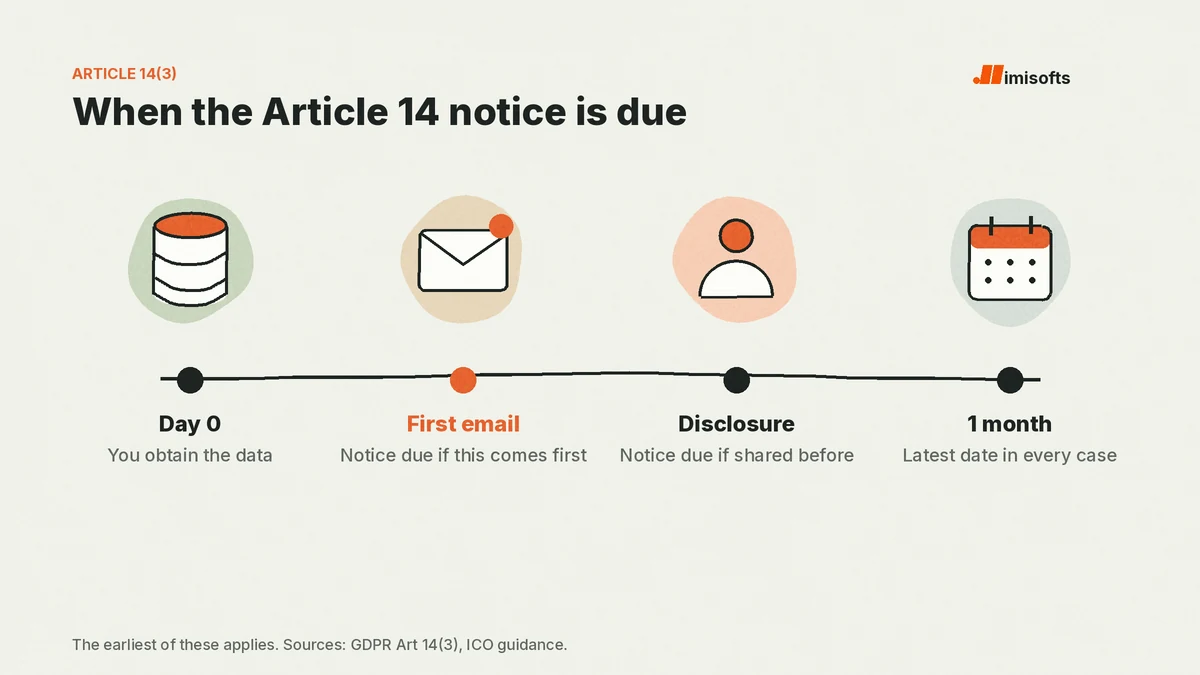
Under Article 13 the answer is simple: "at the time when personal data are obtained." Under Article 14(3) there are three deadlines, and the earliest one wins:
- Within a reasonable period after obtaining the data, "but at the latest within one month."
- At the first communication, if you will use the data to contact the person.
- At the first disclosure, if you plan to pass the data to another recipient.
The ICO adds a point that catches list buyers: "the one month time limit still applies in these situations." Its example is a disclosure planned two months after obtaining the data, where the person must still be informed within a month. So a list that sits unused for six weeks needed its notice by the end of the first month, even with no email sent.
Placing the notice on your website is not enough on its own. The ICO says you must make people aware of it, and "Simply putting it on your website, in case people happen to look there, is not enough."
The 4 exemptions, and why public data is not one
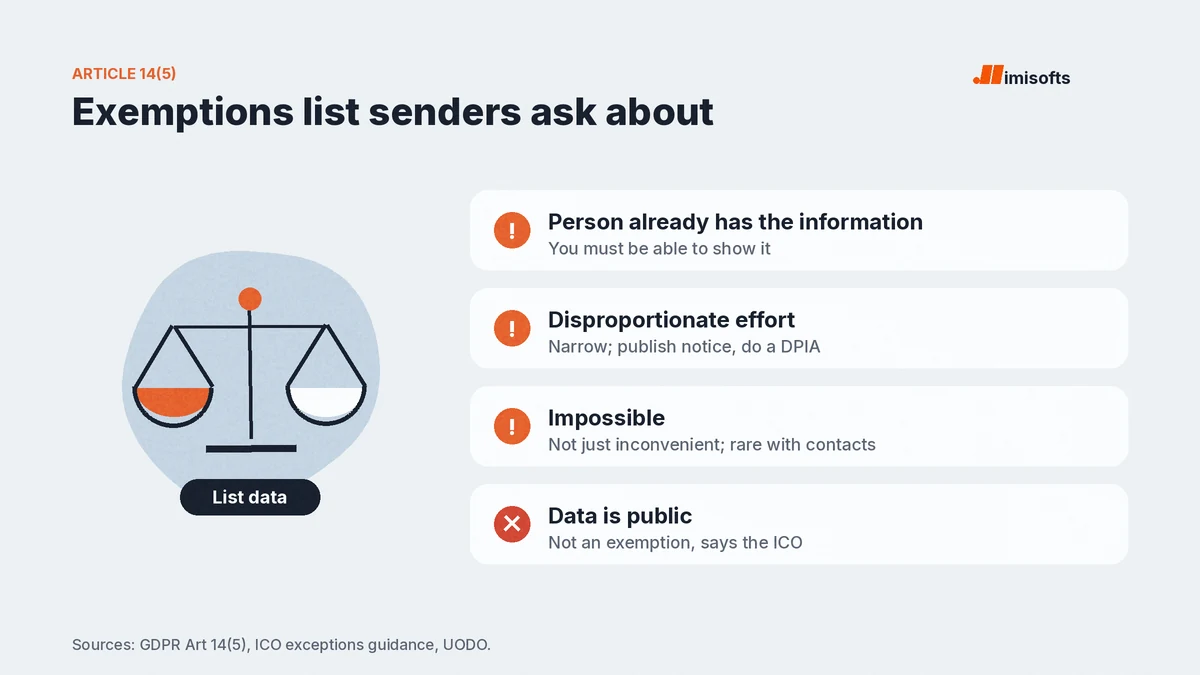
Article 14(5) switches the duty off in four cases: the person already has the information; giving it is impossible or "would involve a disproportionate effort"; obtaining or disclosure is "expressly laid down" by EU or national law that protects the person's legitimate interests; or the data is covered by professional secrecy. Article 13(4) has only the first of these.
The ICO reads them narrowly. "There is no automatic exception from the right to be informed just because the personal data is in the public domain," it says. If you rely on the person already having the information, you must be able to show it. Impossibility must be shown, "not just inconvenient," and is most likely when you have no contact details. Disproportionate effort "should be treated as the exception, not the rule," needs a documented assessment, and still requires you to publish the notice; the ICO says you should also carry out a data protection impact assessment.
For a sender who holds a work email address for every contact, in our view these exemptions rarely fit: the contact details that make the outreach possible also make the notice possible.
The Bisnode case: public registers still need a notice
Poland's regulator, UODO, imposed its first GDPR fine, of just over PLN 943,000 on Bisnode, a data company now part of Dun & Bradstreet. Bisnode took data on business owners from public registers but, UODO says, informed only the people whose email addresses it had. UODO held that a company taking data from public registers must meet Article 14 "by directly providing information to the data subject."
The courts largely agreed. The regional administrative court upheld the duty for people running a business or with their business suspended, but annulled the part covering people who had stopped, and with it the fine amount, which UODO must reconsider. On September 19, 2023 the Supreme Administrative Court dismissed Bisnode's appeal and said the "disproportionate effort" exception should be read restrictively and, as a rule, applied to public purposes such as statistics, research and archives.
What this means for a cold email list
If the GDPR or UK GDPR applies to your outreach and you email contacts from a bought, rented or scraped list, Article 14 applies. The notice is due at the first email or within one month of obtaining the data, whichever is earlier. For whether the list itself is lawful, see is buying B2B email lists legal; for the balancing test behind legitimate interests, see our legitimate interest assessment guide.
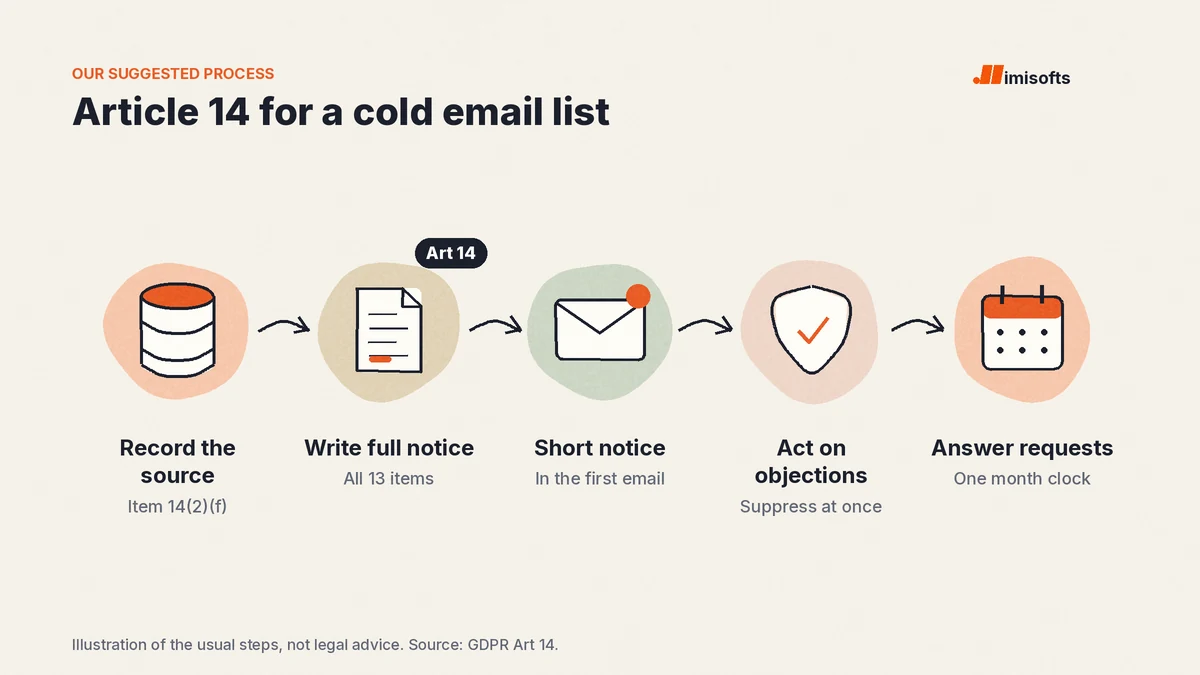
In our view a layered notice works well for outreach: a short paragraph in the first email covering who you are, where you got the address, why you are writing and how to object, with a link to a full notice that lists all 13 items. Article 21(4) also requires the right to object to be brought to the person's attention, explicitly and separately from other information, at the latest at the first communication. A practical sequence:
- Record the source of every contact when it enters your CRM, because item 14(2)(f) asks for it.
- Write the full notice with all 13 items and publish it at a stable link.
- Add the short notice to the first email of every sequence.
- Act on objections at once and keep a suppression list.
- Answer access requests on time; our guide to DSAR response time covers the one-month clock.
Some countries also require consent for marketing email, including some B2B email, whatever the notice says. Check the country first in our cold email laws by country hub.
A sample short notice for a first email
This is an illustration to adapt with your adviser, not a template that fits every business. Replace the brackets with your own details:
"We are [Company], [address], [contact email]. We found your work email on [source, for example your company website] and are writing because [purpose]. We rely on our legitimate interest in offering [service] to businesses like yours. We keep your details for [period] unless you object. You can ask for access, correction or deletion, object at any time by replying 'stop', and complain to your data protection authority. Full notice: [link]."
The full notice behind the link then adds the categories of data, recipients such as your sending platform and CRM, any transfers outside the EU, and the rest of the 13 items. Keep a copy of each version with its date, which also helps your record of processing activities.
Fines and the 2026 enforcement push
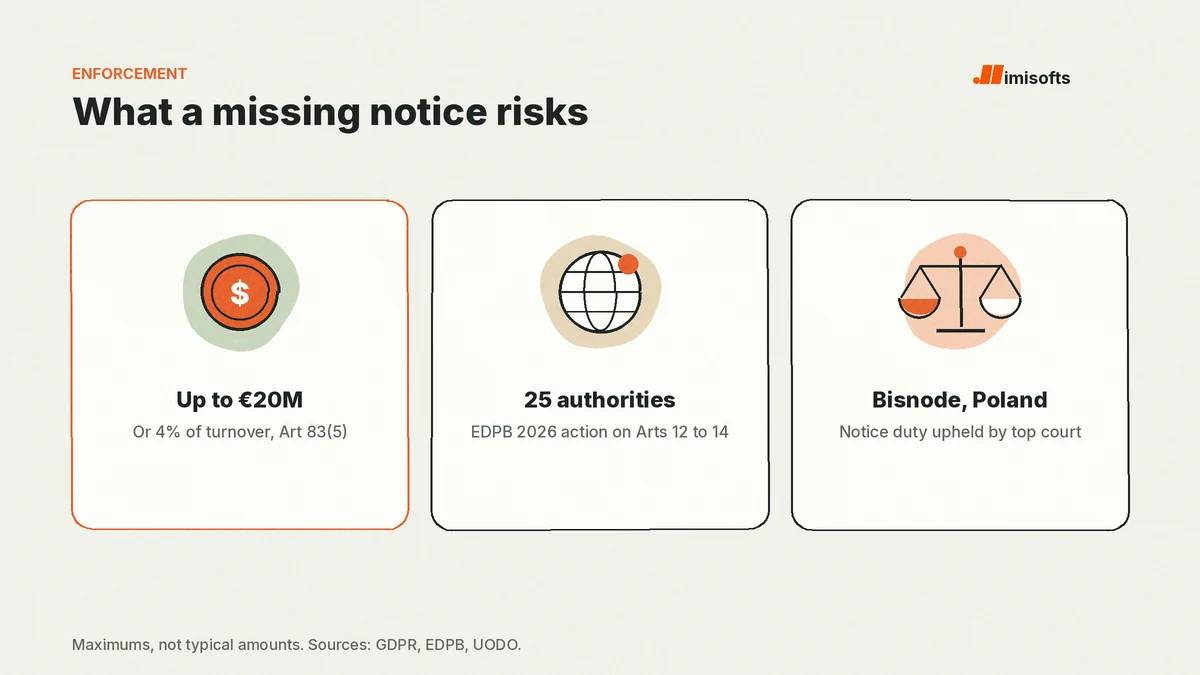
Articles 12 to 22 sit in the higher fine tier of Article 83(5)(b): up to €20 million, or for an undertaking up to 4% of total worldwide annual turnover of the preceding financial year, "whichever is higher." These are maximums; our GDPR fines guide shows how regulators set real amounts.
The EDPB's 2026 coordinated action means more controllers are being asked about their notices this year. Participating authorities will contact controllers "either through enforcement actions or fact-finding exercises" and pool their findings into a consolidated report. Senders who also run their own mail servers should keep the notice next to the technical work; our guide to email hosting cost and the email deliverability consultant cost guide cover that side.
How imisofts can help
We set up and run the sending side of outbound: domains, mailboxes, SPF, DKIM and DMARC, warm-up and monitoring, and the CRM fields that record where each contact came from. Those tools are among the recipients your notice should name. The legal wording stays with you and your adviser. See our email infrastructure service or talk to us about your setup.
Frequently Asked Questions
Under Article 13 it has 12 items, including your identity and contact details, purposes and legal basis, recipients, storage period, the person's rights and the right to complain. Article 14 has 13 items for data you did not collect from the person, adding the categories of data and the source.
Article 13 applies when you collect data from the person, and the notice is due when you collect it. Article 14 applies when the data came from somewhere else, such as a bought list or a public register, and is due within one month, or at your first contact if sooner.
Yes, if the GDPR or UK GDPR applies to you, which is usually the case when you target people in the EU or the UK. A bought, rented or scraped list falls under Article 14, so the notice is due at the first email or within one month of getting the data, whichever is earlier. A short notice in the email with a link to the full notice is a common approach.
No. The ICO says there is no automatic exception just because data is in the public domain. Poland's UODO fined Bisnode for not informing people whose data it took from public business registers, and the Supreme Administrative Court upheld the duty in 2023.
Not on its own. The UK ICO says you must make people aware of it, and that simply putting it on your website, in case people happen to look there, is not enough. Link it from your forms and first emails.
Breaches of Articles 12 to 22 can bring fines of up to €20 million or 4% of total worldwide annual turnover of the preceding year, whichever is higher, under GDPR Article 83(5)(b). These are maximums, not typical amounts.