Short answer. To answer a subject access request, confirm whether you hold the person's data, then send a copy of it with eight items of information set out in GDPR Article 15: purposes, categories, recipients, storage period, their rights, the right to complain, the source of the data, and any automated decision-making. You have one month, the first copy is free, and you may ask for ID only when you have reasonable doubts about who is asking.
It is a common request to get wrong. In September 2026 Italy's authority fined a training company EUR 8,000, in part for failing "to respond adequately and promptly" to a rights request "for over seven months." For outbound teams the hard part is usually the source of a contact. If your outreach runs on your own domains and mailboxes, our email infrastructure service builds the sending layer, including one-click unsubscribe and suppression lists.
This guide covers how to recognise a request, ID checks, the search, what to send, fees and refusals, other people's data, and a template reply. For the deadline rules in detail, including the UK changes of 2026, see our guide on DSAR response time. Sources were read on November 27, 2026, apart from the UK Act and the CNIL decision, read on November 10, 2026. This is general information, not legal advice.
Key numbers
| Item | Number |
|---|---|
| Deadline to answer (From receipt, Article 12(3)) | 1 month |
| Possible extension (Complex or numerous requests) | 2 further months |
| Items to send with the copy (Article 15(1)(a) to (h)) | 8 |
| Fee for the first copy (Reasonable fee only for further copies or excessive requests) | Free |
| UK clock change (Starts at ID or fee, pauses for clarification) | 5 February 2026 |
| Business School fine (Italy) (Request not handled properly for over seven months) | EUR 8,000 |
| KASPR fine (France) (CNIL, December 2024; gave only a generic source) | 240,000 euros |
| Authorities in the 2024 access review (1,185 controllers responded) | 30 |
GDPR text on EUR-Lex and the ICO guide to subject access read November 27, 2026; EDPB and CNIL pages read November 10 and 27, 2026.
How to recognise a subject access request
A request does not need a form or the right words. The UK regulator's guide to subject access, last updated 16 July 2026, says a person "can make a SAR verbally or in writing, including via social media," and that they do not "need to use a specific form of words, refer to legislation or direct the request to a specific contact." A reply to your cold email that says "what data do you hold on me?" counts.
The ICO adds that a person "may ask a third party (eg a relative, friend or solicitor) to make a SAR on their behalf." In that case you need to be satisfied the third party is authorised. In the EU, a September 2026 Italian decision summarised by the European Data Protection Board said requests sent through a channel the controller provides, "even if different from the preferred channel indicated in its privacy notice, should generally be considered valid."
Done for you by imisofts
Selling to UK businesses?
imisofts runs PECR-aware cold email and appointment setting for UK companies and books qualified meetings into your calendar.
The deadline in one paragraph
Article 12(3) says you must answer "without undue delay and in any event within one month of receipt of the request," with a possible extension "by two further months" for complex or numerous requests, notified within the first month with reasons. In the UK, for requests received from 5 February 2026, the month starts at the latest of receipt, receipt of ID you asked for, or payment of a fee, and pauses while you ask for further information you reasonably require to find what the request covers. The ICO calls the pause "stopping the clock": it "pauses on the day you request it and resumes the day after you receive it."
ID checks and clarification
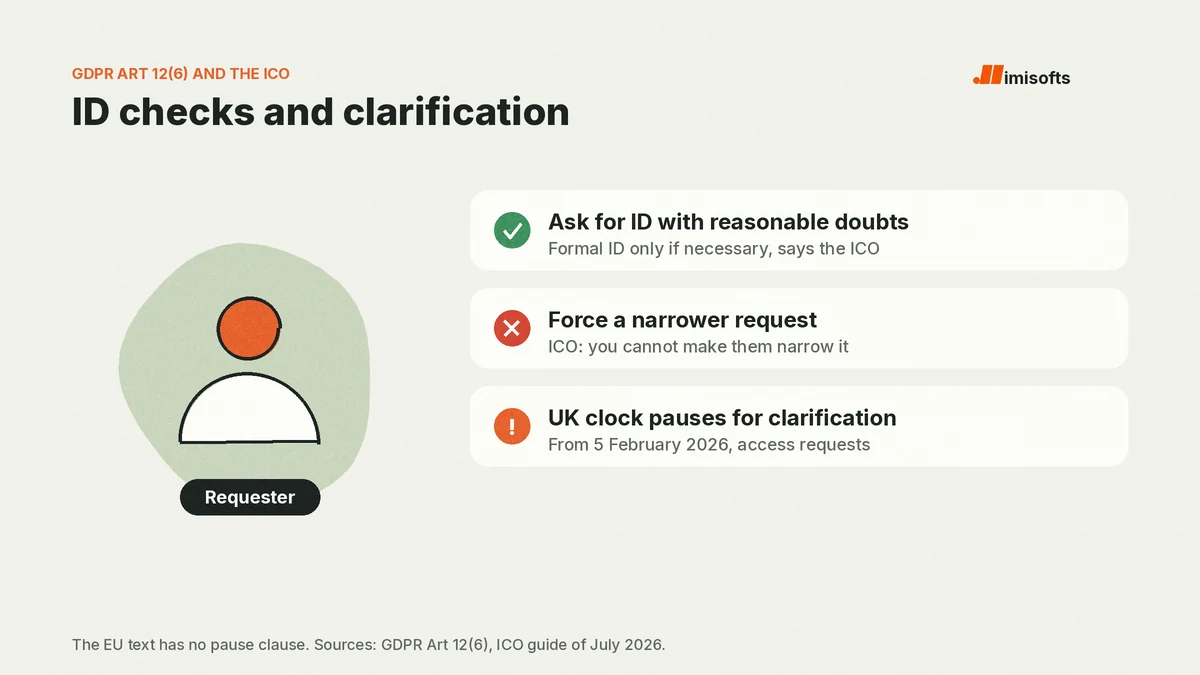
Article 12(6) lets you ask for more information only "where the controller has reasonable doubts concerning the identity" of the person. The ICO's guidance is direct: "You should be reasonable and proportionate about what you ask for," and "you should only request formal identification if necessary." In our view, a request from the same email address you wrote to will rarely give you reasonable doubt. Asking a prospect for a passport scan to learn what is in your CRM is the kind of barrier European regulators flagged in their 2024 review, which listed "being requested to provide excessive identification documents" among the problems.
Ask for ID early: the ICO says the timescale "does not start until you receive the information you requested." Separately, you can ask what the person wants if you hold a lot of data, and the clock pauses while you wait, but the ICO says "You cannot force someone to narrow the scope of their request."
The search: every tool that holds the contact
The ICO says "You must make a reasonable and proportionate search," but "you do not need to conduct searches that are unreasonable or disproportionate to the importance of the information." The UK wrote that test into the UK GDPR in 2025. For an outbound team, a reasonable search usually means:
- the CRM record, notes and activity history;
- the sequencer or sending tool, including sent emails and replies;
- enrichment and list tools, and the export or purchase the contact came from;
- call recordings and transcripts, if you call;
- shared spreadsheets and the inboxes of the people who worked the lead.
Write down where you looked. If a regulator asks, a record of the search is your evidence.
What to send: the copy and the eight items
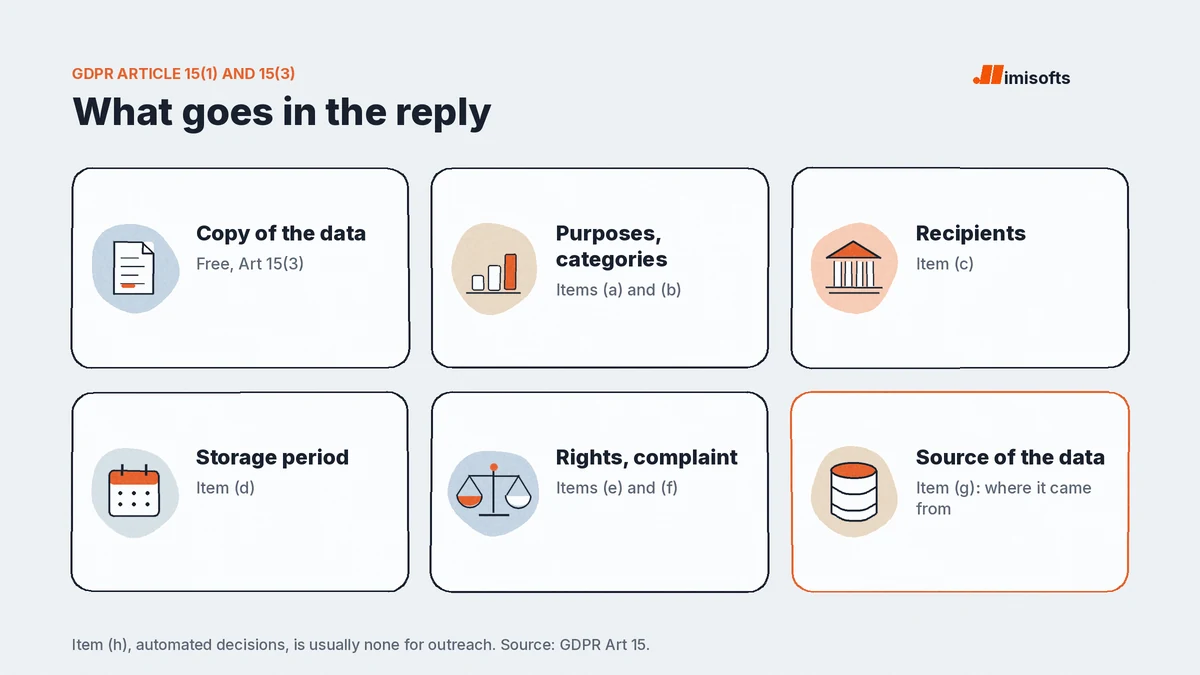
Article 15(3) says "The controller shall provide a copy of the personal data undergoing processing," and if the request came by email, "in a commonly used electronic form" unless the person asks otherwise. Alongside the copy, Article 15(1) lists eight items.
| Article 15(1) | What to tell the person | Example for a cold email list |
|---|---|---|
| (a) | The purposes of the processing | B2B sales outreach |
| (b) | The categories of personal data | Name, job title, work email, company |
| (c) | Recipients or categories of recipient | Sending platform, CRM provider |
| (d) | How long you keep it, or the criteria | Your retention rule for unreplied leads |
| (e) | Their rights to rectify, erase, restrict, object | How to use each |
| (f) | The right to complain to a regulator | Name the authority |
| (g) | "Any available information as to their source" | The vendor or site the contact came from |
| (h) | Automated decision-making and its logic | Usually "none" for outreach |
Item (g) is a known risk for contact data businesses. France's CNIL fined the contact data company KASPR 240,000 euros in December 2024; the lead breach was collecting LinkedIn details that users had chosen to limit, and among the other breaches, it told people only that their details came from publicly accessible sources, while it knew some of the sources (our summary of the French decision). If data goes outside the EU or UK, Article 15(2) adds the safeguards used for the transfer. Most of these items should already be in your GDPR privacy notice; the ICO notes the supplementary information "largely corresponds" with it.
Fees and refusals
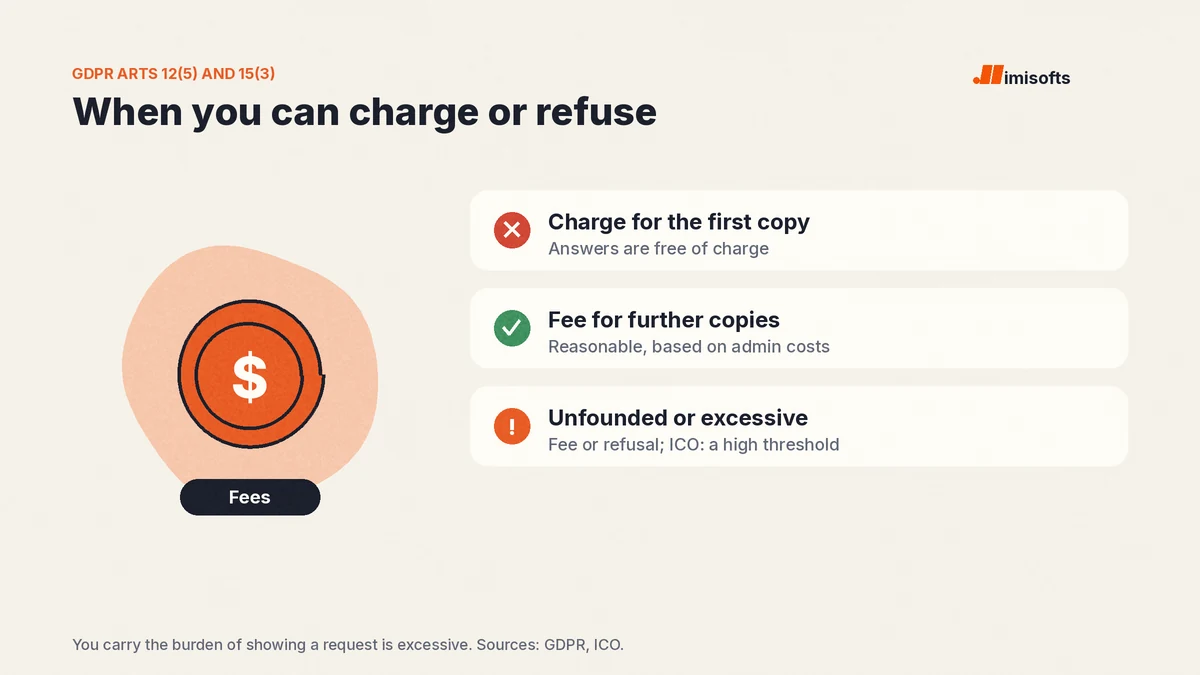
Article 12(5) makes the answer free. You may charge "a reasonable fee" or refuse only where requests are "manifestly unfounded or excessive, in particular because of their repetitive character," and you carry the burden of showing it. The ICO calls this "a high threshold." Under Article 15(3) you may also charge "a reasonable fee based on administrative costs" for further copies. If you ask for a fee, the ICO says to do it as soon as possible, and "It's generally reasonable to close the request if you don't receive a response within one month."
If you refuse all or part of a request, tell the person why, and that they can complain to you, complain to the regulator and go to court. The ICO also says you "should document your reasons" for relying on an exemption.
Other people's data in the reply
Article 15(4) says the copy "shall not adversely affect the rights and freedoms of others." In practice, a sales thread can name your colleagues or another prospect. The ICO says you do not have to disclose information about another person unless "the other person has consented to the disclosure; or it is reasonable to disclose the information without their consent." In our view, redacting other people's details is usually better than withholding the whole email.
A template reply
This is our own wording, not a regulator's form. Adapt it to what you found.
Thank you for your request of [date]. We hold the following personal data about you, attached as a file: [name, job title, work email, company, emails we sent and your replies]. We use it to contact you about [service] on the basis of our legitimate interests. It is held in [CRM] and [sending tool], which process it for us. We obtained your details from [source] on [date]. We keep contacts who do not reply for [period]. You can ask us to correct or erase your data, restrict its use, or object to marketing at any time, and you can complain to [authority]. We do not make automated decisions about you.
If the person also objected to marketing, confirm in the same reply that you have suppressed their address. Our guide to GDPR data subject rights covers that objection and the other rights.
The bottom line
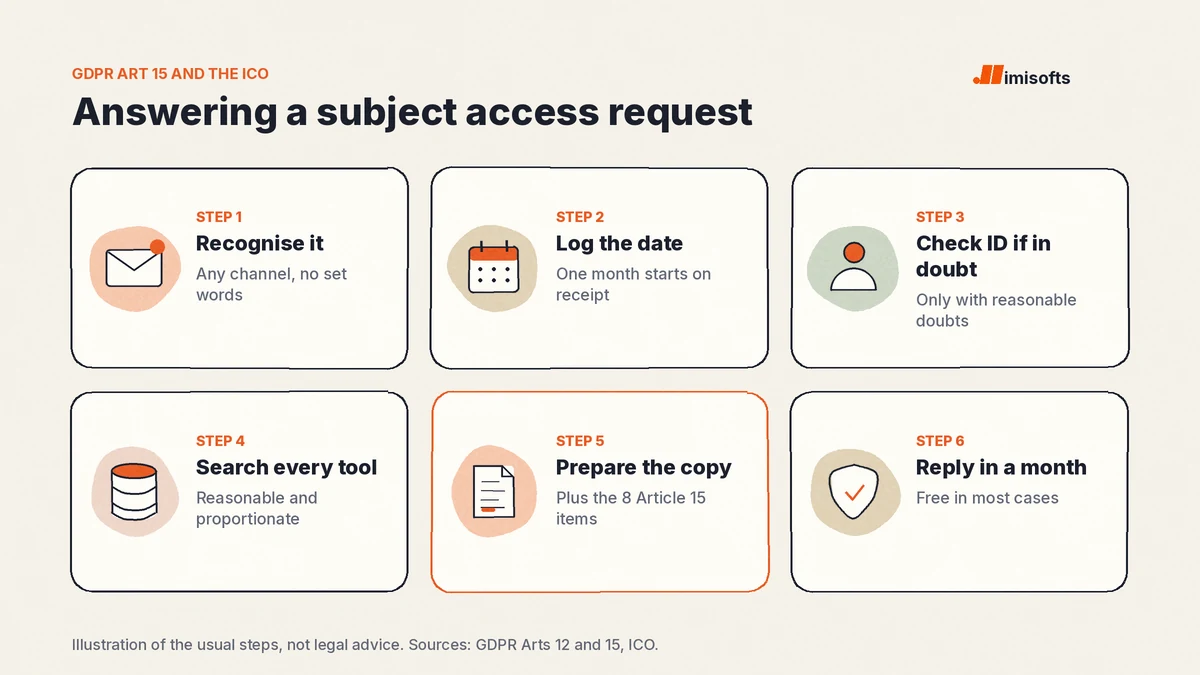
Recognise the request in any channel, log the date, ask for ID only when in doubt, search every tool, prepare the copy with the eight Article 15 items, and reply within a month. The source of each contact is the item most likely to trip a sales team, so record it when the contact enters your stack, not when the request arrives. Regulators check this in bulk: in 2024, 30 European authorities reviewed the right of access, with 1,185 controllers responding. If you hire outside help for outreach, our page on email deliverability consultant cost shows what that work usually includes, and our email infrastructure team can set up suppression and unsubscribe handling.
Frequently Asked Questions
A copy of the personal data and the eight items in GDPR Article 15(1): purposes, categories of data, recipients, storage period, the person's other rights, the right to complain to a regulator, any available information about the source, and any automated decision-making. If data is sent outside the EU or UK, add the transfer safeguards.
One month from receipt, extendable by two further months for complex or numerous requests if you tell the person within the first month. In the UK, for requests received from 5 February 2026, the month starts when you receive any ID or fee you asked for, and pauses while you wait for further information you reasonably require.
Only where you have reasonable doubts about who is asking, under Article 12(6). The ICO says to be reasonable and proportionate and to request formal identification only if necessary.
Not in most cases. You can charge a reasonable fee for further copies, or charge or refuse when a request is manifestly unfounded or excessive. The ICO calls that a high threshold, and you must be able to show it.
No. The ICO says a request can be made verbally or in writing, including via social media, with no set form of words, and a third party such as a solicitor can make it for the person. A reply to a cold email asking what data you hold counts.
Yes, if you have that information. Article 15(1)(g) requires any available information as to the source. France's CNIL fined KASPR 240,000 euros in December 2024, in part for telling people only that their data came from public sources while it knew some of the actual sources.