October 11, 2026. Cold calling a Canadian business is legal, and it skips the National Do Not Call List: the CRTC's rules say the list rules "do not apply to a telemarketing telecommunication made to a business consumer." Everything else still applies. The Telemarketing Rules, which cover registration, calling hours from 9:00 a.m. to 9:30 p.m. on weekdays, caller ID and your own do not call list, apply "whether or not the telemarketing telecommunication is exempt" from the list, and so do the rules for automatic dialing-announcing devices, whose wording reaches AI voice agents. Each breach can cost a company up to $15,000, and on October 7, 2026 the CRTC set a $10,000 penalty for a sole proprietor trading as Window Brothers whose notice of violation listed 202 breaches.
This guide maps the Unsolicited Telecommunications Rules, the Telecommunications Act and the National DNCL operator's own guidance, all read 11 October 2026, for teams that call Canadian numbers from inside or outside Canada. If you are building an AI calling program, our compliant AI calling service is set up for exactly these consent and recording rules. This is a map of the rules, not legal advice.
Key numbers
| Item | Number |
|---|---|
| National DNCL Rules, calls to a business consumer (Part II of the Unsolicited Telecommunications Rules) | Do not apply |
| Weekday calling hours (recipient's time zone) | 9:00 a.m. to 9:30 p.m. |
| Weekend calling hours (Saturday and Sunday) | 10:00 a.m. to 6:00 p.m. |
| Maximum penalty per violation, corporation (Telecommunications Act s.72.01; $1,500 for an individual) | $15,000 |
| Internal do not call list retention (add requests within 14 days) | 3 years and 14 days |
| Maximum age of the DNCL download you call from | 31 days |
| Predictive dialer abandonment cap (no live agent within 2 seconds counts as abandoned) | 5 percent a month |
| DNCL subscription, all area codes, annual (single area code $3,218) | $62,166 |
| Sales call conveying a pre-recorded or synthesized voice (ADAD Rules, even when exempt from the DNCL) | Express consent required |
| CRTC Decision 2026-261 penalty (October 7, 2026; notice had set $55,356 for 202 violations) | $10,000 |
Unsolicited Telecommunications Rules, Telecommunications Act, National DNCL telemarketer FAQ, CRTC 2026-261 and CRTC 2026-132, all read 11 October 2026.
Three rulebooks, and which ones reach B2B calls
The CRTC's framework is one document with three operative parts, and the business exemption only switches off the first:
- Part II, the National DNCL Rules. No telemarketing calls to numbers on the list without express consent, a paid subscription to the list, and a list download no older than 31 days. Calls to a business consumer are outside this part, as are calls to people with an existing business relationship, registered charities, surveys and newspaper subscriptions.
- Part III, the Telemarketing Rules. Registration, identification, hours, caller ID, your internal do not call list, dialer abandonment limits and record keeping. These apply to every telemarketing call, business recipients included.
- Part IV, the ADAD Rules. Calls that use an automatic dialing-announcing device to sell or promote need the recipient's express consent. These also apply whether or not the call is exempt from the list.
The Telecommunications Act defines an existing business relationship narrowly: a purchase or lease in the past 18 months, an inquiry or application in the past six months, or a written contract that is current or expired within 18 months. A webinar sign-up two years ago does not count.
Registration is required even for exempt calls
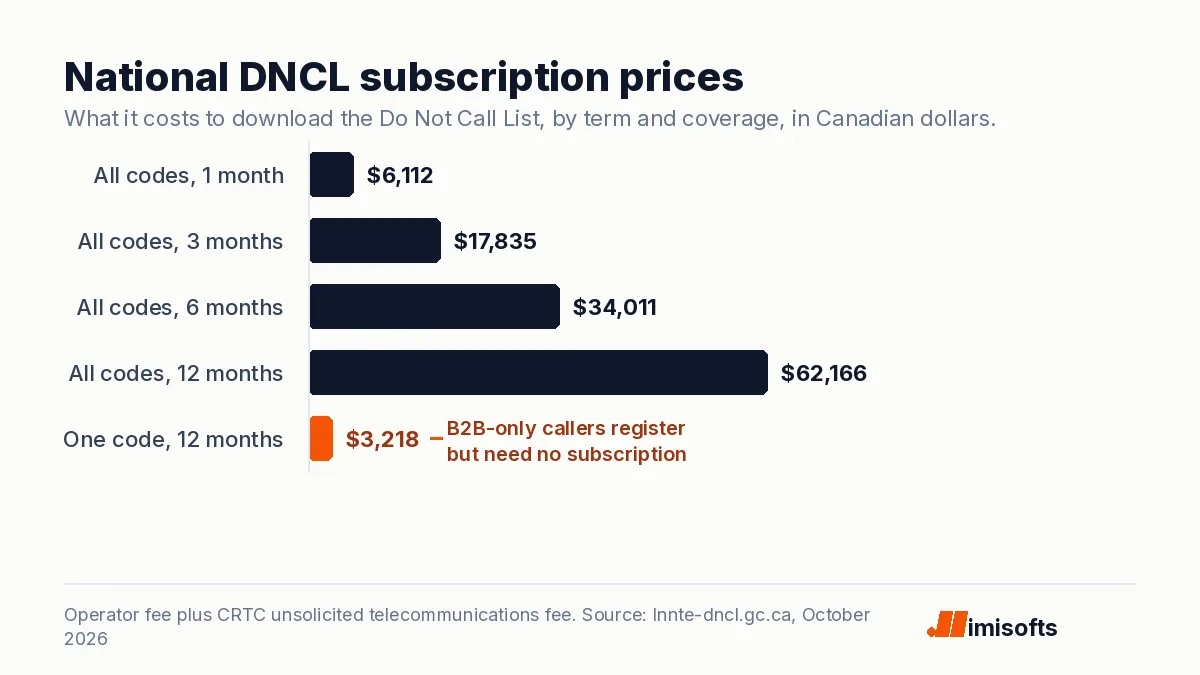
The operator's telemarketer FAQ is blunt: organizations on whose behalf telemarketing is conducted "must register their organization's information with the National DNCL. Even if the calls you make directly, or that are made on your behalf are exempted, you must still register." Its own chart sets out the split. A company calling only exempt numbers, such as businesses, registers but does not have to subscribe. A company calling consumers who are not exempt must register and subscribe.
Subscriptions are priced by area code. Downloading every area code costs $62,166 a year, made up of $40,460 for the list operator and $21,706 for the CRTC's unsolicited telecommunications fee, with shorter terms at $34,011 for six months, $17,835 for three months and $6,112 for one month. A single area code costs $3,218 a year or $290 for a month, and a number-by-number query costs $0.50, up to 100 numbers per session. You may not share a subscription with affiliates, although a third party may scrub lists on your behalf.
Rules every telemarketing call must follow
- Hours. 9:00 a.m. to 9:30 p.m. on weekdays and 10:00 a.m. to 6:00 p.m. on Saturday and Sunday, in the recipient's time zone. Where a province sets tighter hours for an activity, those win.
- Identify yourself on connection. Give the caller's name, the telemarketer's name and, for an agency, the client's name. On request, give a local or toll-free number answered by a person or a voicemail that promises a callback within three business days, plus an email or postal address.
- Show a number. Display the originating number or another number where you can be reached.
- Run your own do not call list. Process a request during the call, add it within 14 days and keep it for three years and 14 days. The client must keep its own list too.
- Dial carefully. Sequential dialing is banned, emergency lines and healthcare facilities are off limits, and a predictive dialer may abandon no more than 5 percent of calls in a calendar month, where an abandoned call is one with no live agent within two seconds.
- Keep records for three years and hand them to the CRTC within 30 days of a request.
Voice mail broadcasts are carved out of the Telemarketing Rules, but the ADAD Rules contain no such carve-out, so a dropped pre-recorded sales message is not a loophole.
AI voice agents and the ADAD rules
The rules define an automatic dialing-announcing device as "any automatic equipment incorporating the capability of storing or producing telecommunications numbers used alone or in conjunction with other equipment to convey a pre-recorded or synthesized voice message to a telecommunications number." An AI agent that dials from a list and speaks in a synthesized voice matches that wording, and we found no CRTC decision that carves conversational AI out of it. The practical reading is simple: an AI sales call needs express consent from the person or business being called, even when the number belongs to a company and even though the National DNCL does not apply.
Consent has to be recorded in a form the rules accept: a signed form, oral consent verified by an independent third party or kept as an audio recording, consent through a toll-free number or online, or another documented method. It must name who may call and the number that may be called, the onus of proving it sits with the telemarketer and its client, and it can be withdrawn at any time. The CRTC is now asking the question directly. Its June 11, 2026 consultation on the rules asks whether the ADAD definition is sufficient to capture "software, applications, or technologies that use synthesized voices, recordings, artificial intelligence, or other methods of non-human generated voice messages." Until it answers, the safe AI motion in Canada is inbound calls, callbacks people asked for and outbound calls to contacts who opted in, with a human taking cold dials.
Calling Canada from outside Canada
The operator's FAQ says the rules "apply regardless of where the call originates," so a team in Dubai, Manila or Texas dialing Canadian numbers is covered, and the business that hires an overseas call center carries its own duties, from registration to keeping its own do not call list. The Telecommunications Act's penalties reach "the person who commits the violation", and the Rules' due diligence defence expects a written contract that obliges your telemarketer to comply.
Canada's anti-spam law is not the main rulebook for calls. Section 6(8) of CASL excludes a message that is "an interactive two-way voice communication between individuals" or "a voice recording sent to a telephone account", so live cold calls fall under the CRTC rules above. Whether an AI agent's synthesized voice fits either exclusion has not been tested, one more reason to treat AI sales calls as needing consent. CASL does govern the emails and texts around a calling campaign, which we cover in our guide to cold email laws in Canada.
What enforcement looks like in 2026
Under section 72.01 of the Act each breach of the rules is a violation carrying an administrative monetary penalty of up to $1,500 for an individual and $15,000 for a corporation, and under section 72.03 a violation that continues over several days counts separately for each day. The most recent decision shows how the numbers stack. In Compliance and Enforcement Decision 2026-261, dated October 7, 2026, a notice of violation issued in November 2025 to Andrei Crivoseia, trading as Window Brothers, listed 202 violations between May 2023 and October 2024, including 24 calls to numbers on the list without consent, 24 calls without a list subscription, 41 calls without registering with the operator and a failure to keep an internal do not call list. The notice set a total of $55,356. The Commission settled on $10,000, citing the purpose of a penalty as promoting compliance rather than punishment.
The Rules also give you a defence if you can show that a breach was an error and that your routine practice included written policies, training, a list download and an internal list no older than 31 days, monitoring, and a contract requiring any telemarketer you hire to comply. Build those records before the first call, because they are what the CRTC asks for.
What the 2026 review could change
The consultation closed for interventions on July 27, 2026 and for replies on August 11, 2026, and we found no decision published when we checked. Besides the AI question, it proposes defining a business consumer as "a person that is primarily or substantially engaged in the selling or promoting of products or services", and aligning the definitions of telemarketing and solicitation with CASL. A definition like that would decide whether sole proprietors and freelancers count as businesses, which today is the grey zone for B2B teams. Recheck the CRTC's site before you scale a campaign.
Checklist for calling Canadian numbers
- Register your organization, and your clients, with the National DNCL operator, even if you only call businesses.
- Subscribe and download the list no more than 31 days before calling any consumer numbers, or keep consumer numbers out of the dialer.
- Call between 9:00 a.m. and 9:30 p.m. on weekdays and 10:00 a.m. and 6:00 p.m. at weekends in the recipient's time zone, and check provincial rules for your sector.
- Script the identification line and keep a callback number and an email address valid for at least 60 days after the call.
- Honour do not call requests on the call, add them within 14 days and keep them for three years and 14 days.
- Keep predictive dialer abandonment at or under 5 percent a month and never dial sequentially.
- Use an AI voice for sales only with documented express consent that names your company and the number; calls that are not sales calls must still follow the ADAD conditions on hours, identification and caller ID.
- Keep every record for three years and put a compliance clause in every telemarketing contract.
Canada is one of the stricter markets for automated calling and one of the easier ones for live B2B calls. If you want help with the consent capture, the recording and the scripts behind a compliant program, see our TCPA and CRTC aware AI calling setup, and compare the rules with our guides to cold calling in the UK, Australia and AI cold calling in the US.
Frequently Asked Questions
Yes. The National DNCL Rules do not apply to telemarketing calls made to a business consumer, so you can call businesses without scrubbing them against the list. The CRTC's Telemarketing Rules still apply to those calls, including registration with the National DNCL operator, identification, calling hours, caller ID and keeping your own do not call list.
Yes. The operator's guidance says organizations on whose behalf telemarketing is conducted must register even if the calls are exempt. A company calling only exempt numbers registers but does not need a paid subscription to download the list.
9:00 a.m. to 9:30 p.m. on weekdays and 10:00 a.m. to 6:00 p.m. on Saturday and Sunday, in the time zone of the person receiving the call. Stricter provincial hours for a regulated activity take precedence.
Not without express consent. The ADAD Rules define an automatic dialing-announcing device as equipment that conveys a pre-recorded or synthesized voice message, and they require express consent for telemarketing calls made with one, whether or not the call is exempt from the National DNCL. The CRTC's 2026 consultation is asking whether the definition is sufficient to capture synthesized voices and artificial intelligence.
Up to $1,500 per violation for an individual and up to $15,000 per violation for a corporation under section 72.01 of the Telecommunications Act, and under section 72.03 a violation continued over several days counts once for each day. In October 2026 the CRTC set a $10,000 penalty for a sole proprietor whose notice of violation listed 202 violations.
Not to live calls. Section 6(8) of CASL excludes interactive two-way voice communications between individuals and voice recordings sent to a telephone account, so live cold calls fall under the CRTC's telemarketing rules. How the exclusions apply to an AI agent's synthesized voice has not been tested. CASL does apply to the cold emails and text messages that support a calling campaign.