Affiliate disclosure: some links in this article are partner links. If you start a paid plan through them, imisofts may earn a commission at no extra cost to you. We only recommend tools we actually use to run client campaigns.
Short answer. Lead scoring software adds points to each lead for fit (job title, company size, industry) and for engagement (visits, clicks, replies), then flags the leads that pass a threshold for sales. On the vendors' own pages on 12 November 2026, Apollo's Free plan allowed up to two custom scores, without AI scoring, at $0, Apollo's unlimited scores started at $99 per seat a month billed monthly, HighLevel's engagement score, which its help article ties to no plan, sat in an account that starts at $97 a month, and HubSpot's contact scoring needed Marketing Hub Professional at $890 a month for three seats on monthly payments with an annual commitment ($800 a month paid annually). Close's lead scoring guide describes no points engine: it builds priority tiers from custom fields and saved searches.
Below: how a score is built, a sample model you can copy, what five tools score and on which plan, and what a three-person team pays. We earn a commission if you buy Apollo or HighLevel through our links, and nothing from HubSpot or ActiveCampaign. We also have a partner link with Close, which this page does not use.
Key numbers
| Item | Number |
|---|---|
| Apollo custom scores on Free and Basic (unlimited on Professional and Organization; no AI scoring on Free) | Up to 2 |
| Apollo Professional, per seat, billed monthly ($79 billed annually; pricing page lists AI Lead Scoring from here) | $99 a month |
| Apollo Basic, per seat, billed monthly (help center says AI scoring includes Basic; the pricing card does not list it) | $59 a month |
| HubSpot Marketing Hub Professional (3 core seats, up to 5 scores incl. contacts; annual commitment; $800 paid annually) | $890 a month |
| HubSpot Sales Hub Professional, per seat (annual commitment; up to 5 scores, companies and deals only; $90 paid annually) | $100 a month |
| HubSpot score decay intervals | 1, 3, 6 or 12 months |
| ActiveCampaign Plus at 1,000 contacts (pricing page: lead scoring in the Pipelines add-on, price not published; help center also lists Starter ($15)) | $49 a month, billed yearly |
| HighLevel Starter (help article names no plan (Starter is our reading); one engagement score, no automatic decay) | $97 a month |
| Close Solo, one user, billed monthly (guide describes no points engine; Smart View tiers on all plans) | $19 a month |
| HubSpot Marketing Hub Pro, per included seat ($890 for 3 core seats on an annual commitment) | $296.67 a month |
Prices and limits read on 12 November 2026 from the Apollo, HubSpot, ActiveCampaign, HighLevel and Close pricing pages and help centers.
What lead scoring is: fit, engagement and a threshold
HubSpot's lead scoring overview (updated 3 November 2026) splits scores into two kinds. Engagement scores "qualify records based on their actions and interactions, such as visiting your website, subscribing to your newsletter, clicking a CTA, or opening a marketing email." Fit scores "qualify records based on their demographic information through property values, such as their age, job title, company size, or annual revenue." A combined score combines the two.
Three more parts make a score usable:
- Negative points. HubSpot's guide says you "can add points for good fit industry and size, but subtract points for a non-operating region." HighLevel's help center lists email bounces and unsubscribes as actions that reduce a score.
- A threshold. HighLevel's help center describes workflows that launch "when a contact's score crosses a threshold (e.g., greater than 20) to trigger sales outreach, email sequences, or nurture campaigns."
- Decay. HubSpot can reduce old engagement points "every 1, 3, 6, or 12 months." HighLevel's engagement score "does not include an automatic score decay feature," so you build it with a timed workflow.
A separate option is AI scoring, where the tool picks the criteria. Apollo's auto-scores use "your company website, account information, and prospecting activity." HubSpot's AI scores for contacts are "Marketing Hub Enterprise only."
A sample B2B lead scoring model
This is our starting model for a B2B team that sells to companies of 50 to 500 staff. It is a suggestion, not a benchmark: change the points once you can compare them with your own closed deals.
| Criterion | Type | Points |
|---|---|---|
| Job title decides on your product | Fit | +15 |
| Company size inside your target range | Fit | +15 |
| Industry you have closed before | Fit | +10 |
| Country you serve | Fit | +10 |
| Submitted a demo or contact form | Engagement | +15 |
| Replied to an email | Engagement | +15 |
| Visited the pricing page | Engagement | +10 |
| Clicked a link in an email | Engagement | +5 |
| Opened an email | Engagement | 0 (our choice: the weakest action) |
| Competitor's email domain | Negative | -50 |
| Job seeker or student | Negative | -30 |
| Unsubscribed or bounced | Negative | -20 |
We would cap each side at 50 points so a busy reader cannot outscore a perfect fit. HubSpot builds this in as a group limit, "the maximum number of points added or subtracted for a specific group." Then set three bands: 60 or more goes to sales the same hour (our speed to lead guide covers why the first hour matters), 30 to 59 stays in a nurture sequence (see our lead nurturing email automation guide), and under 30 stays with marketing.
A hypothetical example: an operations director at a 120-person logistics company in a country you serve scores 50 on fit. A pricing page visit and one email click add 15, so 65 sends the lead to sales. The founder of a 5-person agency in the same country scores 25 on fit (title and country), and three opens add nothing, so that lead stays with marketing.
Fit points need the fields filled in. A lead with a blank job title or company size scores zero on those rows, which is the job of an enrichment tool; our best lead enrichment tools guide compares them.
Which tools score leads, and on which plan
Prices are list prices read on each vendor's own page on 12 November 2026, before tax.
| Tool | What it scores | Cheapest plan with scoring | Limit on that plan |
|---|---|---|---|
| Apollo | People and companies: filters and signals; AI auto-scores on paid plans only | Free, $0 (custom scores only) | Up to 2 custom scores on Free and Basic; unlimited from Professional ($99 per seat a month billed monthly, $79 billed annually) |
| HubSpot | Contacts (Marketing Hub only), companies, deals (Sales Hub only) | Sales Hub Professional, $100 per seat a month on an annual commitment (companies and deals); Marketing Hub Professional, $890 a month with 3 core seats on an annual commitment (contacts) | Up to 5 scores on Professional; decay every 1, 3, 6 or 12 months |
| ActiveCampaign | Contacts, by rules you set (contact scores are one of two score types) | Unclear: the help center lists Starter ($15 a month billed yearly at 1,000 contacts); the pricing page says Plus ($49) and up, with the Pipelines add-on (price not published) | No limit on the number of scores; scores can expire |
| HighLevel | One engagement score, from actions | Starter, $97 a month, on our reading (the help article names no plan) | Applies to all contacts; no automatic decay; no score history |
| Close | No points engine in its guide; tiers from custom fields and Smart Views | Solo, $19 a month billed monthly for one user | Tiers are saved searches, not points; Smart Views on all four plans |
Apollo: scores prospects before you contact them
Apollo's Scores Overview describes a points model: "Prospects earn points when they match the filters and signals included in a score," and Apollo groups the totals into "Excellent," "Good," "Fair" and "Not a fit." The same page says "When you prospect for people or companies, Apollo displays a score for each result in the score column," so the scores rank people and companies in Apollo's database before you contact them.
The plan limits, in Apollo's own words: "You can create up to two custom scores on free and basic plans. Professional and organization plans include unlimited custom scores." On AI scoring the two Apollo pages differ. The help center says it "is available on paid plans, including basic, professional, and organization plans." The pricing page lists "AI Lead Scoring" on the Professional and Organization cards and not on Basic, where it shows "2 Lead Score Limit." Check which one your account gets during the 14-day trial before you pay for Basic at $59 a seat a month, billed monthly, on that basis. The help center is clear that AI scoring "isn't available on free plans."
If you want to test a model on real prospects first, start on Apollo's Free plan (partner link) and build your two custom scores there.
HubSpot: the fullest scoring, at the highest price
Of the help pages we read, HubSpot's covers the most: fit, engagement and combined scores, group limits and timed decay. The catch is the plan. Contact scoring is "Marketing Hub only," and HubSpot's Marketing Hub pricing lists Professional at $890 a month paid monthly on an annual commitment, or $800 a month paid annually, with 3 core seats, 2,000 marketing contacts and "Up to 5 scores." That is $296.67 per included seat a month. Sales Hub Professional costs $100 per seat a month on the same terms ($90 paid annually) and also allows up to 5 scores, but only on companies and deals. AI scoring for contacts needs Marketing Hub Enterprise, listed at $3,600 a month on an annual commitment. Our HubSpot seats and credits guide covers the rest of the bill.
ActiveCampaign: unlimited scores, unclear plan
ActiveCampaign's contact scoring article (updated 12 May 2026) says "There is no limit to the number of scores you can create in your account," that scores "can be set to expire after a period of time," and that a score can run once per contact ("Static Scoring") or each time a contact matches ("Dynamic Scoring"). That article lists Starter, Plus, Pro and Enterprise. The pricing page disagrees: its comparison table marks lead scoring "Not included" on Starter and "Included in Pipelines add-on" on Plus, Pro and Enterprise, and it does not print the add-on's price. Plus is $49 a month billed yearly at 1,000 contacts with one user seat, so we could not total a full ActiveCampaign price.
HighLevel: one engagement score for every contact
HighLevel's Contact Engagement Score guide (modified 5 March 2025) scores 12 action types, from email events and replies to form submissions, payments and booked appointments, under Settings, then Manage Scoring. It scores actions, not profile fields, and the same FAQ lists four limits: "Engagement scoring applies to all contacts globally," there is no automatic decay, the Manage Score section "does not support condition-based weightings for the same action," and there is no built-in history of score changes. Two of its action types, "Contact Tag" and "Contact Changed" (for example "when a custom field is updated"), are how we would add fit points.
The guide names no plan, so Starter is our reading. HighLevel's pricing page heads its plans with "Unlimited contacts, unlimited Users" and lists Starter at $97 a month with no per-user charge shown, before usage such as texts. If your leads arrive by form and email and the score should trigger follow-up, try HighLevel for 14 days (partner link).
Close: no score field, tiers by saved search
Close's lead scoring guide describes no points engine. It walks through "lead scoring in Close by using Custom Fields, Custom Activities, and Smart View filtering": store the criteria in custom fields, then save a Smart View for each tier, such as "High-Priority Leads" with "Company size: 100+ employees" and "Job title: Manager or Director." The pricing page includes Smart Views, "dynamic lead lists," on all four plans, from Solo at $19 a month for one user to Scale at $149 per user, billed monthly ($9 and $139 billed annually). For a small team that needs a high, medium and low list, that may be enough; what the guide does not describe is points that add up as a lead acts. Our Close pricing guide covers the plans.
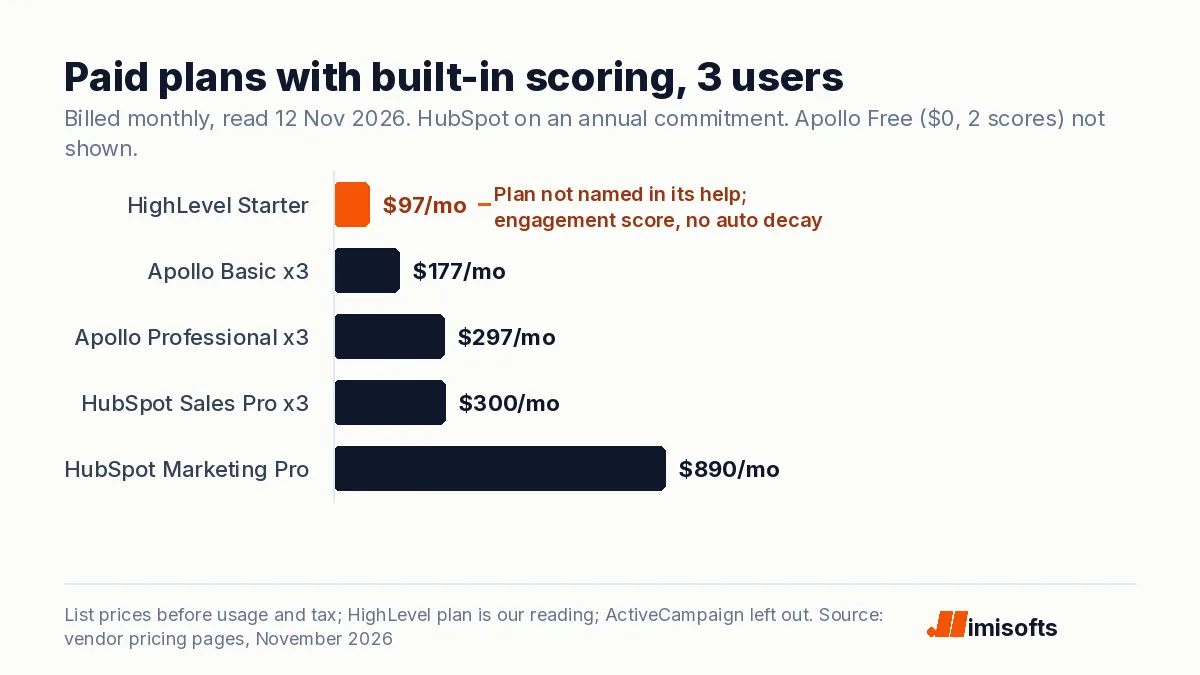
What a three-person team pays
List prices for three users, before usage and tax. HubSpot's monthly figure is paid monthly on an annual commitment.
| Option | Billed monthly | Billed annually, per month | What you get |
|---|---|---|---|
| Apollo Free | $0 | $0 | Up to 2 custom scores, no AI scoring |
| HighLevel Starter | $97 | Not shown on the page | One engagement score (plan not named in the help article) |
| Close Essentials | $147 | $105 | Smart View tiers, no points |
| Apollo Basic | $177 | $147 | Up to 2 custom scores |
| Apollo Professional | $297 | $237 | Unlimited scores, AI scoring |
| HubSpot Sales Hub Professional | $300 | $270 | Up to 5 company or deal scores |
| HubSpot Marketing Hub Professional | $890 | $800 | Up to 5 scores incl. contacts, decay |
On these list prices HubSpot Marketing Hub Professional costs about 9.2 times HighLevel Starter a month (about 8.3 times paid annually), and 3 times Apollo Professional for three seats billed monthly, though HubSpot's figure carries an annual commitment and Apollo's does not. ActiveCampaign is left out because its two pages disagree on the plan and its Pipelines add-on price is not published.
Our take, and who pays us
If you prospect outbound and want to rank people before you email them, we would start on Apollo Free, build two custom scores, and move to Professional only when you need more than two or the AI scoring that the pricing page lists from Professional. If inbound leads should trigger follow-up the moment they act, HighLevel Starter at $97 a month is the lowest paid list price we could confirm for three users, if its score comes with Starter as we read it; you add fit rules with tags and build decay yourself. If you want fit, engagement and decay working without building them, HubSpot Marketing Hub Professional does it, at the highest price in our three-user table. If your team already lives in Close, its Smart View tiers cost nothing extra.
We earn a commission if you buy Apollo or HighLevel through our links. Our AI automation agency builds CRM workflows such as score-based routing, and our email infrastructure service sets up the domains and inboxes that outbound email is sent from. For the wider tool choice, see our sales automation software guide and Apollo pricing guide. To build your first score on real prospects, open a free Apollo account (partner link).
Frequently Asked Questions
Software that adds points to each lead for fit, such as job title and company size, and for engagement, such as page visits, clicks and replies, then flags leads above a threshold for sales. Apollo, HubSpot and HighLevel have it built in, ActiveCampaign has contact scoring (its pricing page ties lead scoring to an add-on), and Close's guide builds tiers from custom fields and saved searches instead.
List your fit criteria and the actions that signal intent, give each a points value, subtract points for bad fits, and set bands. Our sample gives up to 50 fit points and caps engagement at 50, sends 60 or more to sales the same hour, keeps 30 to 59 in nurture, and leaves under 30 with marketing.
In HubSpot's definitions, fit scores use property values such as job title, company size or annual revenue, and engagement scores use actions such as visiting your website, clicking a CTA or opening a marketing email. A combined score combines both.
Apollo's Free plan allows up to two custom scores at $0 on its pricing page and help center, read on 12 November 2026. Its help center says AI scoring is not available on Free.
Marketing Hub or Sales Hub Professional or Enterprise. Contact scores need Marketing Hub, listed at $890 a month with 3 core seats on monthly payments and an annual commitment ($800 paid annually), with up to 5 scores on Professional. Sales Hub Professional, $100 per seat a month on an annual commitment, scores companies and deals only.
Only if the tool does it for you or you build it. HubSpot can reduce old engagement points every 1, 3, 6 or 12 months and ActiveCampaign scores can expire; HighLevel's help center says its engagement score has no automatic decay, so you subtract points with a timed workflow.