Short answer. Speed to lead is the time between a person raising a hand, by filling in a form, calling or starting a chat, and your first real attempt to talk to them. The strongest published evidence we could check says the chance of qualifying a lead drops sharply after the first hour. In research published in Harvard Business Review, firms that tried to contact a lead within an hour were nearly 7 times as likely to qualify it as firms that waited even one more hour, and more than 60 times as likely as firms that waited a day or longer. Most teams are still slow: in a test RevenueHero published in March 2024, only 365 of 1,000 B2B websites replied to a demo request at all, and the average reply took 1 day, 5 hours and 17 minutes. Set a target in minutes, measure it from your CRM's timestamps, and make sure any automated or AI call you use to get there has the consent the law requires.
Key numbers
| Item | Number |
|---|---|
| US companies audited with a test lead (Harvard Business Review, March 2011) | 2,241 |
| Share that replied within an hour (same audit) | 37% |
| Share that never replied (same audit) | 23% |
| Average reply time, companies replying within 30 days (same audit) | 42 hours |
| Likelihood of qualifying: first-hour try vs an hour later (1.25 million leads at 42 companies) | nearly 7 times as likely |
| Likelihood of qualifying: first-hour try vs 24 hours or more (same study) | more than 60 times as likely |
| B2B websites that answered a demo request (RevenueHero, March 2024) | 365 of 1,000 |
| Average reply to a demo request (automated replies included) | 1 day, 5 hours, 17 minutes |
| Missed call billed as a Google Local Services lead (during business hours) | caller on the line more than 20 seconds |
Harvard Business Review study of March 2011 as quoted by SmartCompany in July 2011, RevenueHero's March 2024 test and Google's Local Services help center, read on 27 October 2026.
What the research measured
The study most speed-to-lead advice traces back to is "The Short Life of Online Sales Leads" by James Oldroyd, Kristina McElheran and David Elkington, published in Harvard Business Review in March 2011. It reported two pieces of work.
The first was an audit. The authors sent a web-generated test lead to 2,241 US companies and timed the replies. The article's figures, as quoted by SmartCompany at the time:
| Reply timing | Share of the 2,241 companies |
|---|---|
| Within an hour | 37% |
| Within one to 24 hours | 16% |
| More than 24 hours | 24% |
| Never replied | 23% |
Among the companies that replied within 30 days, the average reply took 42 hours.
The second was an analysis of 1.25 million sales leads received by 29 B2C and 13 B2B companies in the US. Firms that tried to contact a lead within an hour of the inquiry were nearly 7 times as likely to qualify it, which the authors defined as having a meaningful conversation with a key decision maker, as firms that tried even an hour later, and more than 60 times as likely as firms that waited 24 hours or longer.
Two cautions apply. The data predates 2011, before website chat, business texting and online booking were common. And "qualify" means reaching a decision maker, not closing a sale. Neither changes the direction of the finding: the odds of reaching a decision maker fall fast after the first hour.
Most teams are still slow
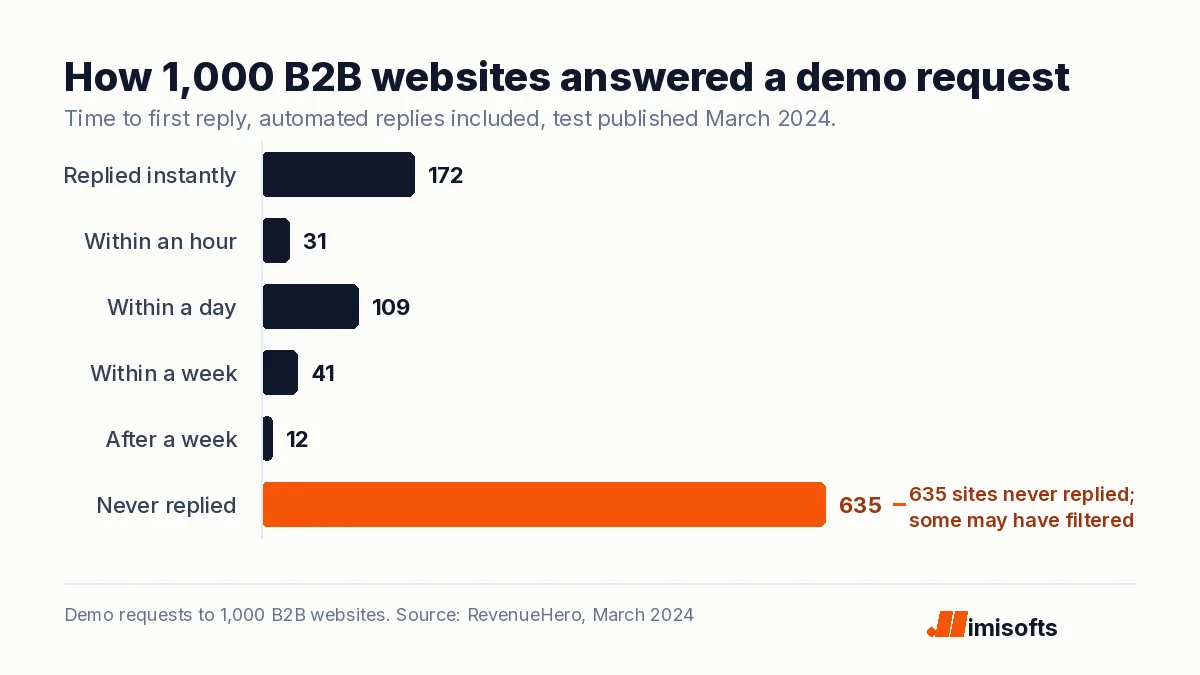
A newer test suggests little has changed. In a test published in March 2024, the scheduling vendor RevenueHero requested a demo on 1,000 B2B websites and timed every reply, automated ones included. It received 365 replies, with an average response time of 1 day, 5 hours and 17 minutes: 172 sites replied instantly, 31 within an hour, 109 within a day, 41 within a week and 12 after more than a week. The other 635 never replied. RevenueHero notes that some of those may have screened its request out with enrichment tools, so read 635 as an upper limit on ignored leads. Even so, only 203 of the 1,000 requests got any reply within an hour, and 172 of those were instant replies, which RevenueHero counted whether or not they were automated.
Slow replies waste what you paid for
When you pay for leads, an unanswered lead is money spent for nothing. LocaliQ's 2026 search benchmarks put the average cost of a lead from search ads at $66.69 across industries, $90.92 for home and home improvement businesses, $93.69 for business services and $131.63 for legal services. A firm that answers a third of its paid leads an hour late still pays full price for them.
Some lead programs bill you even when you never speak to the person. Google's Local Services Ads count a missed call during business hours as a billable lead if the caller stays on the line for more than 20 seconds, as we explained in Google LSA missed call charges. For a home service business that misses calls while crews are on jobs, speed to lead is a direct cost line, which is why we compared an AI answering service for HVAC with human answering services.
How to measure speed to lead
You need three timestamps for every lead, and most CRMs already store them:
- Created: when the form, call or chat arrived.
- First attempt: the first call, text or personal email from your side. An automatic "thanks, we received your request" email does not count.
- First conversation: the first two-way exchange, a connected call or a reply.
Report the median time from created to first attempt, not the average, because a few leads that sit over a weekend will distort an average. Break it down by source, by hour of day and by rep. The after-hours share is usually the surprise: a lead that arrives at 7 pm and gets a call at 9 am the next day is 14 hours old before anyone speaks to it.
Six ways to get under five minutes
- Route instantly. Assign every new lead to an owner the moment it arrives, by territory or round robin, with a fallback owner if nobody acts within a few minutes.
- Acknowledge in seconds. Send an email, and a text if the person agreed to texts, that confirms the request and offers a booking link. In the US, business texting from a local number needs 10DLC registration.
- Put the calendar on the form. Let qualified leads book a meeting on the thank-you page, so the fastest response is their own.
- Call from a task, not a list. Create a call task with the lead's details the second the lead lands, and alert the owner on their phone.
- Cover nights and weekends. An answering service or an AI voice agent can answer, qualify and book outside office hours; compare options in our guide to the best AI voice agents.
- Work the missed-call queue first. A missed call from a new number is often a paid lead, so call it back before anything else.
What to look for in speed-to-lead software
Many CRMs and dialers now sell a speed-to-lead feature, and the label covers very different things. Before you pay for one, check that it can:
- Trigger on every source. Web forms, landing pages, ad lead forms, chat and inbound calls should all start the same clock, or your report will flatter you.
- Call the rep first, then the lead. The fastest pattern rings the assigned rep, and when they pick up it dials the lead, so a person is on the line within seconds of the form.
- Fall back automatically. If the first rep does not answer within a set time, the lead should move to the next rep or to an after-hours flow without anyone noticing it is stuck.
- Respect consent and quiet hours. Automated texts and AI calls should only go to leads whose consent covers them, and only within the calling hours that apply where the lead lives.
- Report the median by source. You want the median time to first attempt and to first conversation, broken down by source and rep, not a single average.
Whatever you buy, test it with your own form on a Friday evening and see how long the reply takes.
Fast is not the same as automated
The quickest way to reach a lead is often an automated text or call, and that is where the law steps in. Under the FCC's TCPA rules, a call to a mobile number that uses an autodialer or an artificial or prerecorded voice needs the called person's prior express consent, and if the call is telemarketing it needs prior express written consent; telemarketing calls with an artificial or prerecorded voice to a residential line need written consent too. In February 2024 the FCC confirmed that calls made with AI-generated voices count as "artificial" under the act. So the consent language belongs on the form that creates the lead, worded for the kind of call or text you will send, with a record of when and how the person agreed.
People can also withdraw consent; our guide to TCPA opt-out requirements covers how revocation works. States add their own rules on calling hours and registration; see telemarketing laws by state. A person calling back a lead who has just asked to be called is usually the simplest path. This is general information, not legal advice.
Speed to lead in real estate and home services
Two industries feel this most. Real estate agents pay for leads through Google, Facebook and pay-at-closing programs such as Zillow Preferred, and each of those leads is worth most in its first hour; we priced each of those sources in real estate lead generation cost. Home service businesses lose calls while technicians are on jobs; our AI calling for home services answers those calls, books the job and hands emergencies to a person.
How imisofts can help
We set up the response system end to end: instant routing and follow-up in your CRM, AI calling built around TCPA consent that answers and books around the clock, and reporting that shows your real response times by source. If you also want more leads to answer, our lead generation team runs outbound campaigns that book meetings into the same system.
Frequently Asked Questions
Speed to lead is the time between a lead's inquiry, such as a form, call or chat, and your first attempt to reach them. Teams usually also track the time to the first real conversation. Both are measured from timestamps your CRM already records.
As fast as you can make it, with under five minutes during business hours as a practical target. Research published in Harvard Business Review found that firms trying to reach a lead within an hour were nearly 7 times as likely to qualify it as firms that tried an hour later, and more than 60 times as likely as firms that waited 24 hours or longer.
The five-minute figures that are widely quoted come from earlier research that we could not read in its original form, so we do not repeat them. The strongest evidence we could check is the 2011 Harvard Business Review study, which measured the first hour. Five minutes is a sensible operating target rather than a proven threshold.
Record three timestamps for every lead: when it was created, when your side made the first personal attempt to reach it, and when the first two-way conversation happened. Report the median time from creation to first attempt, broken down by lead source, hour of day and rep, because averages are distorted by leads that wait over a weekend.
Yes, if you have the right consent. The FCC confirmed in February 2024 that calls made with AI-generated voices count as artificial voices under the TCPA. Under the FCC's rules, an artificial or prerecorded voice call to a mobile number needs the person's prior express consent, and a telemarketing call needs prior express written consent. Put the consent language on the form that creates the lead and keep a record of it. This is general information, not legal advice.
Yes. Google's How leads work page counts a missed call during business hours as a valid, billable lead if the caller stays on the line for more than 20 seconds, so unanswered calls still cost money.