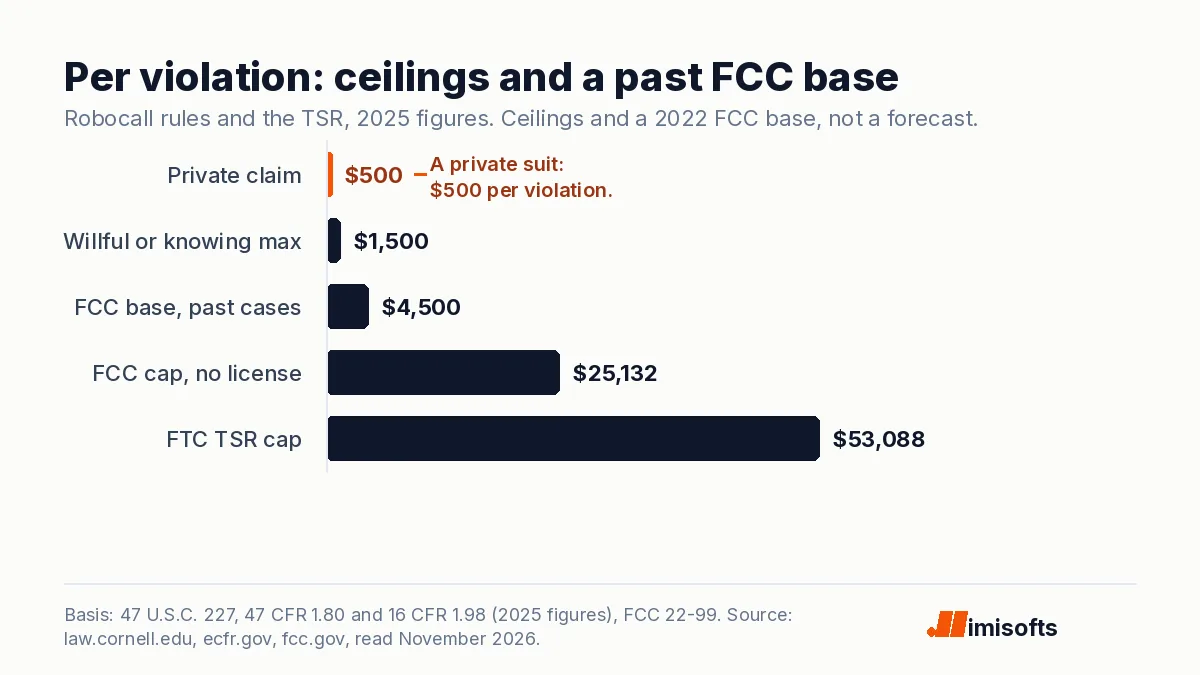
How much is a TCPA fine per call? There is no single number. Under section 227(b)(3) of the Telephone Consumer Protection Act (TCPA), a person can sue over an unlawful robocall or autodialed text for $500 per violation, or actual loss if greater, and a court may, in its discretion, raise the award to up to three times (up to $1,500 on a $500 claim) if the violation was willful or knowing. The FCC’s ceiling for a robocall violation by a business with no FCC license is $25,132 per violation, a 2025 figure (eCFR, up to date as of 13 November 2026, read on 17 November 2026).
My view: read those numbers as rates, not totals.
In my view, price TCPA risk per call. Private and state damages are stated per violation, and one call or text can be one violation.
Key numbers
| Item | Number |
|---|---|
| Private damages per robocall violation, 227(b)(3) (or actual loss if greater; up to 3 times if willful or knowing) | $500 |
| Do-not-call private damages, 227(c)(5) (after more than one call in 12 months; up to 3 times if willful or knowing; due-care defense) | Up to $500 |
| State attorney general action, 227(g)(1) (or actual monetary loss; up to 3 times if willful or knowing) | $500 per violation |
| FCC ceiling, robocall violation, no FCC license (47 CFR 1.80(b)(10) catch-all, 2025 adjustment) | $25,132 per violation |
| FCC add-on for an intentional robocall violation (47 CFR 1.80(b)(5); $10,000 in the statute) | Up to $12,266 |
| FCC caller ID ceiling, 227(e) (2025 figure) | $14,432 per violation |
| FTC civil penalty under the TSR (16 CFR 1.98(d), for penalties assessed after 17 January 2025) | Up to $53,088 per violation |
| FCC base in earlier 227(b) cases (December 2022) (as stated in the Sumco notice) | $4,500 per robocall |
| Sumco Panama forfeiture (3 August 2023) (33,333 verified calls at $9,000 each; over five billion placed) | $299,997,000 |
| Kramer forfeiture, caller ID law (September 2024) (3,000 verified calls, $1,000 base, 100% upward adjustment) | $6,000,000 |
| Sumco fine per call placed, my division | Under 6 cents |
Read on 17 November 2026 from 47 U.S.C. 227 and 503 on Cornell LII, 47 CFR 1.80, 16 CFR 1.98 and 47 CFR 64.1200 on eCFR (up to date as of 13 November 2026), the FTC’s Telemarketing Sales Rule guide, and FCC documents 22-99, 23-64 and 24-104.
Five routes, five price lists
Four of the five routes covered here are in 47 U.S.C. 227; the fifth is the FTC’s separate Telemarketing Sales Rule (TSR).
| Who | Rule | Amount | Conditions |
|---|---|---|---|
| A person who got the call or text | 227(b)(3), robocall rules | $500 per violation, or actual loss if greater | Up to 3 times if willful or knowing |
| A person who got more than one call in 12 months in breach of the FCC’s do-not-call rules | 227(c)(5) | Up to $500 per violation, or actual loss if greater | Calls by or on behalf of the same entity; up to 3 times if willful or knowing; due-care defense |
| A state attorney general | 227(g)(1) | $500 per violation, or actual monetary loss | A pattern or practice; up to 3 times if willful or knowing |
| The FCC | 227(b)(4); 47 CFR 1.80(b)(5) and (b)(10) | Up to $25,132 per robocall violation by a business with no FCC license | Plus up to $12,266 if intentional; 2025 figures |
| The FTC | TSR; 16 CFR 1.98(d) (FTC Act 5(m)(1)(A)) | Up to $53,088 per violation | TSR telemarketing; for penalties assessed after 17 January 2025 |
On my reading, the Act sets no total cap on private or state damages. In a private do-not-call suit under 227(c)(5), it is an affirmative defense that the business “has established and implemented, with due care, reasonable practices and procedures to effectively prevent telephone solicitations” in breach of the rules. This is general information, not legal advice.
The $299,997,000 Sumco fine: $9,000 per verified call
On 3 August 2023 the FCC imposed $299,997,000 on Sumco Panama and related companies, which it said “placed over five billion auto warranty robocalls” between January 2021 and March 2021. Its December 2022 notice had proposed “a base forfeiture of $4,500 per each of the 33,333 apparently unlawful robocalls that we verified were made without prior express written consent, and without the requisite disclosures”, $149,998,500, plus “a 100% upward adjustment to the base penalty”. The final order tied that adjustment to caller ID violations under section 227(e). So the FCC priced 33,333 verified calls at $9,000 each. Divided by the more than five billion calls placed, the fine is under 6 cents a call, my division.
“The FCC fined a robocaller $300 million, so fines only hit scammers.” (illustrative)
That order priced 33,333 verified calls; the private claim in section 227(b)(3) is per violation.
My suggestion: before a campaign, multiply the calls on the list by $500 to see what missing consent could cost, then confirm consent for each call.
Section 227(b)(3): “$500 in damages for each such violation”.
How the FCC sets a robocall penalty
On my reading, a robocall violation by an unlicensed business falls under the catch-all in 47 CFR 1.80(b)(10), for “any case not covered in paragraphs (b)(1) through (9)”: $25,132 “for each violation or each day of a continuing violation”; I found no 2026 adjustment on eCFR. For a violation “with the intent to cause such violation”, section 227(b)(4)(B) adds “an additional penalty not to exceed $10,000”, $12,266 after adjustment under 1.80(b)(5); the text does not say per violation, and the FCC may not charge the same conduct under both. Its notice must come within a year of the violation, or four years with intent.
It has priced cases below those ceilings. Its December 2022 notice, which put the ceiling then at “up to $22,021 per violation”, said the FCC “has adopted a base forfeiture of $4,500 per unlawful robocall in previous enforcement actions involving section 227(b)”. In September 2024 it fined Steve Kramer $6,000,000 under the caller ID law, section 227(e) (ceiling now $14,432 per violation), for robocalls with an AI voice that “imitated U.S. President Joseph R. Biden, Jr.’s voice”: “a base forfeiture of $1,000 per each unlawful call”, “an upward adjustment of 100%”, applied to “a subset of 3,000 unlawful spoofed calls”.
FCC robocall cases skip the warning step. Section 503(b)(5) says a person that holds no FCC “license, permit, certificate, or other authorization” and is not an applicant can be fined only after it “is sent a citation of the violation charged”, is given a reasonable opportunity for an interview, and “subsequently engages in conduct of the type described in such citation”. Sections 227(b)(4) and 227(e)(5) say that paragraph “shall not apply” to robocall and caller ID violations. I found no such sentence in the do-not-call subsection, so on my reading the citation step still applies there.
Texts can count as calls
In Campbell-Ewald Co. v. Gomez (2016) the Supreme Court wrote: “A text message to a cellular telephone, it is undisputed, qualifies as a ‘call’ within the compass of §227(b)(1)(A)(iii).” For do-not-call, 47 CFR 64.1200(e) applies the rules to “telephone solicitations or telemarketing calls or text messages to wireless telephone numbers”, to the extent FCC order 03-153 describes. So those amounts can apply text by text; I have not checked how the TSR treats texts. More in our guide to TCPA text messages.
A 1,000-call campaign, priced (hypothetical)
Take a hypothetical campaign: 1,000 prerecorded sales calls to cell phones without the consent the rules require, each call one violation. A suit covering every call would claim $500,000, or up to $1,500,000 if willful or knowing. At the $4,500 base from the FCC’s 2022 notice, a forfeiture before adjustments would be $4,500,000; the 2025 ceiling of $25,132 per violation gives $25,132,000, before any intent add-on. If they were also TSR telemarketing and each counted as a separate violation, the FTC’s ceiling would reach $53,088,000.
These are ceilings and stated bases, not a forecast; the FCC also weighs the violator’s “ability to pay”, among other factors.
What I would do this week
Keep consent next to the call
My suggestion: store the consent for every artificial or prerecorded voice sales call with the call record, so you can show it call by call. Our TCPA compliance checklist names the rule paragraph for each check.
Scrub before every campaign
In a private do-not-call suit, the defense needs practices “established and implemented, with due care”. My suggestion: scrub the national registry and your own list before each campaign, and check the Reassigned Numbers Database for numbers that changed hands.
Keep records for years
Our TCPA statute of limitations guide covers how long a private claim can wait. My suggestion: keep consent and call logs at least that long.
Read the vendor contract
Section 227(c)(5) counts calls made “by or on behalf of the same entity”, so a vendor’s calls can count against you; see our guide to TCPA vicarious liability. My suggestion: name consent and do-not-call duties in the contract.
My team’s record: 500+ projects delivered across 30 countries. Our pages on AI calling built around TCPA consent and AI calling for home services describe what we build; whether a call is lawful is for you and your lawyer. Comparing tools? See the best AI voice agents and our AI answering service for HVAC.
The bottom line
A person can sue for $500 per robocall violation; the FCC ceiling for unlicensed firms is $25,132 a violation. In my view, consent records and a working do-not-call list cost less than one campaign’s exposure. This is general information, not legal advice.