Short answer. A data sharing agreement sets the rules for passing data, usually personal data, from one organization to another: why it is shared, who is responsible, how it is kept safe and when it is deleted. A data license grants someone permission to use data you control for named purposes, usually in return for payment. The UK regulator calls a data sharing agreement good practice "although it is not mandatory", while HIPAA requires a covered entity to have a data use agreement before it uses or discloses a limited data set of health records (16 direct identifiers removed).
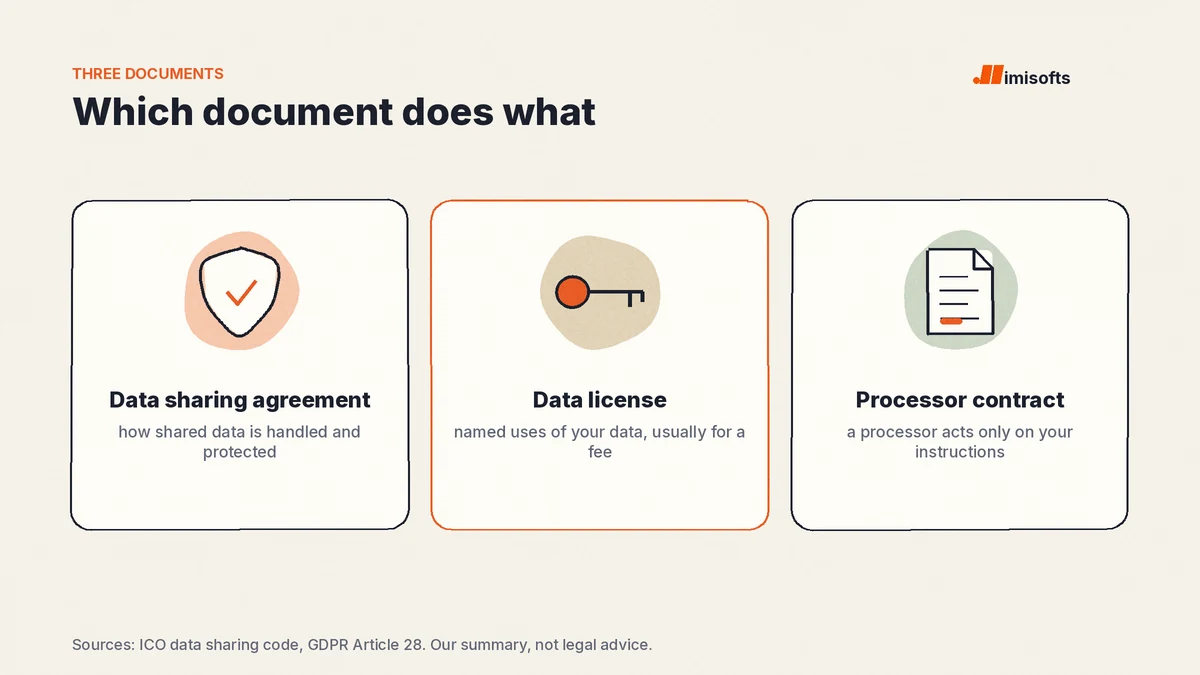
The two often appear in the same deal. If your company is weighing a sale of its records to an AI buyer, the license is the commercial core and the sharing terms ride alongside it. Our AI data licensing service starts by working out which documents your data needs.
This guide explains each document from its primary source, puts the differences in one table, adds the third document people confuse with both (the processor contract, often called a DPA), and ends with a checklist. Sources were read on November 22, 2026. This is general information, not legal advice.
Key numbers
| Item | Number |
|---|---|
| Differences compared in this guide (our summary table) | 6 |
| ICO status of a data sharing agreement (good practice; ICO guidance under review) | Not mandatory |
| Direct identifiers removed for a HIPAA limited data set (45 CFR 164.514(e)(2)) | 16 |
| Purposes allowed for a limited data set (research, public health, health care operations) | 3 |
| Promises a data use agreement recipient must make (including not to identify the information or contact people) | 5 |
| GDPR article on joint controller arrangements (responsibilities set out between them) | Article 26 |
| GDPR article on processor contracts (processing on documented instructions) | Article 28(3) |
| EU database right term (from 1 January after completion) | 15 years |
| Feist v. Rural (no copyright in facts) (US Supreme Court, 499 U.S. 340) | 1991 |
ICO data sharing code of practice; GDPR (Regulation (EU) 2016/679) and Directive 96/9/EC on EUR-Lex; 45 CFR 164.514 on eCFR (as of 11/19/2026); Feist v. Rural on LII; CDLA Permissive 2.0. Read November 22, 2026.
What a data sharing agreement is
The clearest definition comes from the UK Information Commissioner's Office. Its data sharing code of practice says these agreements "set out the purpose of the data sharing, cover what happens to the data at each stage, set standards and help all the parties involved in sharing to be clear about their roles and responsibilities."
The ICO lists other names for the same document: "an information sharing agreement; a data or information sharing protocol or contract; or a personal information sharing agreement." It also says what does not count on its own: a memorandum of understanding (except between government departments and certain other public bodies), a list of standards, or "an addendum to a purchase agreement or to a purchase order or proposal."
There is no set format. The ICO says a good agreement names the controllers "at every stage, including after the sharing has taken place," states the lawful basis for sharing, lists the data items (a "data specification"), and sets common rules for retention, security, staff training, individual rights requests and what happens to the data when the sharing ends.
One caution from the same page: an agreement "does not provide immunity from breaching the law," but the ICO "will take into account the existence of any relevant data sharing agreement when assessing any complaint." The ICO also notes the code is under review after the Data (Use and Access) Act, so check the page for updates.
What a data license is
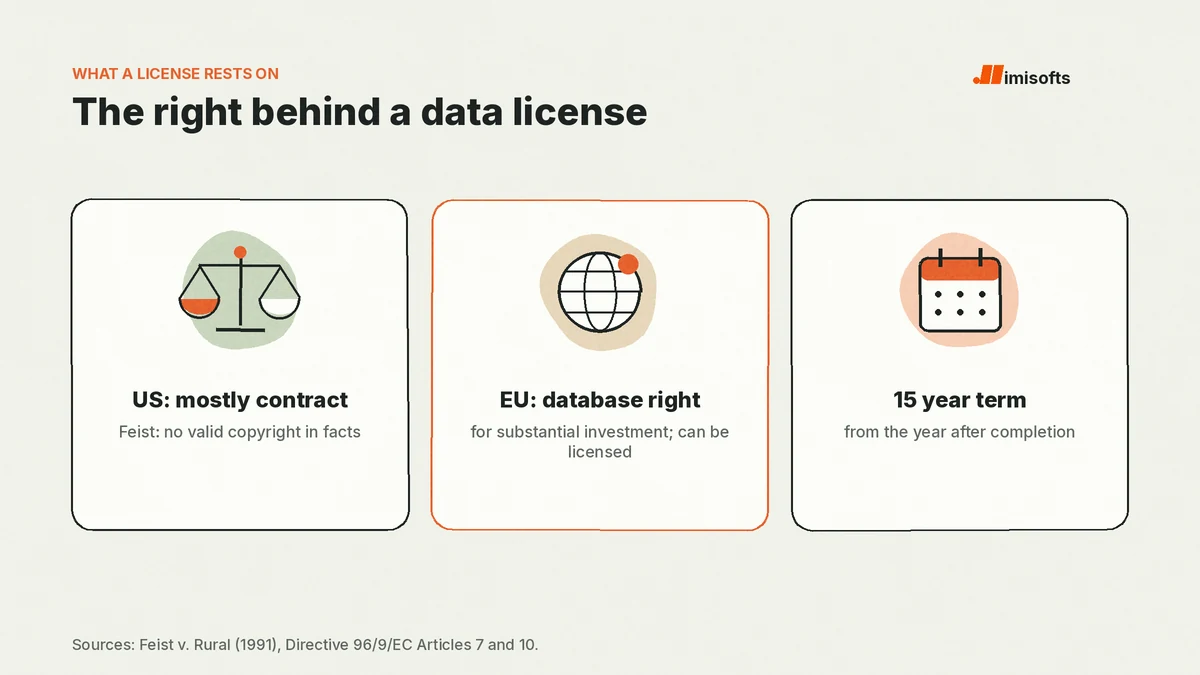
A license is permission. The owner of a right lets someone else do something that the right would otherwise stop, on stated terms. With data, the hard question is what right the owner holds in the first place.
In the United States, raw facts are not protected by copyright. In Feist Publications v. Rural Telephone Service (1991), the Supreme Court wrote that "there can be no valid copyright in facts" and that a factual compilation is protected only for "an original selection or arrangement of facts." So, in our reading, a US data license relies largely on contract: the buyer agrees to limits in exchange for access.
In the European Union, the Database Directive adds a separate right for the maker of a database that shows "a substantial investment in either the obtaining, verification or presentation of the contents." That right lets the maker prevent extraction or re-utilization of the whole or a substantial part, and Article 7(3) says it "may be transferred, assigned or granted under contractual licence." It expires 15 years from the first of January after the database is completed, and a substantial change that amounts to "a substantial new investment" gives the result its own term.
Published model licenses show what the grant looks like. The Community Data License Agreement, Permissive 2.0 lets a recipient "use, modify, and share the Data" if it follows the terms. It defines "Results" as outcomes of computational analysis, "including for example machine learning models," and places no restriction on them. We would expect a seller licensing to an AI buyer to want the opposite: named uses, limits on trained models and a fee. Our guide to the AI data licensing agreement lists the 10 terms to check.
Data sharing agreement vs data license: 6 differences
The table is our summary of the sources in this guide. Real contracts mix the two, so read it as the default shape of each document.
| Question | Data sharing agreement | Data license |
|---|---|---|
| Main job | Governs how shared data is handled and protected | Grants permission to use data for named purposes |
| Typical data | Personal data moving between organizations | Any dataset, personal or not |
| Payment | Usually none | Usually a fee, often over the term |
| Legal footing | Data protection law (UK GDPR accountability, GDPR Articles 26 and 28, HIPAA) | Contract, plus any copyright or EU database right |
| Outputs and models | Not usually addressed | Should say who owns derived data and trained models |
| End of the deal | Deletion or return of the shared data (ICO list) | End of term, plus deletion terms if the license sets them |
A simple test we use: if the document mostly answers "how do we keep this data lawful and safe?", it is a sharing agreement. If it mostly answers "what may the buyer do with our data, and what do they pay?", it is a license.
Where the processor contract (DPA) fits
The third document comes up in the same searches. A data processing agreement, or DPA, is the common name for the contract or other legal act the GDPR requires when a processor handles personal data on a controller's behalf. Article 28(3) of the GDPR says processing by a processor "shall be governed by a contract or other legal act" that sets out "the subject-matter and duration of the processing, the nature and purpose of the processing, the type of personal data and categories of data subjects," and that the processor acts "only on documented instructions from the controller."
The difference with a sharing agreement is who decides. A processor follows your instructions; in our reading, a recipient under a sharing agreement is usually a controller with its own purposes, and the ICO says "all controllers remain responsible for compliance." When two organizations decide the purposes together, Article 26 makes them joint controllers, who must set out their responsibilities "by means of an arrangement between them." Article 26(3) adds that people can still exercise their rights "against each of the controllers."
An AI lab that buys a license to train its own model decides its own purposes, so it is usually not acting as your processor, although the roles depend on the facts. That is why a processor contract alone rarely fits a data sale.
When the law requires a formal agreement
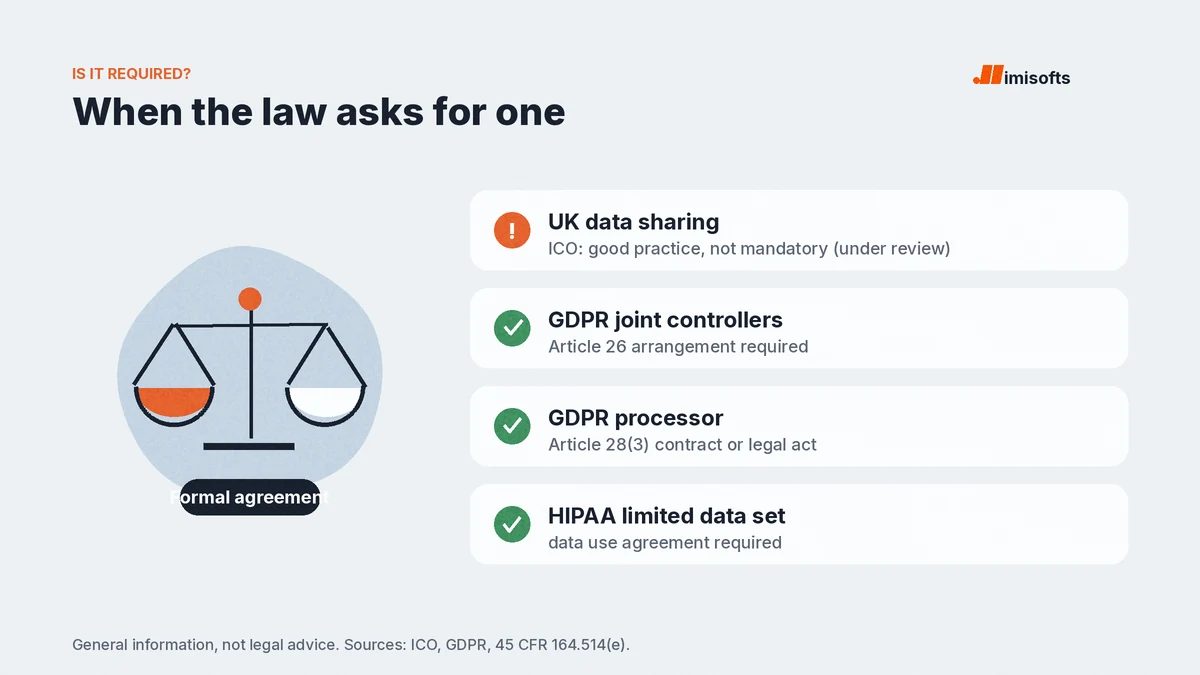
| Situation | Rule | Agreement |
|---|---|---|
| Sharing data in the UK | ICO data sharing code (under review) | Good practice, "not mandatory" |
| Joint controllers (EU or UK) | GDPR Article 26 | Required: an arrangement setting out responsibilities |
| A processor acting for you | GDPR Article 28(3) | Required: a contract or other legal act |
| A HIPAA limited data set | 45 CFR 164.514(e) | Required: a data use agreement |
| A paid data license | Contract | No rule in this guide requires one; in our reading, the contract is where the terms are set |
The HIPAA rule is the most specific. For a covered entity under 45 CFR 164.514(e), a limited data set is protected health information with 16 direct identifiers removed, of the individual or of relatives, employers or household members, from names and postal addresses to IP addresses and full face photographs. It may be used only "for the purposes of research, public health, or health care operations," and only under a data use agreement. That agreement must set the permitted uses and who may receive the data, and the recipient must promise five things, including to "not identify the information or contact the individuals." Training a commercial AI model is not named among the three purposes, so check with counsel whether a given use fits one of them.
For US companies outside health care, state privacy laws may still apply to a data deal. Our CCPA compliance guide covers California's thresholds, and the right to erasure guide covers deletion requests that follow the data. This is general information, not legal advice.
Which documents an AI data deal needs
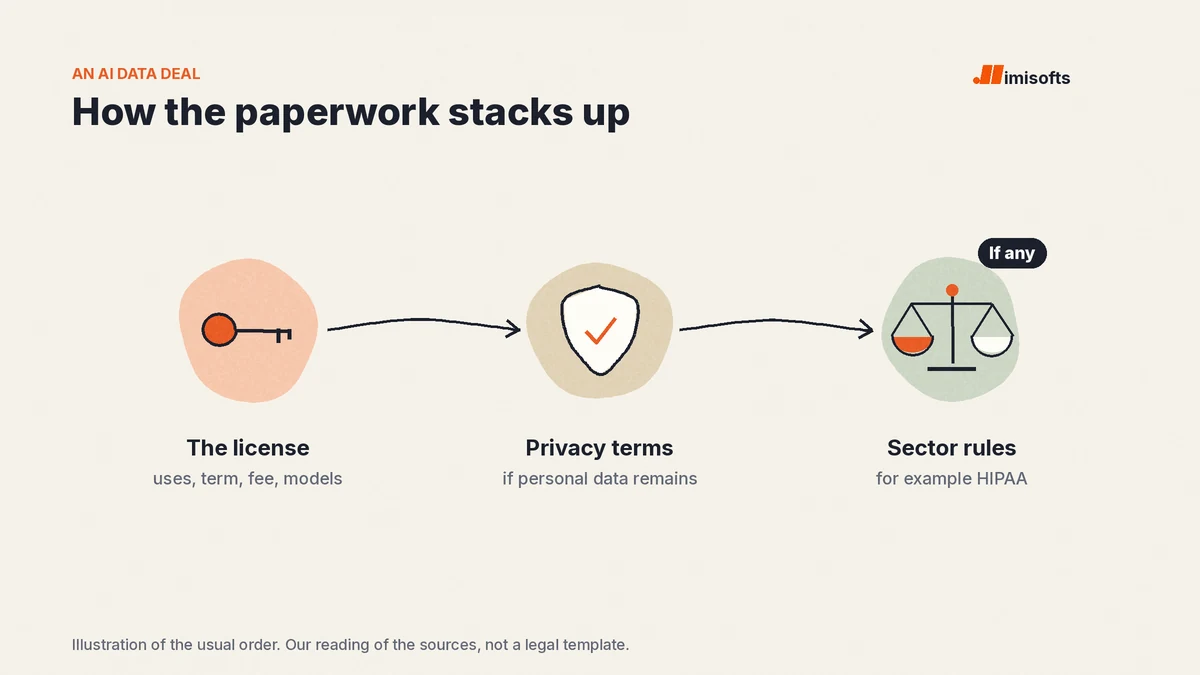
When a company licenses its records to an AI buyer, the paperwork usually stacks in this order. This is our reading of the sources above, not a legal template.
- The license. Named uses (training, fine-tuning, retrieval), term, fee, exclusivity, and who owns derived data and trained models. The CDLA clause that imposes no restriction on Results shows what happens when a license is silent on models.
- Data protection terms, if any personal data remains. The lawful basis, the data specification, security, retention and deletion, in the spirit of the ICO list. Removing personal data before the sale shrinks this part.
- Sector rules. Health records shared as a HIPAA limited data set follow its data use agreement rules and three purposes; other regulated data has its own rules.
Our guide on how to sell data to AI companies walks through the buyer process, and what data monetization means explains where licensing sits among the other ways data earns money.
Checklist before you sign either document
- Name every party and its role (controller, joint controller, processor or licensee) at every stage.
- Write the purpose in precise terms, and list the exact data items shared.
- State the lawful basis for any personal data, and the legal power to share it.
- Set security, staff training and breach procedures.
- Say who answers access, objection and erasure requests.
- For a license: list the permitted uses, the term, the fee, and what happens to models trained on the data.
- Set the end: deletion or return of the data, and a date to review the arrangement.
How imisofts can help
imisofts is a Dubai based agency that builds automation and data work for established companies. Our team can map which of your records might be licensable, prepare and anonymize them, and support you and your lawyers through the buyer process. If you want a first look, check if your company qualifies. We are not a law firm, and we do not promise a payout; whether a buyer pays, and how much, depends on the data and the buyer.
Frequently Asked Questions
A document that sets the rules when one organization shares data, usually personal data, with another. The UK ICO says it should cover the purpose, each party's role, the lawful basis, the data items, security, retention and what happens when the sharing ends. It is also called an information sharing agreement or protocol.
Not always. The UK ICO calls it good practice and says it is not mandatory (its guidance is under review after the Data (Use and Access) Act). GDPR joint controllers must set their responsibilities in an arrangement (Article 26), processors need a contract or other legal act (Article 28(3)), and HIPAA requires a data use agreement for a limited data set.
A data processing agreement binds a processor that handles personal data only on your documented instructions (GDPR Article 28(3)). A data sharing agreement covers sharing with another organization that, in most cases, uses the data for its own purposes as a controller.
A contract that grants permission to use a dataset for named purposes, usually for a fee. In the US it relies largely on contract because raw facts are not copyrightable (Feist, 1991); in the EU a database right of 15 years, for databases built with substantial investment, can be granted under contractual licence.
Usually a data license that names the AI uses, the term, the fee and who owns trained models, plus data protection terms if any personal data remains in the dataset. Health records follow HIPAA's own rules.
Not in the United States. The Supreme Court held in Feist v. Rural (1991) that there can be no valid copyright in facts; only an original selection or arrangement is protected. The EU adds a separate database right for substantial investment.