Short answer. The California Consumer Privacy Act (CCPA) applies to a for-profit business that does business in California and meets any one of three tests: gross annual revenue of $26.625 million or more in the preceding calendar year, buying, selling or sharing the personal information of 100,000 or more California residents or households, or earning 50% or more of its revenue from selling or sharing it. That is how the California Privacy Protection Agency (CPPA) puts it in its official FAQ.
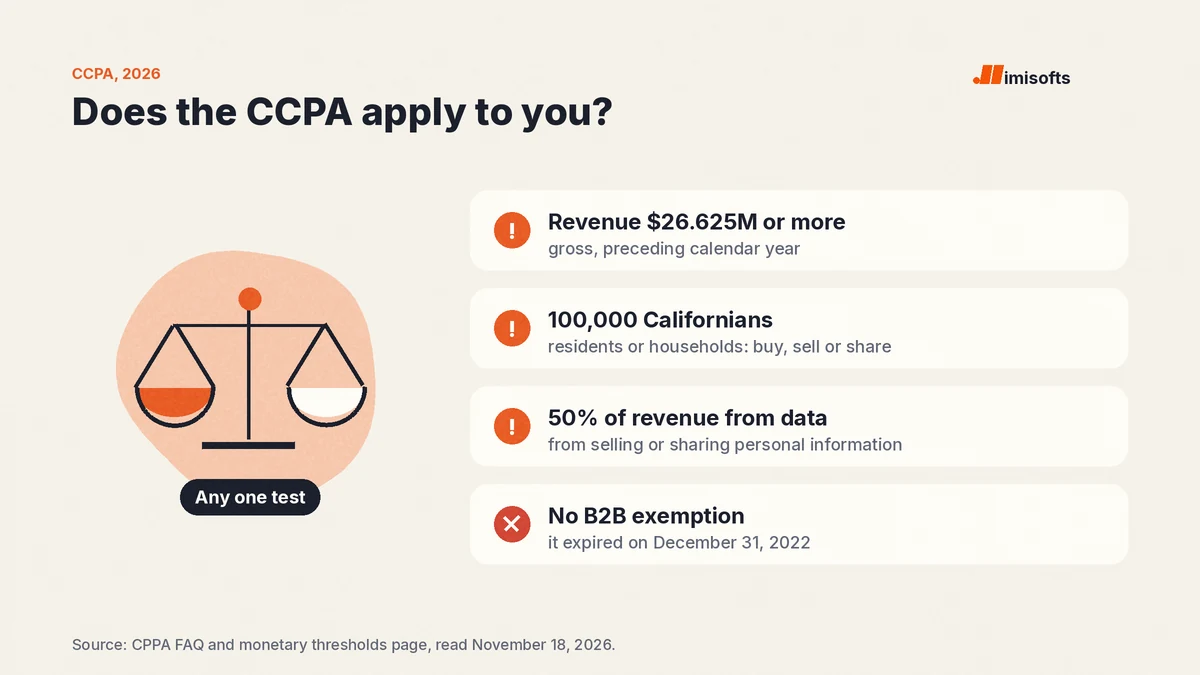
Compliance means a privacy notice, working ways to submit requests, answers within 45 days, and honoring opt-out signals such as the Global Privacy Control. Fines run up to $2,663 per violation and $7,988 per intentional violation, the amounts in force since January 1, 2025.
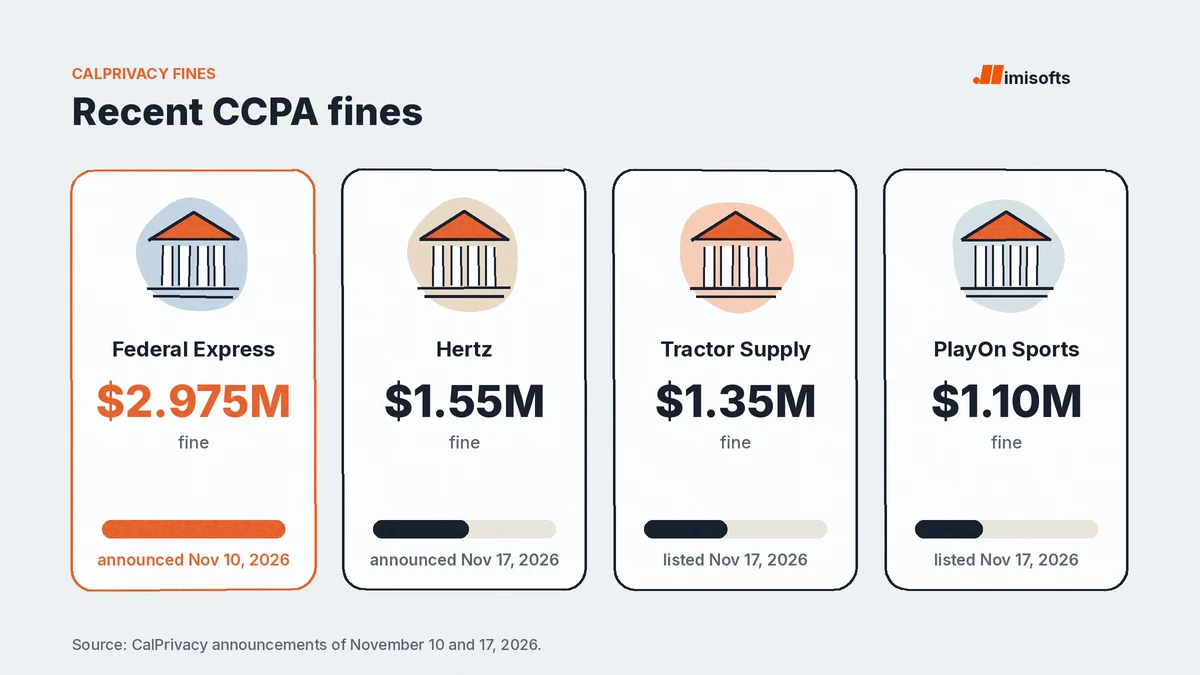
The agency, which now calls itself CalPrivacy, is enforcing. On November 17, 2026 it fined Hertz $1.55 million, and on November 10 FedEx $2.975 million, both partly over opt-out signals. If your team sends cold email or buys lead data, the B2B side matters too; we cover it below alongside our email infrastructure work. This is general information, not legal advice.
Key numbers
| Item | Number |
|---|---|
| Revenue threshold (preceding calendar year, from January 1, 2025 (was $25 million)) | $26.625 million |
| Volume threshold (California residents or households whose data is bought, sold or shared) | 100,000 |
| Data revenue threshold (of annual revenue from selling or sharing) | 50% |
| Fine per violation ($7,988 if intentional or involving known under-16s) | $2,663 |
| Damages, 1798.150 (per consumer per incident, or actual damages) | $107 to $799 |
| Response deadline (extendable to 90; receipt confirmed within 10 business days) | 45 calendar days |
| Opt-out deadline (at most; opt-out signals such as GPC count) | 15 business days |
| Hertz fine (CalPrivacy decision announced November 17, 2026) | $1.55 million |
| FedEx fine (CalPrivacy decision announced November 10, 2026) | $2.975 million |
| Data broker fee (2026 registration; DROP deletions every 45 days from August 1, 2026) | $6,000 |
CPPA FAQ, Updated Monetary Thresholds, regulations page, data broker page and September 23, 2025 announcement; CalPrivacy announcements of November 10 and 17, 2026; Cal. Civ. Code 1798.155. Read November 18, 2026.
Who must comply: the three CCPA thresholds
The CPPA FAQ says the CCPA applies to for-profit businesses that collect consumers' personal information, decide why and how it is processed, do business in California, and meet any one of these thresholds:
- Revenue: "a gross annual revenue of $26.625 million or more (effective January 1, 2025) for the preceding calendar year".
- Volume: buy, sell or share the personal information of 100,000 or more California residents or households.
- Data revenue: derive 50% or more of annual revenue from selling or sharing California residents' personal information.
The revenue figure was $25 million until the end of 2024. The agency's monetary thresholds page explains that Civil Code 1798.199.95(d) adjusts it for inflation "every odd-numbered year", which raised it 6.5% for 2025. The next adjustment falls in an odd-numbered year, 2027.
The law also reaches some entities controlled by a covered business, certain joint ventures, and companies that volunteer to be covered. Service providers and contractors that process data for a covered business carry their own obligations. Nonprofits and government agencies are generally outside it, the FAQ says.
Personal information is broad. The FAQ lists a name, an email address, purchase records, browsing history, geolocation, fingerprints and "inferences about the consumer's preferences and characteristics". This is general information, not legal advice.
B2B contact data is covered too
A work email is not out of scope. The CPPA FAQ says the exemptions for employee data and "personal information reflecting business-to-business transactions" in Civil Code 1798.145(m) and (n) "expired on December 31, 2022."
The agency made a related point on November 10, 2026, in its FedEx decision announcement. Executive Deputy Director Tom Kemp said the decision "confirms that the CCPA protects Californians from online surveillance, even in a business-to-business (B2B) setting".
So a prospect list with names and work emails of people in California is personal information under the CCPA, if your business meets one of the thresholds. Our guide on whether buying B2B email lists is legal covers the purchase side.
The six rights and the response deadlines
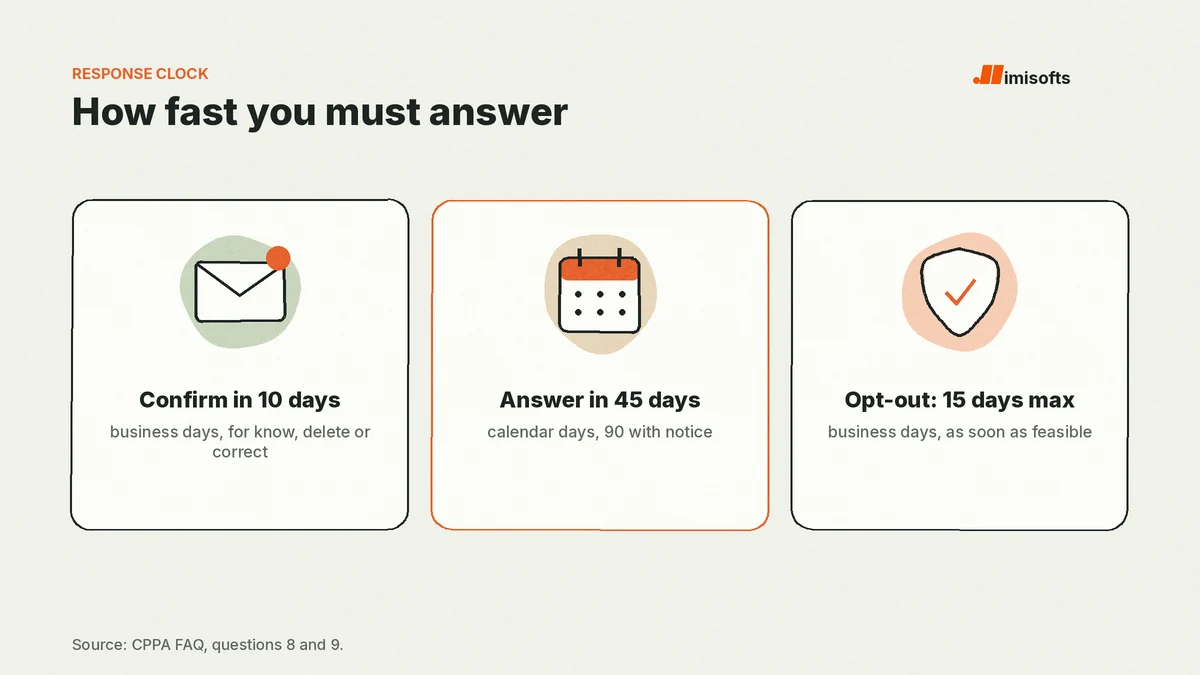
The FAQ names six rights: to limit the use of sensitive personal information, to opt out of sale or sharing, to correct, to know, to equal treatment, and to delete. A consumer can ask to know "up to twice a year, free of charge", and a business cannot make anyone waive these rights.
| Request | What the business must do | Deadline |
|---|---|---|
| Know, delete, correct | Confirm receipt, then respond in substance | 10 business days to confirm; 45 calendar days to respond, extendable by 45 (90 in total) with notice |
| Opt out of sale or sharing | Stop selling or sharing; honor opt-out preference signals such as the Global Privacy Control | As soon as feasible, at most 15 business days |
| Limit sensitive personal information | Limit use of sensitive personal information, such as a social security number, financial account information or precise geolocation | As soon as feasible, at most 15 business days |
Requests to know, delete or correct generally need at least two submission methods. One must be a toll-free number and, if you have a website, one must be on the website. A business that operates only online needs just an email address. For the GDPR side, see our guide to DSAR response times; our guide to right to erasure covers deletion across systems.
Opt-out signals: what Hertz and FedEx were fined for
The FAQ says businesses "must honor opt-out preference signals ("OOPS") that meet certain requirements, such as the Global Privacy Control, as a valid request to opt-out of sale/sharing." "Sharing" here means sharing for cross-context behavioral advertising, the kind of tracking at issue in the FedEx decision.
The Hertz and FedEx decisions of November 2026 both turned on this:
- Hertz, $1.55 million (November 17): CalPrivacy alleged Hertz failed to process opt-out preference signals, failed to tell consumers how it processed them, and added "unnecessary friction" to opting out, according to the agency's announcement. Hertz must now test its request methods and opt-outs every quarter, including "all tag management containers", and review each new tracking technology before adding it.
- FedEx, $2.975 million (November 10): the agency alleged FedEx said it did not sell or share personal information while taking part in cross-context behavioral advertising, did not honor opt-out signals, used a request webform that did not cover tracking technologies, and had cookie controls that "did not work properly".
CalPrivacy's Hertz announcement adds that the California Opt Me Out Act, in effect from January 2027, requires browsers operating in California to offer easy-to-use opt-out preference signals.
CCPA fines per violation and recent penalties
Civil Code 1798.155(a) sets an administrative fine of up to $2,500 per violation and $7,500 per intentional violation or violation involving the data of consumers known to be under 16, "as adjusted". Since January 1, 2025 the adjusted amounts are $2,663 and $7,988. The same amounts apply to civil penalties under Civil Code 1798.199.90(a).
Under Civil Code 1798.150(a)(1)(A), damages are $107 to $799 per consumer per incident, or actual damages if greater. The agency cannot enforce a violation more than five years old, its FAQ says.
| Company | Amount | Type, as CalPrivacy lists it |
|---|---|---|
| General Motors | $12.75 million | Civil penalty, with the Attorney General and district attorneys (connected vehicle data) |
| Federal Express | $2.975 million | Administrative fine, decision announced November 10, 2026 |
| Hertz | $1.55 million | Fine, decision announced November 17, 2026 |
| Tractor Supply Company | $1.35 million | Fine, listed by CalPrivacy on November 17, 2026 |
| PlayOn Sports | $1.10 million | Fine, listed by CalPrivacy on November 17, 2026 |
| CC Filson Co. | $217,987 | Administrative fine, listed by CalPrivacy on November 17, 2026, plus an order to stop device-based sales and shares to ad tech companies within 30 days until it certifies compliance |
For scale, FedEx's fine equals about 372 violations at the $7,988 intentional rate. The announcements do not say how violations were counted. This is general information, not legal advice. Filson's fine took into account confidential financial information confirming its assertion that it "would be unable to pay a multi-million dollar fine", the agency said.
CCPA deadlines from 2026 to 2030
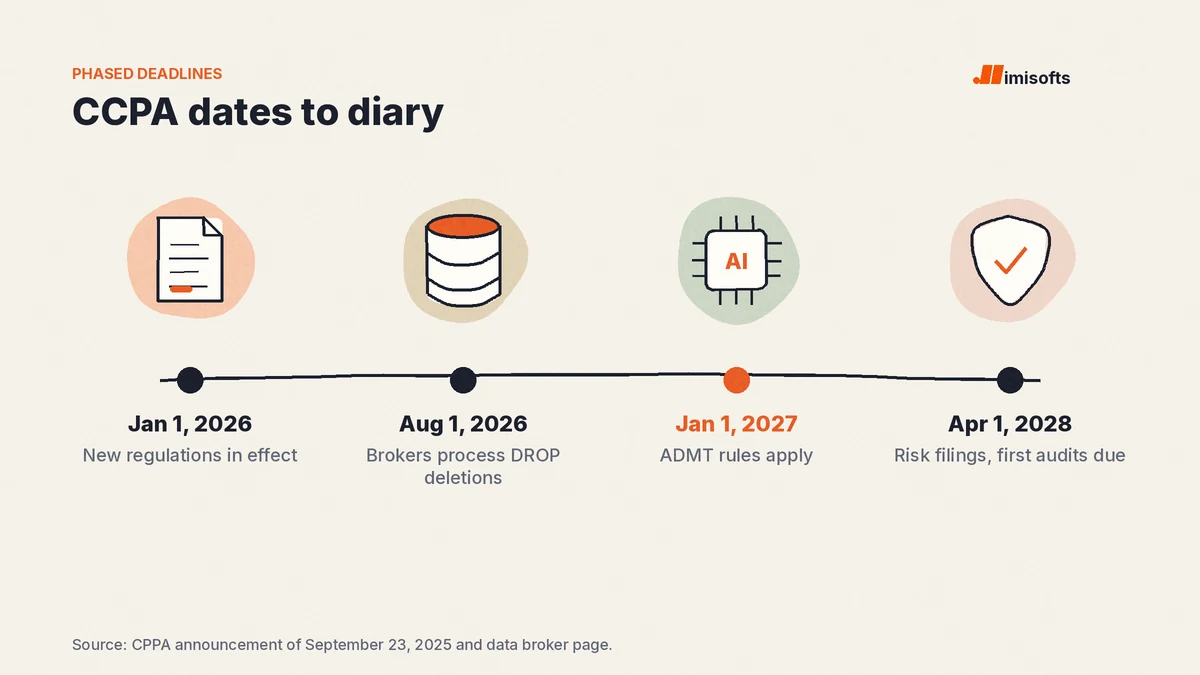
The CPPA board adopted new regulations on July 24, 2025, and they took effect on January 1, 2026, the regulations page says. They update the existing rules and add risk assessments, cybersecurity audits and rights over automated decisionmaking technology (ADMT). Some parts are phased in, according to the agency's September 23, 2025 announcement; the DROP date comes from its data broker page:
| Date | What applies |
|---|---|
| January 1, 2026 | Updated regulations in effect; risk assessment duties begin |
| August 1, 2026 | Data brokers must process DROP deletion requests at least every 45 days |
| January 1, 2027 | ADMT rules apply to businesses that use ADMT for significant decisions |
| April 1, 2028 | Risk assessment attestation and summary due; cybersecurity audit certification due for businesses over $100 million |
| April 1, 2029 | Cybersecurity audit certification due for $50 million to $100 million |
| April 1, 2030 | Cybersecurity audit certification due under $50 million |
The announcement sets these dates for businesses that must complete audits or risk assessments, not for every covered business. Check which processing triggers them in the regulations text before planning. This is general information, not legal advice.
If you buy or sell lead data: the Delete Act and DROP
A data broker, under Civil Code 1798.99.80(c), is a business that knowingly collects and sells to third parties "the personal information of a consumer with whom the business does not have a direct relationship." Whether your own business fits depends on whether you sell data about people you have no direct relationship with; check the definition with counsel.
The agency's data broker page sets out the duties:
- Register every year between January 1 and 31. The 2026 fee was $6,000 plus a third-party processing fee for electronic payments. Missing January 31 can bring fines.
- Process deletions. Since August 1, 2026, brokers must log in to the Delete Request and Opt-Out Platform (DROP) "at least once every 45 days" and process consumer deletion requests, subject to limited exceptions.
- Get audited. From January 1, 2028, and every 3 years after, an audit by an independent third party.
If you buy a list, ask the seller for its California registration and how it handles DROP deletions. The same question applies to scraped data; see is web scraping legal. This is general information, not legal advice.
CCPA compliance checklist for a small team
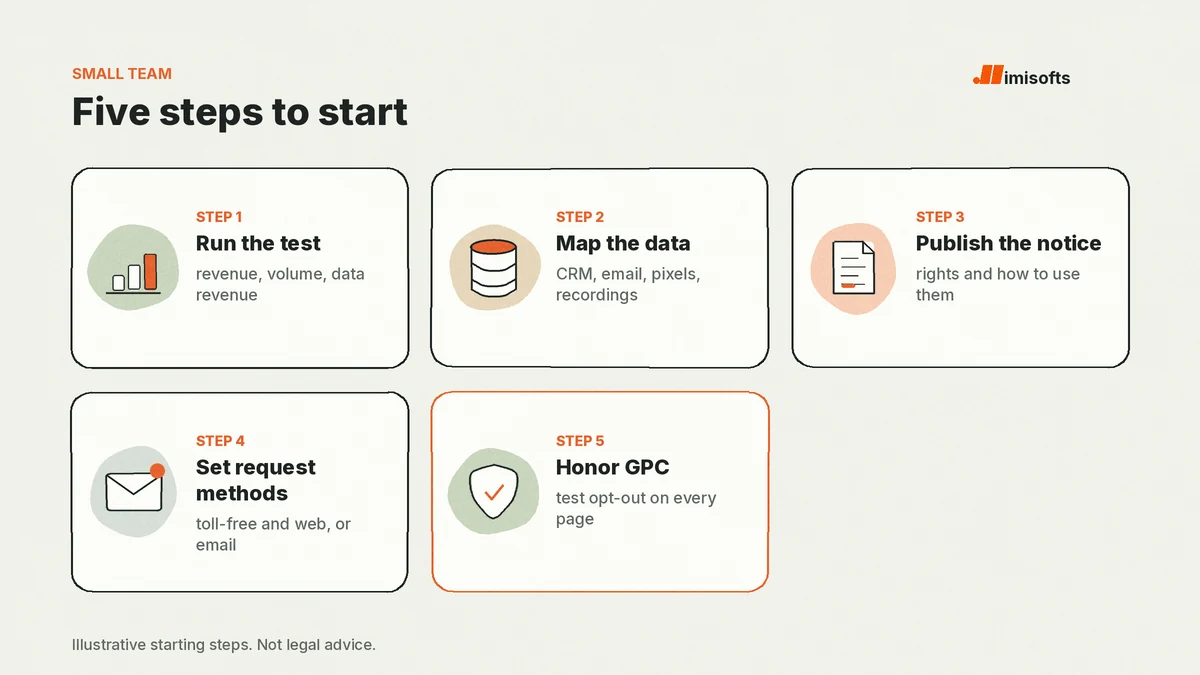
These steps follow the duties above. They are a starting point, not a full program:
- Run the threshold test. Revenue for the preceding calendar year, the count of California residents or households whose data you buy, sell or share, and the share of revenue from selling or sharing data.
- Map the data. CRM, email platform, enrichment tools, call recordings, chat widgets and ad pixels. If you run a chatbot, include it; our guide to AI chatbot costs for a business covers that setup.
- Publish the notice. A privacy policy that includes instructions on how to submit requests, as the CPPA FAQ says it must.
- Set up the request methods. Two methods (a toll-free number plus a method on your website), or an email address if you only operate online, and a 10-business-day and 45-calendar-day clock.
- Honor opt-out signals. Test that the Global Privacy Control turns off selling and sharing tags on every page and device, an issue in both the Hertz and FedEx decisions.
- Check your vendors. Service providers and contractors that process data for you carry their own CCPA obligations.
- Diary the dates: January 2027 for ADMT and browser signals, April 2028 for risk assessment filings and the first audits.
If you also email people in Europe, the GDPR applies on top; our guide to GDPR fines covers that side.
How imisofts can help
imisofts is a Dubai-based agency that builds outbound systems: lead generation, cold email infrastructure, CRMs and AI agents. We can map where contact data sits in your stack, set up suppression and deletion lists that sync across tools, and check that opt-out signals switch off tracking tags. We are not lawyers, so your counsel should sign off the policy and the threshold test. To plan the sending side, talk to our email infrastructure team. This is general information, not legal advice.
Frequently Asked Questions
A for-profit business doing business in California is covered if it meets one test: $26.625 million or more in gross revenue, buying, selling or sharing data on 100,000 or more California residents or households, or earning 50% or more of revenue from selling or sharing data. Some entities controlled by covered businesses, and service providers and contractors, have obligations too.
Yes. The exemptions for employee and business-to-business personal information in Civil Code 1798.145(m) and (n) expired on December 31, 2022, the CPPA says. A work email of a California resident is personal information if your business meets a threshold.
Up to $2,663 per violation and $7,988 per intentional violation or violation involving known under-16s, the amounts in force since January 1, 2025. CalPrivacy fined Hertz $1.55 million and FedEx $2.975 million in November 2026.
Confirm receipt within 10 business days and answer a request to know, delete or correct within 45 calendar days, extendable by another 45 with notice. Opt-out requests must be honored within 15 business days at most.
Yes. The CPPA says businesses must treat opt-out preference signals that meet its requirements, such as the Global Privacy Control, as a valid request to opt out of sale or sharing. The Hertz and FedEx decisions of November 2026 both cited failures here.
It protects California residents. It applies to a for-profit business that does business in California and meets one of the three thresholds; the CPPA FAQ does not limit it to businesses based in California.