Short answer. Check ten terms before you sign an AI data licensing agreement: the permitted uses, future technologies, derived data, model outputs, exclusivity, the term and what happens at the end, payment, privacy and de-identification, confidentiality, and warranties and liability. The first one sits at the center of a pending lawsuit. In a case filed on November 26, 2025, Fastcase sued Alexi in federal court, alleging that data licensed in 2021 for "internal research purposes" was used to train a commercial AI product, according to a Proskauer analysis of the complaint.
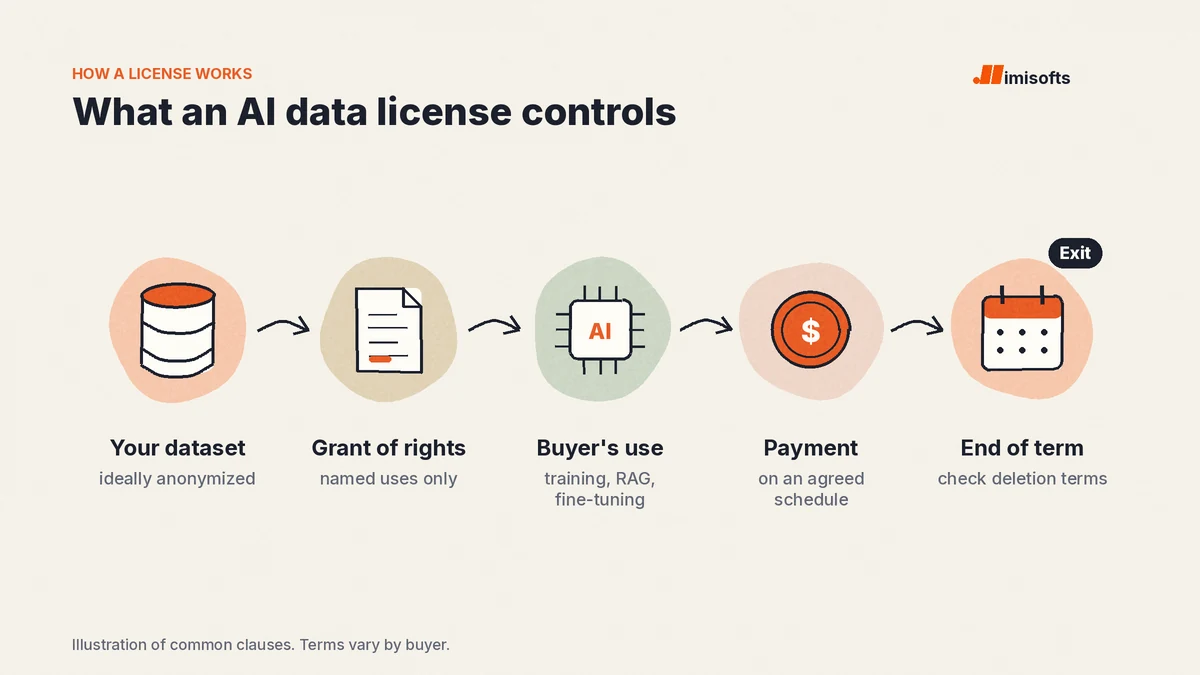
A data license lets an AI company use a copy of your records for agreed purposes, for an agreed time, while you keep ownership. If you are still deciding whether to license your company data at all, start with our guide on how to sell data to AI companies. This guide is for the step after that: the contract.
It is written for owners and operators of established companies, not for lawyers, and it does not replace one. Sources were read on November 18, 2026. This is general information, not legal advice.
Key numbers
| Item | Number |
|---|---|
| Terms to check before signing (this guide's checklist) | 10 |
| Reddit data licensing arrangements (aggregate contract value, signed January 2024) | $203.0 million |
| Reddit contract terms (S-1, filed February 22, 2024) | 2 to 3 years |
| Reddit minimum 2024 revenue expected (about 32.7% of the total) | $66.4 million |
| Fastcase v. Alexi filed (D.D.C., over a 2021 data license) | November 26, 2025 |
| CCPA conditions for deidentified data (Civil Code 1798.140(m)) | 3 |
| HIPAA Safe Harbor identifiers to remove (HHS de-identification guidance) | 18 |
| EU AI Act model provider duties apply from (Article 53, under the original Regulation) | August 2, 2025 |
Reddit S-1 (SEC); Proskauer Rose LLP blog on Fastcase v. Alexi; California Civil Code 1798.140; HHS HIPAA de-identification guidance; Regulation (EU) 2024/1689; CDLA Permissive 2.0. Read November 18, 2026.
What an AI data licensing agreement does
A data licensing agreement is the contract that decides what a buyer may do with a copy of your data, for how long, for how much, and what happens when the deal ends. The seller is the licensor. The AI company is the licensee.
Public model agreements show how much hangs on a few definitions. The Community Data License Agreement, Permissive 2.0, a Linux Foundation project, lets a recipient "use, modify, and share the Data". It then defines "Results" as "any outcome obtained by computational analysis of Data, including for example machine learning models and models' insights", and says the agreement does not impose "any restriction or obligations" on Results. That is a sensible choice for open data. For a private commercial license, it may give away more than you meant to.
Disclosed deals can be large. Reddit's S-1 filing of February 22, 2024 says that in January 2024 it "entered into certain data licensing arrangements with an aggregate contract value of $203.0 million and terms ranging from two to three years."
The 10 terms to check before you sign
| Term | What to look for |
|---|---|
| 1. Permitted uses | Each AI use named: training, fine-tuning, retrieval (RAG), inference, and a line that anything not named is excluded |
| 2. Future technologies | Whether "technologies now known or later developed" is included, and which grant it attaches to |
| 3. Derived data | Who owns cleaned, tagged or summarized versions of your data |
| 4. Models and outputs | What the buyer may do with models trained on your data and with text they produce |
| 5. Exclusivity | Whether you can license the same data to other buyers, and in which fields |
| 6. Term and exit | Length of the license, and what happens to copies when it ends |
| 7. Payment | Fees (fixed or usage-based), the payment schedule, and what happens to unpaid amounts if the deal ends early |
| 8. Privacy | De-identification standard, no attempts to re-identify, no onward transfer |
| 9. Confidentiality | What the buyer may say publicly about its training data, including summaries the law requires |
| 10. Warranties and liability | What you promise about the data, who carries the risk, and audit rights |
The sections below take the terms in four groups: the scope of use, the money and the clock, privacy, and risk.
Scope of use: name every AI use
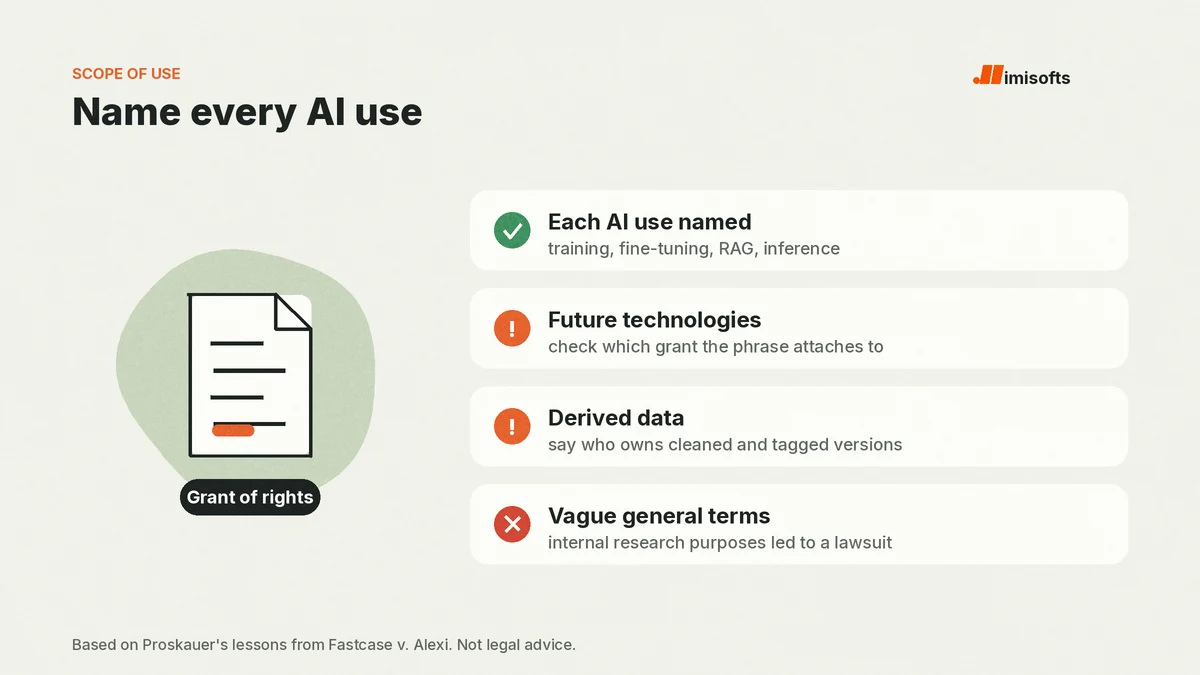
Proskauer's first lesson from the Fastcase dispute is to list permitted uses as separate, defined concepts "rather than relying on general terms". Its examples include "retrieval augmented generation (RAG), fine‑tuning, train, pre‑training, inference serving, model, weights, derived data, prompts, output". The firm also suggests separating "generative uses that can create or transform content" from machine learning uses "that only detect patterns or train classifiers".
Three clauses carry most of the scope:
- Future technologies. Many licenses use a phrase such as "technologies whether now known or later developed". Proskauer warns that care must be taken so the phrase "modifies the appropriate grants". We suggest you decide whether you want it at all.
- Derived data. Proskauer notes that "in the context of generative AI, the actual desired use case is, in most cases, to create derivative works from the licensed data". Say who owns cleaned, tagged and summarized versions of your records.
- Models and outputs. A clause like the CDLA's "No Restrictions on Results" leaves trained models and their outputs free of any restriction. If you want limits, for example on a model that competes with your own product, they have to be written in.
What the Fastcase case shows about vague licenses
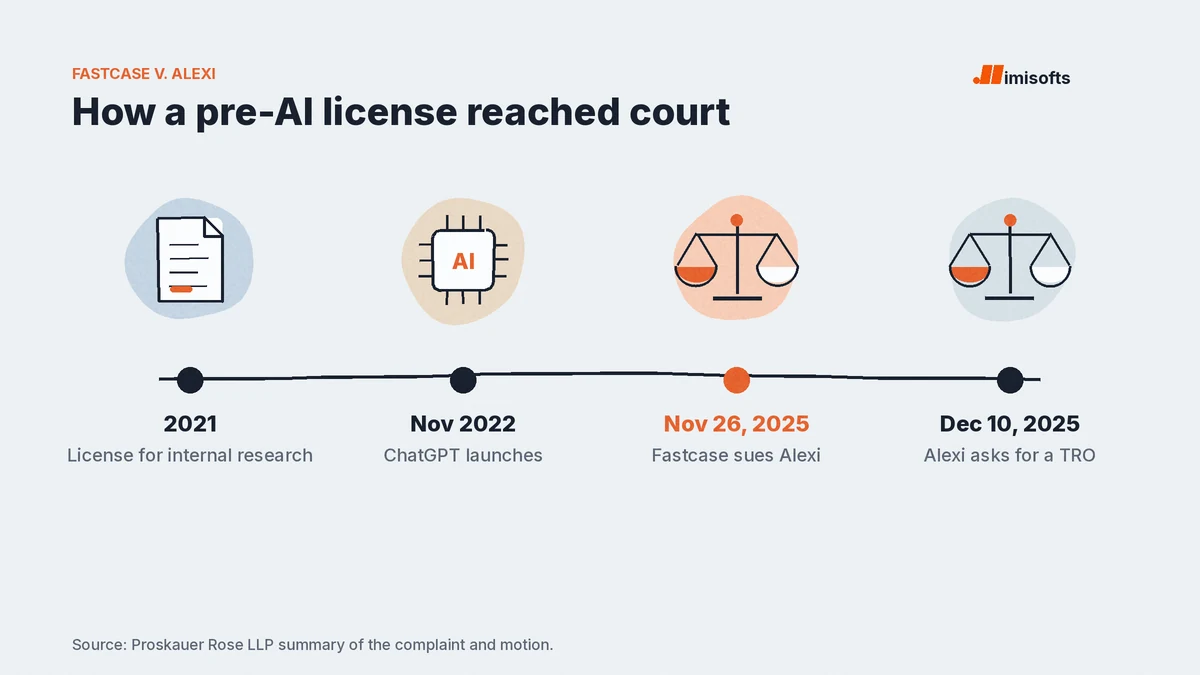
The facts below come from Proskauer's summary of the complaint and of Alexi's motion. The 2021 license gave Alexi access to Fastcase's legal research database "restricted for 'internal research purposes'" and said: "In no event can the data be used for commercial purposes or for any purpose which is competitive with Fastcase."
Fastcase alleges Alexi later used the data to train and run a commercial AI legal research product. On December 10, 2025, Alexi filed a motion for a temporary restraining order and a preliminary injunction that, per Proskauer, seeks to keep its licensed access while the suit is pending, and it contends its use "is consistent with the terms of the Agreement". Proskauer lists the key questions as whether AI training fell within "internal research purposes" and whether Alexi's alleged display of the data to end users was a "publication".
The license was signed before ChatGPT launched in November 2022, and Proskauer calls it "an open question" whether it should be read narrowly to exclude uses nobody contemplated then. Proskauer also notes: "The old forms are likely silent on the issue". If you have licensed data to anyone before, we suggest you reread those agreements with AI uses in mind too.
Money and the clock: term, exclusivity and payment
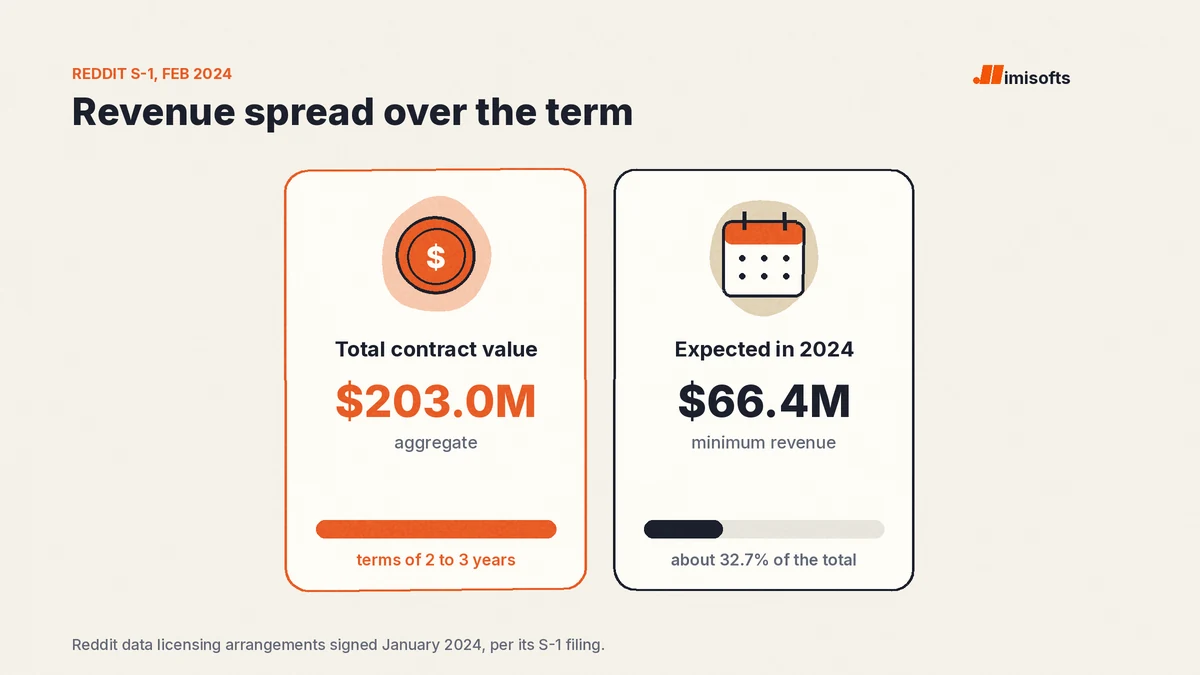
Term. Reddit's 2024 arrangements ran two to three years. A fixed term is only half of the clause. Ask in writing what happens at the end: whether the buyer must delete its copies, by when, and how it confirms that it did. Models already trained on your data are a separate question, and the answer should be in the contract, not assumed.
Exclusivity. An exclusive license stops you from licensing the same records to anyone else, so we suggest limiting it by field, by time, or both. A non-exclusive license lets you license the same data again.
Payment. We found no published price list for company data, so the only reliable figures are disclosed deals. Reddit expected "a minimum of $66.4 million of revenue to be recognized during the year ending December 31, 2024" from the $203.0 million total, at least about 32.7% in 2024. Revenue from these deals is recognized over the term; check your own payment schedule and what happens to unpaid amounts if the buyer ends the deal early.
Misuse. Reddit says its arrangements "include protections against abuse and misuse of Reddit data", and also warns it "may be unable to adequately control the misbehavior of partners". We suggest backing contract protections with audit rights and remedies.
Privacy terms the law already asks for
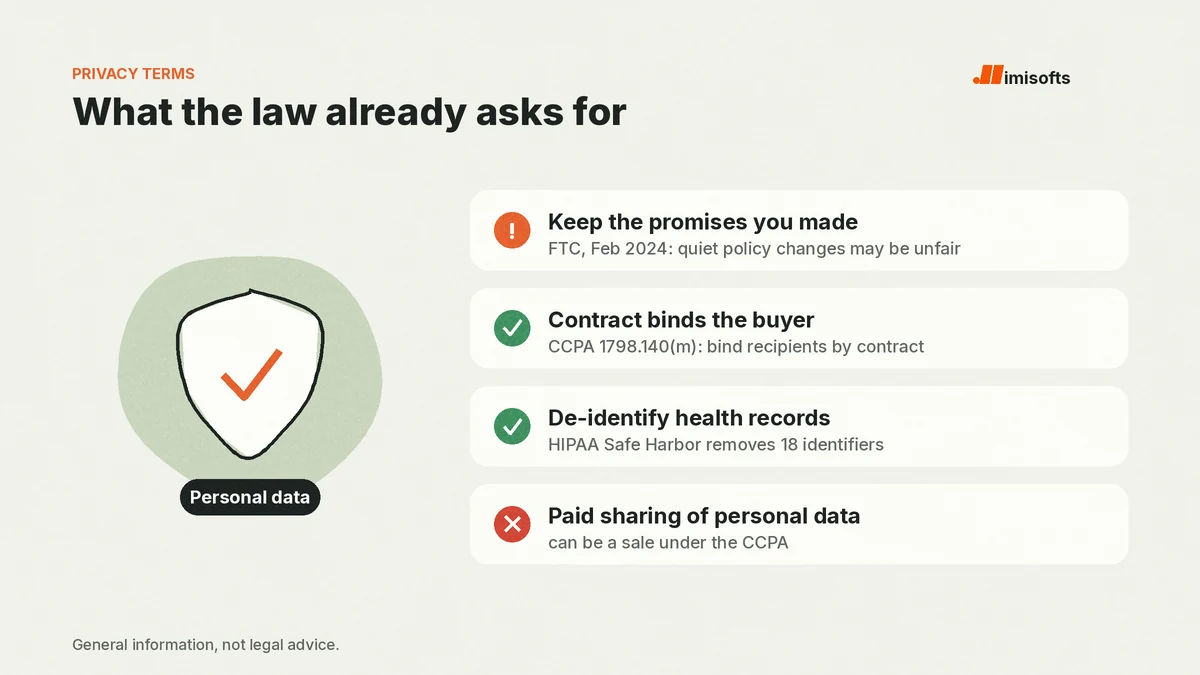
Three rules shape the privacy part of a license.
Your own promises. The FTC wrote in February 2024 that "it may be unfair or deceptive for a company to adopt more permissive data practices", for example "using that data for AI training", and to tell people only "through a surreptitious, retroactive amendment to its terms of service or privacy policy." Check your privacy policy and your customer contracts before personal data goes anywhere near a license.
California. Under the CCPA, a "sale" includes making personal information available to a third party "for monetary or other valuable consideration", which can cover a paid license of personal information. Deidentified data is treated differently, but only if the business meets three conditions in Civil Code 1798.140(m): it takes reasonable measures so the data cannot be linked to a consumer, publicly commits not to re-identify it, and "contractually obligates any recipients of the information to comply" with those rules. So if you want the data treated as deidentified, the license has to bind the buyer to them, and we suggest an explicit no-re-identification clause.
Health records. If you are a HIPAA covered entity, note that the Privacy Rule allows two de-identification methods, Expert Determination and Safe Harbor. Under HHS guidance, Safe Harbor removes 18 types of identifiers, from names to "any other unique identifying number, characteristic, or code", and requires that the covered entity have no actual knowledge that what remains could identify a person.
If your records hold data about people in the EU or UK, similar questions can arise under the GDPR; our guide to the right to erasure covers one of them: finding every copy when someone asks you to delete their data.
Risk terms: warranties, liability and disclosure
Warranties. The CDLA 2.0 gives the data "AS IS" and excludes any liability of the data provider for damages. We suggest you expect a commercial buyer to ask for more: a promise that you own the data or have the right to license it, and that it holds nothing you were not allowed to share. Keep those promises to what you can check, and cap your liability.
Disclosure. Under Article 53 of the EU AI Act, providers of general-purpose AI models must "draw up and make publicly available a sufficiently detailed summary about the content used for training", using a template from the AI Office. That chapter applies from August 2, 2025, under the Regulation's own timetable. If the buyer trains such a model, agree in advance how your data will be described in that summary, and keep the rest under a confidentiality clause.
Copyright versus contract. Proskauer also notes that some claims rest on contract and some on copyright. In our view, where the records themselves are not protected by copyright, the license terms may be your main protection, which is one more reason to draft them carefully.
A pre-signing checklist
- Every permitted AI use named, and a line that everything else is excluded
- Ownership of derived data and limits on trained models agreed
- Exclusivity limited by field or time, or the license kept non-exclusive
- End-of-term deletion, with a written confirmation
- Payment schedule and early-termination terms clear
- No re-identification and no onward transfer, in writing
- Privacy policy and customer contracts checked first
- Warranties limited to what you can check, liability capped, audit rights included
- Your lawyer has read the whole agreement before you sign
How imisofts helps with your data license
imisofts runs AI data licensing for established companies: we inventory your records, match them with buyers, explain every offer and its terms in plain words, and coordinate redaction and anonymization. We do not give legal advice. Your lawyer reviews and negotiates every agreement, and nothing is shared without your sign-off.
The same inventory is also the starting point for your own internal AI tools; see what an AI chatbot for business costs. To see whether your records could support a license, check if your company qualifies.
What we could not verify
- What any AI lab's standard data license says. Labs do not publish their buy-side templates.
- The status of Fastcase v. Alexi after December 2025; we did not open the court docket.
- Prices for company data. We found no published price list.
- Whether later EU amendments change the AI Act dates quoted here.
Frequently Asked Questions
A contract that lets a buyer use a copy of your data for named purposes, for a set time, while you keep ownership. It covers permitted uses, the term, payment, privacy and liability. Reddit's data licensing arrangements of January 2024, for example, have terms of two to three years.
Licensing records to an AI company so it can train, fine-tune or ground its models. Reddit's S-1 reports data licensing arrangements with an aggregate contract value of $203.0 million, signed in January 2024.
At least ten terms: permitted uses, future technologies, derived data, model outputs, exclusivity, term and exit, payment, privacy and de-identification, confidentiality, and warranties and liability.
That depends on the contract. Write down whether copies are deleted, by when and how deletion is confirmed, and what happens to models already trained on your data.
It can be. The CCPA defines a sale as making personal information available to a third party for monetary or other valuable consideration. Deidentified data is treated differently only if three conditions in 1798.140(m) are met, including a contract that binds recipients to those rules.
Yes, we suggest one reviews every agreement before you sign. The Fastcase case shows how a vague phrase such as internal research purposes can lead to a lawsuit. This is general information, not legal advice.