Short answer. You do not sell your company data outright. You license an anonymized copy to an AI lab for an agreed use and term, and you keep ownership. A deal usually runs in six steps: a fit call, a data inventory, a valuation, offers and terms, cleaning and your approval, then payment. AI labs say they want data that is "not already easily accessible online", and the sums can be real: Reddit's S-1 filing reports data licensing arrangements worth $203.0 million in aggregate contract value, signed in January 2024.
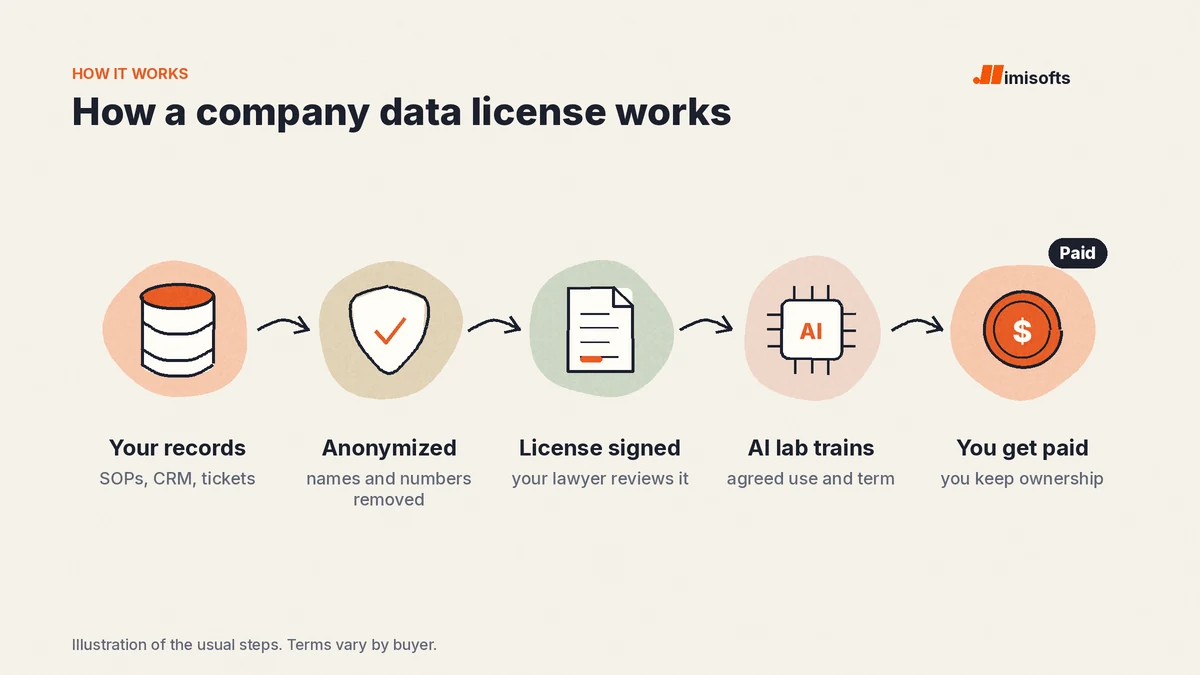
This guide is for owners and operators of established companies, usually 30 to 300 people with years of records in tools like a CRM, a helpdesk and project boards. It explains why AI labs pay for business records, what kind of records they value, how a license deal runs from first call to payment, the privacy checks to do first, and how imisofts runs the process for you. Sources were read on November 17 and 18, 2026. This is general information, not legal advice.
Key numbers
| Item | Number |
|---|---|
| Reddit data licensing arrangements (aggregate contract value, signed January 2024 (S-1)) | $203.0 million |
| Reddit contract terms (same S-1, filed February 22, 2024) | 2 to 3 years |
| OpenAI Data Partnerships opened (public and private training datasets) | November 9, 2023 |
| HIPAA Safe Harbor identifiers to remove (HHS de-identification guidance) | 18 |
| Steps from fit call to payment (imisofts process) | 6 |
| imisofts upfront fee (paid only when a license closes) | $0 |
Reddit S-1 (SEC, filed February 22, 2024); OpenAI Data Partnerships page; FTC Office of Technology blog (February 2024); HHS HIPAA de-identification guidance; imisofts AI data licensing page. Read November 17 and 18, 2026.
Why AI labs pay for company records
AI models learn from the data they are trained on, and the public web has been read many times over. What it does not show is how real companies get work done: how a quote becomes a project, how a support ticket gets solved, who approves what. That knowledge sits inside company systems.
OpenAI said as much when it opened its Data Partnerships program on November 9, 2023. It wrote that it is interested in "large-scale datasets that reflect human society and that are not already easily accessible online to the public today", and that it is "particularly looking for data that expresses human intention", such as long-form writing or conversations. It also offers private datasets for training its own models, and says it is not seeking "sensitive or personal information, or information that belongs to a third party".
Public filings show that licensing is already a revenue line for some companies. In its S-1 filed on February 22, 2024, Reddit wrote: "In January 2024, we entered into certain data licensing arrangements with an aggregate contract value of $203.0 million and terms ranging from two to three years." Reddit also called the market for data "new and evolving rapidly". Reddit is a huge public platform, so its number is a sign that the market is real, not a price for a company like yours.
The market now reaches ordinary businesses. On November 6, 2026, Wired reported that data brokers are collecting internal corporate files to help train AI models. It quoted a pitch claiming that labs pay media companies $350,000 to $1.8 million as a one time fee for old work records such as documents, emails, chat messages and tickets. Treat figures like that as a sales pitch, not a price list.
What company data AI labs value, and what stays out
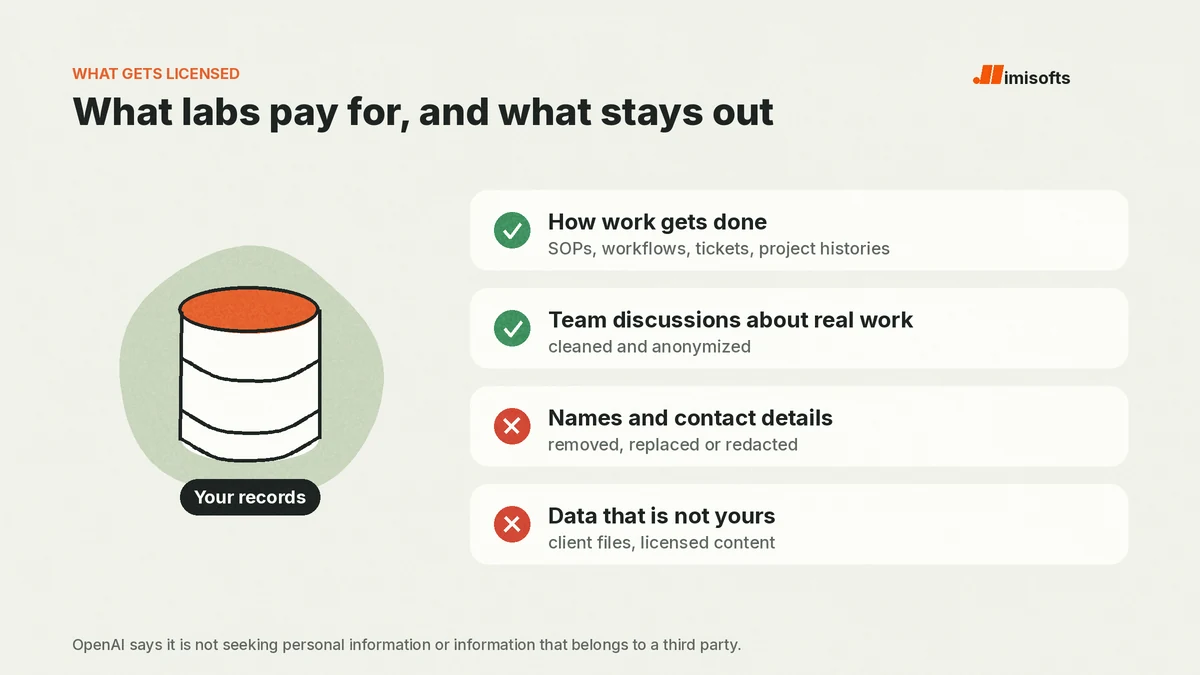
Labs pay for the record of how work gets done, not for names or numbers. In our inventories we look for records like these:
| What labs value | Where it usually lives |
|---|---|
| SOPs, playbooks and process documents | Wiki, shared drive, Notion or Confluence |
| Workflows, approval chains and handoffs | Project boards, ticket histories, CRM stages |
| Support conversations and how they were resolved | Helpdesk |
| Sales stages and pipeline history | CRM |
| Project histories, change orders and reviews | Project management tools |
| Engineering docs, issue triage and release notes | Code repository and issue tracker |
| Team discussions about real work, cleaned | Team chat |
What stays out: names of clients, staff and partners (removed or replaced), phone numbers, email addresses, money amounts and ID numbers (redacted), anything that belongs to a third party, and any folder or system you choose to exclude. That matches OpenAI's own line that it does not want personal information or information that belongs to someone else.
How to sell data to AI companies: the six steps
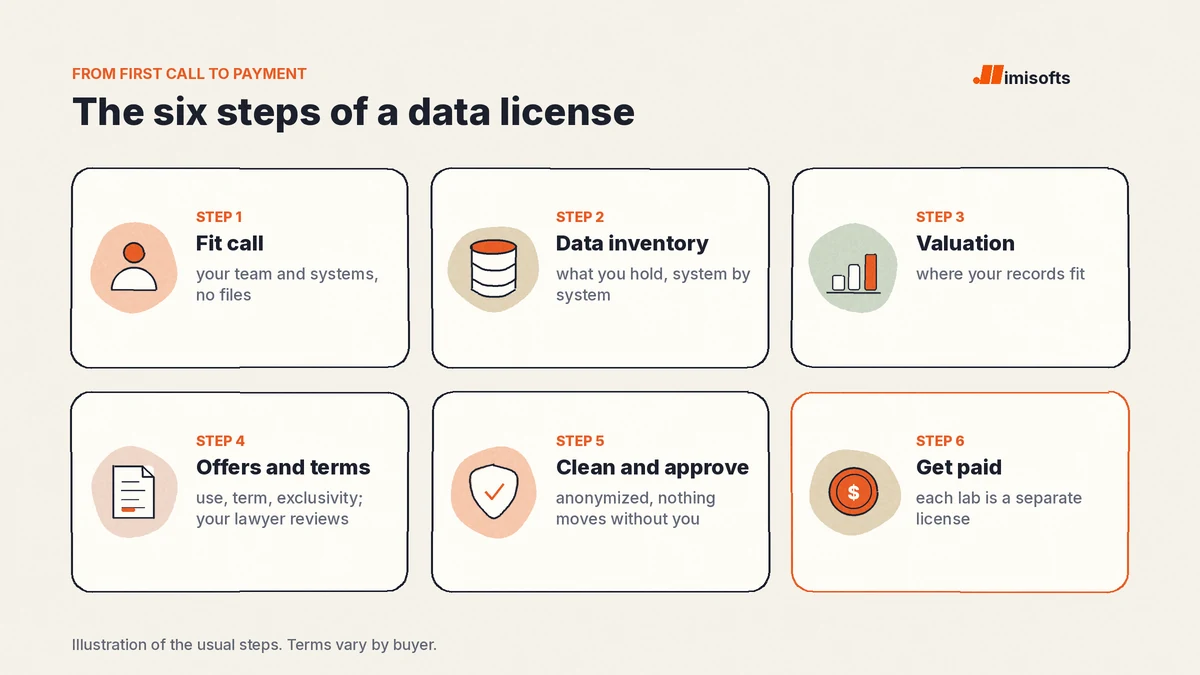
- Fit call. A short call about your team, your systems and how many years of records you hold. No files change hands.
- Data inventory. A map of your records, system by system: what exists, how many years it covers and how it is organized. The summary holds no sensitive content.
- Valuation. The inventory is compared with what labs are buying now, so you see where your records fit and what drives their value.
- Offers and terms. Interested labs make offers. Each one sets the records included, the permitted use, the term and whether the license is exclusive. Your lawyer reviews the agreement before you sign.
- Clean, anonymize and approve. Records are redacted and anonymized, and can be rewritten synthetically, before release. Nothing moves until you approve the final dataset.
- Get paid. The lab pays your company. A non-exclusive license leaves you free to license the same dataset to another lab later.
Your team's part is small: one call, some answers about your tools, a review of the offers and a final sign-off.
Privacy and legal checks before you license anything
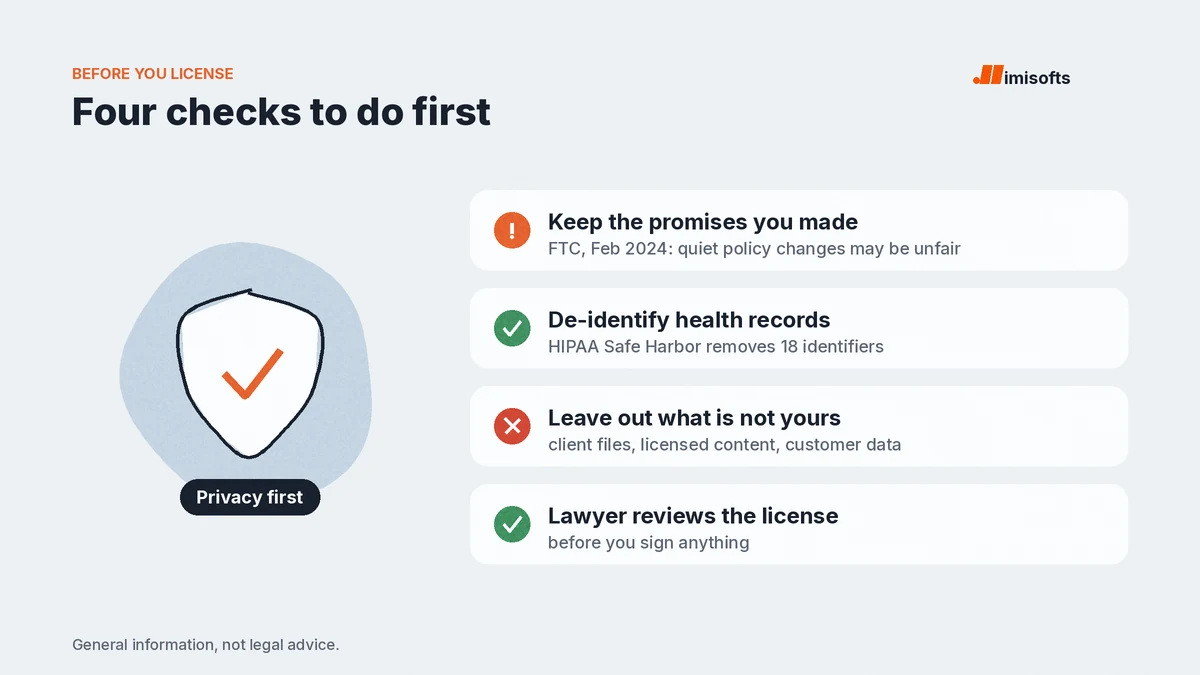
Keep the promises you already made. In February 2024 the FTC's Office of Technology warned that it "may be unfair or deceptive" for a company to start "using that data for AI training" and only tell people "through a surreptitious, retroactive amendment" to its terms or privacy policy. Before you license anything, read your own privacy policy, customer contracts and NDAs, and leave out any data those documents do not let you share.
Health records need de-identification first. Under the HIPAA Privacy Rule, the HHS guidance names two ways to de-identify protected health information: Expert Determination and Safe Harbor. Safe Harbor removes 18 types of identifiers, from names and street addresses to "any other unique identifying number, characteristic, or code".
Leave out what is not yours. Files a client gave you under contract, licensed content and personal data about customers usually need permission or must be excluded. A lawyer who knows your contracts should review the license before you sign.
What a data license can be worth
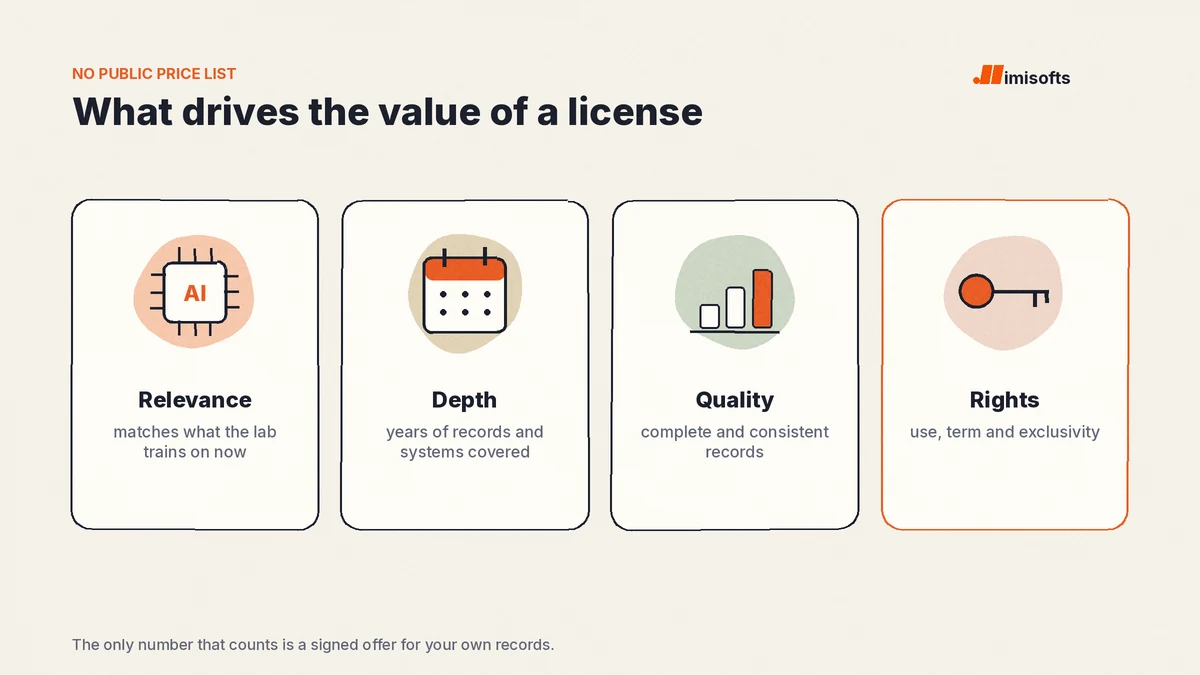
There is no public price list for company data. What a lab offers depends on four things: how relevant your records are to what it is training now, how many years and systems they cover, how complete and consistent they are, and the rights it asks for (use, term and exclusivity). Reddit's $203.0 million is a platform deal, and broker pitches quoted in the press are claims. The only number that counts is a signed offer for your own records.
Which companies qualify
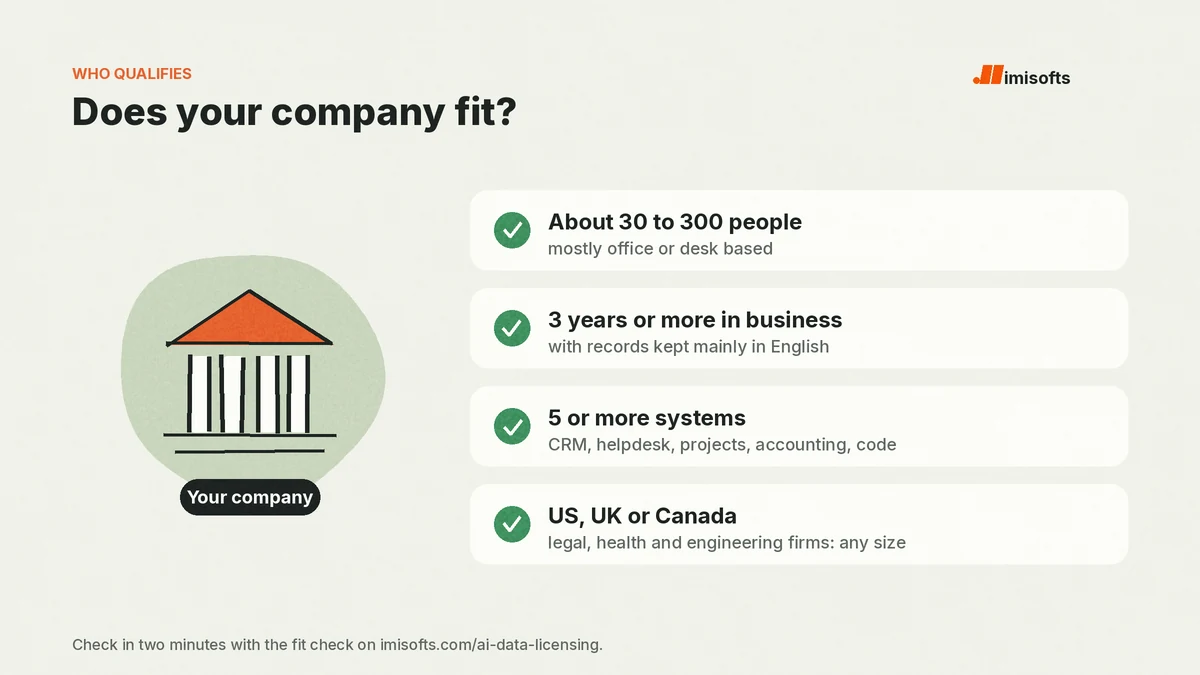
- A team of about 30 to 300 people, mostly office or desk based
- In business for 3 years or more
- 5 or more data sources or tools, such as a CRM, helpdesk, accounting software, project management or a code repository
- Records kept mainly in English
- Headquartered in the US, the UK or Canada
Legal, accounting, healthcare, energy and engineering firms can qualify at almost any size. The quickest check is the four-question fit check on our service page.
How imisofts helps you earn from your data
imisofts runs the whole process with you: the fit call, the inventory across your systems, matching your records with labs that buy that kind of data, explaining every offer, coordinating redaction and anonymization, and following each license through to payment. You make the decisions; we do the work.
- No upfront cost. We are paid only when a license closes and the money reaches your account.
- We never hold your raw data. The fit call and the inventory need no files, and the data moves only after you sign.
- Nothing moves without your sign-off. You approve the final dataset, and your lawyer reviews every agreement.
The inventory we build also maps how your company runs, which is the starting point for your own internal AI; see our AI automation work. To find out whether your records qualify, book a free Data Fit Call.
What we could not verify
- What labs pay companies of a given size. No lab publishes prices for company data, and the figures quoted in broker pitches are not independent.
- Which labs are buying which kinds of business records right now. Labs do not publish their buying lists.
- The rest of the Wired report, which sits behind a paywall; we used only its free opening.
Frequently Asked Questions
Yes, usually by licensing an anonymized copy rather than selling it outright. AI labs such as OpenAI have published programs for private training datasets, and Reddit's S-1 reports data licensing arrangements worth $203.0 million in aggregate contract value, signed in January 2024.
A deal usually runs in six steps: a fit call, an inventory of your records, a valuation, offers and terms, redaction and anonymization with your approval, then payment. Your lawyer reviews the license before you sign.
Records of how work gets done: SOPs, workflows, approvals, support tickets, CRM stages, project histories and engineering docs. OpenAI says it wants data that is not easily accessible online and that expresses human intention, and that it does not want personal or third-party information.
No. A license gives the lab the right to use an anonymized copy for an agreed purpose and term. You keep ownership of your records, and a non-exclusive license lets you license the same dataset again.
It depends on what you promised. The FTC warned in February 2024 that quietly changing a privacy policy to allow AI training may be unfair or deceptive. Leave out data your privacy policy or contracts do not let you share, and have a lawyer review the deal. This is general information, not legal advice.
Nothing upfront. imisofts is paid only when a license closes and the payment reaches your account.