Short answer. Data monetization means turning data into money, and MIT CISR researchers count three ways to do it: improving work, wrapping products with data, and selling information. Licensing is the part that grew fastest as AI buyers arrived. Reddit's annual report shows its other revenue, which it says comes from content licensing and direct sales to users (the latter not material), rising from $15.2 million in 2023 to $140.0 million in 2025.
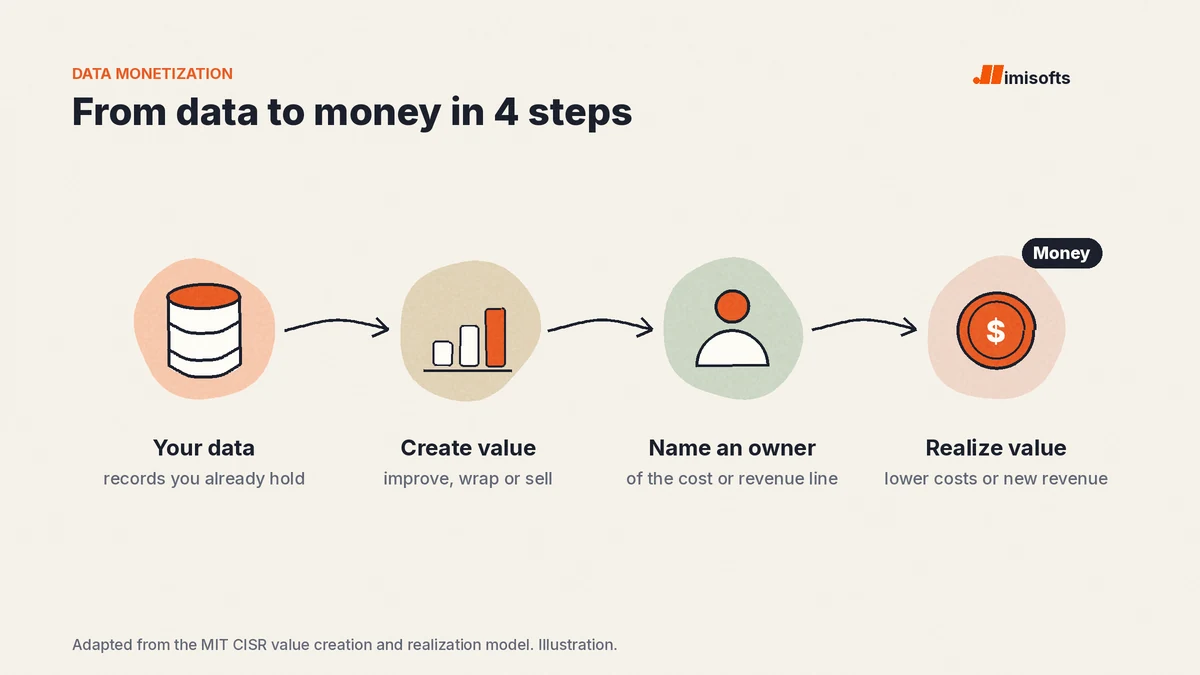
So for many companies the question is no longer only "can our data cut costs?" It is also "would an AI lab pay to license it?" If you want to know whether your records could be licensed, our AI data licensing service starts with that check.
This guide explains the term in plain words, shows the three ways with real examples, and covers the rules that apply when data leaves your company. Sources were read on November 19, 2026. It is general information, not legal or financial advice.
Key numbers
| Item | Number |
|---|---|
| Ways to monetize data (MIT CISR) (improving, wrapping, selling) | 3 |
| Reddit other revenue, 2023 (Form 10-K for 2025) | $15.2 million |
| Reddit other revenue, 2024 (about 7.5 times 2023) | $114.7 million |
| Reddit other revenue, 2025 (up about 22%, about 6.4% of revenue) | $140.0 million |
| Shutterstock Data, Distribution, and Services, 2024 (up 28%, includes Giphy and Studios) | $175.3 million |
| Shutterstock data offering growth, 2024 (metadata used to train AI models) | 15% |
| Microsoft analysts' data gathering time saved (within fifteen months, MIT CISR) | 30 percent |
| FTC warning on quiet policy changes (Office of Technology blog) | February 13, 2024 |
MIT CISR research briefing (August 2023); Reddit Form 10-K for 2025 and Shutterstock Form 10-K for 2024 (SEC EDGAR); FTC Office of Technology; California Civil Code 1798.140. Read November 19, 2026.
What data monetization means
In a 2023 MIT CISR research briefing, Barbara Wixom, Cynthia Beath and Leslie Owens define data monetization as "converting data into money." They warn that companies read the term "too narrowly as 'selling data sets' or too broadly as 'creating benefits from data use.'"
The useful line they draw is between creating value and realizing it. A dashboard that saves time creates value. Money only shows up when that time saving becomes a lower cost or a higher sale. In their words, it is the act of "bringing more money in or putting less money out" that makes data monetization real.
That definition matters because many data projects stop at the first step. The briefing puts it bluntly: "if an improvement is supposed to reduce costs or budgets and those don't change, data is not being monetized."
Two more points from the same briefing help. First, the authors say data monetization "is not intrinsically ethical or unethical," and they apply it to charities, government bodies and schools as well as companies. Second, they call it a day to day activity, like any other part of the job, rather than a one off project.
The 3 ways to monetize data
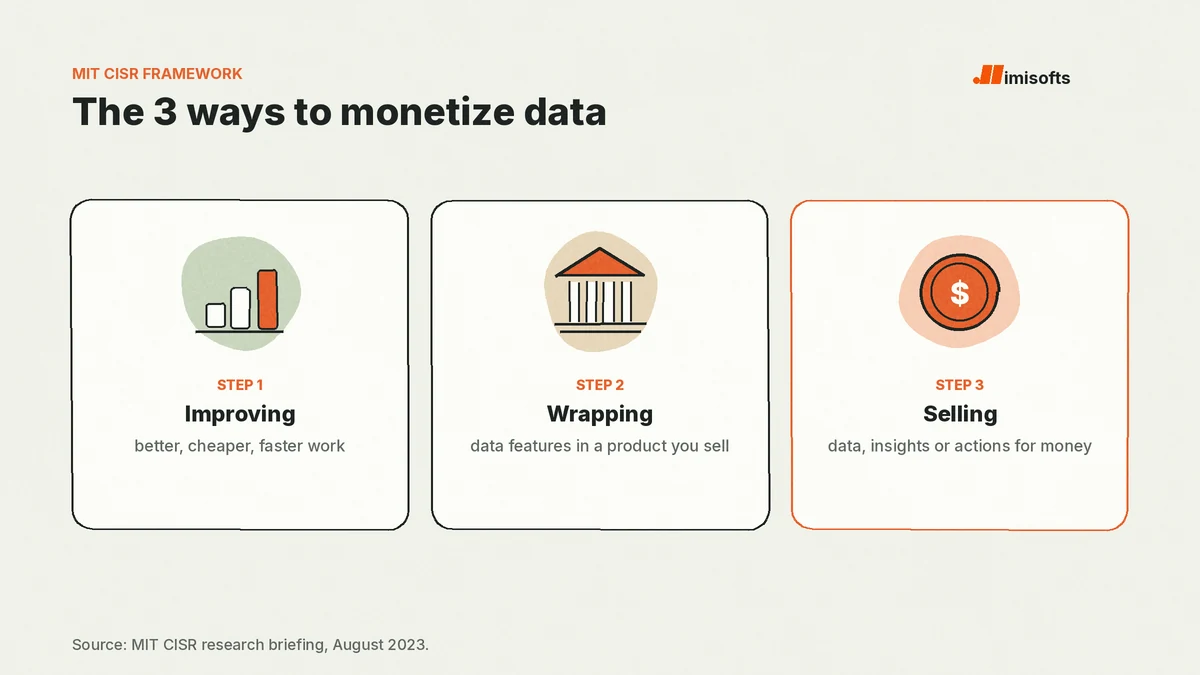
The MIT CISR framework sorts every data monetization effort into one of three approaches. A company can run all three at once.
| Approach | What it means | Where the money shows up | Example from the briefing |
|---|---|---|---|
| Improving | Using data to make work better, cheaper or faster | Lower costs, or staff time moved to work that earns more | Microsoft cut analysts' data gathering time by 30 percent in fifteen months, then moved them to work with sales partners |
| Wrapping | Adding data features to a product customers already buy | A higher price, more units sold, or more related sales | A health device that sends tailored alerts to a phone |
| Selling | Exchanging data, insights or actions for money | New revenue from information offerings | Retailers selling point of sale data to IRI since the late 1970s; Walmart Luminate |
Improving is a two step process. The airline example in the briefing uses weather forecasts to rebook passengers before delays hit. The value is created by the rebooking. The money is realized as lower overtime pay and fewer customer refunds.
Wrapping only counts when the extra value reaches the books. The authors note that a product owner judged on adoption or churn may be reluctant to charge more for a better product. If the value is never collected, the wrap has not monetized data.
Selling is the most direct. "With selling, data in some form is exchanged for money." The briefing says information offerings are typically priced from the value they create for the buyer. Healthcare IQ, for example, priced its data and tools on its analysis that a $100 million hospital would save at least $8 million in prices. TRIPBAM priced its offerings on an estimate of 2 to 3 percent savings on total travel spend.
Value created is not money in the bank
The briefing points to realization, not analysis, as the hard part. It lists common leaks:
- An efficiency lands in a downstream team whose owner has no reason to cut costs.
- Saved hours relieve stressed staff instead of reducing spend.
- A better product ships at the old price, so customers keep all of the new value.
The practical fix is to name, before a project starts, which line on the income statement should move and who owns that line. If nobody can name it, the project may still be worth doing, but it is not data monetization in the strict sense.
One way to keep this honest is a simple review every quarter: list each data project, the line it was meant to move, and whether that line moved. The briefing asks readers to try exactly this for the last three years of their own data initiatives, across improving, wrapping and selling.
How AI training changed data monetization
Selling data is not new. What changed is the buyer. Companies building AI products have, in the FTC's words, "a continuous appetite for more and newer data," and the filings below show some of them paying for licensed access.
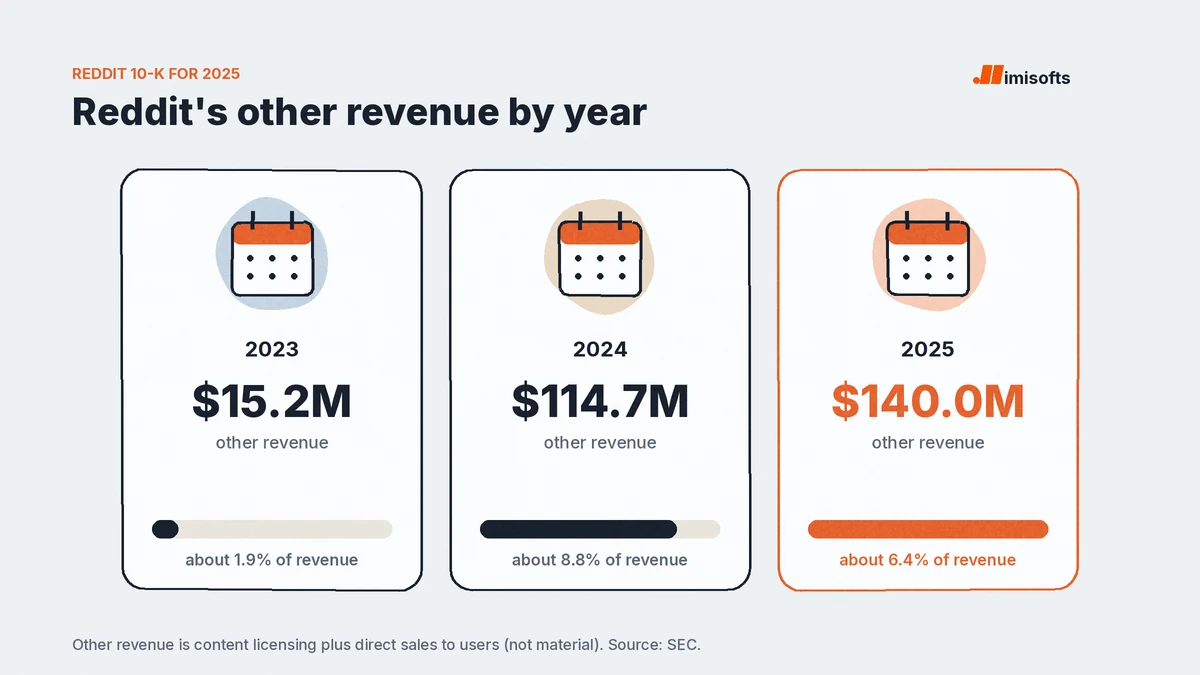
The clearest public numbers come from company filings. Reddit's Form 10-K for 2025 says other revenue "consists of revenue from content licensing and products sold directly to users," and that revenue from products sold directly to users, including Reddit Premium and Reddit Gold, "was not material." It says the increase came from "content licensing agreements executed in 2024 and 2025."
| Year | Reddit other revenue | Share of total revenue |
|---|---|---|
| 2023 | $15.2 million | about 1.9% |
| 2024 | $114.7 million | about 8.8% |
| 2025 | $140.0 million | about 6.4% |
That is about 7.5 times more from 2023 to 2024, then up about 22% in 2025. Reddit describes how these deals work: customers get "the right to access content from our platform over the contractual period," priced as "a fixed fee or usage-based fee," and the revenue is recognized over the license period. In other words, it is a license with a term, not a one-time sale of a file.
Stock media shows the same pattern. Shutterstock's Form 10-K for 2024 describes a data offering "which provides metadata associated with our content collection, used to train AI models." Its wider Data, Distribution, and Services line, which also includes Giphy and Shutterstock Studios, grew 28% to $175.3 million in 2024, "primarily driven by growth in our data offering, which grew 15%."
These are large platforms with millions of records. They show that buyers pay for licensed data. They do not show what a mid-size company would earn, and we do not quote a typical price for that reason. For the sell side process, see our guide on how to sell data to AI companies.
The rules that come with selling data
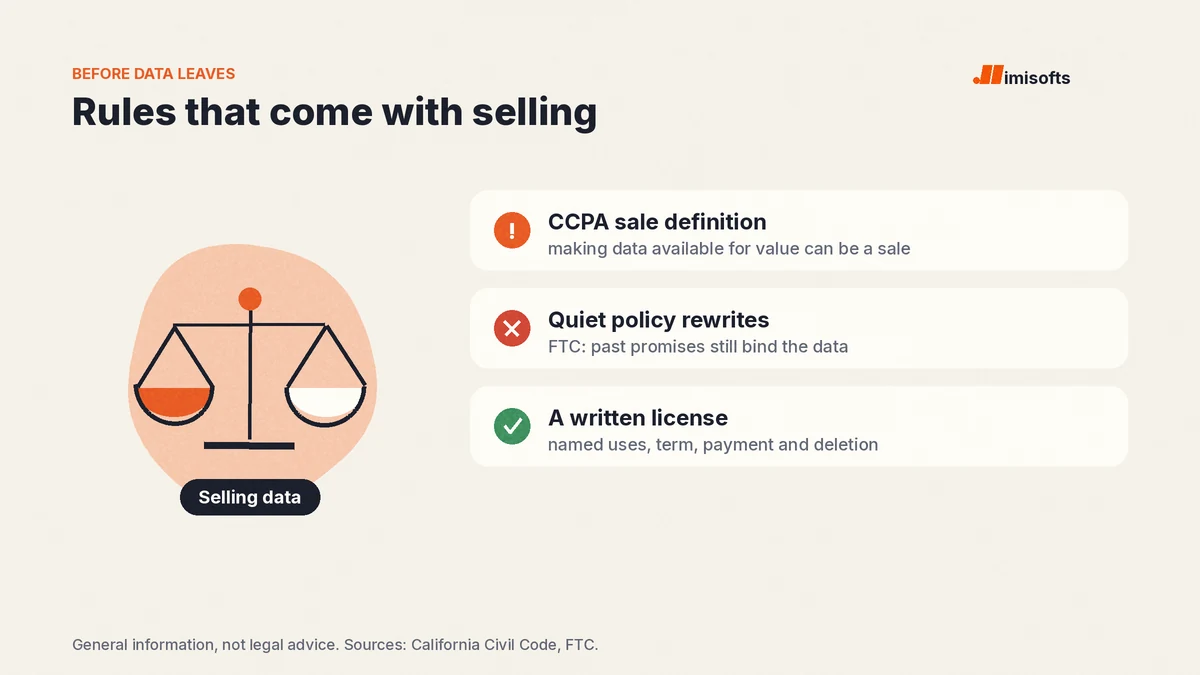
The selling approach brings legal duties that improving and wrapping rarely trigger, because data leaves the company.
Privacy law. Under California Civil Code 1798.140(ad)(1), a "sale" includes "making available" a consumer's personal information to a third party "for monetary or other valuable consideration." Licensing customer records to an AI lab can fit that definition. Our CCPA compliance guide covers the duties that follow.
Your own promises. On February 13, 2024 the FTC's Office of Technology warned that "a business that collects user data based on one set of privacy commitments cannot then unilaterally renege on those commitments after collecting users' data." It said it will act against companies that try to change the rules by "surreptitiously re-writing their privacy policies or terms of service."
The contract. A license decides what the buyer may do, for how long, and what happens at the end. Our guide to the AI data licensing agreement lists the 10 terms to check before you sign.
Where a mid-size company should start
- List your data assets. Note what each dataset holds, how many years it covers, and whether it contains personal information.
- Pick the approach per dataset. Operational data often fits improving. Product usage data fits wrapping. Unique, well organized records in a specialist field are the candidates for selling or licensing.
- Check your rights. Read the privacy notices and contracts under which the data was collected. If they do not allow the new use, the FTC warning above applies.
- Name the money line. For each project, write down which cost or revenue line should change, by how much, and who owns it.
- Get legal review before any data leaves. Licensing is a contract with a term, payment terms and deletion duties.
How imisofts can help
imisofts is a Dubai based agency that builds automation and data work for established companies. Our team can map which of your records might be licensable, prepare and anonymize them, and support you through the buyer process. If you would like a first look, check if your company qualifies. We do not promise a payout; whether a buyer pays, and how much, depends on the data and the buyer.
Frequently Asked Questions
Turning data into money. MIT CISR researchers describe three ways: using data to improve work so costs fall, adding data features to products so they sell for more, and selling data, insights or actions as information offerings.
An airline that uses weather data to rebook passengers and so pays less overtime and fewer refunds; a device maker that adds data driven alerts to a product; and Reddit, whose content licensing drove other revenue to $140.0 million in 2025.
No. Selling is one of three approaches. Improving work and wrapping products also count, as long as the value shows up as lower costs or higher revenue.
Selling and licensing data became a larger source of revenue for some platforms as AI buyers looked for licensed data. Reddit's other revenue grew from $15.2 million in 2023 to $114.7 million in 2024 after it signed content licensing deals.
It can be, but it depends on your privacy notices, contracts and the laws that apply. Under the CCPA, making personal information available for valuable consideration can be a sale, and the FTC has warned against quietly changing privacy terms to allow new uses.
There is no reliable public average for mid-size companies. Prices depend on how unique the data is, its size, its quality and the buyer's use. Treat any number quoted without a named source with caution.