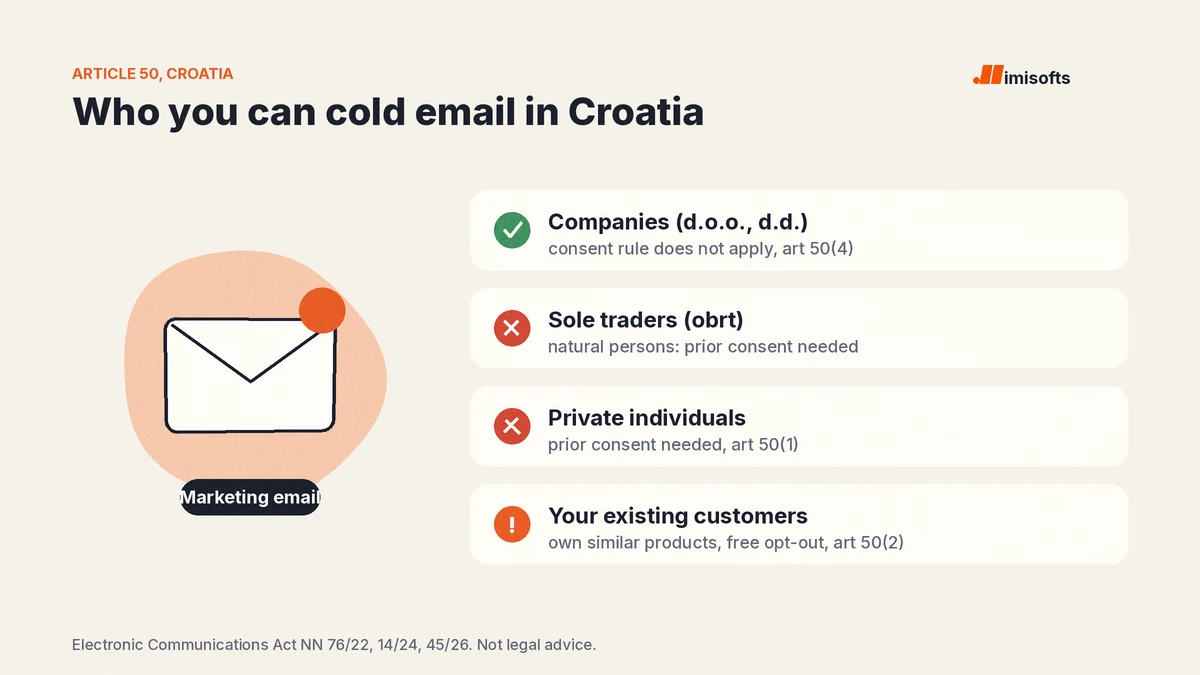
Short answer. Croatia requires prior consent for marketing email, but article 50(4) of the Electronic Communications Act (Zakon o elektroničkim komunikacijama, NN 76/22) says the consent rule "does not apply" to marketing sent to legal persons, such as a d.o.o. or a d.d. Every marketing email, to a company or a person, must still show who sent it and give a valid address where the recipient can ask, free of charge, to stop. A company that breaks article 50(1) to (3) faces a fine of EUR 13,270 to EUR 132,720 under article 170, and its computers can be confiscated.
We sell cold email services, so we have a stake in this topic. On 23 November 2026 we read the Electronic Communications Act in its consolidated text on Zakon.hr (NN 76/22, 14/24 and 45/26, in force from 7 May 2026) and the original text in Narodne novine, the Electronic Commerce Act, the Crafts Act, the regulator HAKOM's page on unwanted communications and the GDPR on EUR-Lex. Translations from Croatian are ours. This is general information, not legal advice.
In short: email Croatian companies at their business addresses with a clear sender and a working stop address, get consent before you email sole traders and private people, and keep a GDPR basis for every named contact. Below is the rule, the exceptions, the fines and a setup we suggest. For the rules in other countries, see our cold email laws by country table.
Key numbers
| Item | Number |
|---|---|
| Law (Electronic Communications Act, article 50, unchanged since 2022) | NN 76/22 |
| Prior consent for marketing email to companies (article 50(4), legal persons only) | Not required |
| Prior consent for sole traders (obrt) and private people (article 50(1); an obrt owner is a natural person) | Required |
| Company fine (article 170(1)) | EUR 13,270 to 132,720 |
| Responsible person fine (article 170(2)) | EUR 2,650 to 13,270 |
| Natural person fine (article 170(3)) | EUR 1,320 to 6,630 |
| Email provider must answer an abuse complaint within (article 50(6)) | 15 days |
| Ne zovi register covers (not email) | Calls, SMS, MMS |
| GDPR fine ceiling (of worldwide turnover, whichever is higher) | EUR 20M or 4% |
Electronic Communications Act (NN 76/22, 14/24, 45/26) and Crafts Act read on Zakon.hr, HAKOM and EUR-Lex on 23 November 2026.
What article 50 of the Electronic Communications Act says
Article 50 is headed "unwanted electronic communications". The consolidated text shows no amendment to it since the Act was passed on 1 July 2022. Its first four paragraphs are the ones that matter for senders.
- Paragraph 1, the consent rule. Automated calling systems, fax and email, "including SMS messages and MMS messages", may be used for direct marketing and sales "only with the prior consent of the end user".
- Paragraph 2, existing customers. A trader may use the email addresses it got from its own consumers in a sale to market its own similar products or services, if those consumers can object free of charge and simply, when the address is collected and in every message.
- Paragraph 3, every marketing email. It is banned to send marketing email that hides or misstates the sender, that breaks the e-commerce rules, or that has no valid email address or number where the recipient can ask, free of charge, to stop further messages.
- Paragraph 4, the business exception. "The provisions of paragraphs 1 and 2 of this article do not apply to the communication from paragraph 1 of this article to legal persons for the purpose of direct marketing and sales."
Read together: consent is the rule for people, legal persons are exempt from the consent rule, and paragraph 3 is not in the exemption, so its duties apply to every marketing email, B2B included.
The rest of article 50 is aimed at email providers. They must offer spam filters, publish an abuse address, answer an abuse complaint within 15 days at most, and bind their users by contract not to spam. When a provider gets proof that a user sent spam, it can warn the user or suspend the account, and repeat breaches can end with the account deleted.
The B2B exception covers legal persons, not sole traders
The exception in paragraph 4 names legal persons. Under articles 2 and 4 of the Companies Act, a d.d. (joint stock company) and a d.o.o. (limited liability company) are companies, and a company becomes a legal person when it is entered in the court register.
It does not cover an obrt, the common Croatian sole trader form. Article 4 of the Crafts Act defines the obrt owner (obrtnik) as "a natural person" who carries on the business in their own name and for their own account, and the 2027 version of the Act (NN 114/26) keeps the same sentence. So a plumber, consultant or agency trading as an obrt is an end user under paragraph 1, and a cold email to them needs prior consent, the same as one to a private person.
Before a list of Croatian contacts goes into a sequence, we would sort it by legal form. The legal form in the business name (d.o.o., d.d. or obrt) usually tells you which side of the line a contact sits on; when it is missing, check the court register for companies or the crafts register for an obrt before you send.
Existing customers: the similar products rule
Paragraph 2 is the narrow route to emailing consumers without fresh consent. All of these must be true:
- you got the email address from the consumer in a sale of your products or services;
- you market only your own similar products or services;
- the consumer had a clear, free and simple way to object when you collected the address, and has one in every message;
- the consumer did not refuse this use in advance.
Unlike Slovakia's version of this rule, article 50(2) sets no time limit after the last sale. It does not reach leads who never bought, newsletter lists bought from someone else, or another company's products.
What every marketing email must carry
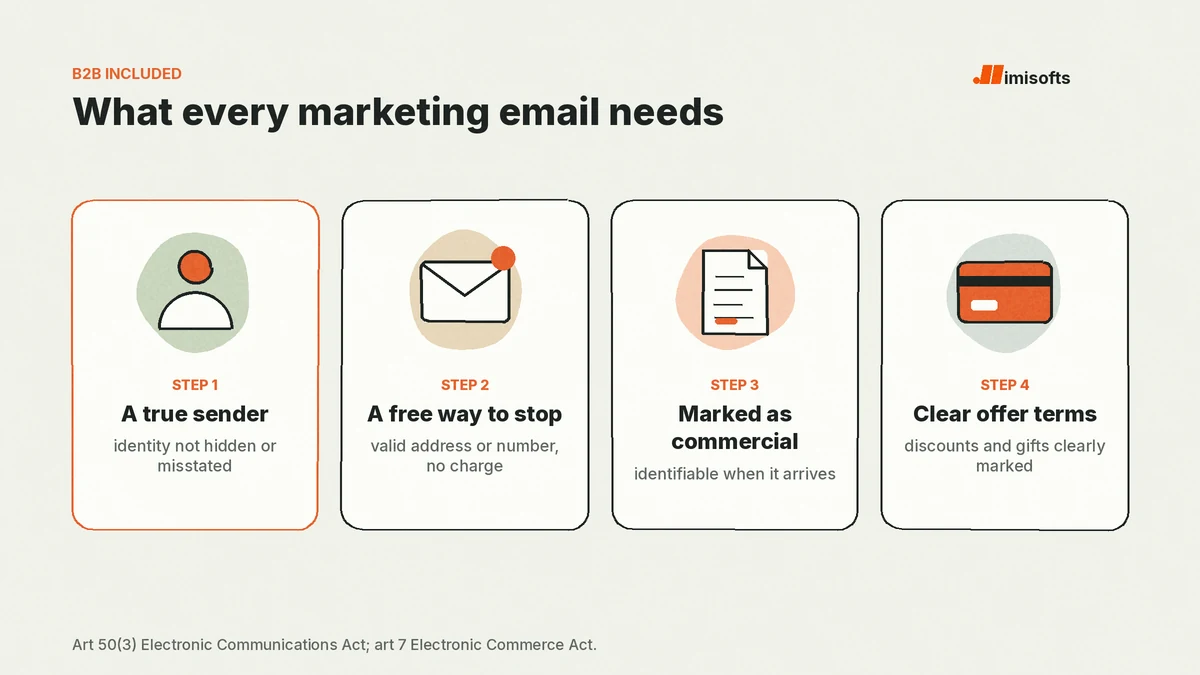
These duties apply to B2B email as well, because paragraph 4 does not switch off paragraph 3:
- A true sender. No hidden or misstated identity of the person on whose behalf the email is sent.
- A free way to stop. A valid email address or number where the recipient can ask, at no charge, to stop further communication.
- E-commerce compliance. Article 7 of the Electronic Commerce Act adds that a commercial communication must be identifiable as one when it arrives, the sender must be clearly identifiable, promotional offers such as discounts and gifts must be clearly marked, and their conditions must be easy to find.
HAKOM's consumer page puts the same duties in plain words: promotional content must come "exclusively from registered numbers/email addresses that do not conceal the sender's identity", and each message must say how to stop receiving such content without charge.
One wrinkle. Article 8 of the Electronic Commerce Act says unsolicited commercial email is allowed "only with the prior consent" of the person it is meant for, "in accordance with" the law on electronic communications. Our reading is that this points back to article 50, including its exception for legal persons. We found no Croatian decision on how the two articles fit together, so a cautious sender may want counsel to confirm this reading for its own case.
GDPR on top: legitimate interest and the right to object
The business exception only settles the e-privacy question. When you email a named person at a company ([email protected]), you also process personal data, so the GDPR applies, and in Croatia its supervisory authority is AZOP, the Personal Data Protection Agency.
- A lawful basis. Recital 47 says processing for direct marketing "may be regarded as carried out for a legitimate interest". You still need to weigh your interest against the recipient's; our legitimate interest assessment guide shows how.
- Tell them in the first email. When you did not get the data from the person, article 14(3)(b) says the privacy information is due "at the latest at the time of the first communication" when you use the data to contact them. A short notice in the first email, linking to the full information, is a common approach.
- Stop on objection. Article 21(2) gives a right "to object at any time" to direct marketing, and after an objection the data may no longer be used for it. Put the address on a suppression list that every sender and tool checks.
Buying a list adds its own risks; we cover them in is buying email lists legal.
Who enforces it and what the fines are
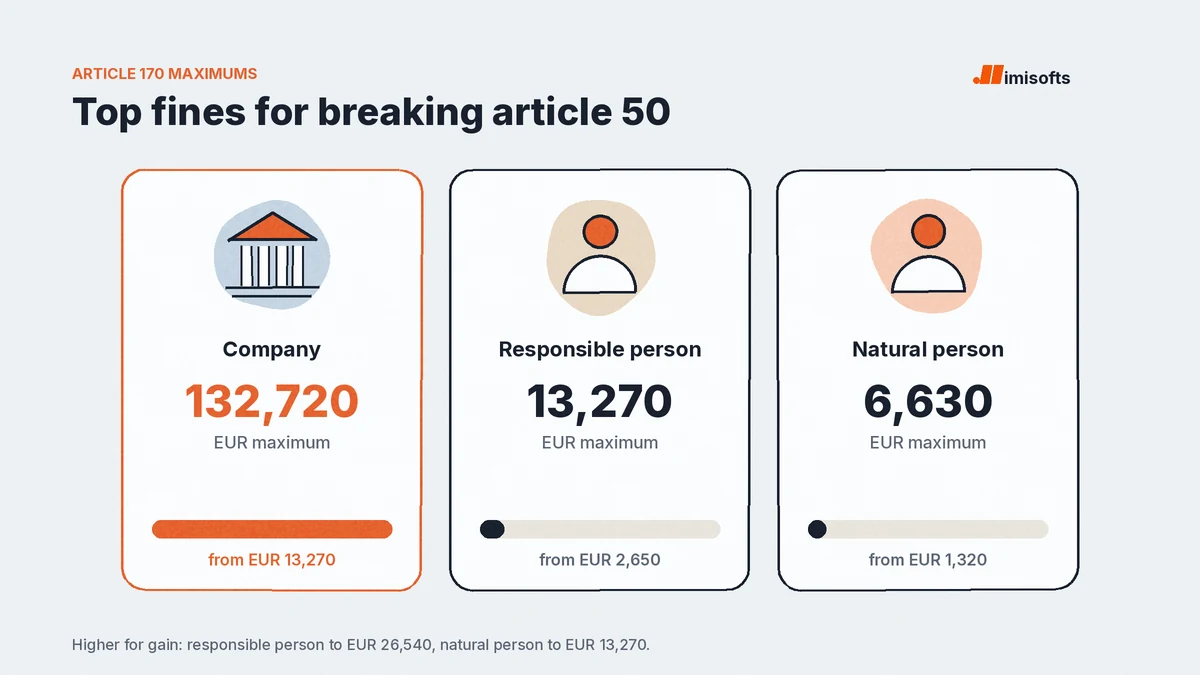
HAKOM, the Croatian Regulatory Authority for Network Industries, is the electronic communications regulator and takes reports of unwanted calls and text messages. Breaches of article 50(1) to (3) are listed as serious breaches in article 170, items 13 to 15. The euro fines took effect when Croatia joined the euro area on 1 January 2023; they are the old kuna amounts (HRK 100,000 to 1,000,000 for a company) converted at about the fixed conversion rate of HRK 7.53450 per euro and rounded down.
| Who is fined under article 170 | Fine range |
|---|---|
| Company (legal person) | EUR 13,270 to EUR 132,720 |
| Responsible person in the company | EUR 2,650 to EUR 13,270 |
| Natural person | EUR 1,320 to EUR 6,630 |
| Responsible person, breach committed for gain | EUR 5,300 to EUR 26,540 |
| Natural person, breach committed for gain | EUR 2,650 to EUR 13,270 |
For items 13 to 15, article 170(5) also allows confiscation of "computer and/or other technical equipment". The top of the company range is ten times its floor, and the ordinary maximum for a responsible person, EUR 13,270 (EUR 26,540 when the breach was for gain), equals the company minimum.
Two other regimes sit on top. The Electronic Commerce Act (article 23) still states its fines in kuna, HRK 5,000 to 100,000 for a company, about EUR 664 to EUR 13,272 at the fixed rate. And GDPR fines under article 83(5) reach EUR 20 million or 4% of worldwide annual turnover, whichever is higher. AZOP does use that power: on 14 November 2025 it announced a EUR 4.5 million fine on a telecom operator, for data transfers and ID copies rather than marketing. Our GDPR fines guide has the full scale.
The Ne zovi register covers calls and texts, not email
Croatia's Ne zovi (Do Not Call) register is, in HAKOM's words, a free public register of telephone numbers whose users do not want traders to contact them "via phone calls, SMS, or MMS messages". It comes from the Consumer Protection Act, and an operator must add a number within 7 days of a request. It holds phone numbers only, so it gives you nothing to scrub an email list against; for email, the consent rule, the legal person exception and your own suppression list do that work. For email registers elsewhere, see our do not email list guide.
A setup we suggest for emailing Croatian companies
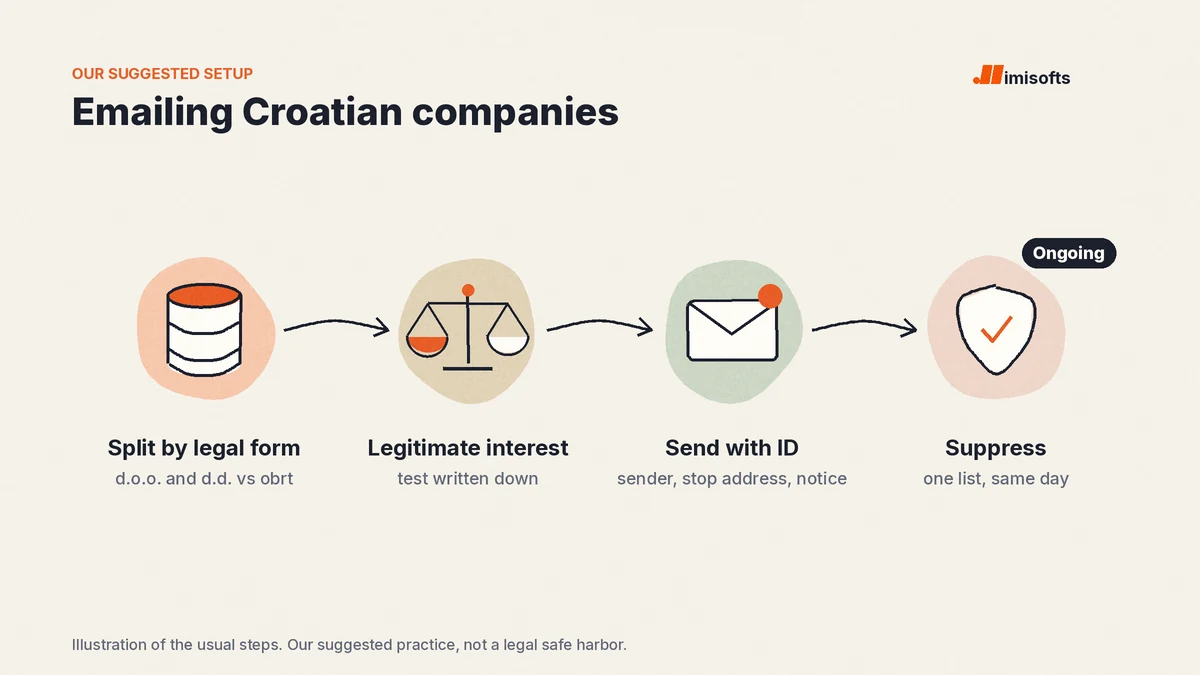
- Split the list by legal form. d.o.o. and d.d. contacts can go into a B2B sequence; obrt owners and private addresses need consent first.
- Write down your legitimate interest test for the named contacts at those companies.
- Put the sender's full company name and address in every email, plus a working email address where the recipient can ask, free of charge, to stop. A one-click unsubscribe link can sit on top of it.
- Add a short privacy notice to the first email, with a link to your policy.
- Keep one suppression list across every inbox and tool, and add each stop request the day it arrives.
- Check the sending setup. Authenticated domains and warmed inboxes keep a legal campaign out of spam; our email hosting cost and email deliverability consultant cost guides price the parts.
This is our suggested practice, not a legal safe harbor. For nearby EU markets, see cold email laws in Hungary and cold email laws in Slovakia.
How imisofts can help
We build and run cold email programs for B2B teams selling into Europe, including list sorting, suppression lists, opt-out handling and email infrastructure setup. If you plan to email Croatian companies, we can review your list sources and templates against the points in this guide before the first send. That review is not legal advice; your lawyer confirms the legal position. You can also see our lead generation service, or compare cold email agency pricing before you decide who runs it.
Frequently Asked Questions
To companies, yes in most cases. Article 50(4) of the Electronic Communications Act lifts the prior consent rule for marketing email to legal persons such as a d.o.o. or d.d. Every email must still name the sender truthfully and give a free way to stop. Private people and sole traders (obrt) need prior consent.
Yes. The business exception covers legal persons only, and the Crafts Act defines an obrt owner as a natural person. A cold marketing email to an obrt needs the owner's prior consent. If the owner bought from you as a consumer, the article 50(2) rule for your own similar products may apply; check it with counsel.
Under article 170 of the Electronic Communications Act, a company can be fined EUR 13,270 to EUR 132,720, a responsible person EUR 2,650 to EUR 13,270, and a natural person EUR 1,320 to EUR 6,630. Computer equipment can also be confiscated. GDPR fines are a separate regime, up to EUR 20 million or 4% of turnover.
No. HAKOM describes the Ne zovi register as a list of telephone numbers whose users do not want traders to contact them by phone calls, SMS or MMS. The register does not cover email addresses; for email, consent, the company exception and opt-out handling do that job.
Yes, when you email a named person, because a named work address is generally treated as personal data. Recital 47 allows legitimate interest for direct marketing, article 14 asks for privacy information by the first email when you did not get the data from the person, and article 21 lets the person object at any time. AZOP is the Croatian supervisor.
HAKOM, the Croatian Regulatory Authority for Network Industries, is the electronic communications regulator and takes reports of unwanted calls and texts; article 170 of the Electronic Communications Act sets the fines. AZOP, the Personal Data Protection Agency, is the GDPR supervisor.