Short answer. Slovakia requires prior, demonstrable consent before marketing email, but section 116(15) of the Electronic Communications Act (Act No. 452/2021, in force since 1 February 2022) waives it for "direct marketing addressed to the published contact details" of a legal person or a natural person who is an entrepreneur. Every such email must still offer a free opt-out and show who sent it and where to ask them to stop, and you may not email anyone to ask for consent. The regulator can fine a business from EUR 200 up to 5% of its turnover for the previous accounting period, or up to EUR 300,000 when there is no turnover to measure (section 124).
We sell cold email services, so we have a stake in this topic. On 17 November 2026 we read Act 452/2021 on Slov-Lex, the official Slovak legislation portal, in the version in force from 18 August 2026, and checked that the version taking effect on 1 January 2027 carries the same section 116 text and the same section 124 sentences we quote. We also read the GDPR on EUR-Lex. Translations from Slovak are ours. This is general information, not legal advice.
Key numbers
| Item | Number |
|---|---|
| Act 452/2021 in force since (section 116 on unsolicited communication) | 1 February 2022 |
| Prior consent for B2B email to published contacts (section 116(15), opt-out and sender ID still needed) | Not required |
| Minimum fine for a business (section 124(3)) | EUR 200 |
| Maximum fine (previous accounting period; no warning-only route for s.116) | 5% of turnover |
| Maximum fine with no turnover (section 124(6)) | EUR 300,000 |
| Keep consent records (after withdrawal, section 116(5)) | at least four years |
| Confirm a withdrawal within (section 116(6)) | 30 days |
| Customer email window after the contract ends (section 116(16)) | one year |
Act 452/2021 read on Slov-Lex on 17 November 2026 (version in force from 18 August 2026, checked against the 1 January 2027 version).
What section 116 of Act 452/2021 requires
Section 116 is headed "Nevyžiadaná komunikácia" (unsolicited communication). It defines direct marketing as any presentation of goods or services, written or oral, sent through a publicly available service directly to one or more subscribers or users. For email it sets these duties:
- Prior demonstrable consent before marketing by email, SMS, MMS, fax or automatic calling, "obtained before contacting" the recipient (116(3)).
- No contact to ask for consent: calls, email, SMS and the other channels may not be used to obtain that consent (116(4)).
- Consent means GDPR consent: the Act points to Article 4(11) of the GDPR for what valid consent is (116(5), footnote 126).
- Records for at least four years: whoever holds the consent keeps the durable record of it for at least four years after it is withdrawn (116(5)).
- Say how to withdraw: when collecting consent, you state how it can easily be withdrawn (116(5)).
- Confirm withdrawals within 30 days and keep that confirmation for at least four years (116(6)).
- Identity and a stop address: email may not be sent where "the identity and address of the sender, to which the recipient can send a request to stop" is not known (116(15)).
The B2B exception: published contact details
Section 116(15) lists two cases where the consent of 116(3) is not needed for email, SMS or MMS. The second is the one that matters for prospecting. In our translation, consent is not required "if it is direct marketing addressed to the published contact details of a subscriber or user who is a natural person-entrepreneur or a legal person."
The same paragraph also sets three rules for these emails:
- The recipient must be able to refuse "easily and free of charge at any time," both when the details are collected and "in every message delivered."
- The email must show the sender's identity and an address for stop requests.
- It may not encourage visits to a website in breach of the e-commerce act (footnote 128 points to section 4(6) of Act 22/2004).
What the text does not settle, on our reading:
- "Published" is not defined. We found no definition in the Act, and the phrase "published contact details" appears only twice, both in section 116. We would treat it as contact details the company or sole trader has made public itself, for example on its own website or in a public register, and keep a dated record of where each address came from.
- Named employees are not mentioned. The exception speaks of the subscriber or user who is the legal person or entrepreneur. A generic company address (info@) fits the wording most clearly; a named employee's address found on the company site is less certain, and on our reading it is personal data under the GDPR either way.
- Private individuals are outside this exception. Emailing a consumer who has not bought from you needs prior consent.
Why you cannot email to ask for consent
Section 116(4) bans using calls, automatic calling systems, fax, email, SMS or MMS "for the purpose of obtaining the prior consent." So a first email that asks anyone whether you may send offers is itself a breach. We suggest collecting consent where the person comes to you: a website form, a checkout box or an event sign-up, with the withdrawal method stated at that moment.
Existing customers: the one-year window
The first case in 116(15) covers your own customers. You may email marketing for "own similar goods and services" without fresh consent when you obtained the email address "in connection with the sale of goods or services," with the same opt-out at collection and in every message. Section 116(16) limits this: details obtained in connection with a sale may be used "for one year from the end of the contractual relationship." After that year you need prior consent, unless the recipient is a business emailed at its published contact details.
GDPR on top: legitimate interest and the right to object
In short, on our reading, section 116 decides whether you may send the email, and the GDPR decides whether you may process the personal data in it. Recital 47 of the GDPR says "The processing of personal data for direct marketing purposes may be regarded as carried out for a legitimate interest." On our reading, legitimate interest is the basis a B2B sender would assess first, and it needs its own balancing assessment.
- Right to object: under Article 21(2) the person can object "at any time" to processing for direct marketing, and under 21(3) the data "shall no longer be processed for such purposes."
- Say it in the first email: Article 21(4) requires that right to be "explicitly brought to the attention of the data subject" at the latest at the first communication, "clearly and separately from any other information."
- Give the privacy information by the first email: when the data did not come from the person, Article 14(3)(b) sets the deadline for the privacy information as "at the latest at the time of the first communication."
Our guide to a legitimate interest assessment walks through the balancing test, and GDPR fines covers the separate GDPR penalty scale.
Who enforces it and what the fines are
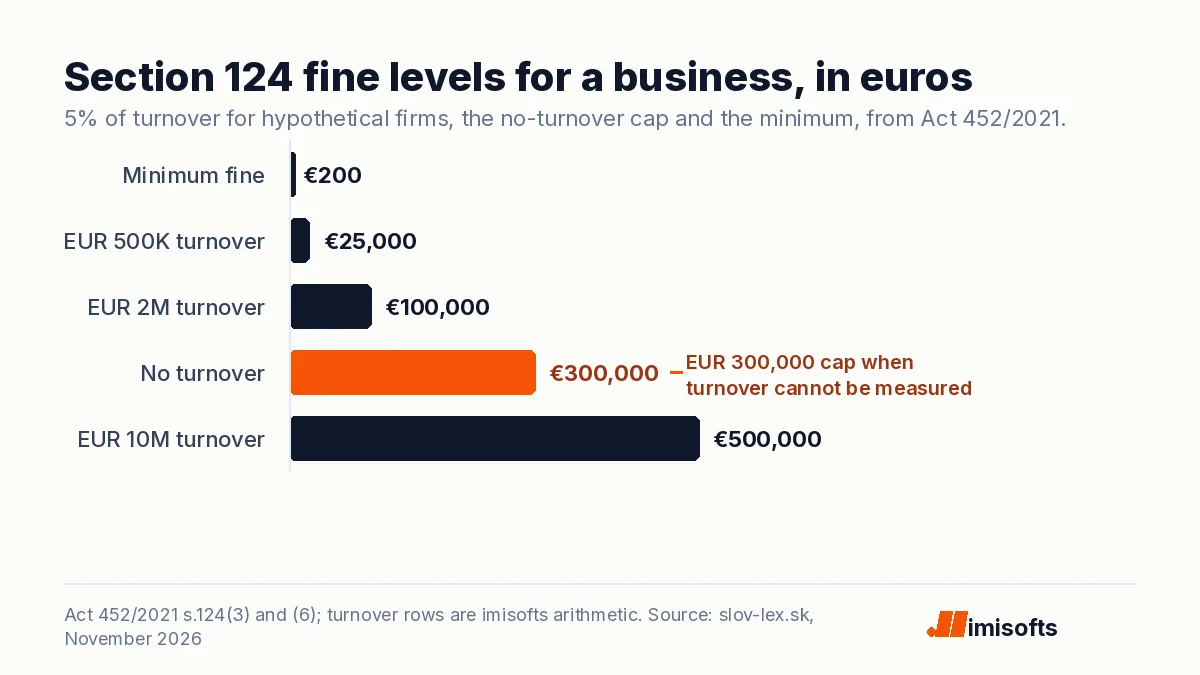
The Act names the Regulatory Authority for Electronic Communications and Postal Services ("Úrad pre reguláciu elektronických komunikácií a poštových služieb") as the "Office." Under section 124(3), the Office imposes on a legal person or natural person-entrepreneur that breaches section 116(3) to (6), (8), (12) or (14) to (16) a fine "from 200 euro up to 5% of turnover" for the previous accounting period. Under 124(6), if the business had no turnover or it cannot be calculated, the fine is "at most up to 300,000 euro." Section 124(4), which lets the Office issue only a warning for some first breaches, does not list section 116.
| Situation | Fine range under section 124 |
|---|---|
| Any business, minimum | EUR 200 |
| Hypothetical firm with EUR 500,000 turnover | EUR 200 to EUR 25,000 |
| Hypothetical firm with EUR 2,000,000 turnover | EUR 200 to EUR 100,000 |
| No turnover, or not calculable | EUR 200 to EUR 300,000 |
| Hypothetical firm with EUR 10,000,000 turnover | EUR 200 to EUR 500,000 |
The turnover rows are our arithmetic on the 5% ceiling, not cases. We found no published Slovak decision on marketing email, and the Office's 2024 decision on advertising SMS would not load for us, so we quote no amount from a real case. On our reading, GDPR fines are a separate regime that can apply as well where personal data is mishandled.
How Slovakia compares with its neighbours
On our reading, Slovakia's rule for B2B email is more open than the Czech, Polish and Austrian rules. Our Czech Republic guide found no business exception, our Poland guide found prior consent for companies too since 10 November 2024, and our Austria guide found prior consent for every recipient. Our Hungary guide found that the consent rule covers private individuals, and that the regulator there says the ban covers ads to a private individual rather than a company or contact person. The full table is in cold email laws by country.
A setup we suggest for emailing Slovak companies
- List only published business contacts. Keep the source and date for each address, and leave out private individuals.
- Prefer company role addresses where the exception's wording is clearest, and treat named addresses as personal data under the GDPR.
- Identify yourself: sender name and a working address for stop requests in every email.
- A free opt-out in every email, honored across every campaign through a suppression list.
- The Article 21 objection notice and the Article 14 privacy information in the first email.
- No consent-request emails, calls or texts to anyone (116(4)).
- Keep records of consents and withdrawal confirmations for at least four years.
The sending side matters too: authenticated domains and separate sending infrastructure help a careful campaign reach the inbox. Our email infrastructure service sets that up, our guide to email hosting cost prices the mailboxes, and email deliverability consultant cost covers outside help.
How imisofts can help
We build and run cold email programs for B2B teams selling into Europe, including suppression lists, opt-out handling and sender setup. If you plan to email Slovak companies, we can check your list sources and templates against the points in this guide before the first send; your lawyer confirms the legal position.
Frequently Asked Questions
To businesses, often yes. Section 116(15) of Act 452/2021 lets you email marketing to the published contact details of a legal person or entrepreneur without prior consent, with a free opt-out and the sender's identity and stop address in every email. Private individuals need prior consent, unless they are your customers under the one-year rule for similar goods and services.
Not prior consent for its published contact details, under section 116(15). You still need a free opt-out in every email, your identity and a stop address, and a GDPR basis such as legitimate interest for any personal data.
No. Section 116(4) bans using email, calls, SMS, fax or automatic calling to obtain the prior consent, so the consent request itself would breach the Act.
The Regulatory Authority for Electronic Communications and Postal Services can fine a business from EUR 200 up to 5% of its turnover for the previous accounting period, or up to EUR 300,000 when there is no turnover, under section 124 of Act 452/2021. GDPR fines are a separate regime.
For one year from the end of the contractual relationship, for your own similar goods and services, under section 116(16), with an opt-out at collection and in every message. After that you need prior consent, unless you email a business at its published contact details.
At least four years after consent is withdrawn, under section 116(5). Withdrawals must be confirmed within 30 days, and that confirmation is also kept for at least four years (116(6)).