Affiliate disclosure: some links in this article are partner links. If you start a paid plan through them, imisofts may earn a commission at no extra cost to you. We only recommend tools we actually use to run client campaigns.
Short answer. Hungary requires prior, clear and express consent before advertising is emailed to a natural person (section 6(1) of the Grt., Act XLVIII of 2008, in force since 1 September 2008). An email whose sole purpose is to ask for that consent also counts as an advertisement (section 14(2) of the e-commerce act), so you cannot email a private individual to ask permission. The regulator, the NMHH, says the ban covers ads sent to a private individual rather than to "a company or contact person", but it also warns against using contact details found on websites without consent unless they were published for advertising, and the GDPR still applies to named addresses. The NMHH can fine HUF 50,000 to 500,000 in a proceeding, about €137 to €1,370 at the ECB rate of 12 November 2026, and again for a repeat breach.
We earn a commission if you sign up for Kit through our links, and we sell cold email services. On 13 November 2026 we read the Hungarian acts on Jogtár's free legislation service (the official njt.hu did not load for us), the NMHH's undated English electronic advertising page, one NMHH decision and one NAIH letter. Translations from Hungarian are ours. This is general information, not legal advice.
Key numbers
| Item | Number |
|---|---|
| Consent to email ads to a natural person (Grt. 6(1)) (the Grt. is in force since 1 September 2008) | Prior, clear and express |
| Email that only asks for consent (e-commerce act 14(2)) (Grt. section 6 applies to it) | Counts as an ad |
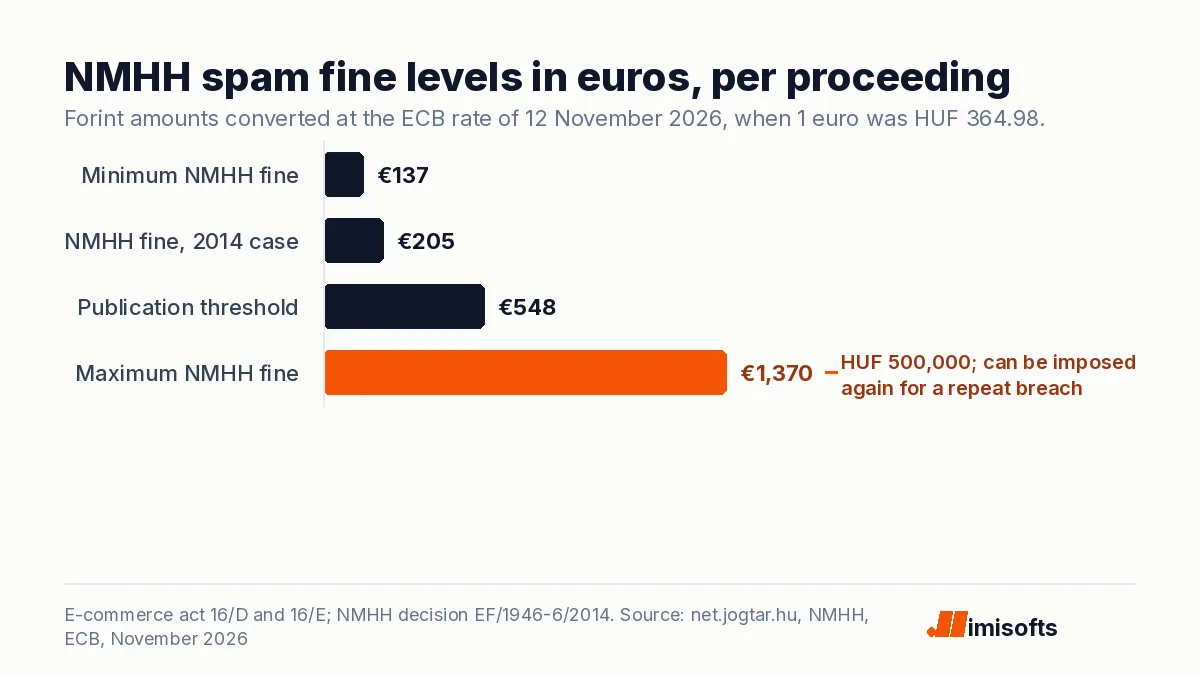
| NMHH electronic commerce fine, per proceeding (about €137 to €1,370; can be imposed again for a repeat) | HUF 50,000 to 500,000 |
| Fine that makes the NMHH publish its decision (about €548; also in certain other cases) | HUF 200,000 or more |
| NMHH fine in decision EF/1946-6/2014 (a 2012 decision had found an ignored unsubscribe) | HUF 75,000 |
| Time limit to start proceedings (Grt. 25) (from the breach, or from when it stops) | 3 years |
| Withdrawal channels you must offer (Grt. 6(6)) (post and email) | 2 |
| GDPR maximum fine for an undertaking (Art. 83(5)) (worldwide, preceding financial year; whichever is higher) | €20 million or 4% of turnover |
| Kit free plan, subscriber cap ($0 a month) | 10,000 |
| Kit Creator plan, 1,000 subscribers (billed monthly, or $390 a year; unlimited sequences) | $39 a month |
| ECB rate used for euro figures (12 November 2026) | €1 = HUF 364.98 |
Hungarian acts read on 13 November 2026 on net.jogtar.hu; the NMHH page, NMHH decision and NAIH letter the same day; GDPR text from EUR-Lex (read 12 November 2026); ECB rate of 12 November 2026; Kit prices from kit.com/pricing on 13 November 2026.
What section 6 of the Grt. requires
Section 6 of the Grt. opens with "unless a separate law provides otherwise" (our translation). Read with the e-commerce act, it sets seven duties for emailing ads to private individuals:
- Prior, clear and express consent before the first advertising email (6(1)). The NMHH adds that "consent automatically deemed to be prior consent shall not be accepted"; on our reading, a pre-ticked box does not count.
- A consent statement with the person's name, the scope of data they agree to, and that the consent is voluntary and informed, plus place and date of birth for age-restricted ads (6(2)). An email-only box captures no name, so we would ask for one.
- A register of consents, kept by the advertiser, the advertising service provider and the publisher; its data goes to a third party only with the person's prior consent (6(5)), and the authority can ask to see it (26(3)).
- Free withdrawal at any time, with the person's data deleted from the register "without delay" (6(3), our translation).
- Withdrawal by post and by email, both, in a way that identifies the person (6(6)).
- Those contact details in every advertising email, shown "clearly and conspicuously" (6(7), our translation).
- A label and a real sender: each email must show it is an advertisement and identify the advertiser and the real sender (e-commerce act 14/A(1)).
The electronic communications act adds that even with consent, a direct marketing message whose sender cannot be identified may not be sent (section 162(3)).
Why the consent request email is itself an ad
Section 14(2) of the e-commerce act says a communication whose sole purpose is to request the Grt. 6(1) consent also counts as an electronic advertisement, and section 14(5) applies Grt. section 6 to it. The NMHH page agrees: messages sent without prior consent are illegal, "as are messages requesting permission to send advertising".
Grt. 6(8) adds that a consent request may not contain advertising beyond the business's name and designation. So collect consent where the person comes to you: a sign-up form, a checkout checkbox or an event form. Nothing we read says whether a double opt-in confirmation email counts under 14(2); on our reading it answers the person's own request, but we would keep it free of advertising beyond your business name.
Companies, contact persons and sole traders
The statute protects "a natural person as the recipient" (our translation) and does not mention companies. The NMHH's page says: "The law prohibits the unsolicited sending of electronic advertising if it is not sent to a company or contact person, but to a private individual." It says it "only carries out its supervisory procedure on the basis of applications or notifications submitted by natural persons", though the act lets it start proceedings on its own initiative too (16/C(1)), and that it cannot act against "mailings in foreign languages or aimed at non-Hungarian consumers". On our reading, that last line limits which cases the NMHH takes, not what is lawful.
On our reading of that page, an advertising email to a Hungarian company or its contact person is outside the Grt. consent rule. We could not confirm whether the NMHH or a court treats a named employee's address as a "contact person". Four limits apply either way:
- Addresses found on websites. The NMHH says contact details posted on websites "should not be used for advertising without prior consent if the contact details are not specifically published for advertising purposes", without limiting that to private individuals. We would only use an address published for receiving offers, and the page does not say even that is enough.
- An ad label and a real sender. Section 14/A(1) is not limited to natural persons, and the NMHH says advertising messages "must clearly indicate that the content is an advertisement and include information that identifies the advertiser".
- Objections. Section 162(2) of the electronic communications act bars direct marketing contact outside Grt. section 6 with a subscriber who has declared they do not want it. We did not confirm how that declaration is made, so we would treat any "no" as permanent.
- Sole traders. The NMHH page does not address sole traders (egyéni vállalkozó); in our view they are closer to a person than a company, so we would get consent first.
The GDPR still covers named business addresses
On our reading, a named address such as [email protected] is personal data, so the GDPR applies whatever the Grt. says; in Hungary the NAIH supervises it. Article 6(1)(f) allows processing necessary for legitimate interests unless the person's interests or rights override them, and Recital 47 says direct marketing "may be regarded as carried out for a legitimate interest" (see our legitimate interest assessment guide). Article 21 gives a right to object "at any time", after which "the personal data shall no longer be processed for such purposes", and that right must be "explicitly brought to the attention" of the person at the latest in your first message. Where you did not get the address from the person, Article 14(3)(b) requires your privacy information by that first communication too. For an undertaking, breaching these rights can cost up to €20 million or 4% of worldwide annual turnover of the preceding financial year, whichever is higher (Article 83(5)).
One tension: Grt. 6(3) requires deleting a withdrawn person's data from the consent register without delay, while a sender may want a minimal suppression entry so the address is never imported again. Nothing we read settles whether that fits 6(3), so ask your lawyer; see also GDPR data retention periods.
Who is liable, and what the NMHH can do
Under section 14(6) of the e-commerce act, the advertiser, the electronic advertising service provider (for example an agency that builds and sends a campaign) and the publisher are equally liable for breaching Grt. section 6, and jointly and severally liable for damage. If you send for clients, their consent problem is yours too, and that includes agencies like ours.
| Rule | Where | What it means |
|---|---|---|
| NMHH fine | E-commerce act 16/D(2) | HUF 50,000 to 500,000 (about €137 to €1,370); can be imposed again for a repeat breach |
| Other measures | 16/D(1) | Order the breach to end, ban its continuation, an administrative contract, or an alert to the intermediary service provider you send through |
| Warning only | 16/D(6) | Not available in these proceedings |
| Proof | 16/D(5) | You can be asked to prove compliance; your own statement cannot replace missing evidence |
| Publication | 16/E(1) | Final decisions published when the fine is HUF 200,000 (about €548) or more, and in certain other cases, including a repeat breach |
| Time limit | Grt. 25 | 3 years from the breach, or from when continuing conduct stops |
| Court claims | Grt. 24(5) | The injured person can also sue directly |
| GDPR fine | GDPR Art. 83(5) | For an undertaking, up to €20 million or 4% of worldwide annual turnover, whichever is higher |
The statutory fines are small. The one published decision we read, EF/1946-6/2014, fined a company HUF 75,000 (about €205 at today's rate, not 2014's) after a person received another of its advertising emails on 22 January 2014; a 2012 decision had already found it in breach of 6(3) for ignoring that person's unsubscribe. We found no NMHH spam decision from 2025 or 2026. On our reading, the proof rule matters more than the fine. Conversions use the ECB reference rate of €1 = HUF 364.98.
A compliant setup for Hungarian subscribers
For a B2C list, or any list that includes private individuals or sole traders, we would build it like this:
- Collect consent on your own form, with a name field, an unticked checkbox naming email as the channel, and a privacy notice link (Grt. 6(1) and 6(2)).
- Use double opt-in and keep the confirmation date with the record; on our reading, that is the kind of evidence that could meet 16/D(5).
- Do not make a free guide or discount conditional on the newsletter. In a 2018 information letter, NAIH/2018/3581, the NAIH said a benefit cannot be made conditional on consent to direct marketing the service does not need, and non-subscribers should get the service on equal terms; only losing what is in the newsletter itself, such as exclusive content, is acceptable. The letter is guidance, not a binding decision.
- Put a postal address and an opt-out email address in every footer next to the unsubscribe link, and act on all three (6(6) and 6(7)).
- Mark the email as an advertisement and send it from an identifiable sender (14/A and 162(3)).
- Delete withdrawn subscribers from the consent register without delay (6(3)).
Point 3 changes any funnel that trades a guide for a subscription: make the newsletter a separate, optional checkbox.
Where Kit fits, and where it does not
For the opt-in list this requires, we suggest Kit. It is free for up to 10,000 subscribers, with unlimited forms, landing pages and broadcasts (Kit's pricing page, 13 November 2026). Double opt-in is on when "Auto-confirm new subscribers" is unchecked, which Kit's help center (30 July 2026) "strongly" recommends. Kit's GDPR page describes an optional account-level consent page shown after a visitor subscribes, custom consent checkboxes in its form builder, an EU subscriber filter and a data processing agreement. For Hungary we would put the checkbox on the form, so consent comes before the sign-up. You can start on Kit's free plan and add the Hungarian pieces below.
Kit calls its confirmation email an "incentive email", and the NAIH letter applies to any freebie you attach: deliver it whether or not the person ticks the newsletter box. We did not check whether Kit can make a name field required or add a postal opt-out address to its footer, so test both. Unlimited sequences and visual automations come with the Creator plan: $39 a month billed monthly, or $390 a year, for 1,000 subscribers.
In our view, B2B outreach to Hungarian companies needs the checks above before any sending setup. Our email infrastructure service sets up sending domains and authentication, and our cold email team runs campaigns; sending for a client makes us an electronic advertising service provider under 14(6), so these rules bind us too. Pricing outside help? See what an email deliverability consultant costs and email hosting cost.
How Hungary compares with other EU countries
Our pages on Greece and the Czech Republic explain why both apply opt-in to companies as well as people, a stricter line than the NMHH's reading for Hungary. See also Romania, Austria, the cold email laws by country table and is buying email lists legal.
The bottom line for senders
Our view: email a private individual only after they opt in on your own form with their name on the record, and never send a "may we email you?" message first. For a company, use only an address it published for receiving offers, mark the email as an ad, identify yourself, include a GDPR notice and a working opt-out, and stop at the first objection. Keep the evidence, because your own statement cannot replace it. If you are building the opt-in list now, Kit's free plan is free for up to 10,000 subscribers.
Frequently Asked Questions
Not to private individuals. Section 6(1) of the Grt. (Act XLVIII of 2008) requires prior, clear and express consent before advertising is emailed to a natural person, and section 14(2) of the e-commerce act treats an email that only asks for consent as an advertisement too. The NMHH's English page says the ban covers ads sent to a private individual rather than to a company or contact person, but the same page warns against using contact details found on websites without consent unless they were published for advertising, and the GDPR still applies.
The NMHH's undated English page says the ban covers advertising that is not sent to a company or contact person but to a private individual. The same page says contact details posted on websites should not be used for advertising without prior consent unless they were published for advertising, so we would only use an address the company published for receiving offers. A named address also falls under the GDPR: rely on a lawful basis such as legitimate interest, mention the right to object at the latest in your first email, and honour objections. We would get consent before emailing a sole trader.
Not to a private individual. Section 14(2) of the e-commerce act says a communication whose sole purpose is to request the Grt. 6(1) consent counts as an electronic advertisement, and section 14(5) applies Grt. section 6 to it. The NMHH lists messages requesting permission to send advertising as illegal alongside unsolicited ads. Collect consent on your own forms instead, and keep any confirmation email free of advertising beyond your business name.
The NMHH can impose an electronic commerce fine of HUF 50,000 to 500,000 in a proceeding, about €137 to €1,370 at the ECB rate of 12 November 2026, and can fine again for a repeat breach. It publishes final decisions with fines of HUF 200,000 or more, and in certain other cases. Under the GDPR, an undertaking can be fined up to €20 million or 4% of worldwide annual turnover of the preceding financial year, whichever is higher. Injured people can also sue, and NMHH proceedings under the Grt. must start within 3 years (Grt. section 25).
The National Media and Infocommunications Authority (NMHH) handles breaches of Grt. section 6 by email and other electronic channels except voice calls, under section 24(4) of the Grt. The e-commerce act lets it open proceedings on request or on its own initiative (16/C(1)); its English page says it proceeds on notifications from natural persons about ads sent to them. The NAIH, Hungary's data protection authority, supervises the GDPR.
On our reading, no. Section 6(6) of the Grt. requires that people can withdraw consent both by post and by email, and section 6(7) requires every advertising email to show the address and other contact details for withdrawing, clearly and conspicuously. Add a postal address and an opt-out email address next to the link, and delete withdrawn subscribers from your consent register without delay.