Short answer. California regulates sales calls through four sets of rules. Business and Professions Code 17592 bars sales calls to California numbers on the national Do Not Call Registry, with a list no older than three months; Public Utilities Code 2872 and 2874 ban prerecorded autodialer calls between 9 p.m. and 9 a.m. and require a live, natural voice to introduce any recorded message and say if it uses an AI voice; Penal Code 632 and 632.7 require every party's consent to record confidential calls and calls involving cell phones, with $5,000 per violation in damages under 637.2; and Business and Professions Code 17511.3 makes some sellers register, on the Attorney General's form, for $50 a year. The Attorney General can seek civil penalties up to the federal FTC maximum, $53,088 per violation on 19 November 2026.
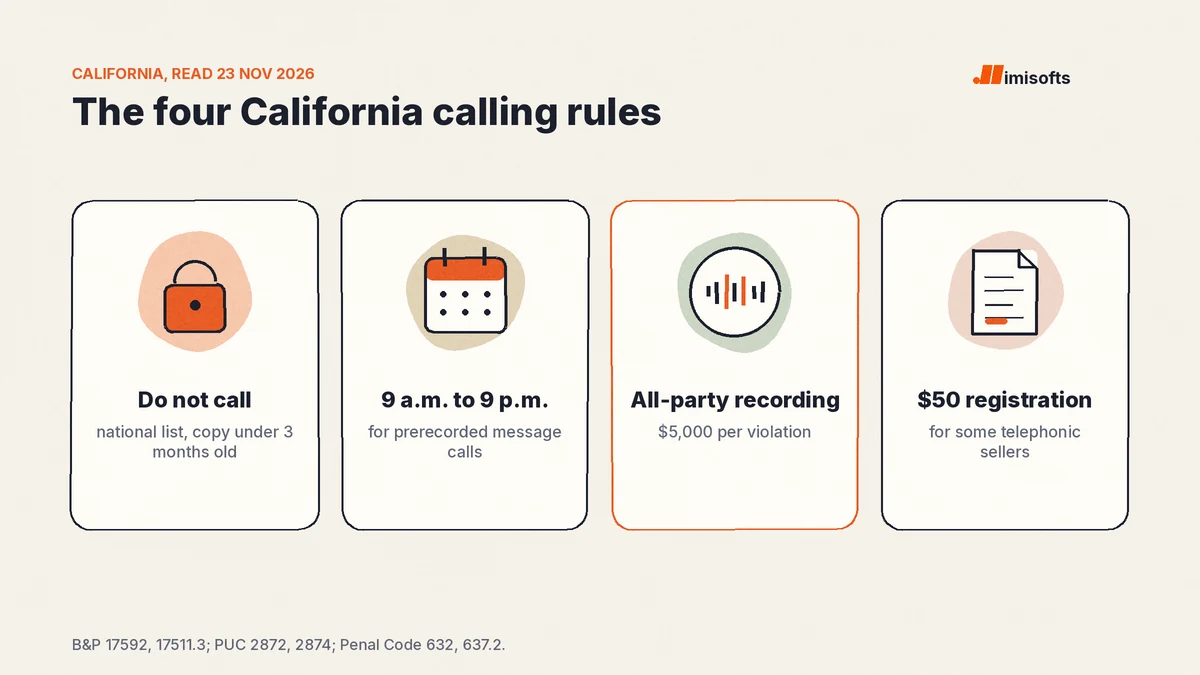
We sell AI calling services that must follow these rules, so we read each section on the Legislature's own California Law site and the federal rules on eCFR on 23 November 2026. We did not search case law or open the Attorney General's registration form. This is general information, not legal advice.
Key numbers
| Item | Number |
|---|---|
| Oldest do not call list copy allowed (B&P 17592(a)(2)) | 3 months |
| Prerecorded call ban, California time (PUC 2872(c)) | 9 p.m. to 9 a.m. |
| Recording without all-party consent (per violation, or 3x actual damages) | $5,000 |
| Criminal fine for recording (per violation, Penal Code 632) | up to $2,500 |
| Telephonic seller registration fee (a year, filed at least 10 days before) | $50 |
| Public action civil penalty cap (per violation, 16 CFR 1.98 as of 19 Nov 2026) | $53,088 |
| Small claims penalty after an injunction (for calls within 30 days of service) | up to $1,000 |
| Established business relationship window (B&P 17592(e)(4)) | 18 months |
California codes read on leginfo.legislature.ca.gov and 16 CFR 1.98 and 47 CFR 64.1200 on eCFR on 23 November 2026.
California's do not call rule (B&P 17592)
Under section 17592, a "telephone solicitor" is anyone who makes or causes a call "to a California telephone number" to sell or lease goods or services, offer a prize, offer consumer credit, sell investment, insurance or financial services, or gather marketing information for a direct sale. Such a solicitor may not call a number on the current "do not call" list.
Section 17592 does not create a separate state list. It defines the list as "the California telephone numbers on the national 'do not call' registry" run by the FTC, and a copy "is current if it was obtained from the Federal Trade Commission no more than three months prior to the date a call is made." The federal safe harbor uses a 31-day copy (see our DNC scrubbing guide), so if you scrub for the federal rule you already meet California's.
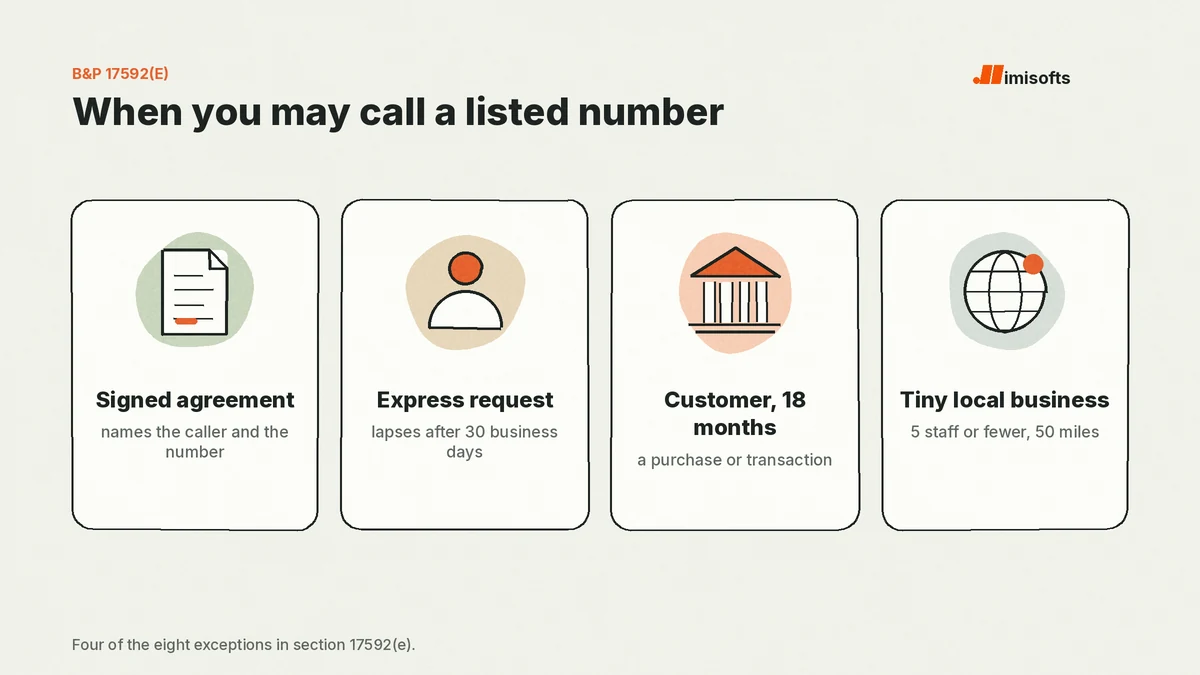
Section 17592(e) lists eight exceptions. The ones outbound teams use most:
- Written agreement. A signed, written agreement that authorizes calls by or on behalf of a specific party to that California number. It cannot sit in a contract of adhesion, and in a dispute the caller has the burden of proving it by producing the signed document.
- Express request. The person asked to be called. The request is presumed gone 30 business days after their last inquiry or consent, or as soon as they ask not to be called.
- Established business relationship. A purchase, rental, lease or financial transaction with the seller in the last 18 months.
- Very small local businesses. A business with no more than five employees or contractors, where the owner makes the calls personally to people within 50 miles, and the service sold is not telemarketing.
Two more rules in the same section catch outbound teams. Under 17592(d), anyone who sells, leases or rents calling lists may not include numbers on the current list, so a bought list is not a defense. And a business relationship does not extend to a separate legal entity, such as a parent, subsidiary or affiliate, unless it shares the brand name; once a customer asks to go on a company's own do-not-call list, every entity under that brand must stop calling.
Calling hours and autodialers (PUC 2872)
The general federal rule bars sales calls to residential subscribers before 8 a.m. or after 9 p.m. local time (47 CFR 64.1200(c)(1)). California adds a narrower rule for automatic dialing-announcing devices: equipment that stores or generates numbers and can "disseminate a prerecorded message to the telephone number called" (PUC 2871).
PUC 2872(c) says no one may use such a device "to place a call that is received by a telephone in this state during the hours between 9 p.m. and 9 a.m. California time." So a prerecorded message campaign into California, including one that plays an artificial voice, has a 9 a.m. to 9 p.m. window, one hour shorter at the start of the day than the federal window for live calls. Whether a live, conversational AI agent counts as such a device is not answered in the text; our view is to plan as if it does.
AI voices and prerecorded messages (PUC 2874)
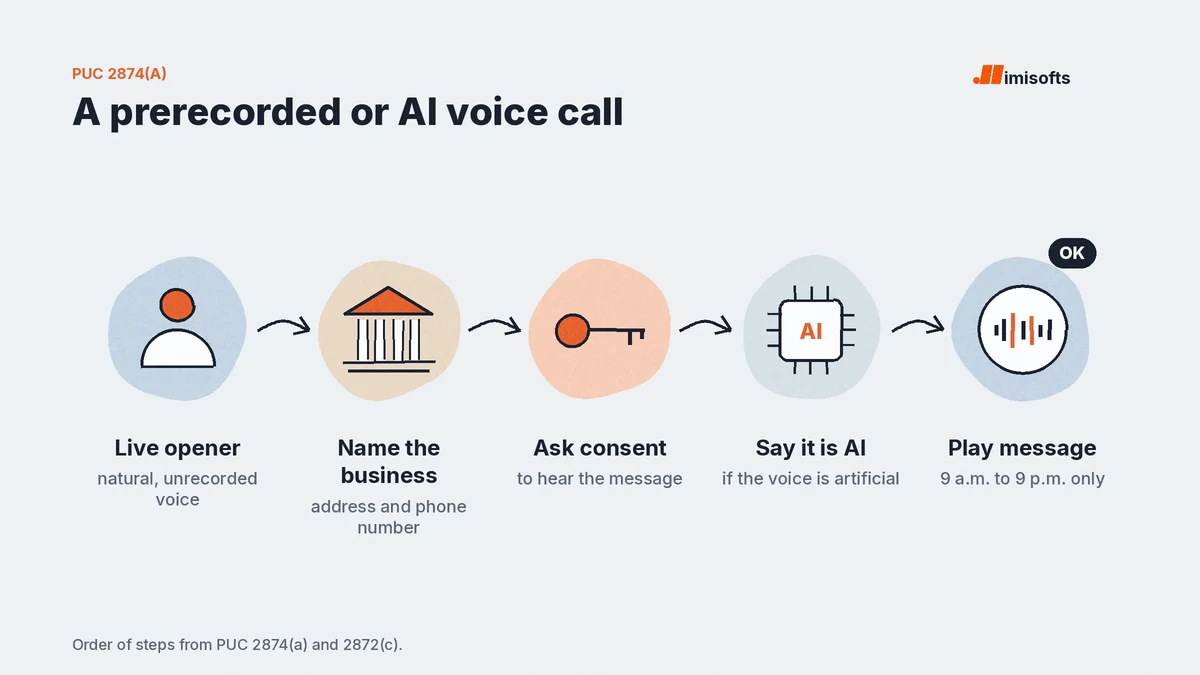
PUC 2874(a) lets a device play its message only "after an unrecorded, natural voice announcement has been made to the person called by the person calling." That live announcement must:
- state the nature of the call and the business's name, address and telephone number;
- ask whether the person consents to hear the prerecorded message;
- "Inform the person called if the prerecorded message uses an artificial voice."
The third duty came with AB 2905 (Stats. 2024, chapter 316), in force since 1 January 2025, which defines an "artificial voice" as one "generated or significantly altered using artificial intelligence." In practice a human has to open the call before an AI voice message plays. We explain our reading of why the AI agent cannot make that announcement itself in our page on the California AI caller disclosure law.
A separate law, B&P 17941, makes it unlawful to use a bot to interact with a person in California "online" to mislead them about its artificial identity in order to drive a sale; disclosing that it is a bot removes the liability. It is written for online interactions; the phone rule is PUC 2874.
Recording sales calls: all-party consent
Penal Code 632(a) makes it a crime to record a confidential communication, including by telephone, without "the consent of all parties", with a fine of up to $2,500 per violation. Section 632.7 applies the all-party rule to calls involving cell or cordless phones. Under section 637.2, anyone injured can sue for the greater of $5,000 per violation or three times actual damages, and does not need to show actual damages.
For an outbound team that records for quality or uses AI transcription, that means a recording notice at the start of every California call. Our table of call recording laws by state shows the other all-party states.
Telemarketer registration with the Attorney General ($50)
Section 17511.3 requires a "telephonic seller" to register with the Consumer Protection Section of the department, on a form provided by the Attorney General, "not less than 10 days before doing business in this state", with a $50 filing fee and a declaration signed under penalty of perjury. Registration lasts a year and renews for another $50; material changes must be filed within 10 days.
The duty is narrower than it sounds. Section 17511.1 defines a telephonic seller by what the calls represent: free extra items with a purchase, a prize or gift tied to a purchase or payment, a price "below the regular price", and similar offers. A long list of exemptions follows, including catalog sellers and calls to past customers. Our view: a B2B appointment-setting campaign that makes none of the subdivision (a) offers is likely outside the registration rule, but we read subdivision (a) closely and not (b) to (d), so check all four against your script before you decide.
Penalties for breaking California's calling rules
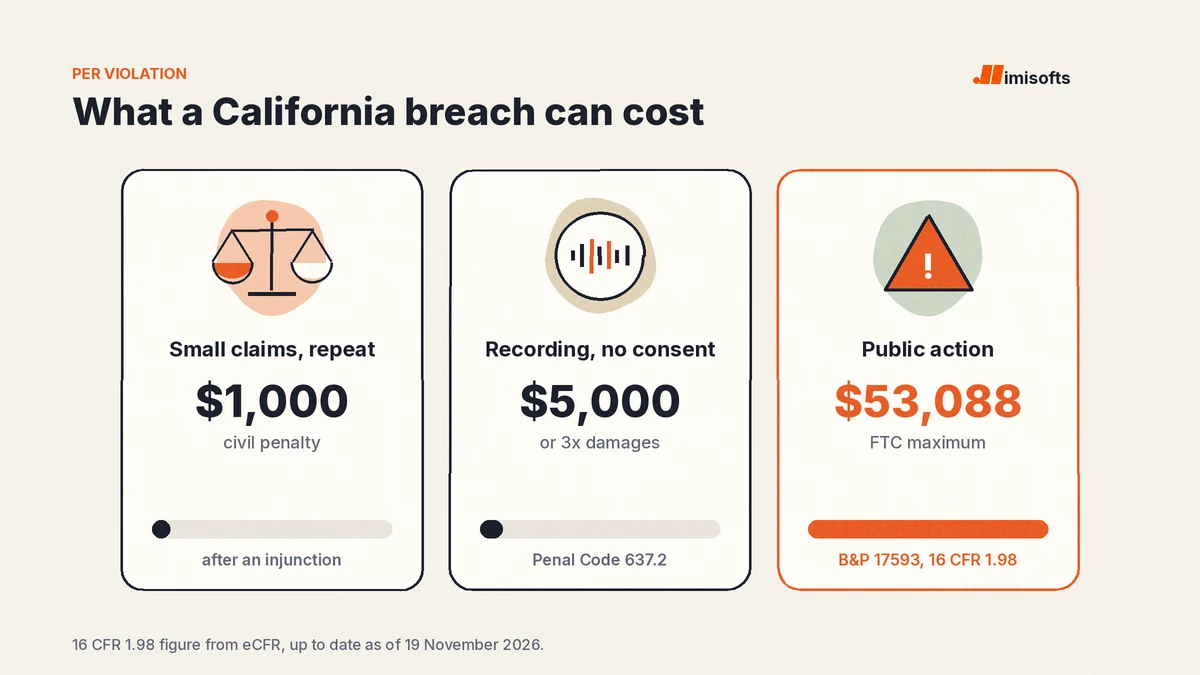
- Public enforcement. Under B&P 17593(a), the Attorney General, a district attorney or a city attorney can seek an injunction and a civil penalty up to the amount the FTC may seek under 15 U.S.C. 45(m)(1)(A), as set in 16 CFR 1.98. On eCFR (up to date as of 19 November 2026), that figure is $53,088 per violation.
- Private small claims. A person who received a prohibited call may get a small claims injunction. If further calls arrive within 30 days after it is served, they can sue again in small claims for a civil penalty of up to $1,000.
- Defense. It is an affirmative defense that the violation "was accidental and in violation of the telephone solicitor's policies and procedures and telemarketer instruction and training". The defense needs both parts: the violation was accidental, and it broke your written policies and training. Keep those records.
- Recording. $5,000 per violation or three times damages under Penal Code 637.2.
A California compliance checklist for outbound teams
- Scrub California numbers against the national registry; a 31-day copy satisfies both the federal and the three-month California rule.
- Keep signed written agreements that name your business and the number for any consent-based calls to registered numbers.
- Run prerecorded message campaigns only from 9 a.m. to 9 p.m. California time, with a live opener that names the business, asks consent and says if the message uses an artificial voice.
- Play a recording notice at the start of every call you record or transcribe.
- Check your script against 17511.1 to see whether you must register as a telephonic seller.
- Write down your procedures and training; they are the basis of the 17593(d) defense.
California sits in our telemarketing laws by state comparison next to states like Florida. For how we plan the hours, the live opener and the recording notice into a calling program, see our TCPA-compliant AI calling service.
Frequently Asked Questions
The main ones are Business and Professions Code 17592 (no sales calls to California numbers on the national Do Not Call Registry), Public Utilities Code 2872 and 2874 (prerecorded calls only 9 a.m. to 9 p.m. and only after a live announcement), Penal Code 632, 632.7 and 637.2 (all-party consent to record) and B&P 17511.3 (registration for some telephonic sellers).
Live sales calls follow the federal window of 8 a.m. to 9 p.m. at the called person's location. Calls placed with an automatic dialing-announcing device that plays a prerecorded message may not be received in California between 9 p.m. and 9 a.m. California time, under PUC 2872(c).
No separate list is defined in B&P 17592. The California list is the California numbers on the national registry run by the FTC, and a copy counts as current if it is no more than three months old when the call is made.
Only telephonic sellers as defined in B&P 17511.1, mainly those whose calls offer free extra items, prizes or gifts tied to a purchase, or below-regular prices, and who are not exempt. They register at least 10 days before doing business, on a form provided by the Attorney General, for $50 a year.
Under PUC 2874, a prerecorded or artificial voice message may play only after an unrecorded, natural voice announcement that names the business, asks for consent to hear the message and says if the message uses an artificial voice.
Public prosecutors can seek civil penalties up to the FTC maximum under 16 CFR 1.98, $53,088 per violation as of 19 November 2026. A consumer can get a small claims injunction and then up to $1,000 for calls within 30 days after it is served. Recording without consent carries $5,000 per violation.