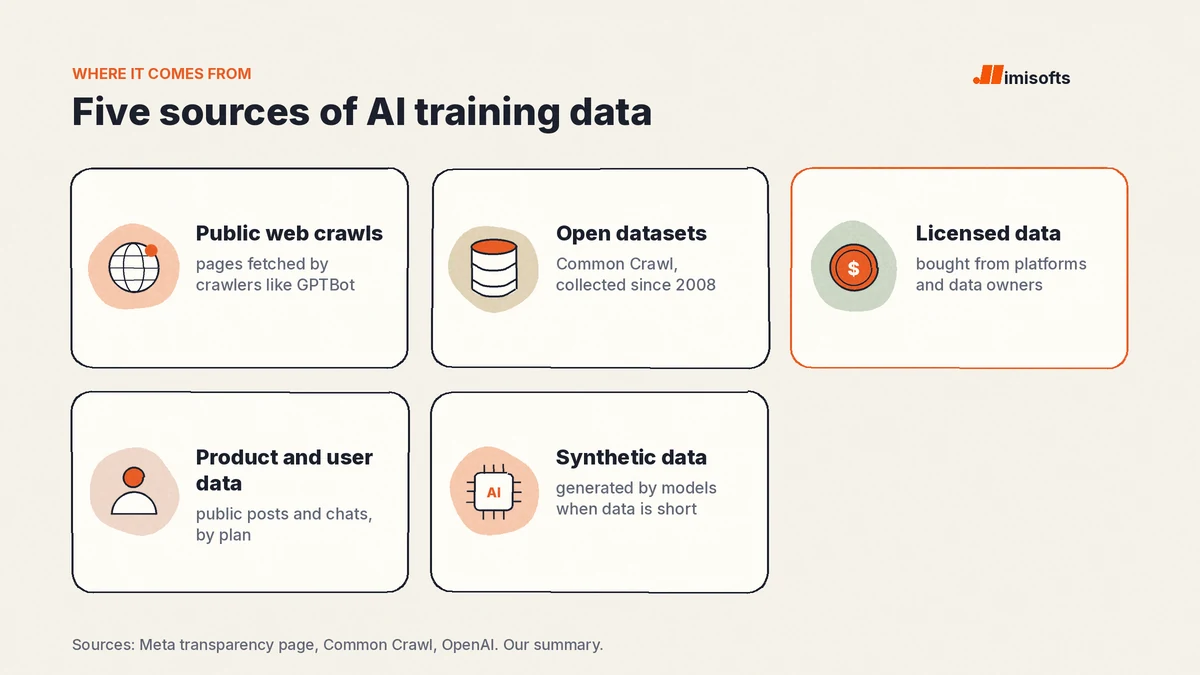
Short answer. AI training data comes from five places: public web crawls, licensed data bought from platforms and other data owners, content and chats from the lab's own products, synthetic data the models generate, and open datasets such as Common Crawl, which has collected petabytes of web pages since 2008. Paying for data makes more sense as the free supply runs short: Epoch AI estimates the usable stock of human public text at about 300 trillion tokens and projects that models will use it up between 2026 and 2032 if trends continue. Reddit disclosed licensing deals worth $203.0 million in its 2024 IPO filing.
For an established company that owns records nobody else has, that shift matters. Data that was never on the open web is the part labs cannot crawl. Our AI data licensing service helps owners work out whether their records are the kind buyers look for.
This guide takes each source from primary pages where possible, explains why money now changes hands, and ends with what it means for a company that holds data. Sources were read on November 23, 2026. This is general information, not legal advice.
Key numbers
| Item | Number |
|---|---|
| Main sources of AI training data (web crawls, open datasets, licensed, user, synthetic) | 5 |
| Common Crawl collecting since (petabytes of data, free to access on Amazon) | 2008 |
| Pages in Common Crawl's October 2026 archive (371.19 TiB uncompressed) | 2.16 billion |
| Llama 3 pretraining data (all from publicly available sources (April 2024)) | 15T+ tokens |
| Epoch AI estimate of usable public text (paper of June 6, 2024) | ~300T tokens |
| Projected years that stock is fully used (if trends continue) | 2026 to 2032 |
| Reddit data licensing contracts (Jan 2024) (terms of 2 to 3 years) | $203.0M |
| Reddit expected minimum 2024 revenue (Form S-1) | $66.4M |
| Claude chat retention if you allow training (Anthropic, August 28, 2025) | 5 years |
| Bartz v. Anthropic settlement (about $3,000 per work; final approval July 20, 2026) | $1.5B |
Common Crawl; Meta transparency page and Llama 3 announcement; Epoch AI; Reddit, Inc. Form S-1 on SEC EDGAR; OpenAI Help Center and crawler docs; Anthropic; Authors Guild report of the Bartz v. Anthropic order. Read November 23, 2026.
The five places AI training data comes from
Meta gives the plainest official list. Its transparency page says the data behind its AI "includes a mix of publicly available data, licensed data and information from Meta's products and services", and that new data is added on a rolling basis from public sources, licensed partners, public content on Meta's products, people's interactions with its AI features, and synthetic data. OpenAI's and Anthropic's own pages, quoted below, document the crawler and chat parts of the same picture.
| Source | What it is | Who pays | Example from a primary source |
|---|---|---|---|
| Public web crawls | Pages fetched by a lab's crawler | Usually no payment to the site owner | OpenAI's GPTBot crawls content that may be used in training |
| Open datasets | Ready made collections anyone can download | Free to access | Common Crawl's October 2026 archive: 2.16 billion pages |
| Licensed data | Data bought or licensed from platforms and other data owners | The lab pays the owner | Reddit: $203.0 million in contracts signed in January 2024 |
| Product and user data | Public posts on the lab's platforms and users' chats | Nobody; users can opt out on some plans | OpenAI may train on Free, Plus and Pro chats unless the user opts out |
| Synthetic data | Data generated by models | Made by the lab itself | Meta uses it "when there isn't enough data to work with" |
Size is measured in tokens. Meta explains that a token "can be a word or part of a word, a piece of an image, or milliseconds of video", and that its models are generally trained on trillions of them. When Meta released Llama 3 in April 2024, it said the model was pretrained on "over 15T tokens that were all collected from publicly available sources", seven times the data used for Llama 2. OpenAI, Anthropic and Google do not publish the size or full makeup of the training sets behind their current models.
Public web crawls and the crawlers behind them
The open web is still the base layer. Common Crawl says its corpus "contains petabytes of data, regularly collected since 2008", and that access to the copy hosted by Amazon is free. Its October 2026 crawl, gathered between October 5 and 18, holds 2.16 billion web pages (371.19 TiB uncompressed) from 34.3 million registered domains, and 830.1 million of those URLs were new to the archive. That is about 38% of the crawl, by our arithmetic.
Labs also run their own crawlers. OpenAI's crawler documentation says GPTBot "is used to crawl content that may be used in training our generative AI foundation models", and that disallowing GPTBot in robots.txt "indicates a site's content should not be used in training". OpenAI keeps search separate: a site can allow OAI-SearchBot to appear in OpenAI's search results while blocking GPTBot.
Site owners who do not want their pages used for training can block these crawlers. If you run a website, our guides on blocking AI bots in Cloudflare and the shared AI training control in robots.txt cover the settings.
Licensed data: why labs now pay for it
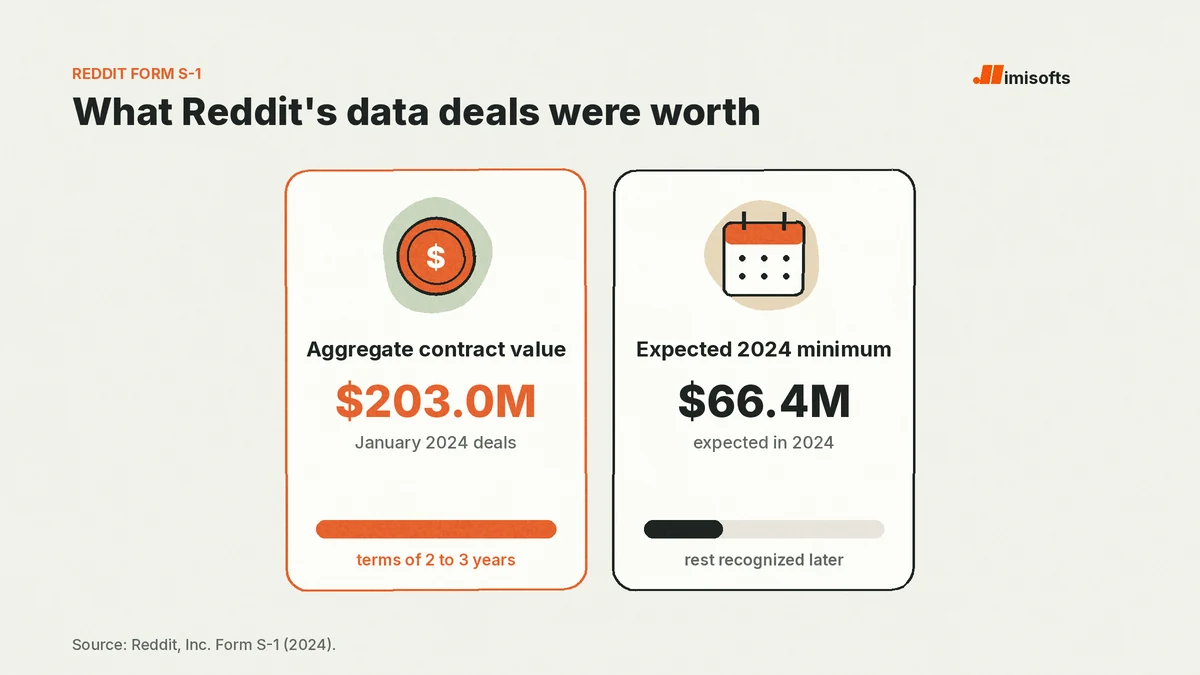
Crawled text costs nothing to collect, but some valuable data sits behind logins, in archives or inside companies, and its owners are now being paid for it. The clearest public number comes from a securities filing. In its Form S-1, Reddit wrote: "In January 2024, we entered into certain data licensing arrangements with an aggregate contract value of $203.0 million and terms ranging from two to three years." It expected at least $66.4 million of that to be recognized as revenue in 2024, about 33% of the contract value by our arithmetic.
Reddit also said why it saw value in the data: "We believe our growing platform data will be a key element in the training of leading large language models." The passage we cite does not split the total by contract, so we do not either.
Meta, which trains on its own platforms' public posts, still buys. Its transparency page says: "Some datasets are purchased or licensed from third parties, including commercial datasets and partner content." Our guide to the AI data licensing agreement covers the terms a seller should check in such a deal.
Your own chats and posts
The third source is the product itself. Meta's page says its training data includes "publicly shared posts from Instagram and Facebook and people's interactions with AI at Meta features".
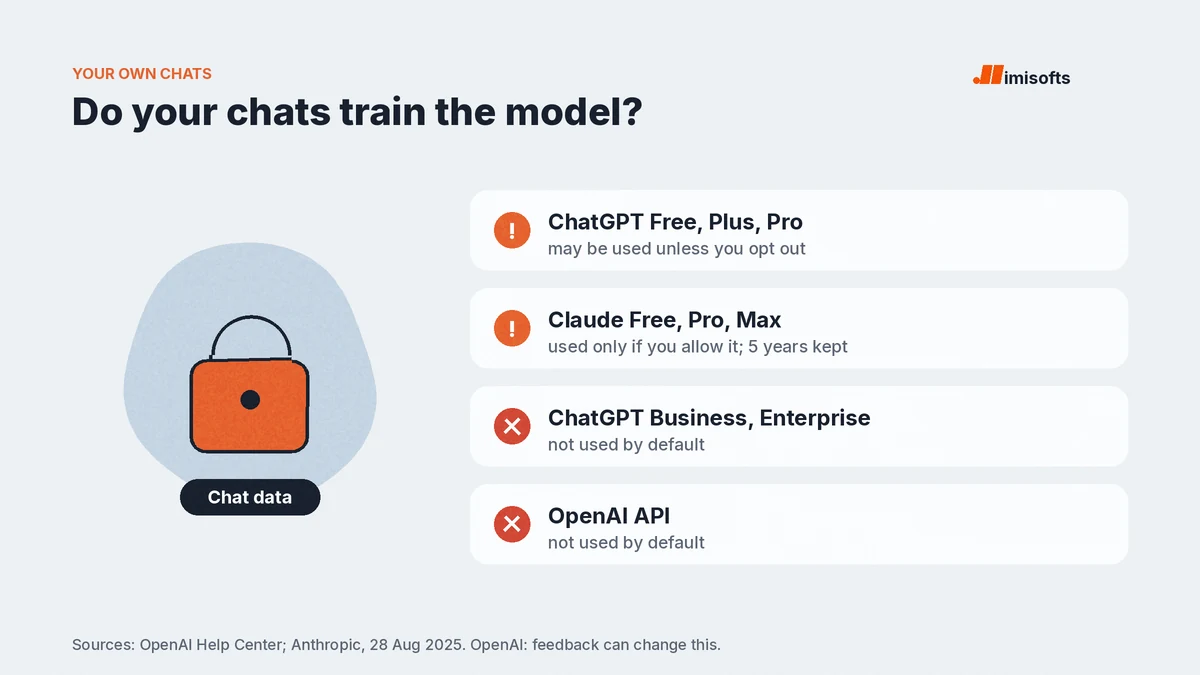
For chat apps, the rule depends on the plan. OpenAI's help article says that on Free, Plus and Pro "we may use your content to train our models", with an opt out under Data controls in settings, and that if you give feedback (a thumbs up or thumbs down), "the entire conversation associated with that feedback may be used to train our models". It also says that by default it does not use inputs or outputs from ChatGPT Business, Enterprise, Edu or the API to improve its models.
Anthropic changed its consumer terms on August 28, 2025: users of Claude Free, Pro and Max were asked to choose whether their chats may be used to improve Claude, with a deadline of October 8, 2025, and retention was extended "to five years, if you allow us to use your data for model training". The change does not apply to its commercial plans or to API use.
For a business, the practical point is to put staff on business plans, or check the settings, before customer data goes into a chat. If you are weighing a chatbot of your own, see what an AI chatbot for business costs.
Synthetic data
When real data runs short, labs make more with models. Meta says it generates and uses synthetic data to augment existing data with context such as labels, "to help when there isn't enough data to work with or when we have more of some types of data than others", and to help keep its AI reliable, safe and efficient. Our view: synthetic data is made from what a model already learned, which is one reason fresh human data keeps its value.
Are AI labs running out of training data?
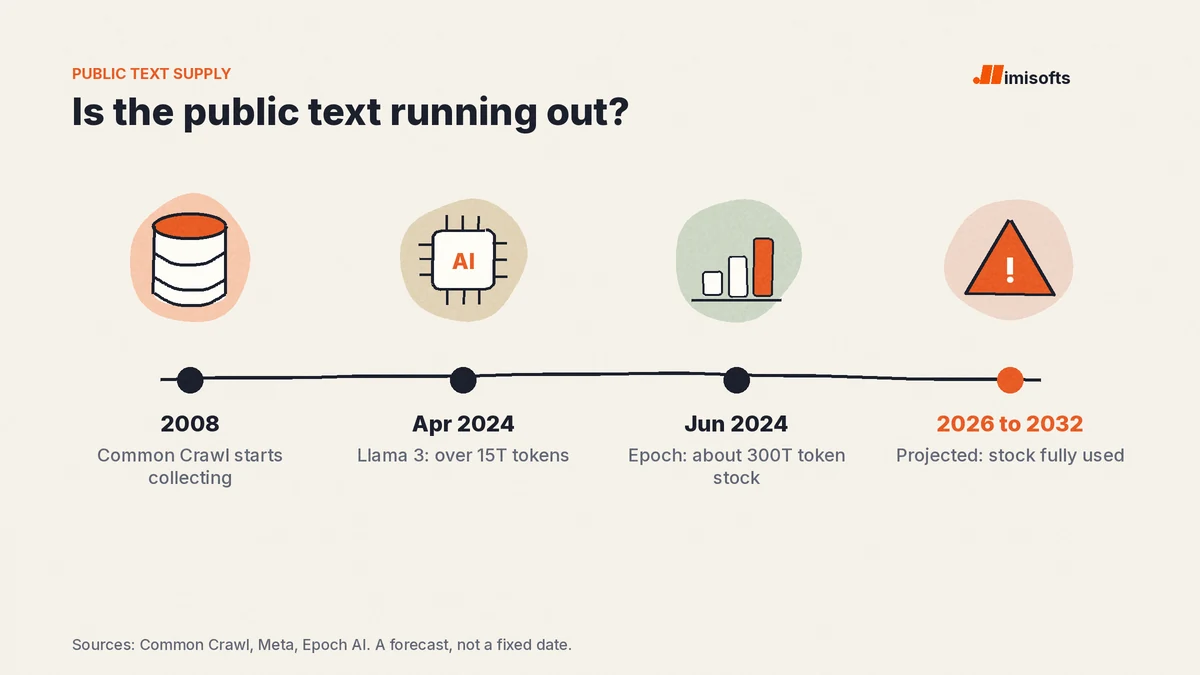
Possibly, for public text. In a paper published on June 6, 2024, Epoch AI estimated "the effective stock of quality and repetition adjusted human-generated public text for AI training at around 300 trillion tokens", and wrote that "if trends continue, language models will fully utilize this stock between 2026 and 2032, or even earlier if intensely overtrained."
For scale only: Llama 3's more than 15 trillion tokens equal roughly 5% of that estimate, though the two figures measure different things (raw training tokens against a quality adjusted stock). Epoch's projection is a forecast that depends on how models keep growing, not a fixed date.
Our view: if the public stock is close to used, more of the next gains may come from data that is not public, such as support tickets, transaction records, call recordings, technical manuals and industry archives. Established companies hold much of that kind of data.
When the source was not licensed
Taking data without permission has a price. In Bartz v. Anthropic, a class action by authors over books downloaded from pirate libraries, the federal court in the Northern District of California granted final approval of a $1.5 billion settlement on July 20, 2026, as reported by the Authors Guild. The Guild reports that the approximately $3,000 per work award is "four times the statutory minimum for ordinary infringement" of $750. At about $3,000 a work, $1.5 billion covers roughly 500,000 works, by our arithmetic.
The settlement also requires Anthropic to destroy its files from Library Genesis and Pirate Library Mirror, and the Guild reports that Anthropic "represented that neither dataset, nor any portion of them, was in the training corpus of any of its commercially released large language models". The release covers only past conduct on the input side through August 25, 2025, not claims about model outputs. We could not open the settlement website in our browser, so these details come from the Guild's report of the order.
What this means for a company that owns data
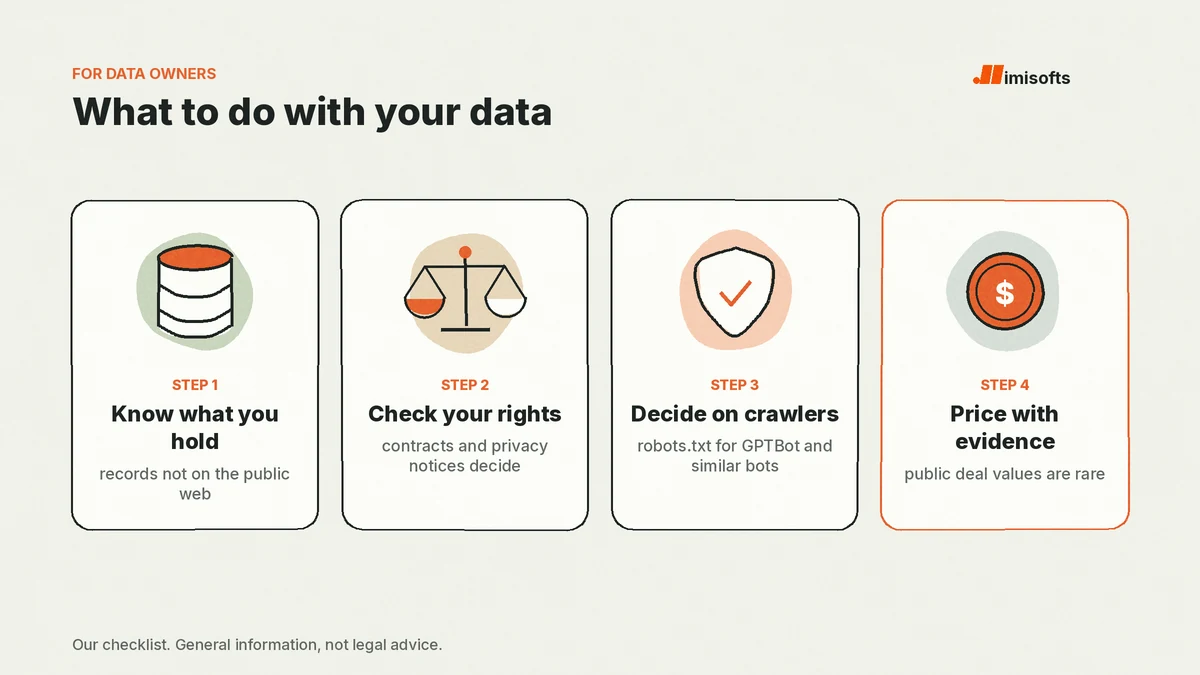
- Know what you hold. List the records you created yourself and that are not on the public web. Those are the ones a crawler cannot reach.
- Check your rights. Customer contracts, privacy notices and supplier terms decide what you may license. Personal data needs a lawful basis or proper anonymization first.
- Decide on crawlers. Blocking GPTBot and similar bots on your website keeps public pages out of future crawls by the bots that honor robots.txt; it does not remove data already collected.
- Price with evidence. Public deal values are rare in primary filings. Reddit's is one, and it describes a large platform, not a typical company.
Our guides on how to sell data to AI companies, what data monetization means and the data sharing agreement versus a data license walk through the next steps.
How imisofts can help
imisofts is a Dubai based agency that builds automation and data work for established companies. Our team can map which of your records might be licensable, prepare and anonymize them, and support you and your lawyers through the buyer process. If you want a first look, license your company data with our help. We are not a law firm, and we do not promise a payout; whether a buyer pays, and how much, depends on the data and the buyer.
Frequently Asked Questions
From five main places: public web crawls, open datasets such as Common Crawl (collected since 2008), data licensed from platforms and other data owners, content and chats from the lab's own products, and synthetic data generated by models. Meta's transparency page lists a similar mix for its own AI.
OpenAI does not publish the full makeup of its training data. Its own pages say GPTBot crawls web content that may be used for training, and that chats on the Free, Plus and Pro plans may be used unless the user opts out. Business, Enterprise, Edu and API data are not used by default.
For public human text, possibly. Epoch AI estimated the usable stock at about 300 trillion tokens in June 2024 and projected that models would fully use it between 2026 and 2032 if trends continue, or earlier if heavily overtrained. It is a forecast, not a fixed date.
Yes, for some of it. Reddit disclosed in its 2024 Form S-1 that it signed data licensing contracts worth $203.0 million in January 2024, with terms of two to three years. Meta says some of its datasets are purchased or licensed from third parties.
You can ask crawlers that honor robots.txt to stay out. OpenAI says disallowing GPTBot indicates your content should not be used to train its models, while OAI-SearchBot can stay allowed for its search results. Blocking does not remove content collected before.
Few deal values appear in primary filings. Reddit's filing gives an aggregate of $203.0 million for its January 2024 contracts, but Reddit is a large platform. What a company's own data is worth depends on how unique, clean and legally licensable it is, and on the buyer.