October 15, 2026. Synthflow no longer publishes self-serve plans. Its pricing page lists a single option, Enterprise, with contracts that start at $30,000 a year and are scoped around call volume, concurrency, telephony, integrations, security needs and launch support. Its documentation calls the model sales-led, warns customers not to treat public documentation as a quote, and records that in-product reselling for agencies was removed on 15 September 2026. Calls are billed by the second, and unanswered calls and voicemail hang-ups are charged as a flat 5 seconds. We build AI voice agents on several platforms, so this guide explains what Synthflow's model means for your budget and how it compares with platforms that still publish their rates.
Everything below comes from Synthflow's pricing page and its documentation on billing and usage, read 15 October 2026. Comparisons with Vapi and Retell use our own guides to their published prices.
Key numbers
| Item | Number |
|---|---|
| Synthflow Enterprise contracts (about $2,500 a month) | from $30,000 a year |
| Public per-minute price (sales-led pricing) | none published |
| Billing increment | per second, pooled into minutes |
| No-answer or voicemail hang-up | flat 5 seconds |
| Failed or user-canceled calls | not billed |
| Chat conversion | 5 AI messages = 1 minute |
| In-product reselling removed | 15 September 2026 |
Synthflow pricing page and billing and usage documentation, read 15 October 2026.
What Synthflow costs now
The entry point is an Enterprise contract from $30,000 a year, which averages $2,500 a month. Synthflow says the final price depends on call volume, concurrency, telephony setup, integrations, security requirements and launch support. In return, the pricing page lists:
- Enterprise SLA and support terms scoped in the contract.
- Synthflow's native telephony, SIP trunking or approved enterprise telephony.
- Custom concurrency planning, routing, escalation paths, handoffs and fallback logic.
- Integrations with CRMs, calendars, contact-center systems, webhooks, APIs and knowledge sources.
- MSA and DPA support, a data handling review and an enterprise security review.
- Implementation, onboarding, testing, training, launch support and ongoing optimization.
Synthflow's documentation adds that some existing workspaces still run on legacy billing, governed by their agreement.
How Synthflow measures usage
However the contract is priced, the usage rules in Synthflow's documentation decide how fast an allowance runs down:
- Per-second billing, pooled into minutes. Each call is measured from the moment the person and the agent connect, with partial seconds rounded up. Seconds are added across calls and each full minute is reported, so four calls totalling 125 seconds count as 2 minutes, with 5 seconds carried forward.
- Unanswered calls still cost something. Calls ending as no-answer or hang-up-on-voicemail are recorded as a flat 5 seconds. Failed and user-canceled calls are not billed.
- Transfers stop the meter. Billable AI usage ends when a transfer completes.
- Chat converts to minutes. Every 5 AI-generated chat messages count as 1 usage minute.
- Test simulations are tracked separately. They are measured apart from live usage.
Pooling seconds across calls is the customer-friendly part: short calls are not each rounded up to a full minute. For an outbound campaign, the 5-second rule matters more: 10,000 dials that go unanswered add up to about 833 billed minutes before anyone picks up.
Allowances, overage and carryover
According to the billing documentation, each workspace's Plan and Billing page shows the minutes used against its allocation, whether auto-overage keeps calls running once the allocation is used up and at what rate per extra minute, whether unused minutes carry over, and add-ons such as the concurrency limit. Carryover only exists if your agreement includes it. Synthflow also warns that billing thresholds trigger invoices but are not spending caps, so usage can run past a threshold between checks. If you need hard limits or alerts, agree them with your account team or build them on your side.
What changed for agencies
Synthflow's documentation states that in-product reselling was removed on 15 September 2026, so Synthflow no longer bills an agency's subaccounts. Agencies that resold through it now have to handle client billing themselves, which changes the business model as well as the price.
Synthflow vs Vapi and Retell on price
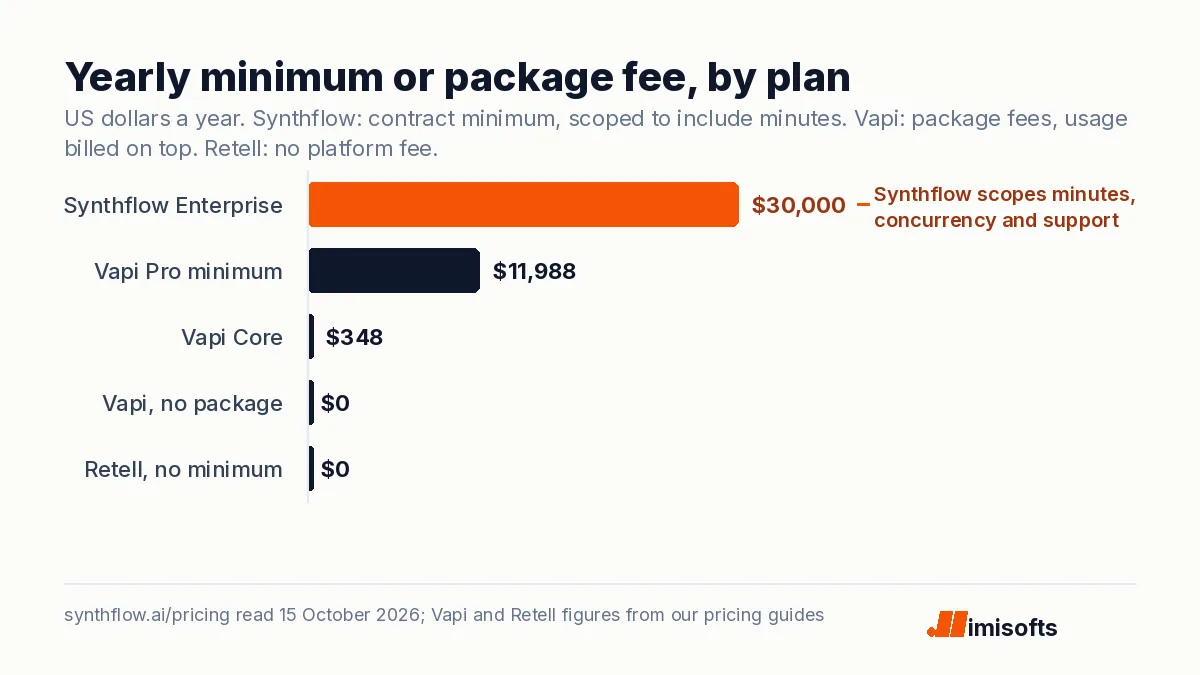
The clearest difference is the minimum commitment. Vapi charges $0.05 a minute in hosting plus provider costs, with packages from $0 and a $999 monthly minimum on its Pro tier, per our Vapi pricing guide. Retell has no platform fee or minimum and a standard build of about $0.149 a minute, per our Retell AI pricing guide.
For scale, $30,000 would pay for about 200,000 minutes a year at Retell's standard-build rate, or about 233,000 to 366,000 minutes at the two ends of Vapi's example range, before any build or support costs. Whether Synthflow's contract is better value depends on the minutes, concurrency and services it includes, which Synthflow scopes per customer. Ask for that breakdown in writing, and compare it with our Vapi vs Retell comparison before you sign.
Who Synthflow suits now
The pricing page is aimed at enterprises: teams that need an SLA, a security review, procurement paperwork and a vendor that runs implementation for them. For those buyers, the contract bundles implementation, onboarding, testing, training and launch support, work you would otherwise staff yourself or pay an agency for on a self-serve platform.
A small business testing an AI receptionist, or an agency that wants to resell minutes, will find the published-price platforms easier to start with. Our AI receptionist cost guide compares vendors that publish prices for smaller volumes, our guide to the best AI answering services for HVAC compares tools that book jobs for trades businesses, and our list of HIPAA-compliant AI receptionists covers medical practices. Our AI voice agents team can also scope the platform to your call volume before you commit to anyone.
How to budget without a published price
When a vendor quotes rather than publishes, work out your own effective rate per minute and compare like with like:
- Estimate monthly minutes: calls a month multiplied by average call length.
- Add the hidden usage: unanswered outbound dials at 5 seconds each, and chat messages divided by 5.
- Find your peak-hour concurrency, because it drives the tier you need on every platform.
- Divide the annual contract by the minutes you will really use. As an illustration only, if a $30,000 contract covered 9,000 minutes a month, the effective rate would be about 28 cents a minute, nearly double Retell's standard build.
- Add the build and support you would otherwise pay for, since Synthflow's contract includes implementation and onboarding.
Questions to ask before you sign
- How many minutes and concurrent calls does the contract include, and what is the overage rate per minute?
- Do unused minutes carry over, and on what terms?
- Which telephony is included, and are carrier minutes billed on top?
- What usage alerts or hard limits can be set, given that threshold invoices are not caps?
- Which usage draws down the allocation: chat messages, unanswered outbound dials and test simulations?
- If you are on legacy billing today, what changes when your agreement renews?
- How are outbound calls handled for consent and calling-hour rules, which in the US come from the TCPA and state laws?
That last point applies whichever platform you choose. Our TCPA-compliant AI calling setup covers consent records, calling windows and opt-outs, and our guide to telemarketing laws by state sets out the stricter state rules.
Frequently Asked Questions
Synthflow's pricing page lists Enterprise contracts starting at $30,000 a year, with the final price scoped around call volume, concurrency, telephony setup, integrations, security needs and launch support. It does not publish a per-minute price.
Its pricing page lists only the Enterprise option, and its documentation describes the pricing model as sales-led. Some existing workspaces still run on legacy billing, governed by their agreement.
Calls are measured per second from connection, with partial seconds rounded up, and seconds are added across calls so that each full minute is billed. No-answer and hang-up-on-voicemail calls count as a flat 5 seconds, failed and user-canceled calls are not billed, and billing stops when a transfer completes.
Synthflow's documentation says in-product reselling was removed on 15 September 2026, so Synthflow no longer bills an agency's subaccounts. Agencies that resold through it now bill their clients themselves.
It has a higher entry point: $30,000 a year against no minimum on Retell and packages from $0 on Vapi. For scale, $30,000 covers about 200,000 minutes a year at Retell's standard-build rate and about 233,000 to 366,000 at Vapi's example range, but Synthflow's contracts include scoped implementation and support, so compare the full quote.
Every 5 AI-generated chat messages count as 1 usage minute, billed at the rate in your agreement. Test simulations are measured separately from live usage.