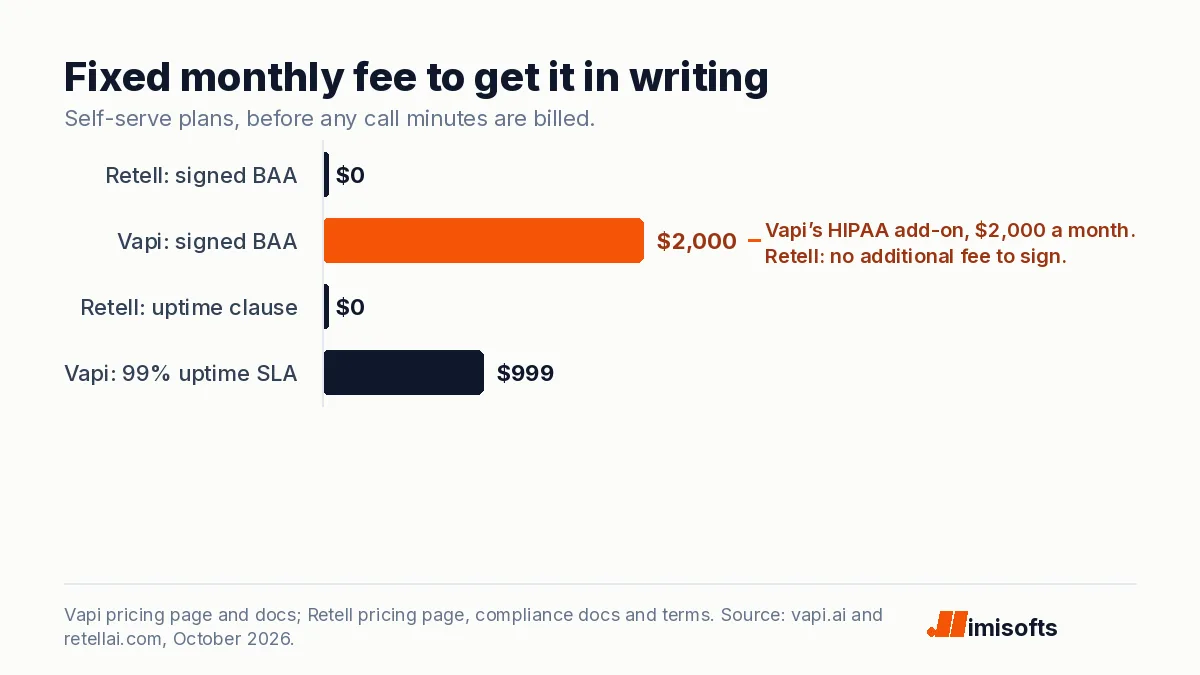
Vapi and Retell sit in the same price range per minute, so choose on the contract. Retell’s pay as you go plan includes a BAA you can self-sign at no additional fee and terms that name a 99.5% uptime target, while Vapi charges $2,000 a month for its BAA and puts its first uptime SLA, 99%, on a package with a $999 monthly minimum. Pick Retell for one self-serve contract covering HIPAA, uptime and the calling rules, and Vapi if your engineers want control of every layer and you can pay for the paperwork.
Google’s AI Overview for “vapi vs retell” compares setup speed, flexibility, telephony features and pricing structure. On 7 October 2026 I read the contracts instead: both companies’ terms of service, pricing pages, trust centers and compliance docs.
Both contracts put what the agent says on you. Only one charges $2,000 a month for the HIPAA paperwork.
Key numbers
| Item | Number |
|---|---|
| Vapi hosting fee, per minute (providers billed at cost) | $0.05 |
| Retell voice agents, per minute | $0.07 to $0.31 |
| Vapi HIPAA add-on with BAA, per month | $2,000 |
| Retell BAA, self-signed (no additional fee) | $0 |
| Vapi Pro package minimum, per month (first uptime SLA, 99%) | $999 |
| Retell uptime target in its standard terms (commercially reasonable efforts) | 99.5% |
| Retell maintenance excluded from uptime, per month | Up to 6 hours |
| Concurrent calls included, Retell pay as you go | 20 |
| Concurrent calls included, Vapi without a package (10 on Core, 30 on Pro) | 4 |
| Vapi raw call data retention without a package | 14 days |
| Retell data retention by default (1 to 730 days if set) | Indefinite |
| Retell addendum: Do Not Call scrub at least every | 31 days |
Read on 7 October 2026 from Vapi’s pricing page, documentation, trust center and terms of service (updated 14 September 2026), and from Retell’s pricing page, documentation, trust center and terms of service (updated 1 June 2026).
The mistake: comparing the demo, not the contract
Per minute, the two are close. Vapi charges $0.05 a minute for hosting and passes the speech, model and voice providers through at cost; its own estimator puts 1,000 minutes at $82 to $129 with its default providers. Retell charges $0.07 to $0.31 a minute, or $70 to $310 for the same 1,000 minutes, depending on the model and voice. The all-in math for six platforms is in our AI voice agent cost comparison.
Capacity favors Retell at the low end: 20 calls at once on pay as you go, against 4 on Vapi without a package, 10 on the $29 Core package and 30 on Pro, with extra lines at $10 a month each. The differences that cost real money show up later, in writing.
Setup speed, flexibility, telephony features, pricing structure.
What Google’s AI Overview for the query compares.
Uptime clause, BAA price, calling duties, data defaults, number exit.
Where Vapi and Retell differ in writing.
Uptime: a clause in the terms or a package you buy
Retell’s terms, last updated on 1 June 2026, say in section 12 that it “shall use commercially reasonable efforts to maintain at least 99.5% uptime,” excluding scheduled maintenance of up to six hours a month and force majeure. The clause sits in the standard terms, so it covers pay as you go. It is an efforts standard, and the terms name no service credit.
Vapi’s docs say usage only accounts get “no response or uptime service-level agreement,” and the $29 Core package adds a response SLA only. The first uptime number is 99% on Pro, priced at 10 percent of your Vapi hosting fee with a $999 monthly minimum; Premier, sold through sales, carries 99.9%. Neither Vapi’s terms nor its pricing page mentions a service credit.
In a 30-day month, 99% allows 7 hours 12 minutes of downtime and 99.5% allows 3 hours 36 minutes, before Retell’s maintenance window. What three vendors put in writing about outages is in AI receptionist downtime; plan call forwarding as the fallback either way.
HIPAA, SOC 2 and card data
This is the biggest gap in dollars. Retell’s compliance docs say its BAA and DPA are available for self-signing on its agreements portal and that “there is no additional fee to sign these agreements.” Vapi sells HIPAA as an add-on at $2,000 a month, which covers its standard DPA and BAA, and emails the BAA for signature. The full BAA price ladder is in our list of HIPAA compliant AI receptionists.
On audits they tie. Vapi’s trust center reports a SOC 2 Type II and a SOC 3 covering 1 July 2025 to 31 July 2026, and Retell’s docs say it holds SOC 2 Type 1 and Type 2.
Card data splits them the other way. Vapi’s trust center lists PCI DSS v4.0.1, each assistant has a PCI mode that is off by default, and Vapi documents a squad pattern that switches recording off while a card is read. Retell’s security and compliance page does not mention PCI, and its PII scrubbing, which covers card numbers, runs after the call completes. More in can an AI receptionist take card payments.
Calling rules: Retell writes them into your contract
Retell’s terms end with Addendum 1, thirteen sections of calling, texting and AI voice terms that form part of the contract. They require prior express written consent for telemarketing, a National Do Not Call Registry scrub at least every 31 days, opt-outs honored within 30 days, calls between 8 a.m. and 9 p.m. local time, revocations processed within 10 business days and consent records kept for five years, which Retell says it does not store.
Vapi’s terms name the TCPA once, in section 9, where you agree to indemnify Vapi for losses from breaking it. Its TCPA Consent Guide lives in the docs and says it is not legal advice and does not cover the federal Do Not Call rules or state law.
Neither platform makes a call legal, and both contracts put what the agent says and does on you. Vapi’s terms deem its Service Actions “performed on your behalf” and make you responsible for their outcomes; Retell’s say AI-generated content “may contain errors, inaccuracies, or unintended outputs.” Both cap their liability at about what you paid over the previous 12 months, as I explain in AI voice agent liability. Our TCPA compliant AI calling page covers the build that carries those duties.
Your data and your number when you leave
The defaults run in opposite directions. Vapi keeps raw call data for 14 days without a package, 30 on Core and 180 on Pro; Retell keeps transcripts, recordings and logs indefinitely unless you set a retention period between 1 and 730 days. One deletes records you may need; the other keeps data you may not want.
Vapi’s free numbers are inbound only and, in Vapi’s words, cannot be ported to another carrier. Retell sells US numbers at $2 a month, calls them “yours once purchased” and bills them until you release them; its terms say that to cancel you must remove them before the period ends, or the plan renews. More in can you keep your number after canceling.
Four checks before you sign either one
Price the paperwork first
If health information will touch the call, the BAA decides the budget: no fee on Retell, $2,000 a month on Vapi. Sign it before a test call carries real patient data.
Decide whether you need uptime in writing
On Vapi that means Pro, with a $999 monthly minimum, for 99%. Retell’s 99.5% clause comes with pay as you go but is an efforts standard with no named credit. Set call forwarding as the fallback either way.
Give the calling duties an owner
On Retell the 31-day registry scrub, 10-business-day revocations and five years of consent records are contract terms. Vapi’s terms list none of them, but the laws behind them still apply to your calls. Name the person who runs them before the first campaign.
Set retention and number ownership on day one
On Retell set a retention period, because the default keeps everything. On Vapi, export what you need within 14 days or buy a package with longer retention. On both, put any number you mean to keep in a carrier account you hold.
The bottom line
My read: for a small business buying its first voice agent, Retell’s self-serve contract puts more in writing for no fixed fee: a BAA, an uptime clause and the calling rules. Vapi earns its $2,000 BAA and $999 SLA when engineers want control of every layer and card data handled inside the platform. I have built inbound and outbound calling for more than 200 businesses, and a platform cannot make a call legal; consent, list scrubbing and disclosure do. For HVAC, plumbing or roofing, see what a managed build costs in AI call answering for home services, or compare AI answering services for HVAC.