Short answer. SaaS lead generation now starts before a buyer reaches your website. In G2's March 2026 survey of 1,076 software buyers, 51% said they start research in an AI chatbot more often than in Google, against 29% in G2's 2025 Buyer Behavior Report, and G2's 2026 Buyer Behavior Report found that review sites (38%) and AI chatbots (37%) are the two biggest influences on a shortlist. A plan that works has three layers: be the answer where buyers research, capture the people who raise a hand and reply within minutes, and run outbound to the accounts that fit but have not raised a hand yet. Paid search fills the gaps at a price: LocaliQ's 2026 benchmarks put the average search ad lead at $66.69 across industries and $93.69 for business services.
Key numbers
| Item | Number |
|---|---|
| Software buyers starting research in an AI chatbot (more often than Google, G2 survey of 1,076, March 2026) | 51% |
| The same measure in G2's 2025 report (G2 2025 Buyer Behavior Report) | 29% |
| Buyers who sourced recommendations from an AI chatbot (in the last two years, G2 2026) | more than 80% |
| Top shortlist influence: review sites (G2 2026) | 38% |
| Second shortlist influence: AI chatbots (G2 2026) | 37% |
| Buyers for whom evaluation is the longest stage (research 36%, decision 22%) | 40% |
| Biggest delay after choosing a vendor: IT security review (budget approval 32%) | 39% |
| B2B websites that answered a demo request (RevenueHero test, published March 2024) | 365 of 1,000 |
| Average search ad cost per lead, business services (LocaliQ 2026) | $93.69 |
Read on 27 October 2026 from G2's 15 April 2026 Answer Economy release and its 2026 Buyer Behavior Report page, RevenueHero's March 2024 test and LocaliQ's 2026 search benchmarks.
Where software buyers look now
G2's two 2026 studies are a large recent read on how software gets bought. G2 runs a software review site, so it has a stake in some of these findings, but both samples run to more than 1,000 buyers:
- 51% of buyers start research in an AI chatbot more often than in Google, 71% use a chatbot at some point in their research, and 61% use AI search and Google side by side (The Answer Economy, April 2026).
- More than 80% of buyers have sourced software recommendations from an AI chatbot in the last two years (2026 Buyer Behavior Report, a survey of more than 1,000 buyers and decision makers).
- The top influences on a shortlist are review sites at 38% and AI chatbots at 37%.
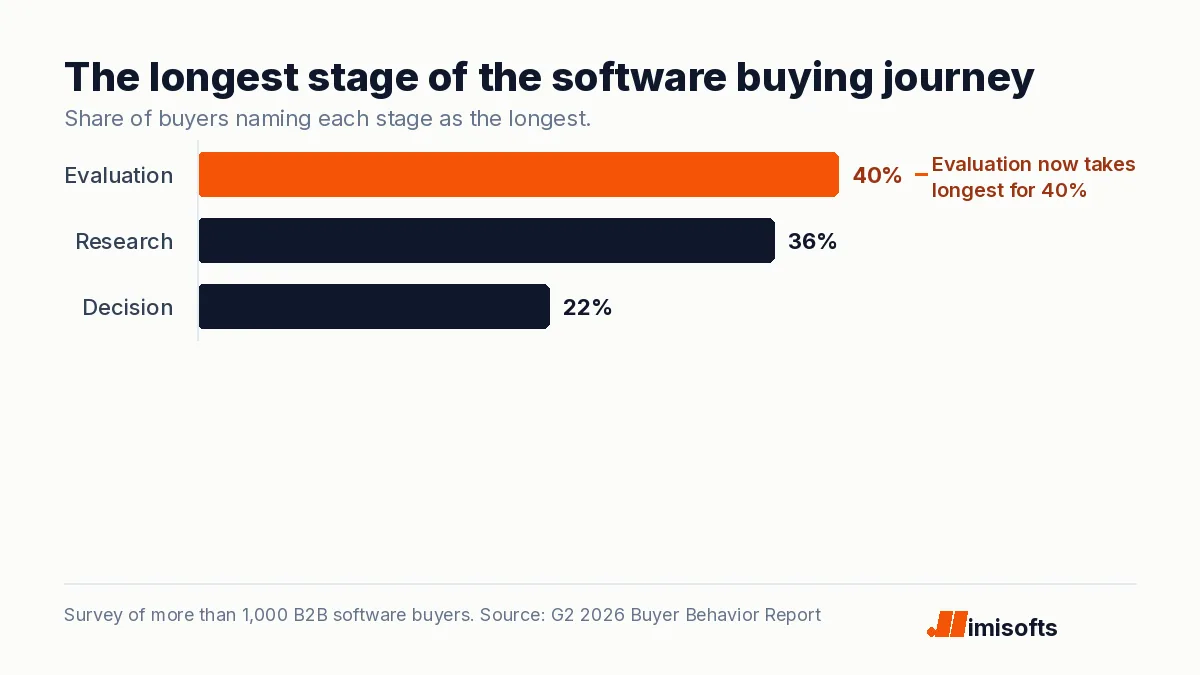
- Evaluation is now the longest stage of the journey for 40% of buyers, ahead of research at 36% and the decision itself at 22%.
- Once a vendor is chosen, IT security review is the biggest source of delay (39%), followed by budget approval (32%) and implementation planning (25%).
Add 6sense's finding that 94% of B2B buying groups rank their preferred vendors before first contact (more in demand generation vs lead generation) and the job becomes clear: much of the selling happens on pages you do not control, before anyone books a demo.
Layer 1: be the answer before the click
AI answers. When a buyer asks a chatbot for the best tool for a job, the answer draws on pages the assistant can find and read, such as comparison pages, review profiles, documentation and independent mentions. Publish clear pages on what you do, who it is for, what it costs and how you compare with named alternatives, and make sure AI crawlers can reach them. Our guides to getting recommended by ChatGPT and whether llms.txt works cover the details.
Review sites. With review sites leading shortlist influence, an empty or stale profile costs deals. The market is consolidating, too: G2 agreed in January 2026 to acquire Capterra, Software Advice and GetApp from Gartner and said the combined business would offer a new pay-per-lead product, as Demand Gen Report covered. Capterra's own pay-per-click terms now run through a G2 Digital Markets account and require a paid Sponsored Profile and approval before you can buy clicks. Ask your happiest customers for reviews every quarter, reply to every review, and keep your pricing and screenshots current.
Evaluation pages. Because evaluation is the longest stage for 40% of buyers and security review the biggest single delay, the pages that win deals are often the plain ones: a security and compliance page, a data processing agreement ready to download, integration documentation and a pricing page that answers what the product will cost a company of the buyer's size.
Layer 2: capture hand-raisers and reply fast
A buyer who requests a demo has done most of their research and is now testing how you treat them, and many B2B companies fail that test. In a test RevenueHero published in March 2024, only 365 of 1,000 B2B websites replied to a demo request, and the average reply took more than a day. Three fixes cover most of the gap:
- Let qualified buyers book on the spot. Show a calendar on the thank-you page for companies that match your ideal customer profile.
- Route and respond in minutes. Assign the lead instantly and call or email within five minutes during business hours; our guide to speed to lead shows what the research measured.
- Treat trials as leads. A free trial sign-up is a raised hand. Watch what each account does in its first week and reach out when it reaches the step that predicts conversion for your product.
Layer 3: outbound to accounts that fit
Inbound only reaches buyers who are already looking. Outbound reaches the accounts that fit your product but have not started a search, which matters when only a small share of any market is buying at a given time. A SaaS outbound program needs a tight ideal customer profile, clean contact data, a sending setup that protects your main domain and messages tied to a trigger, such as a new hire, a funding round or a tool the account just adopted. Our playbook for cold email for SaaS companies covers the messaging, and our email infrastructure service covers the sending side; for what mailboxes cost, see our email hosting cost guide.
LinkedIn works alongside email: a founder or product leader who posts useful material builds familiarity, and LinkedIn Ads can reach the same accounts from a minimum of $10 a day per campaign.
Lead magnets that still work for SaaS
We favor offers buyers can use right away over long gated e-books. Formats that can earn contact details or repeat visits:
- Free tools and calculators. A pricing calculator, ROI estimate or checker that solves one small problem in your product's area. Our own free SPF, DKIM and DMARC checker and DNS propagation checker work this way for our email services.
- Templates and playbooks. A working spreadsheet, policy template or checklist your buyer would otherwise build from scratch.
- Interactive demos. A product tour buyers can click through without booking a call, which suits a long evaluation stage.
- Benchmarks from your own data. Anonymized numbers only you can publish give reviewers, journalists and AI answers a reason to cite you.
Ask for an email only when the asset is worth it, and route anyone from a target account straight to sales.
What each channel costs to run
| Channel | How you pay | What we could verify on 27 October 2026 |
|---|---|---|
| Search ads | Per click | Average cost per lead of $66.69 across industries and $93.69 for business services (LocaliQ, 2026) |
| LinkedIn Ads | Per impression or click | $10 minimum daily budget; $100 minimum lifetime budget for a new campaign |
| Capterra pay per click | Per click | Requires a paid Sponsored Profile and approval; we did not find a public rate card |
| Outbound email | Domains, mailboxes, data and tools | Broken down in our cold email cost per lead guide |
| AI answer visibility | Content, PR and technical work | No media cost; the cost is time and expertise |
The cheapest channel on paper is rarely the cheapest per customer. Compare channels on pipeline created per dollar, and give channels that build familiarity, such as AI answers and review profiles, a full quarter before you judge them.
The numbers that tell you it is working
- Pipeline by source, not leads by source. A channel that brings fewer leads that close is the better channel.
- AI-referred visits and sign-ups. Separate ChatGPT, Gemini and Perplexity traffic in GA4 (here is how); with half of buyers starting research in a chatbot more often than in Google, this is an early signal.
- Speed to lead, as a median in minutes, by source.
- Demo-to-close rate and sales cycle length, by source.
- Review count and recency on the sites your buyers read.
A 90-day SaaS lead generation plan
- Weeks 1 and 2: write down your ideal customer profile, set up source tracking and AI-traffic reporting, and measure your current speed to lead.
- Weeks 3 to 6: publish or fix the evaluation pages (pricing, security, comparisons, integrations), refresh your review profiles and ask ten customers for reviews, and start one outbound sequence to 200 well-chosen accounts.
- Weeks 7 to 12: add instant booking and routing, test search ads on your highest-intent terms, and put more behind whichever source shows the best pipeline per dollar.
How imisofts can help
We help SaaS teams with all three layers: AI search optimization that works to get your product named in chatbot answers, outbound lead generation on a sending setup we build and manage, and, for teams still building, SaaS launch support from MVP to first customers.
Frequently Asked Questions
SaaS lead generation is the work of finding and attracting companies that could buy your software and turning their interest into demos, trials or sales conversations. Today it covers being visible where buyers research, including AI chatbots and review sites, capturing demo and trial requests and replying fast, and outbound to accounts that fit.
The channels that match how buyers research: AI answers and review sites, which G2's 2026 report found are the top two influences on shortlists at 37% and 38%; your own evaluation pages such as pricing, security and comparisons; fast-response demo and trial flows; targeted outbound email; and search and LinkedIn ads to fill gaps. Judge each on pipeline per dollar, not leads.
They are now where research starts for many buyers. In G2's March 2026 survey of 1,076 software buyers, 51% said they start research in an AI chatbot more often than in Google, against 29% in G2's 2025 report. In G2's 2026 Buyer Behavior Report, more than 80% of buyers had sourced software recommendations from a chatbot in the last two years, so a product that is not named in those answers can miss the shortlist.
G2 announced on 29 January 2026 that it would acquire Capterra, Software Advice and GetApp from Gartner. Capterra's own pay-per-click terms now refer to a G2 Digital Markets vendor account, and G2 said the combined business would offer a new pay-per-lead product.
Within minutes during business hours. Research published in Harvard Business Review found that firms trying to reach a lead within an hour were nearly 7 times as likely to qualify it as firms trying an hour later, yet in a test RevenueHero published in 2024, only 365 of 1,000 B2B websites replied to a demo request and the average reply took more than a day.
It depends on the channel. LocaliQ's 2026 benchmarks put the average search ad lead at $66.69 across industries and $93.69 for business services, LinkedIn Ads need a budget of at least $10 a day per campaign, and Capterra's pay-per-click program requires upgrading to a paid Sponsored Profile first. Outbound email and AI search visibility cost mainly setup, data, content and time.