Short answer. Demand generation makes the right buyers know and prefer you before they need you; lead generation collects the details of people who are ready to talk now. You need both, and two numbers explain why. Research by John Dawes of the Ehrenberg-Bass Institute, published by LinkedIn's B2B Institute, estimates that only about 5% of B2B buyers are in the market at any one time. And in 6sense's 2025 survey of more than 4,000 buyers, 94% of buying groups had ranked their preferred vendors before first contact and then bought from that favorite 77% of the time. Lead generation harvests the 5% who are buying now; demand generation decides whether you are on the list when the other 95% start. We usually suggest that small B2B teams fund lead generation first for cash flow and shift budget toward demand over time; Les Binet and Peter Field's analysis for LinkedIn found B2B brands grow best with about 46% of budget on brand building and 54% on activation.
Key numbers
| Item | Number |
|---|---|
| B2B buyers in the market at any one time (Dawes, Ehrenberg-Bass, for the B2B Institute, 2021) | about 5% |
| Buying groups ranking vendors before first contact (6sense, 2025) | 94% |
| Purchases that went to that preliminary favorite (6sense, 2025) | 77% |
| Average B2B buying cycle, 2025 (down from about 11 in 2024) | about 10 months |
| Software buyers starting research in an AI chatbot (more often than Google, G2 March 2026 survey) | 51% |
| B2B budget split found to grow brands best (Binet and Field for LinkedIn, 2019) | 46% brand building, 54% activation |
| Average search ad cost per lead, all industries (LocaliQ 2026) | $66.69 |
| LinkedIn Ads minimum daily budget (any ad format; $100 lifetime minimum for a new campaign) | $10 |
| Marketing budget as a share of company revenue, 2026 (Gartner, mostly companies above $1 billion) | 7.8% |
Read on 27 October 2026 from Marketing Week (B2B Institute, 2021), LinkedIn (2019), 6sense's 12 November 2025 report release, G2 (15 April 2026), LocaliQ's 2026 search benchmarks, LinkedIn's budget guide and Gartner's 11 May 2026 release.
The difference in one table
| Demand generation | Lead generation | |
|---|---|---|
| Goal | Be known and preferred before buyers are in the market | Capture contact details from buyers who are ready now |
| Who it reaches | The whole target market, including the 95% not buying yet | People showing intent: searching, downloading, replying |
| Typical tactics | Thought leadership, LinkedIn and video ads, podcasts, events, PR, being named in AI answers | Search ads, gated content, demo forms, outbound cold email, appointment setting |
| What you measure | Branded search, direct traffic, answers to "how did you hear about us", win rate | Leads, cost per lead, meetings booked, pipeline |
| When it pays back | Over months, and the effect lasts | Within days or weeks, and it stops when spending stops |
The last row is the trade-off. Lead generation is a tap you can turn on and off. Demand generation behaves more like an asset: Binet and Field's analysis, published by LinkedIn in 2019, describes brand effects that take more investment and pay back more slowly, but last much longer and make later activation more effective.
The 95:5 rule and what it does to your budget
In a 2021 column for Marketing Week, Peter Weinberg and Jon Lombardo of LinkedIn's B2B Institute summarized Dawes' finding: only 5% of B2B buyers are in-market right now, so 95% of the buyers you reach will not buy for months or even years. The exact share will differ by category, depending on how often its buyers switch or renew. The same column reports that 95% of B2B marketers expect significant sales within the first two weeks of a campaign.
Put those together and the trap is easy to see. A campaign judged on two-week sales can only win with the 5%, so budget drifts toward lead generation, every competitor bids for the same small group of active buyers, and cost per lead rises. Meanwhile nobody is building familiarity with the 95% who will be buying in the months or years ahead.
Buyers pick a favorite before they talk to you
6sense's 2025 Buyer Experience Report, based on more than 4,000 buyers in North America, EMEA and Asia Pacific, found that:
- 94% of buying groups ranked their preferred vendors before first contact.
- They bought from that preliminary favorite 77% of the time.
- Buying cycles shortened from about 11 months in 2024 to about 10 months in 2025.
- The split between independent research and seller engagement moved from 70/30 to 60/40.
- 89% of purchases included AI features.
That list is the case for demand generation: by the time a buyer fills in your form, the shortlist is usually set. Where that shortlist forms is changing too. In G2's March 2026 survey of 1,076 software buyers, 51% said they start their research in an AI chatbot more often than in Google; in G2's 2025 Buyer Behavior Report the figure was 29%. Being named in those answers is now part of demand generation, and we explain how in how to get ChatGPT to recommend your business.
What each one costs
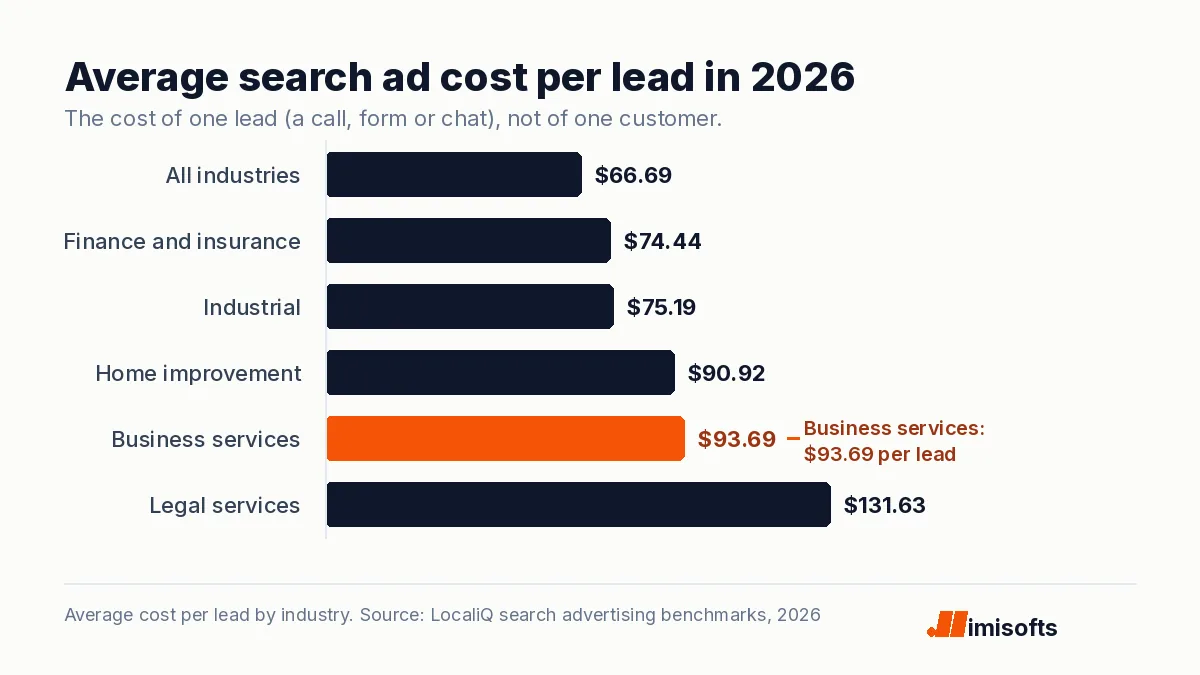
Lead generation is easier to price because it is sold per lead or per click. LocaliQ's 2026 benchmarks put the average lead from search ads at $66.69 across industries, with business services at $93.69, finance and insurance at $74.44 and legal services at $131.63. That is the cost of a call or form, not of a customer.
Demand generation is priced by reach and time. LinkedIn, a common paid channel for B2B demand, sets a minimum daily budget of $10 for any ad format and a $100 minimum lifetime budget for a new campaign, so one campaign left running all month needs a budget of about $300 at the minimum before you know whether it works. Most of the cost of demand generation is usually people and content: the articles, videos, webinars and research that give buyers a reason to remember you.
For scale, Gartner's 2026 CMO Spend Survey found marketing budgets at 7.8% of company revenue, up from 7.7% in 2025, with 15.3% of marketing budgets going to AI. Most of its 401 respondents work at companies with more than $1 billion in annual revenue, so treat it as a reference point, not a target for a ten-person firm.
Which to fund first
There is no single right split, but the stage of the business narrows it down:
- Pipeline is thin and cash matters this quarter. Fund lead generation first: outbound to a tight list of accounts, search ads on high-intent terms and fast follow-up. Keep a small, steady demand base, such as a founder posting on LinkedIn every week and one useful article a week.
- Pipeline is steady but cost per lead keeps rising. You are probably competing for the same 5%. Move budget toward demand generation in steps and watch branded search and inbound win rates.
- Plenty of attention, few meetings. This is the reverse problem: demand without capture. Add clear offers, fast response and outbound to the accounts that engage.
Over time, Binet and Field's B2B guide of about 46% brand and 54% activation is a sensible direction for most firms. A young startup will sit much closer to activation for its first year or two.
Demand generation a small team can run
Demand generation does not need a big budget, but it does need consistency, because its effect builds through repetition. Programs that fit a team of five to fifty:
- Founder-led LinkedIn. One useful post a week from the founder or a senior expert, built on real numbers from client work, reaches the buying committees you want at no media cost.
- A recurring piece of research. A yearly benchmark, a pricing survey or a "state of" report gives journalists, partners and AI answers a reason to cite you.
- Free tools. A calculator, checker or template that solves one small problem keeps your name in front of buyers long before they need the bigger service. We built a free DNS propagation checker for that reason.
- Guest spots. Podcasts, partner webinars and newsletters in your niche borrow someone else's audience of the right buyers.
- Answer-ready pages. Clear pages on what you do, what it costs and how you compare make it easier for AI assistants and buyers to describe you correctly.
Pick two, run them every week for six months, and judge them on the signals in the next section rather than on leads in the first month.
How to measure demand generation without fooling yourself
Demand generation fails when it is judged on last-click leads, because its job is to make the other channels work. Better signals:
- Branded search. In Google Search Console, filter queries with a regular expression such as
yourbrand|your brandand track impressions month by month. - Direct and AI-referred traffic. Set up GA4 to separate visits from ChatGPT, Gemini and Perplexity; our guide to tracking AI traffic in Google Analytics shows how.
- Self-reported attribution. Add a free-text "How did you hear about us?" field to your demo form and read the answers every month.
- Win rate and sales cycle. Deals from buyers who already know you should close faster and more often than cold ones. If they do not, the demand work is not landing.
Demand generation agency or lead generation agency?
Ask any agency what it is paid on. A demand generation agency should be judged on reach within your target accounts, branded search growth and pipeline influence over quarters. A lead generation agency should be judged on qualified meetings and cost per meeting, every month. Be wary of an agency that sells demand generation but reports only leads, or sells leads but cannot show who they were. Our guide to choosing a lead generation agency lists the questions to ask, and appointment setting pricing compares pay-per-meeting deals with retainers.
How imisofts can help
We work on both sides. For lead generation, we run outbound cold email campaigns and lead generation programs that book qualified meetings. For demand, our AI search optimization work aims to get your company named in the answers ChatGPT, Gemini and Perplexity give when buyers research your category.
Frequently Asked Questions
Demand generation builds awareness and preference among the buyers you want, including the large majority who are not buying yet. Lead generation captures contact details from people who are ready to talk now, through search ads, forms and outbound. Demand generation pays back over months; lead generation pays back within weeks but stops when spending stops.
They overlap. Brand marketing builds memory and preference over the long term, while demand generation also includes programs that turn that preference into intent, such as webinars, research and targeted ads to accounts that fit. Binet and Field's analysis for LinkedIn found B2B brands grow best with about 46% of budget on brand building and 54% on activation.
The 95:5 rule, from research by John Dawes of the Ehrenberg-Bass Institute with LinkedIn's B2B Institute in 2021, says that only about 5% of B2B buyers are in the market to buy right now, so about 95% of the buyers you reach will not buy for months or even years. The exact share differs by category.
There is no fixed figure. Binet and Field's B2B work suggests about 46% of the marketing budget on brand building and 54% on activation over the long run, and Gartner's 2026 survey of mostly large companies put total marketing budgets at 7.8% of revenue. Young companies usually start much closer to activation and shift as their pipeline becomes steady.
A demand generation agency plans and runs programs that make target buyers aware of you and prefer you before they are in market: content, thought leadership, LinkedIn and video ads, events and, increasingly, visibility in AI answers. Judge it on reach in your target accounts, branded search growth and influence on pipeline, not only on leads.
Track branded search impressions in Google Search Console, direct and AI-referred traffic in GA4, answers to a 'How did you hear about us?' field on your demo form, and win rates and sales cycle length for buyers who already knew you compared with cold ones.