Short answer. PIPEDA, the Personal Information Protection and Electronic Documents Act, is Canada's federal privacy law for businesses. It applies to every organization that collects, uses or discloses personal information "in the course of commercial activities", and it makes them follow 10 fair information principles, report serious breaches and answer access requests within 30 days. Knowingly breaking its breach or record rules can mean a court fine of up to $100,000 (all amounts in Canadian dollars).
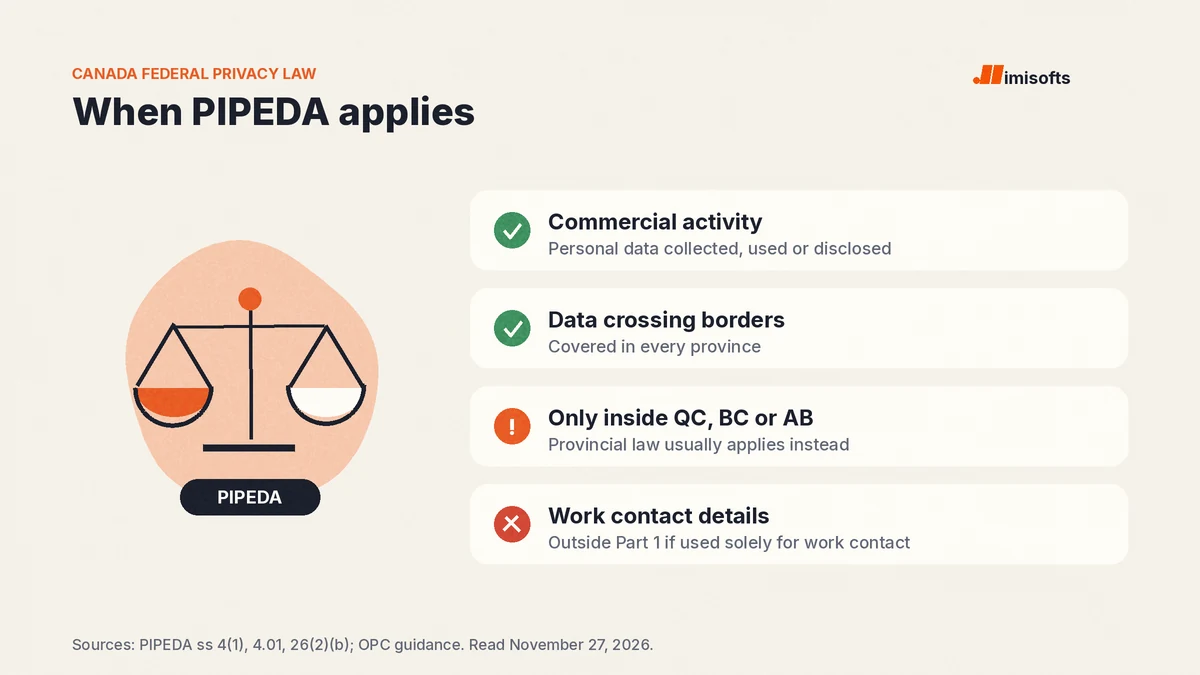
PIPEDA is still the law in force. Bill C-36, which would enact a Protecting Privacy and Consumer Data Act and amend PIPEDA, with fines of up to $25 million or 5% of global revenue (whichever is greater) for the most serious offences, had its first reading on June 15, 2026 and was listed at second reading in the House of Commons, with no debate recorded, when we checked on November 27, 2026.
This guide covers who PIPEDA applies to, where provincial laws take over, the 10 principles, consent, what it means for B2B prospect data, breach reporting, access requests, penalties and how it sits next to Canada's anti-spam law. If you run outbound into Canada, our email infrastructure service sets up the sending side. Sources were read on November 27, 2026. This is general information, not legal advice.
Key numbers
| Item | Number |
|---|---|
| Fair information principles (PIPEDA Schedule 1) | 10 |
| Access request deadline (s 8(3); up to 30 more under s 8(4)) | 30 days |
| Breach records kept (SOR/2018-64, s 6(1)) | 24 months |
| Maximum PIPEDA fine (s 28(b), indictable offence) | $100,000 |
| Summary conviction fine (s 28(a)) | $10,000 |
| Provinces with their own private sector law (Quebec, British Columbia, Alberta) | 3 |
| Bill C-36 proposed fine (Whichever is greater; ISED, June 15, 2026; not law) | $25M or 5% |
| CASL maximum penalty, organization (CASL s 20(4), per violation) | $10M |
PIPEDA and SOR/2018-64 (Justice Laws, current to November 12, 2026), SOR/2001-7 and CASL (Justice Laws); Office of the Privacy Commissioner of Canada; LEGISinfo Bill C-36; ISED backgrounder of June 15, 2026. Read November 27, 2026.
What PIPEDA is and who it covers
PIPEDA is a federal statute (S.C. 2000, c. 5). The consolidated text on Justice Laws was current to November 12, 2026 and last amended on March 4, 2025. Under section 4(1), Part 1 applies to every organization for personal information that it "collects, uses or discloses in the course of commercial activities", and to the personal information of employees and job applicants of a federal work, undertaking or business.
The Act defines a commercial activity as "any particular transaction, act or conduct or any regular course of conduct that is of a commercial character", including selling or leasing donor, membership or other fundraising lists. The Office of the Privacy Commissioner of Canada (OPC) describes personal information as "any factual or subjective information, recorded or not, about an identifiable individual."
Section 4(2) leaves out government institutions covered by the Privacy Act, an individual's personal or domestic use, and information used only for journalistic, artistic or literary purposes. The OPC adds that PIPEDA does not generally apply to non-profits, charities and political parties unless they run commercial activities that are not central to their mandate and involve personal information.
Businesses outside Canada. Being based abroad does not settle the question. In its findings on Clearview AI of February 2, 2021, the OPC wrote that "PIPEDA applies to organizations outside of Canada where a 'real and substantial connection' to Canada exists", and it found that connection in that case. In our reading, a US or UAE company that collects data on people in Canada may be covered where that connection exists.
Done for you by imisofts
Need your cold email infrastructure set up properly?
We buy and configure the domains and inboxes, set SPF, DKIM and DMARC, and warm everything up, so sending starts in about 14 days.
When PIPEDA applies and when a provincial law does
Section 26(2)(b) lets the federal Cabinet exempt organizations or activities where a provincial law "substantially similar" to PIPEDA applies. According to the OPC, Alberta, British Columbia and Quebec have private sector laws deemed substantially similar, and organizations subject to them "are generally exempt from PIPEDA with respect to the collection, use or disclosure of personal information that occurs within that province." Even in those provinces, PIPEDA still applies to "transactions involving personal information transferred across borders" and to federal works, undertakings or businesses.
| Where the data is handled | Law that usually applies | Regulator |
|---|---|---|
| Any other province (commercial data) | PIPEDA | Privacy Commissioner of Canada |
| Inside Quebec | Act Respecting the Protection of Personal Information in the Private Sector | Commission d'accès à l'information (CAI) |
| Inside British Columbia | Personal Information Protection Act (B.C.) | Office of the Information and Privacy Commissioner (OIPC) for B.C. |
| Inside Alberta | Personal Information Protection Act (Alberta) | Office of the Information and Privacy Commissioner (OIPC) of Alberta |
| Data crossing a provincial or national border | PIPEDA, in every province | Privacy Commissioner of Canada |
| Northwest Territories, Yukon, Nunavut | PIPEDA (treated as federally regulated) | Privacy Commissioner of Canada |
| Banks, airlines, telecoms, broadcasters, interprovincial transport | PIPEDA (federally regulated) | Privacy Commissioner of Canada |
Health information has its own layer: New Brunswick, Newfoundland and Labrador, Nova Scotia and Ontario have health information laws that the OPC says are "considered substantially similar to PIPEDA" for personal health information. The OPC is clear that more than one law can apply to the same business, and "when more than one law applies, you must comply with both."
The 10 fair information principles
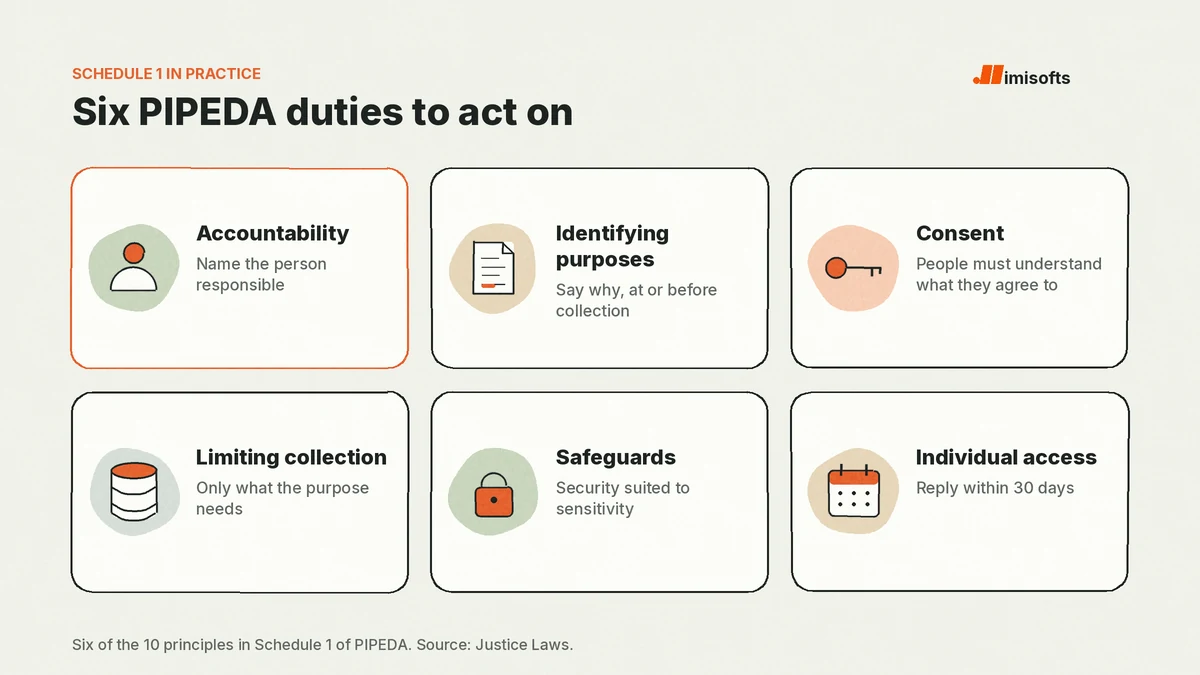
Section 5(1) says every organization "shall comply with the obligations set out in Schedule 1". Schedule 1 holds the 10 principles. Where it says "should", section 5(2) makes that a recommendation, not an obligation.
| # | Principle | What it asks of a business |
|---|---|---|
| 1 | Accountability | You are responsible for data under your control and must name a person accountable for compliance |
| 2 | Identifying purposes | Know and state why you collect the data, at or before collection |
| 3 | Consent | Get the person's knowledge and consent, except where inappropriate |
| 4 | Limiting collection | Collect only what you need for the stated purposes |
| 5 | Limiting use, disclosure and retention | Use it only for those purposes and keep it only as long as needed |
| 6 | Accuracy | Keep it as accurate and complete as the purpose requires |
| 7 | Safeguards | Protect it with security suited to its sensitivity |
| 8 | Openness | Make your policies and practices easy to find |
| 9 | Individual access | On request, tell people what you hold and let them see it |
| 10 | Challenging compliance | Give people a way to complain about your compliance |
On principle 1, the text says an organization "shall designate an individual or individuals who are accountable for the organization's compliance". On top of Schedule 1, section 5(3) adds a reasonableness test: you may collect, use or disclose personal information "only for purposes that a reasonable person would consider are appropriate in the circumstances."
How consent works under PIPEDA
Principle 3 states that "the knowledge and consent of the individual are required for the collection, use, or disclosure of personal information, except where inappropriate." Section 6.1 sets the test for valid consent: it must be reasonable to expect that the people your activities are aimed at "would understand the nature, purpose and consequences" of what they are agreeing to.
Section 7 lists the cases where data can be collected, used or disclosed without knowledge or consent. One of them, section 7(1)(d), covers information that "is publicly available and is specified by the regulations". That is narrower than "anything on the internet": the Regulations Specifying Publicly Available Information name specific sources, such as a public telephone directory where the subscriber can opt out, and a public professional or business directory, listing or notice, but only where the use "relate[s] directly to the purpose for which the information appears" there.
What PIPEDA means for B2B prospect data
For outbound teams, the most useful line in the Act is section 4.01. Part 1 "does not apply to an organization in respect of the business contact information of an individual" that it collects, uses or discloses "solely for the purpose of communicating or facilitating communication with the individual in relation to their employment, business or profession."
The Act defines business contact information as a name, position name or title, work address, work telephone number, work fax number or work electronic address. So a list of names, titles and work emails used only to contact people about their work sits outside Part 1. In our reading, three points limit how far that goes:
- The purpose must stay narrow. The word "solely" matters. Profiling, enrichment with personal details or selling the list is likely a different purpose that falls outside "solely".
- Personal data is not business data. A personal mobile number or a personal Gmail address is unlikely to count as "work" contact information.
- Harvested email addresses have their own rule. Separately from section 4.01, section 7.1(2) switches off the section 7 consent exceptions for an electronic address collected with "a computer program that is designed or marketed primarily for use in generating or searching for, and collecting, electronic addresses", and for using an address collected that way.
Even where PIPEDA does not bite, sending the email is governed by a separate law (see the CASL section below). For outbound programs, see our lead generation service. Data that is not business contact information goes back under the 10 principles, including consent.
Breach reporting: what to report, to whom and when
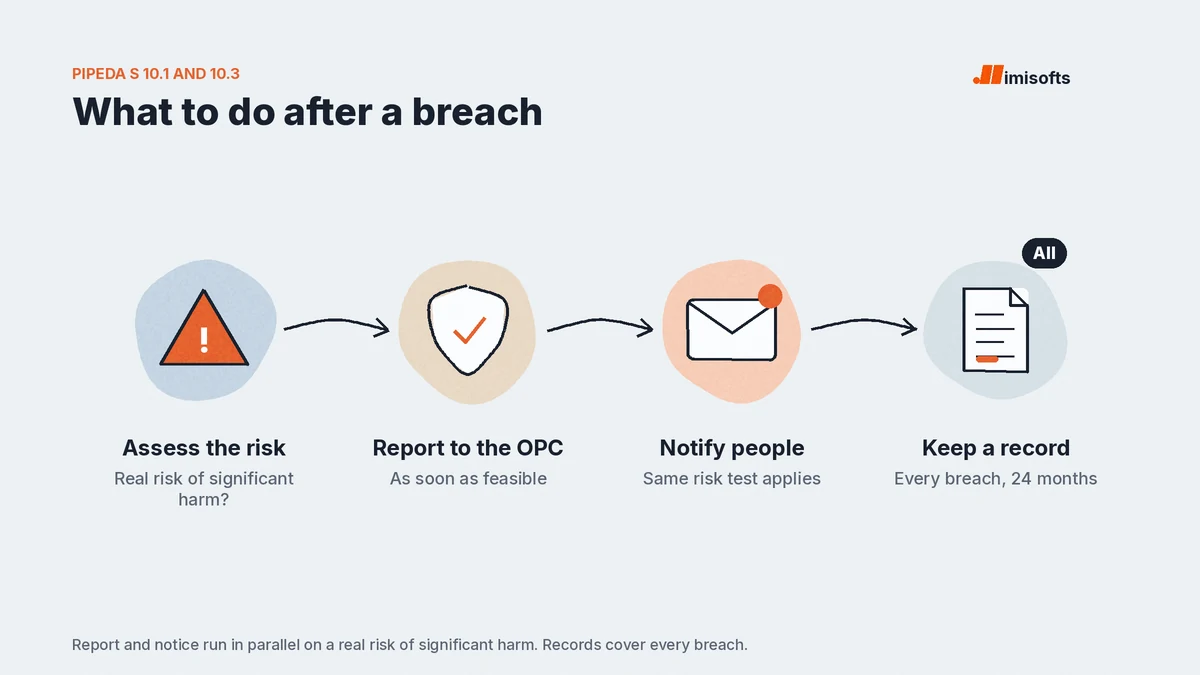
Section 10.1(1) requires an organization to report to the Commissioner "any breach of security safeguards involving personal information under its control if it is reasonable in the circumstances to believe that the breach creates a real risk of significant harm to an individual." The report goes in "as soon as feasible" after the organization determines that the breach happened. Section 10.1(3) adds a duty to notify the affected people on the same test.
The OPC's guidance lists what counts as significant harm: "bodily harm, humiliation, damage to reputation or relationships, loss of employment, business or professional opportunities, financial loss, identity theft, negative effects on the credit record and damage to or loss of property." The two factors for the risk test are the sensitivity of the information and "the probability that the personal information has been, is being, or will be, misused."
Every breach goes on record, reportable or not. Section 10.3(1) says to "keep and maintain a record of every breach", and section 6(1) of the Breach of Security Safeguards Regulations sets the period: 24 months after the day the organization determines the breach occurred. Under section 10.3(2), the organization must give the Commissioner access to, or a copy of, a record on request.
Access requests: the 30-day clock
Under principle 9, a person can ask what you hold about them and how it has been used. Section 8(3) says to respond "with due diligence and in any case not later than thirty days after receipt of the request." Section 8(4) allows an extension of up to another 30 days in limited cases, for example where meeting the deadline "would unreasonably interfere with the activities of the organization". That makes 60 days the outer limit with a valid extension.
Penalties: fines, the Federal Court and damages
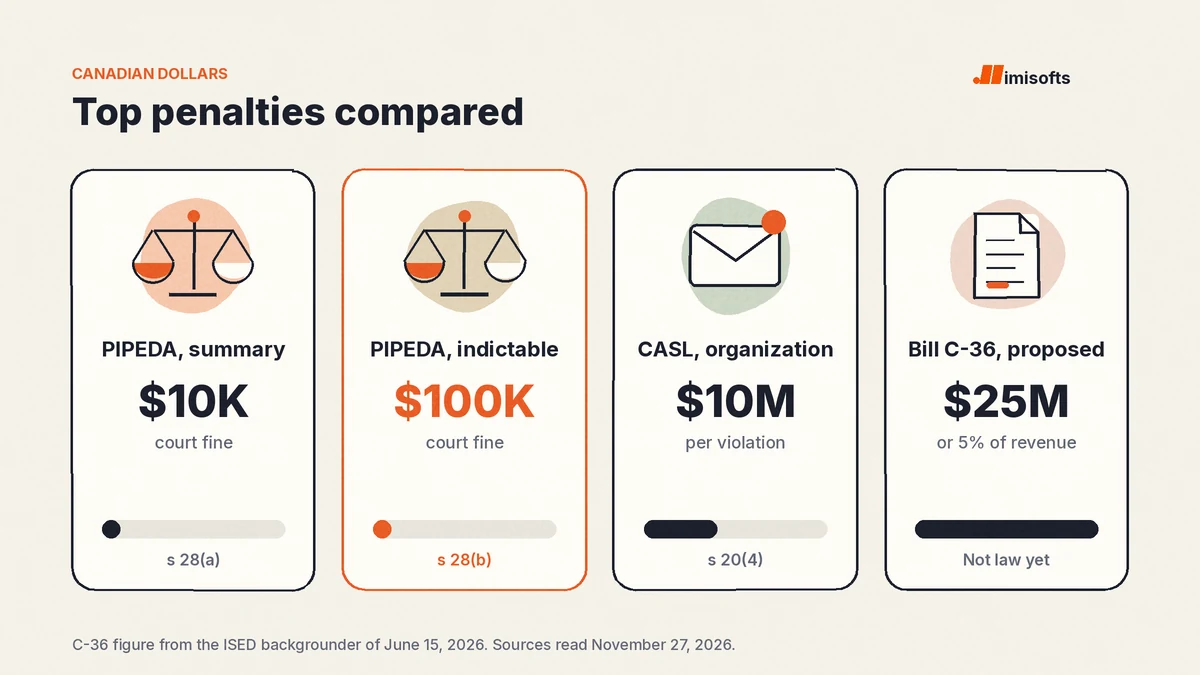
PIPEDA gives the Commissioner no power to fine. The Commissioner investigates complaints and issues findings. Consequences come in two ways:
| Route | Where in the Act | What can happen |
|---|---|---|
| Offence, summary conviction | s 28(a) | Fine of up to $10,000 |
| Offence, indictment | s 28(b) | Fine of up to $100,000 |
| Federal Court application by the complainant, after the Commissioner's report | ss 14 and 16 | Order to correct practices, order to publish a notice, damages including for humiliation |
The section 28 offences are narrow. They cover knowingly breaking section 10.1 (breach reporting and notice) or section 10.3(1) (breach records), failing to keep information that is the subject of an access request until the person has exhausted their recourse (section 8(8)), disadvantaging an employee who in good faith reports a contravention (section 27.1(1)), and obstructing the Commissioner. Other complaints lead to findings; after the Commissioner's report, the complainant can apply to the Federal Court under section 14 for the orders and damages in section 16.
What Bill C-36 would change
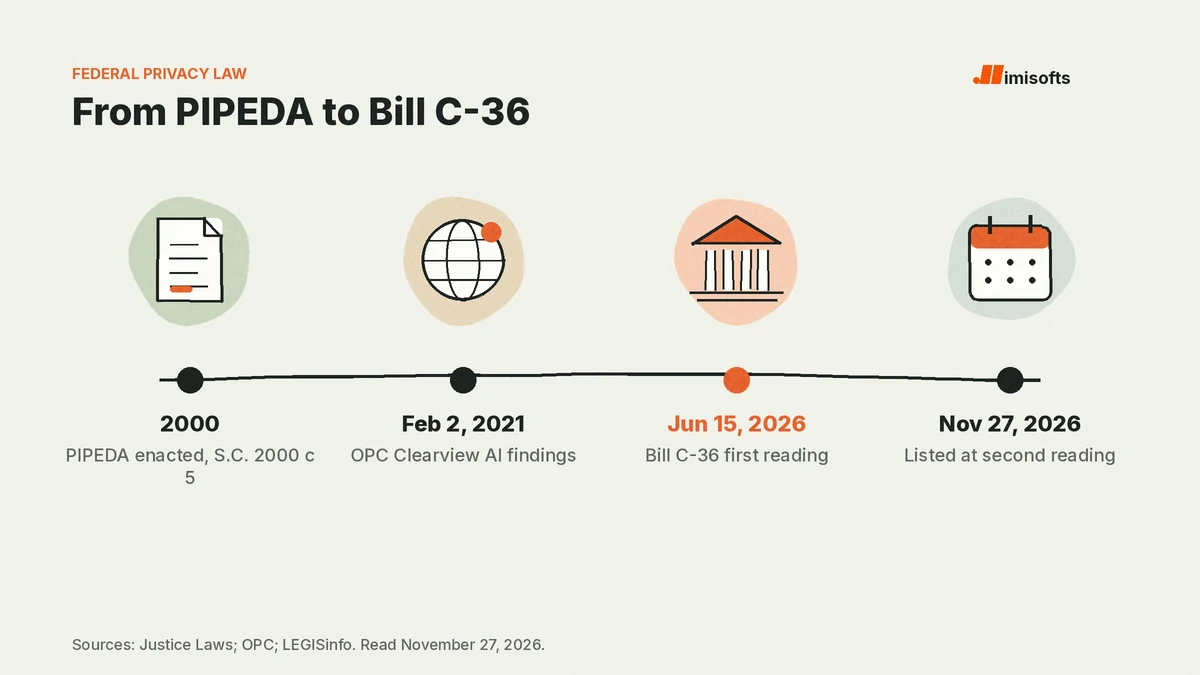
On June 15, 2026 the government introduced Bill C-36, which would enact the Protecting Privacy and Consumer Data Act and amend PIPEDA. The ISED backgrounder calls it "the most significant change to Canada's private-sector privacy law in over 25 years." According to that backgrounder, the bill would:
- create a Digital Safety and Data Protection Commission of Canada, with a Privacy and Consumer Data Commissioner, able to issue binding orders;
- allow administrative monetary penalties of up to $10 million or 3% of global revenue, whichever is greater, and fines of up to $25 million or 5% of global revenue for the most serious offences;
- enable people to request deletion of their information in certain circumstances, and support data mobility;
- require organizations to assess and mitigate privacy risks before sending personal information outside Canada.
The proposed fine floor of $25 million (or 5% of global revenue, if greater) is 250 times PIPEDA's current $100,000 maximum. On revenue terms, the 3% penalty would only exceed $10 million for a company with more than about $333 million in global revenue. LEGISinfo listed the bill at second reading in the House of Commons, with no activity recorded at that stage and no Senate stage yet, when we checked. It is a proposal, not law.
PIPEDA and CASL: two laws for one cold email
PIPEDA governs the data. Canada's anti-spam legislation, CASL (S.C. 2010, c. 23), governs the message. Section 6(1) of CASL prohibits sending a commercial electronic message unless the recipient "has consented to receiving it, whether the consent is express or implied" and the message meets the content rules. CASL's maximum penalty is $10,000,000 per violation for an organization ("any other person") and $1,000,000 for an individual (section 20(4)).
| Question | PIPEDA | CASL |
|---|---|---|
| What it regulates | Collecting, using and disclosing personal information | Sending commercial electronic messages |
| Work email of a prospect | Outside Part 1 if used solely to contact them about their work | Still needs express or implied consent and the content rules |
| Top money penalty | $100,000 court fine (s 28) | $10,000,000 per violation for an organization (s 20(4)) |
So the business contact exemption in PIPEDA does not make a cold email legal by itself. CASL's consent and content rules are covered in our guide to cold email laws in Canada. Phone outreach has its own rules in cold calling laws in Canada.
A PIPEDA checklist for a small outbound team
- Name the accountable person. Principle 1 needs a named individual.
- Map where prospect data sits. CRM, sending platform, enrichment tools and any agency. This answers access requests and breach questions. If a vendor processes data for you, a data processing agreement sets out its duties.
- Keep lists to work contact data. Name, title, work email and work phone, used only to contact people about their work. Do not buy lists built by email-harvesting software.
- Write down the purpose. One line per data set, at or before collection (principle 2).
- Set a retention rule. Delete prospects who are not a fit after a set period (principle 5).
- Prepare a breach log. Record every breach for 24 months and report those with a real risk of significant harm.
- Check CASL separately. Consent and content rules apply to every commercial email.
Your mailbox provider is one of the vendors to list. Our guide to email hosting cost compares the main providers, and what an email deliverability consultant costs covers outside help with the sending setup. Selling into the US as well? The state rules are in our CCPA compliance guide.
How imisofts can help
Our email infrastructure work sets up sending domains and mailboxes for B2B outbound teams. On a stack we set up, we can help list each tool and where it says it processes data, so your adviser has the facts in one place. The legal judgment stays with you and your adviser. See our email infrastructure service or talk to us about your setup.
Frequently Asked Questions
It is Canada's federal privacy law for businesses, the Personal Information Protection and Electronic Documents Act (S.C. 2000, c. 5). It applies to personal information collected, used or disclosed in commercial activities and requires 10 fair information principles, breach reporting and answers to access requests within 30 days.
It can. In its Clearview AI findings of February 2, 2021, the Privacy Commissioner of Canada wrote that PIPEDA applies to organizations outside Canada where a real and substantial connection to Canada exists. The OPC also says all businesses that operate in Canada and handle personal information crossing provincial or national borders in commercial activities are subject to it.
Accountability, identifying purposes, consent, limiting collection, limiting use, disclosure and retention, accuracy, safeguards, openness, individual access, and challenging compliance. They are set out in Schedule 1 of the Act, and section 5(1) makes them obligations, except where the text says "should", which is a recommendation.
Under section 28, knowingly breaking the breach reporting or breach record rules (ss 10.1 and 10.3(1)), two other provisions (ss 8(8) and 27.1(1)), or obstructing the Commissioner, can bring a fine of up to $10,000 on summary conviction or up to $100,000 on indictment. The Commissioner cannot fine; after the Commissioner's report, a complainant can also seek damages in the Federal Court.
Section 4.01 takes business contact information (name, title, work address, work phone, work email) outside Part 1 when it is used solely to communicate with the person about their work. The email itself is still governed by CASL, which requires express or implied consent.
A bill to change it is pending. Bill C-36, which would enact the Protecting Privacy and Consumer Data Act, had first reading on June 15, 2026 and was listed at second reading in the House of Commons on November 27, 2026. It would enact a Protecting Privacy and Consumer Data Act and amend PIPEDA, with penalties of up to $10 million or 3% of global revenue and fines of up to $25 million or 5%, whichever is greater in each case.