Short answer. Data anonymization means changing records so that they can no longer be linked to a person by any means reasonably likely to be used. Pseudonymized or hashed data does not meet that bar: GDPR Recital 26 says pseudonymized data is still information on an identifiable person, and the FTC wrote on July 24, 2024 that hashing does not make data anonymous. In the US, the HIPAA Safe Harbor method gives a fixed checklist of 18 identifiers to remove from health records.
The bar is high because re-identification is easy. A 2019 study in Nature Communications estimated that 99.98% of Americans would be correctly re-identified in any dataset using 15 demographic attributes. If you plan to license company records to an AI buyer, anonymization affects which privacy laws still apply to what you hand over. Our AI data licensing service page explains how we approach this with established companies.
This guide explains the legal tests in the EU, the US health sector and California, the main techniques, and a step by step process. Sources were read on November 26, 2026. This is general information, not legal advice.
Key numbers
| Item | Number |
|---|---|
| Identifiers removed under HIPAA Safe Harbor (HIPAA Privacy Rule 164.514(b)(2)(i)) | 18 |
| Americans re-identifiable with 15 attributes (Nature Communications, July 2019) | 99.98% |
| Populations in that study's tests (Rocher et al., 2019) | 210 |
| Population to keep a 3 digit ZIP (Safe Harbor, else set to 000) | more than 20,000 |
| Age above which Safe Harbor groups ages (grouped as 90 or older) | 89 |
| FTC post: hashing is not anonymization (FTC Technology blog) | July 24, 2024 |
| Duties for deidentified data in California (Civil Code 1798.140(m)) | 3 |
| Anonymization techniques compared here (HHS classes plus NIST synthetic data) | 4 |
GDPR (EUR-Lex); HHS de-identification guidance; California Civil Code 1798.140; FTC Technology blog; Nature Communications (Rocher et al., 2019); NIST SP 800-188. Read November 26, 2026.
What data anonymization means
Under the GDPR, anonymous information is information "which does not relate to an identified or identifiable natural person", or personal data "rendered anonymous in such a manner that the data subject is not or no longer identifiable". Recital 26 adds that the GDPR "does not therefore concern the processing of such anonymous information, including for statistical or research purposes."
In practice, the test is about likely means, not every possible one. To decide whether someone is identifiable, Recital 26 says to take account of "all the means reasonably likely to be used, such as singling out", by the controller "or by another person". The factors include "the costs of and the amount of time required for identification", the technology available at the time of processing, and technological developments.
The FTC uses stricter wording than Recital 26: "data is only anonymous when it can never be associated back to a person."
Pseudonymization vs anonymization
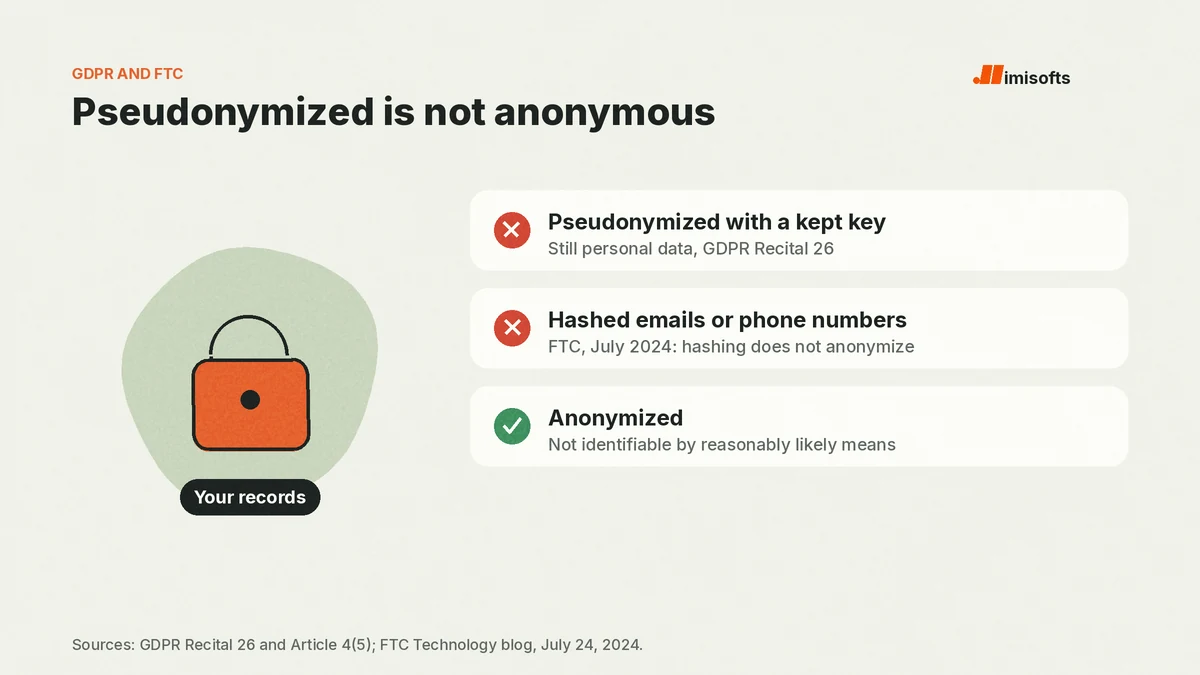
These two words are often mixed up, and the difference decides which law applies.
| Question | Pseudonymized data | Anonymized data |
|---|---|---|
| What is done | Data can no longer be attributed to a person without additional information that is kept separately (GDPR Article 4(5)) | Records are changed so the person is not or no longer identifiable (GDPR Recital 26) |
| Can it be linked back? | Yes, with the additional information | Not by means reasonably likely to be used |
| Still personal data under the GDPR? | Yes, per Recital 26 | No, the GDPR does not apply to anonymous information |
| California term | "Pseudonymize", Civil Code 1798.140(aa) | "Deidentified", Civil Code 1798.140(m) |
In our view, pseudonymization is still useful as a safeguard inside your own systems. But under Recital 26, pseudonymized records that could be attributed to a person with additional information are still treated as information on an identifiable person.
Hashing does not anonymize data. The FTC's July 2024 post says companies "should not act or claim as if hashing personal information renders it anonymized." It notes that hashes of common identifiers such as email addresses, phone numbers, IP addresses or Social Security numbers can be reversed, now "in a matter of seconds, not minutes." The post points to FTC cases against Nomi (hashed device MAC addresses, 2015) and BetterHelp (hashed email addresses shared with Facebook) as examples.
The legal tests in the EU, HIPAA and California
There is no single global standard. This guide covers three tests a US or EU company is likely to meet when preparing records for a buyer.
| Law | The test | Source |
|---|---|---|
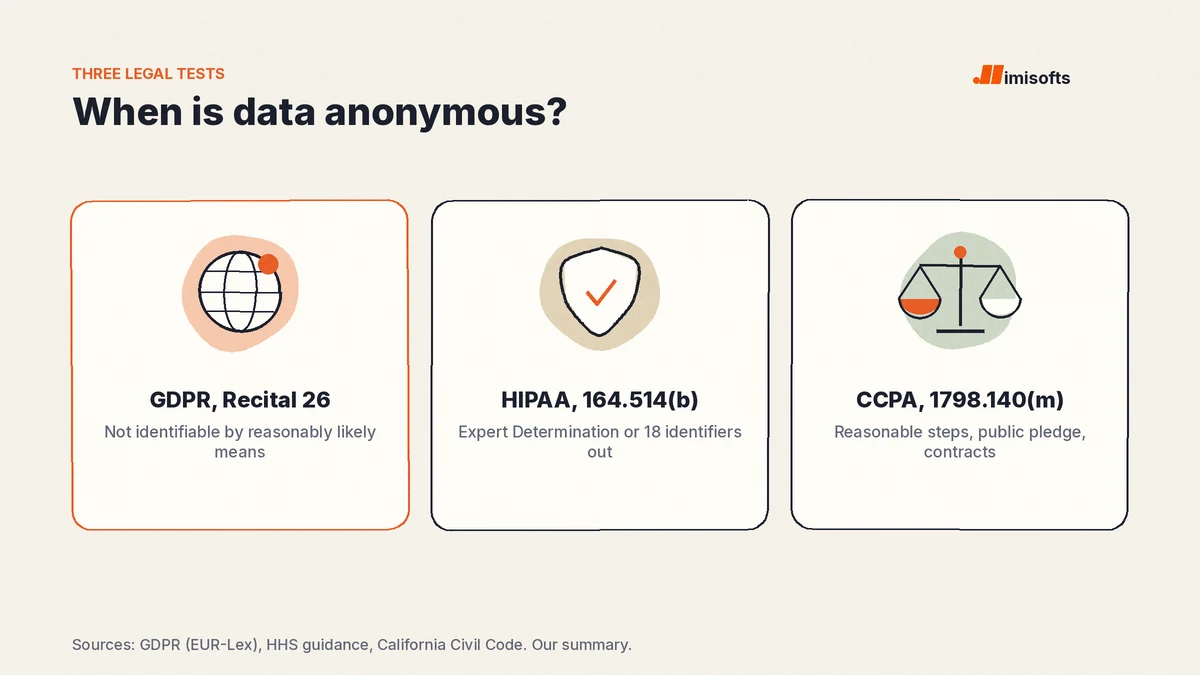
| GDPR (EU) | Not identifiable by any means reasonably likely to be used, by you or anyone else | Recital 26 |
| HIPAA (US health data) | Expert Determination (risk "very small") or Safe Harbor (remove 18 identifiers, no actual knowledge) | HIPAA Privacy Rule 164.514(b), HHS guidance |
| CCPA (California) | Cannot reasonably be linked to a consumer, plus three duties for the business | Civil Code 1798.140(m) |
California's three duties. Under 1798.140(m), information counts as deidentified only if the business that holds it (1) "takes reasonable measures to ensure that the information cannot be associated with a consumer or household", (2) "publicly commits to maintain and use the information in deidentified form and not to attempt to reidentify the information", and (3) "contractually obligates any recipients of the information to comply" with the subdivision. Point 3 matters for licensing: the buyer contract has to oblige the buyer to comply with the subdivision. Our guide to the AI data licensing agreement covers the other terms to check.
This is general information, not legal advice.
HIPAA Safe Harbor: the 18 identifiers
HHS guidance sets out two ways to de-identify protected health information. Under Expert Determination, a qualified expert "determines that the risk is very small" that the information could be used to identify a person, and "documents the methods and results". HHS adds that there is "no explicit numerical level of identification risk" that always meets "very small".
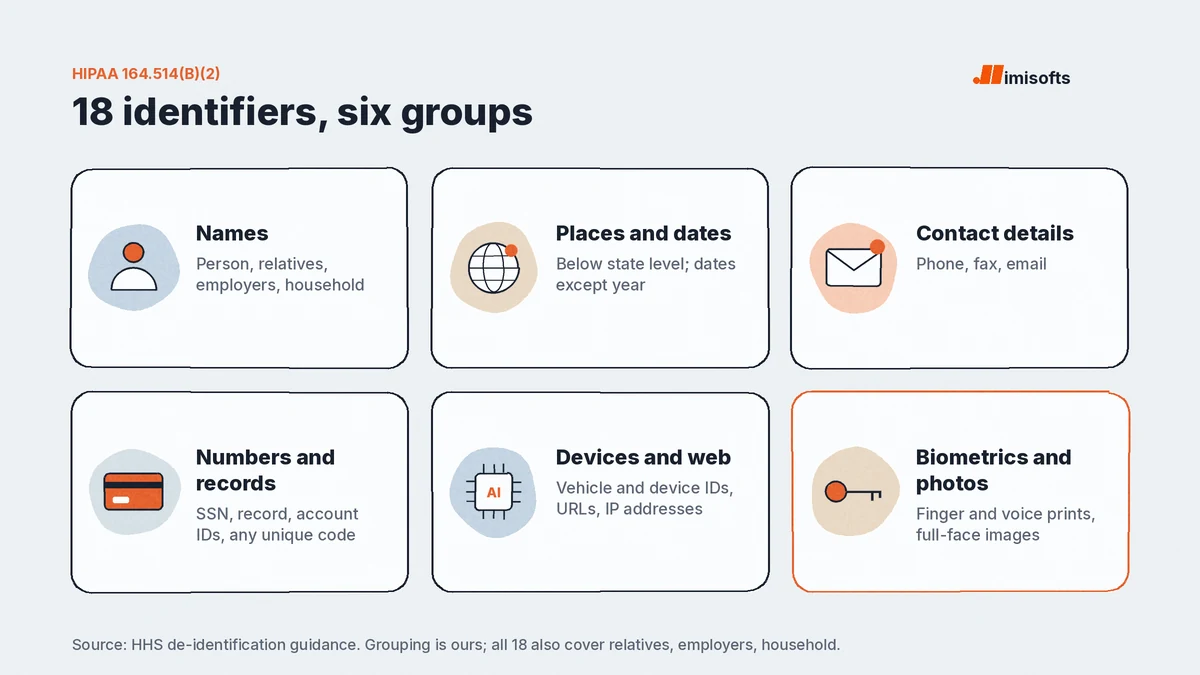
Under Safe Harbor, you remove 18 identifiers of the individual and of their relatives, employers or household members, and you must not have "actual knowledge" that the rest could identify someone:
- Names
- Geographic subdivisions smaller than a state, including street address, city, county and ZIP code (the first three ZIP digits may stay if that area holds more than 20,000 people; otherwise they become 000)
- All elements of dates except the year directly related to a person (birth, admission, discharge, death), and all ages over 89 (which may be grouped as 90 or older)
- Telephone numbers
- Fax numbers
- Email addresses
- Social Security numbers
- Medical record numbers
- Health plan beneficiary numbers
- Account numbers
- Certificate and license numbers
- Vehicle identifiers and serial numbers, including license plates
- Device identifiers and serial numbers
- Web URLs
- IP addresses
- Biometric identifiers, including finger and voice prints
- Full-face photographs and comparable images
- Any other unique identifying number, characteristic or code
HHS says de-identified health information created this way "is no longer protected by the Privacy Rule because it does not fall within the definition of PHI." Safe Harbor is written for HIPAA covered entities, but in our view the list is a useful checklist for any customer record set, because it names fields that commonly identify a person.
Data anonymization techniques
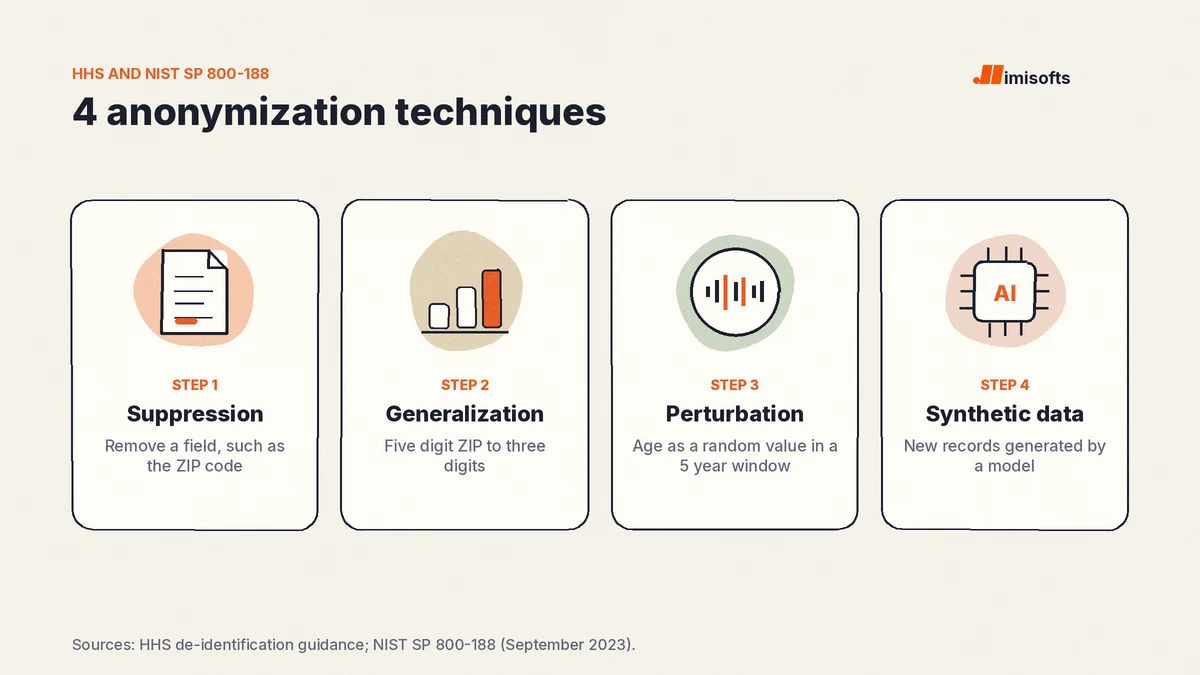
HHS describes three classes of risk mitigation, and NIST SP 800-188 (September 2023) adds synthetic data as a technique.
| Technique | What it does | Example from the source |
|---|---|---|
| Suppression | Removes certain features before release | Removing the ZIP code feature for risky records (HHS) |
| Generalization | Turns values into broader categories | Five digit ZIP to three digits (HHS) |
| Perturbation | Replaces values with different, equally specific ones | Age reported as a random value within a 5 year window (HHS) |
| Synthetic data | Generates new records from a model of the real data | "generating synthetic data using models" (NIST SP 800-188) |
Data masking is a term you will see in database tools. In our view, judge any masking feature by the same test: if the original values can be restored with a kept mapping, treat the result as pseudonymized, not anonymized. Our guide to synthetic data explains why a synthetic set still starts from real records, so privacy checks still matter.
NIST also lists other ways to share: a query interface that applies de-identification, or sharing data in "non-public protected enclaves". In our view, for an AI data deal that can mean the buyer never receives a raw copy at all.
Why re-identification is the real risk
Removing names is not enough. In Rocher, Hendrickx and de Montjoye (Nature Communications, July 23, 2019), the authors built a model tested on 210 populations and found that "99.98% of Americans would be correctly re-identified in any dataset using 15 demographic attributes." They concluded that even heavily sampled anonymized datasets "are unlikely to satisfy the modern standards for anonymization set forth by GDPR".
The point is that combinations of ordinary attributes can single people out, even with names removed. HIPAA Safe Harbor, for example, covers dates and ZIP codes, not only names. NIST says agencies can create a Disclosure Review Board and "perform re-identification studies to gauge the risk associated with de-identification."
How to anonymize company records, step by step
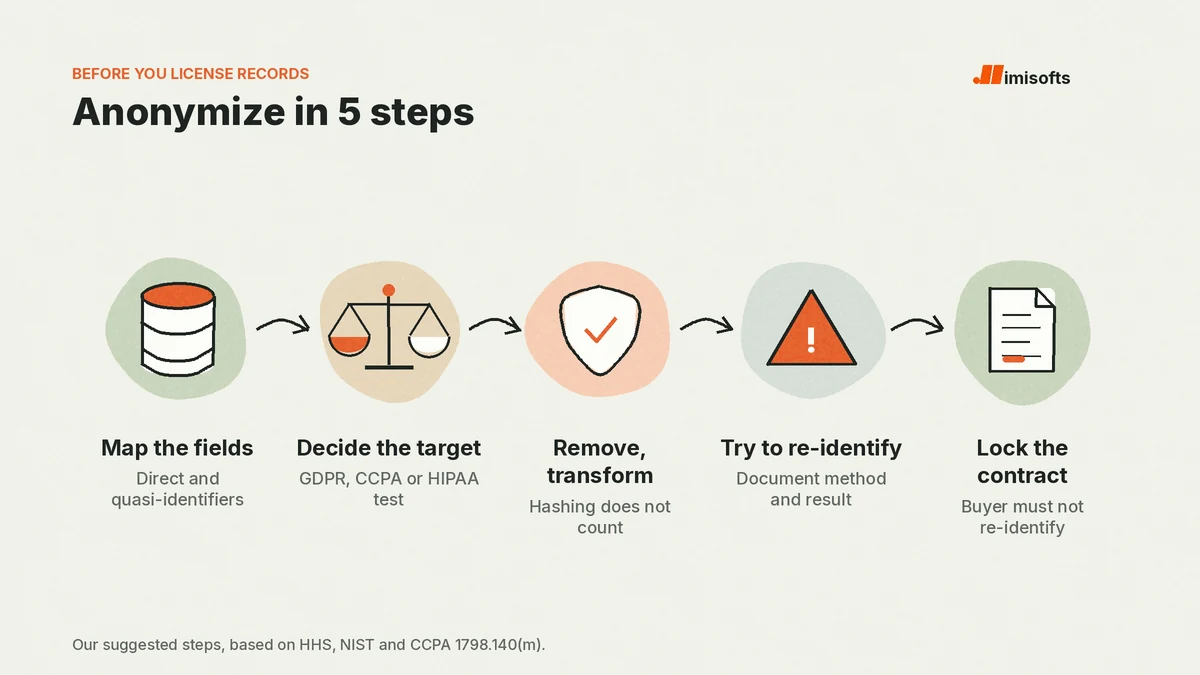
This is the process we suggest for records you plan to license. It is our suggestion, not a legal standard.
- Map the fields. List every column and mark direct identifiers (name, email, phone, account number) and other fields that could help identify someone in combination (dates, location, free text).
- Decide the target. Anonymous under Recital 26, deidentified under CCPA 1798.140(m), or HIPAA de-identified if the records are protected health information held by a HIPAA covered entity. The target sets the bar for every later step.
- Remove and transform. Suppress direct identifiers; generalize or perturb quasi-identifiers; strip names and numbers out of free-text notes. Do not count hashing as removal.
- Test re-identification. Try to single people out with the fields that remain, or have an expert do it, and document the method and result, as HHS asks under Expert Determination.
- Lock it in the contract. For California deidentified data, oblige the buyer to comply with 1798.140(m), including its no re-identification commitment, as (m)(3) requires. We also suggest destroying any linking key you no longer need.
Then keep a record. HHS notes the Privacy Rule "does not explicitly require that an expiration date be attached" to an expert determination, yet Recital 26 points to technological developments, so in our view a review is worth repeating before each new release of the same data. For the full licensing path from inventory to payment, see how to sell data to AI companies. If you would rather keep records in house and put a model to work on them internally, see what an AI chatbot for business costs.
How imisofts can help
imisofts is a Dubai based agency that builds automation and data work for established companies. We work with clients and their lawyers on mapping and preparing records for a data deal, and on access controls through our cybersecurity services. If you are weighing a sale or license, see whether your company's data qualifies. We are not a law firm, and we do not promise that a data set will meet a legal test or that a buyer will pay: that depends on the data, the law that applies and the buyer.
What we could not verify
- The UK ICO's anonymisation guidance: its site showed a bot check when we tried to read it, so this guide makes no claim about UK guidance.
- The content of the EDPB's Guidelines 01/2025 on pseudonymisation, which were open for feedback from January 17 to March 14, 2025: we did not read the document itself.
- Prices of anonymization tools or services: none appeared in the sources we read.
Frequently Asked Questions
Changing records so they no longer relate to an identifiable person. Under GDPR Recital 26 that means the person cannot be identified by any means reasonably likely to be used, by you or anyone else, and then the GDPR no longer applies to the data.
Pseudonymized data replaces identifiers but keeps a separate key, so it can be linked back. GDPR Recital 26 says pseudonymized data is still information on an identifiable person. Anonymized data cannot be linked back by means reasonably likely to be used.
No. The FTC wrote on July 24, 2024 that hashes are not anonymous and that companies should not claim hashing renders personal data anonymized. It says hashes of common identifiers such as emails, phone numbers or Social Security numbers can be reversed in a matter of seconds.
Under Safe Harbor, HIPAA Privacy Rule 164.514(b)(2): names, small geographic units, date elements except year, phone and fax numbers, emails, SSNs, medical record, health plan, account and license numbers, vehicle and device identifiers, URLs, IP addresses, biometrics, full-face photos and any other unique code.
No. Recital 26 says the GDPR does not concern anonymous information. But the bar is high: if the person can still be singled out or identified by reasonably likely means, the data is personal data and the GDPR applies.
It can be. A 2019 Nature Communications study estimated that 99.98% of Americans would be correctly re-identified in any dataset using 15 demographic attributes. HIPAA Safe Harbor, for example, removes dates and small geographic units, not only names.