Short answer. Synthetic data is artificial data that a model generates to copy the patterns of real data. It now makes up a large share of some training runs: Microsoft's Phi-4 report (December 2024) gave 40% of pretraining tokens to synthetic data, and NVIDIA said over 98% of the data in Nemotron-4 340B's alignment step was synthetic. Real, human made data is still bought and licensed: Reddit disclosed $203.0 million of data licensing contracts signed in January 2024 (buyers not named), and Phi-4's own recipe set aside 10% for acquired sources, which include public repositories and explicitly licensed books.
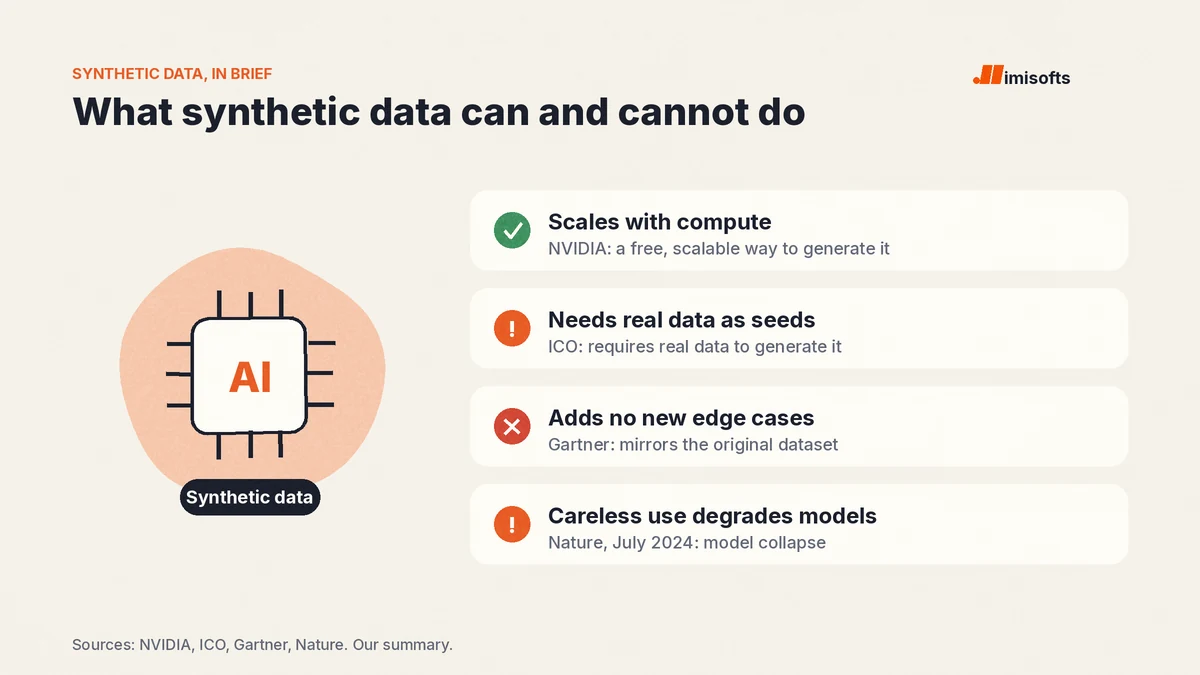
The reason is simple. Synthetic data is made from real data, so it cannot add what the real data never held. If your company owns years of records about real customers, real cases or real operations, that is the kind of input synthetic data depends on. Our AI data licensing service helps established companies find out whether their records are worth licensing.
This guide explains what synthetic data is, how much of today's training it covers, where it falls short, and what that means if you own business records. Sources were read on November 25, 2026. This is general information, not legal advice.
Key numbers
| Item | Number |
|---|---|
| Phi-4 training tokens that were synthetic (Microsoft, Phi-4 report, Dec 2024) | 40% |
| Synthetic share of Phi-4's unique tokens (our arithmetic: 290B of 3,280B) | about 8.8% |
| Epochs of Phi-4 synthetic data (times seen on average, Table 5) | 13.8 |
| Phi-4 tokens from acquired sources (incl. licensed books and academic data) | 10% |
| Nemotron-4 340B alignment data that was synthetic (NVIDIA, June 2024) | over 98% |
| Reddit data licensing contracts (signed January 2024, 2 to 3 year terms) | $203.0M |
| Training sets match public human text stock (Epoch AI projection, if trends continue) | 2026 to 2032 |
| D&A leaders facing synthetic data failures (Gartner prediction, June 2025) | 60% by 2027 |
Microsoft Phi-4 Technical Report; NVIDIA Nemotron-4 340B report and blog; Nature (Shumailov et al., 2024); ICO; Gartner; Epoch AI; Meta; Reddit Form S-1 on SEC EDGAR; Shutterstock. Read November 25, 2026.
What synthetic data is
The UK data protection regulator gives a clear definition. In its guidance on synthetic data, the ICO says synthetic data is "artificial" data generated by data synthesis algorithms that "replicates patterns and the statistical properties of real data (which may be personal information)". It is "generated from real data using a model trained to reproduce its characteristics and structure."
The ICO names two kinds:
- Partially synthetic data replaces only some fields. Its example is a hospital admissions set where location and admission time are synthetic but the real causes of admission are kept.
- Fully synthetic data replaces every field.
In AI, one common form is text written by a large model to train another, such as the synthetic sets and web rewrites in Phi-4's recipe below. NVIDIA, for example, said in June 2024 that its Nemotron-4 340B models give developers "a free, scalable way to generate synthetic data", while adding that users "should still perform careful evaluation" of the output.
How much of AI training is synthetic now
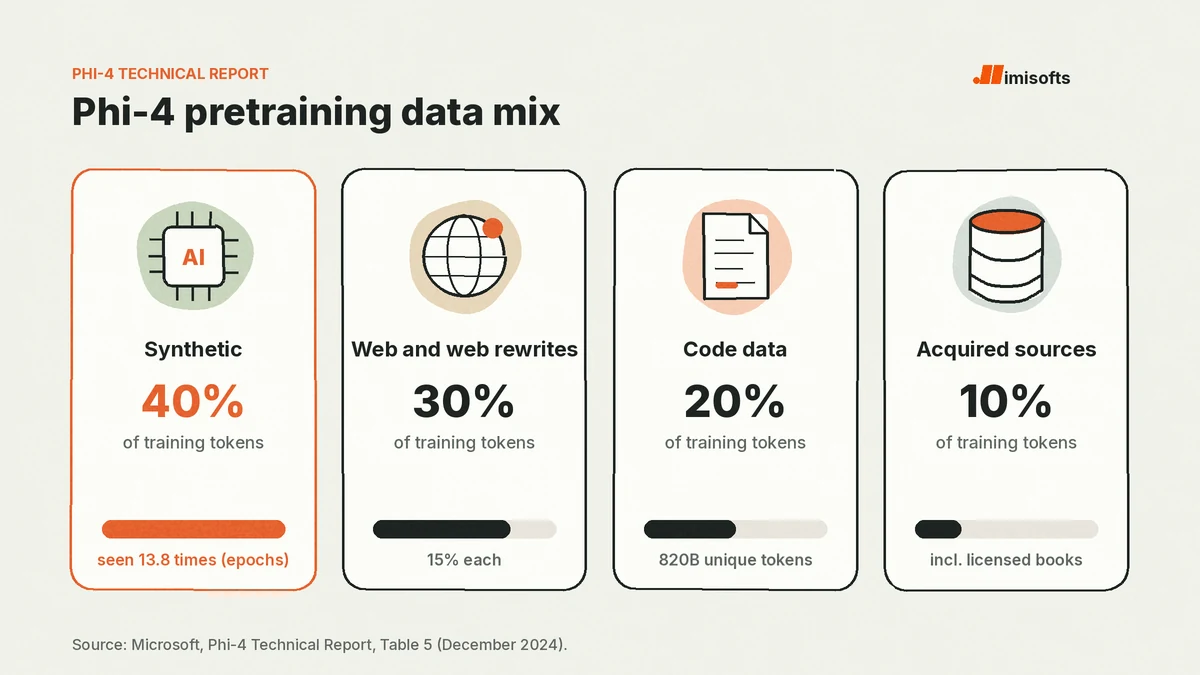
Few labs publish these figures. Two that did show how large the synthetic share can be.
| Phi-4 pretraining source | Share of training tokens | Unique tokens | Epochs (times seen) |
|---|---|---|---|
| Synthetic | 40% | 290B | 13.8 |
| Web | 15% | 1.3T | 1.2 |
| Web rewrites | 15% | 290B | 5.2 |
| Code data | 20% | 820B | 2.4 |
| Acquired sources | 10% | 580B | 1.7 |
Source: Table 5 of the Phi-4 Technical Report, a 14 billion parameter model from Microsoft. The report says that, unlike most language models trained mainly on "organic data sources such as web content or code", phi-4 "strategically incorporates synthetic data throughout the training process."
One detail in that table matters for data owners. Our arithmetic: multiplying unique tokens by repeats gives about 10 trillion tokens seen, of which synthetic is 39.9%. But synthetic data is only 290 billion of the 3,280 billion unique tokens, about 8.8%, because the synthetic set was seen about 13.8 times on average (epochs). The acquired sources, which the report says include "explicitly licensed" material such as licensed books, held 580 billion unique tokens, about twice as many.
NVIDIA went further in one step of training. Its Nemotron-4 340B report says "over 98% of data used in our model alignment process is synthetically generated". Alignment is the stage that tunes a model's behavior after pretraining; NVIDIA's base model was trained on 9 trillion tokens, per its June 14, 2024 announcement.
Meta also says it generates and uses synthetic data, among other things "to help when there isn't enough data to work with".
Why labs still pay for real data
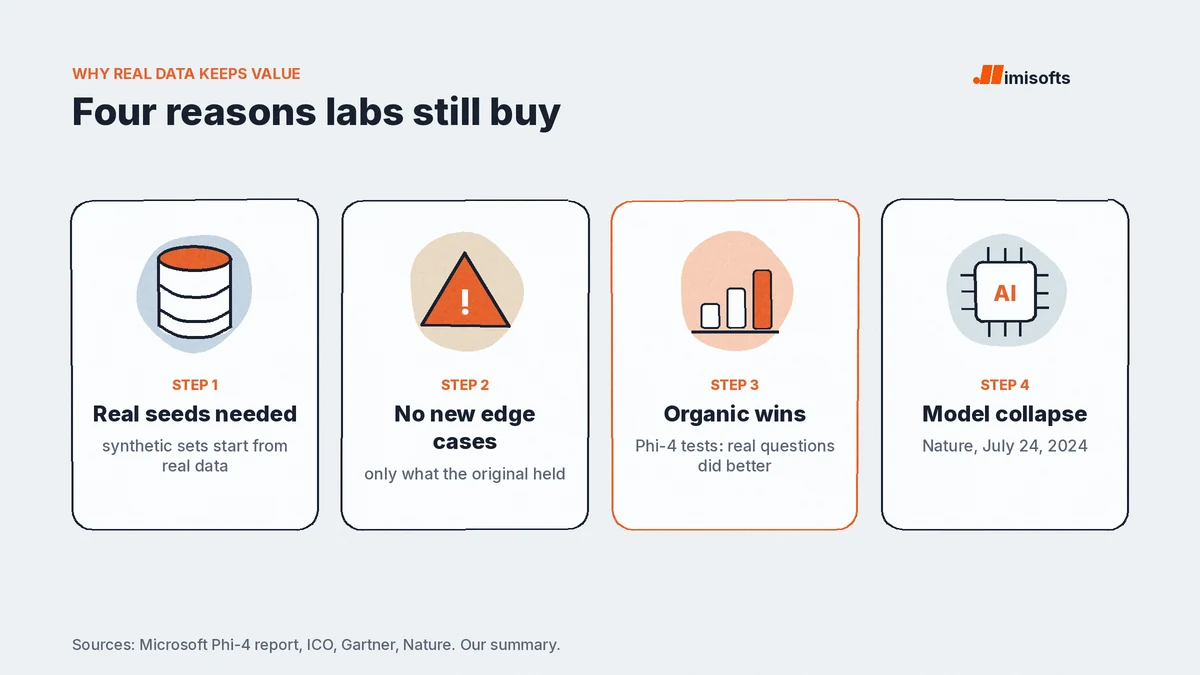
If models can write their own training data, why pay for anything? The primary sources give four reasons.
- Synthetic data starts from real seeds. The Phi-4 report says synthetic dataset generation "begins with high-quality seeds sourced from multiple domains". The ICO puts it plainly: "Synthetic data requires real data to generate it".
- It cannot add what the original lacks. Gartner, in a June 27, 2024 release, says a synthetic dataset "mirrors the original dataset", so if the original has no unusual cases, "these won't appear in the synthetic dataset either."
- Real questions trained better in Microsoft's tests. For question and answer data, the Phi-4 team wrote that "organic questions are substantially more effective than synthetic questions", and that rewritten questions helped, but "the gains were not as pronounced."
- Training on model output can degrade models. A paper in Nature (July 24, 2024) found that "indiscriminate use of model-generated content in training causes irreversible defects", which the authors call model collapse. They add that data about "genuine human interactions" will be "increasingly valuable" as model-written text spreads online.
Supply is the other side. Epoch AI's researchers projected that, if trends continue, models will be trained on datasets about as large as the whole stock of public human text "between 2026 and 2032". They argue synthetic data generation, alongside transfer learning and data efficiency, "might support further progress".
What real data sells for, from filings and releases
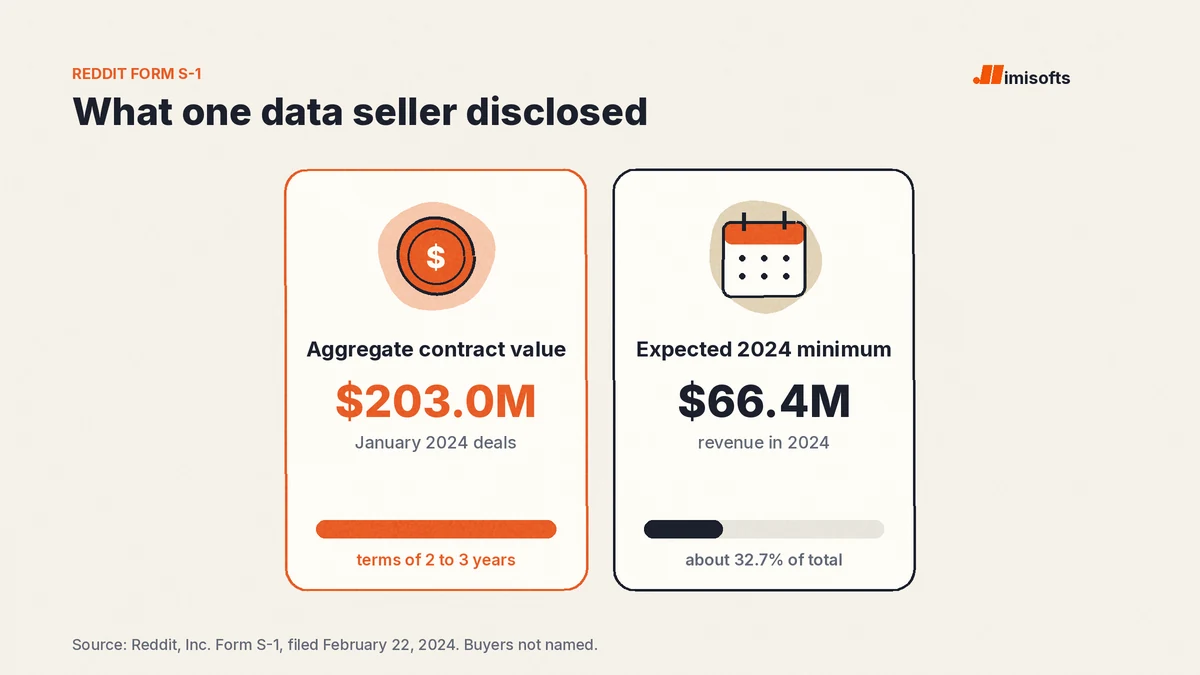
Few prices are public, but the paid deals point to the same thing: large, fresh, rights cleared human data.
- Platform conversations. Reddit's Form S-1 reports data licensing arrangements "with an aggregate contract value of $203.0 million and terms ranging from two to three years", entered in January 2024, with at least $66.4 million (about 32.7%) expected as 2024 revenue. Reddit described its data as one that "constantly grows and regenerates".
- Licensed media. Shutterstock said on March 19, 2026 that it is expanding its licensed training datasets and named OpenAI among the companies its data powers. Daniel Mandell, its SVP of Data Licensing and AI, said "a continuous flow of fresh data" has become "as essential to AI infrastructure and ongoing retraining pipelines as compute power itself." Shutterstock sells this data, so it has a stake in that view.
- Licensed books. Phi-4's acquired sources include public repositories such as arXiv and GitHub and "explicitly licensed" material such as licensed books, and the team also described "acquiring external datasets" of problems and solutions. The report does not say what, if anything, was paid.
- Purchased datasets. Meta's transparency page says "some datasets are purchased or licensed from third parties".
None of these sources gives a price per record or per token. We cover the buyers in more depth in who buys AI training data.
Synthetic data vs real business records
Our comparison, drawn from the sources above:
| Question | Synthetic data | Real business records |
|---|---|---|
| Where it comes from | Generated by a model from real seed data | Created by real customers, staff and operations |
| Cost to make more | Can scale with compute (NVIDIA: "a free, scalable way" to generate it) | Fixed: you cannot make more history |
| Rare and edge cases | Only what the original held (Gartner) | Whatever actually happened |
| Risk if used carelessly | Model collapse when used indiscriminately (Nature) | Privacy and contract limits |
| Privacy | Not automatically anonymous (ICO) | Usually anonymized and rights checked before licensing (our view) |
| Who pays for it | Labs generate it themselves (NVIDIA, Microsoft, Meta) | Owners license it (Reddit, Shutterstock) |
What this means if your company owns data
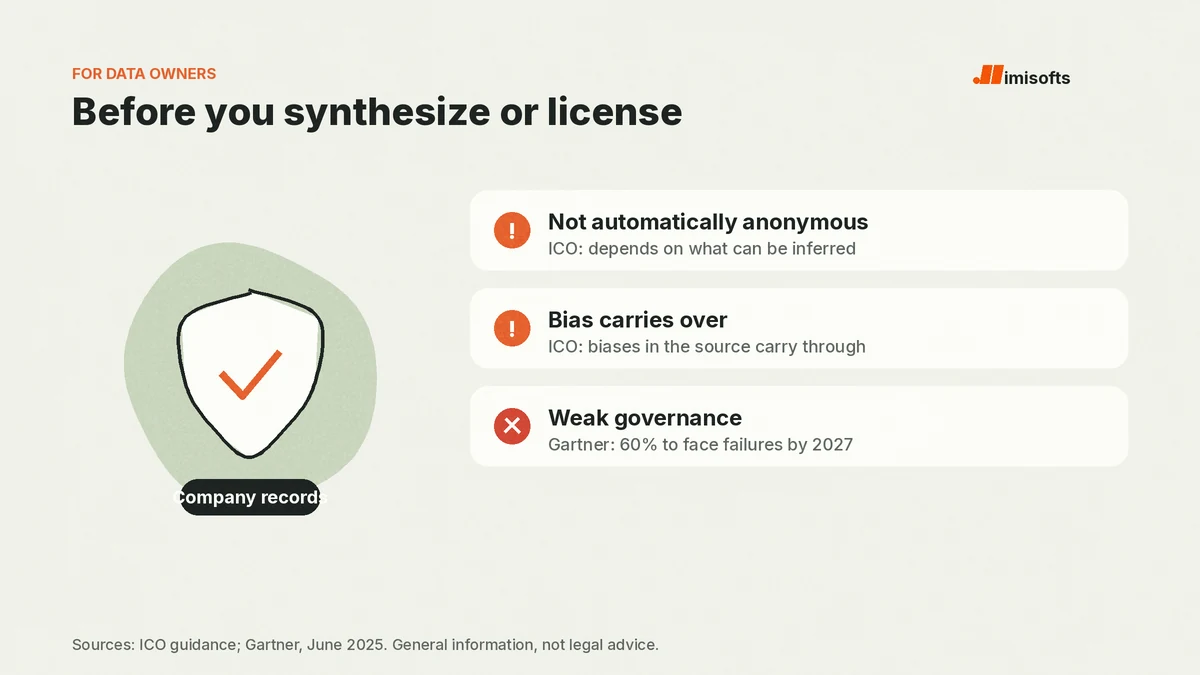
Synthetic data is a reason to prepare your records well, not a reason to think they have lost value. Three points from the sources matter for an owner.
- Synthetic copies are not automatically anonymous. On whether synthetic data is anonymous, the ICO says it "depends on whether the personal information on which you model the synthetic data can be inferred from the synthetic data itself", and that the closer it mimics real data, the "more likely" it is "to reveal someone's personal information." Generating synthetic data from customer records can still involve processing personal information, if the records contain it.
- Bias carries over. The ICO warns that "any inherent biases in the information will be carried through." In our view, a record set that covers many years, regions or customer types is more useful than a narrow one.
- Governance is a known weak spot. Gartner predicted in June 2025 that by 2027, 60% of data and analytics leaders will face "critical failures in managing synthetic data". Gartner sells research on this topic, so read that as an analyst forecast.
In practice, a company has three options: license anonymized real records, generate a synthetic version of them for a buyer (still built from the real data, so the same rights and privacy checks apply), or do neither. Whichever you weigh, start with the contract terms; our guide to the AI data licensing agreement lists what to check, and where AI training data comes from covers the wider supply picture. If you also want a model working on your own records internally, see what an AI chatbot for business costs.
How imisofts can help
imisofts is a Dubai based agency that builds automation and data work for established companies. We can review which of your records might interest an AI buyer, prepare and anonymize them, and support you and your lawyers through talks with buyers. To find out where you stand, check if your company's data qualifies. We are not a law firm, and we do not promise a payout: whether a buyer pays, and how much, depends on the data and the buyer.
What we could not verify
- Prices that labs pay per record or per token for real data, and what synthetic data vendors charge: none appeared in the sources we read.
- The share of synthetic data in the training of closed frontier models from OpenAI, Anthropic or Google: not published in the sources we read.
- Epoch AI's own blog page did not load when we checked; we used the paper's abstract on arXiv.
Frequently Asked Questions
Artificial data generated by an algorithm or model to copy the patterns and statistical properties of real data. The UK ICO says it is generated from real data using a model trained to reproduce its characteristics and structure, and can be partially synthetic (some fields replaced) or fully synthetic (all fields replaced).
Yes. Microsoft's Phi-4 report (December 2024) gave 40% of pretraining tokens to synthetic data, NVIDIA said over 98% of the data in Nemotron-4 340B's alignment step was synthetic, and Meta says it generates and uses synthetic data to build its AI.
Not across the board. In Microsoft's Phi-4 tests, organic questions were substantially more effective than synthetic ones, Gartner notes a synthetic set has no edge cases the original lacked, and a 2024 Nature paper found indiscriminate training on model output causes model collapse.
The term used in a Nature paper published July 24, 2024 for the irreversible defects that appear when models are trained on content generated by earlier models without care: the rarer parts, or tails, of the original data disappear.
Yes. Reddit disclosed data licensing contracts with an aggregate value of $203.0 million signed in January 2024 (buyers not named), Shutterstock licenses training datasets used by OpenAI and others, and Meta says some of its datasets are purchased or licensed from third parties.
Not automatically. The ICO says it depends on whether the personal information behind it can be inferred from the synthetic data, and that the closer synthetic data mimics the real data, the more likely it is to reveal someone's personal information.